
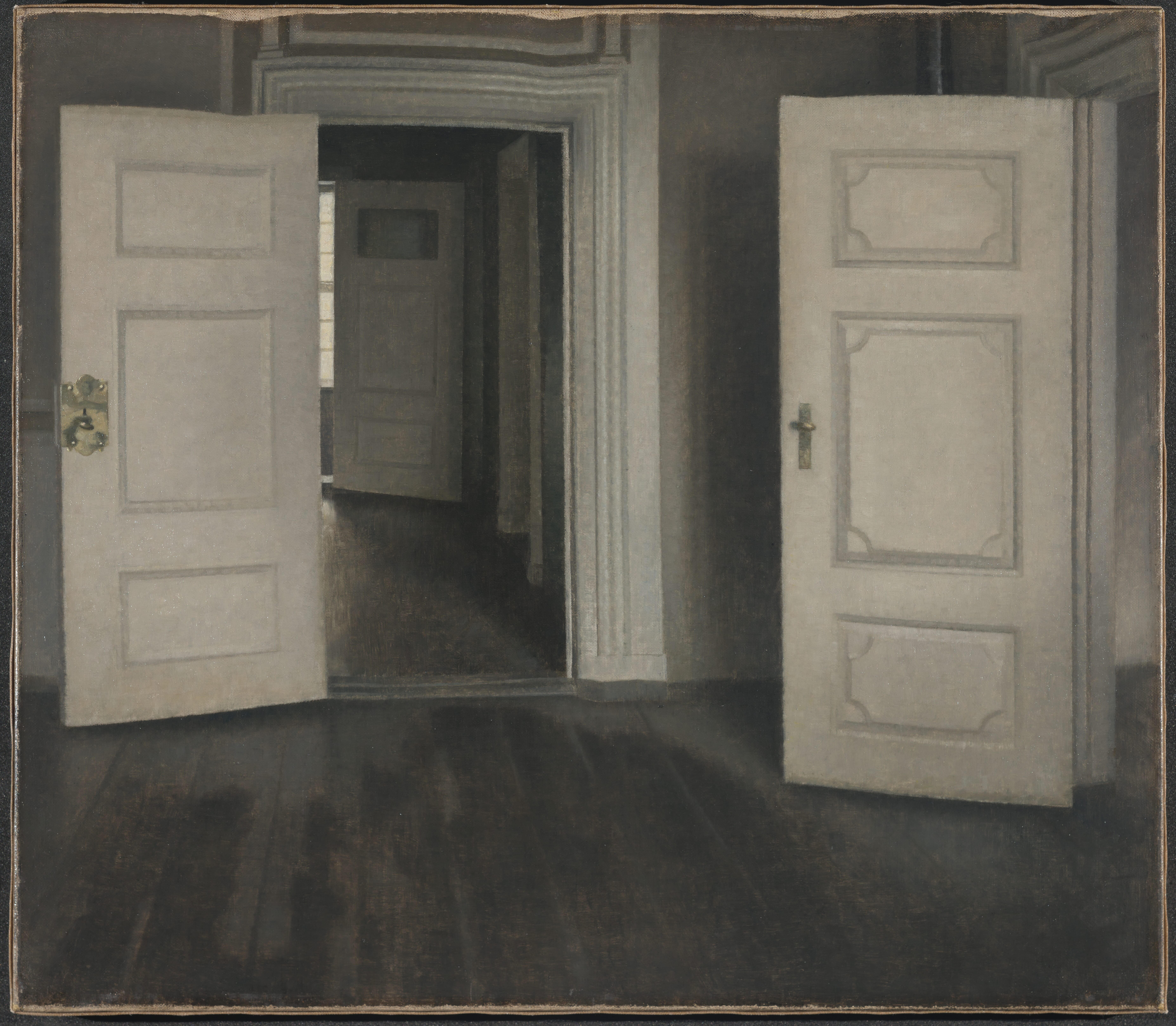
The door is always open. Night and day. The curtain at the door billows with the breeze at times. Sometimes it hangs still in the door’s hollow space, like some kinds of time, an entity between two worlds. What memories does that threshold hold? What stories? But then, can stories really accommodate houses, homes? Can memory? Imagination, though, often walks in boldly where memory falters. My story walks along all these paths. Which of them brings me to the threshold?
Every day, I walk from the factory to my apprentice quarters and back, along the road that takes me past this house. On my first day at work, I woke up to a siren’s insistent blare. This siren did not ask us to hide in bunkers dug into the house, or to draw down the blinds on windows. It only reminded us to report to work or to wrap up for the day.
Since the factory is not too far from where I live, I prefer to walk. And as I do, I look at the houses along the road. My interests are simple now, and few: my job at the factory, my books, and these houses past which I walk every morning and evening or afternoon and night, depending on the shift I work.
This part of the town, to which I have come seeking refuge, is beautifully laid out. Bungalows with manicured gardens, tree-lined, wide, clean roads, covered drains. In this locality, the markets are tiny and well stocked with fresh vegetables and fruits, fish, chicken, mutton, pharmacies, cloth merchants. There are hills in the distance, and no disturbances, except of the nice kinds – of children shouting at play, of people calling out to one another across the roads, or standing at their gates and chatting, of curious dogs barking at passersby. The people living in these areas relax in clubs after work, watch movies, or spend time at home, reading in their verandas or lawns. Sometimes I ask myself – am I looking at a town in flesh and blood or in a picture book?
I don’t have friends, only colleagues with whom I share a smoke or two. They ask me about me. I have no idea where to begin and what to say, so I blow smoke rings, stamp out the ash, then return to the factory floor. Perhaps they find me odd, perhaps they talk about me when my back is turned. I have no instant answers to their questions.
When I walk to work and back, I observe the houses along the roads, the comings and goings, the kind of gate they have, the noises emanating from the depths of their existence, the way they are painted, whether the paint is peeling, shabby, uncared-for. I try to decipher the kind of people who live in the house, their lives, their joys, sorrows, fears. Insecurities. Anxieties. Uncertainties. Tragedies.
Each day I add to the story. A story for each house and then, a story for each neighbourhood. The stories have no end. The stories never end.
One of the houses draws me back again and again. Even in my dreams. Yes, I have begun to dream again, sometimes. This bungalow has overhanging eaves in red that set off its white and brown – the windows and doors are brown, the veranda and outer walls white. The house is surrounded by trees on three sides, but the front is bare. A short straight drive with gardens on either side, leads up to a long, pillared veranda. The main door is always open, the venetian shutters on windows half shut. The low parapet along the length of the terrace is overhung with the leaves and branches of various trees. A large, unmanned gate.
On some days, when the curtain billows at the main door, I catch a glimpse of a room that seems dark from where I walk in the light. Of course, I can’t stand and stare; neither can I resist the temptation to peek. Once I saw some movement beyond the curtain. A pair of legs moving from somewhere in the room to another doorway at the far end. How did I know it was a doorway? I didn’t. I guessed from the shape of the light into which the figure disappeared. I didn’t see it again for many a day.
In other houses in the neighbourhood, people play badminton in the gardens, have tea in the verandas, gossip on the stairs, hang around with friends or visitors at gates or in the driveways. These are ‘company houses’. But in this house, built differently, older than the company houses, no one seems to move about or lend life to the structure. Yet, it is alive, in motion. The doors are shut at night, open in the day time; trees are pruned and plants watered; the driveway is clean, though I never see a car parked there; and once in a while, someone is flitting about on the terrace, among the shades cast by the trees. Hazy forms of lived-ness. Enough to latch on to. The house sits on my eyes when I go to sleep; it stays with me when I wake up each morning, mending what is broken in me.
The short driveway that stops at the veranda of this house is lined by wild lilies. They grow without a care in the world. Mother loved these lilies. She called them her morning dreams, soft, undemanding, a feather touch on the eyelids where they left behind their pollen. To pollinate dreams for another day, she would say. I stop and stare at these white blooms. I see mother’s eyelids – shut, rust-coloured pollen, like eyeshadow on them. Then they fly away. The lilies droop after a few days, leaving petals behind on the dusty driveway. Tomorrow, the driveway will be swept clean.
I wait every morning by the teashop across the road, sipping hot tea slowly, to see who enters the house, who leaves. Who keeps it clean. Who lives there. One evening, on my way back from an extra shift at the factory, I ask for a cup of chai and sit wearily on the low compound wall behind the shop. It’s beginning to get cold in the evenings. The cup warms my palms, giving me a feeling of wellness. From where I sit, the terrace of the house is visible in patches. A figure flits from one tree shade to another, a light is switched on behind her, another figure appears, the two stand still, perhaps chatting. Perhaps they too are having their evening cup of tea or coffee or whatever warms up their souls.
My mother, sister, I, and the ritual of evening tea. Especially on cold evenings such as this. The terrace of our house had potted plants all along its perimeter. It was our duty, as the next generation, to take care of these plants. We learnt from our father, the best gardening teacher we could have had. There was not a plant, tree, fruit or flower that he did not recognise by name, both the botanical and the local. There was nothing he did not know about them. We were more interested in plucking flowers or berries or fruits, but he taught us to listen to the leaves. Our family was large and people walked in and out of our house at all times. The doors were always open. But there was a rear entrance, a tiny slit in the wall with a door through which cleaners and sweepers entered our house. A door that announced class and caste, something I understood only when I grew older. At that time, when we were children and the world was a place of endless, happy adventures, that door meant escape unseen by the many eyes that kept watch on kids and on one another. In a house where privacy was a luxury, that door was freedom. Outside that door was a narrow patch of dirt land that ran perpendicular to the parallel roads flanked by houses. That’s where my friends and I met, to hatch conspiracies against teachers who punished us, to create passwords for the various games we concocted, to simply vent against family members who seemed to be our perennial and invincible enemies at the time. When we shut that door behind us, it seemed to hold our enemies at bay.
Across the road, the light is switched off on the terrace. It’s dark. I have been sitting on the wall behind the teashop, staring at the house or at its darkness or the lights or the trees or the shadows … or perhaps at nothing at all. The tea has turned cold. The teashop owner wants to shut his business for the day. How much do you earn from this? I ask him on a whim. He stops doing whatever he was and looks at me. He has turned down the light in his shop and I can barely see his eyes. The only source of light is the street lamp behind him. He stops staring, then sits down beside me, takes the cup of cold tea from my hands and throws it into the dustbin next to the shop. I can hear the terracotta cup shatter inside the dustbin. Brother, I earn more in a day than you in that factory earn in a month. I turn completely towards him, to look better at him. He speaks English. I’d never heard him do so earlier. And now I’ll go home and help my wife sell rolls. Egg, chicken, mutton, vegetable rolls. Come to our shop sometime. As he gets up to leave, I take his hand. He looks down at me. What have you studied? I ask. Engineering. I worked for two years. Got bored. Then this.
I keep sitting after he leaves. The Engineering college where I met my wife was on a hill. Every day we would hear of snakes in the campus, in the classrooms. The college stood on their homes, the land dug up for human beings. The snakes had nowhere to live. When a snake entered the library one afternoon, my seniors, who were studying for an exam there, ran out. All except one. She stood calmly as the snake wound its way through the room. She walked backwards slowly, calmly, and opened the windows one by one. The snake found its way out. She called her classmates back. Standing quietly in the corridor, watching her, I fell in love. The course bored me but I stayed put. We married the year after I started work, went together to offices in the same neighbourhood, vied for similar positions in our respective companies. Boredom became our comfort zone.
In the house on the other side of the road, the light that went out on the terrace now comes alive in a corner room on the first floor. In the darkness, the room looks like a floating cubicle of light. I imagine the person who has entered this room. What does he want? Or is it a she? Are there perhaps more than one? Doing what? Making love? Arguing? My wife could do the two simultaneously, and then give up both in a fit of laughter. One of the windows of our bedroom overlooked the dirt patch where green shoots appeared after light rains, sprouted into plants and withered away when the rains left. We would stand at the window on some nights, the light in the room behind us, and look at that space, trying to imagine how many new shoots we would find in the morning. It was a memory game between the two of us, to test and to strengthen our memory. A game I wish we had never played.
The window in that floating cubicle across the road opens and somebody leans out of the window. I hear a voice drifting down from that window, a light comes on in the room below it, and a figure now appears in the veranda that goes around the house. A voice floats up from the veranda in response. I get up and walk closer to the gate, hungry to hear the conversation. All I hear are specks of sound. No clear words. No clear conversation. Those sounds carry no meaning, no coherence. But sounds do carry meaning.
The creaking of the back door in our house carried meaning when I was a kid, a call from the world outside, waiting for me to join it in fun and companionship. The meaning changed when I grew up and I learnt not to open that door to the world outside.
The first time the door changed its tune was on a humid afternoon. We had finished lunch. There was a stillness to the neighbourhood brought on by the weather and news of violence from another part of the town. Every city and town and village in the country reported conflict and turmoil every day, there had been no break from the spiral of violence and fear that had gripped the country. Something was always going wrong somewhere or the other. As long as we were safe, why wrack our brains about something happening at a distance?
That afternoon, all we wanted was a short nap – the weather and our full stomachs demanded it. Just as I switched on the fan and went to shut the windows, I heard the noise of scraping on the rear door. Must be a scurrying rat or a urinating dog, I thought. Then I heard it again, louder this time. This was the more deliberate sound of a human act. Somebody was trying to do something to the door. Not a rat. Not a dog. I stood still for some reason. Behind me, my wife, who had already snuggled up in bed, sat up. In the room across the corridor, my parents were watching television. If we could hear the noise from the door that was at some distance from the living quarters, it had to be loud enough, but perhaps it was distorted by the distance between the main house and the rear door, by the trees that grew along the way, by the tiny room filled with junk just before one reached the door.
As I came out into the corridor, my parents too stepped out of their room. The television seemed to have been switched off. Don’t rush to the back door, mother said. There had been reports of attacks on houses marked as belonging to those who had migrated to the state, those who ‘didn’t belong’. But we’d lived here for three generations, the house was built by my grandparents. We belonged here, so what was their worry? I stared with incomprehension at this combined force stopping me from checking a disturbance at our own doorstep.
I lean over the gate to eavesdrop on the conversation of these two shadows flitting from light to darkness. I see one of them light a cigarette, a flash of fire, but I don’t see the face. Above him, the hanging cubicle of light is dark again. The cigarette smoker retreats into the darkness. All is quiet in front of me. On the road behind me, passersby and vehicles keep up a constant monotone. The teashop looks like a patch of shadow.
The house visits me in my sleep with its voices, lights, trees, its garden, its gate, its doors and windows. My wife stands in front of that house but I can barely recognise her. She opens all the windows of the house and snakes slither out of each one of them. The trees gather close around her. The windows knock together, setting up a terrible commotion. Then they begin to crumble, slowly, slowly, bricks, wood, curtains, doors, trees…
Every day, while returning from work, I sit for a while on the culvert opposite the house. It’s as if in some past life I belonged in this place, some strand from another life tied me to it, and without having it in my line of vision every day for the rest of my life, I would not be able to breathe.
The tea vendor hasn’t come for the last few days. The road seems strangely devoid of pedestrians or vehicles, only stray dogs that hover around the closed tea shop. I am spent. The factory is exhausting. I miss the tea seller who gave up engineering to sell tea. ‘Giving up’ is a strange beast. At first, it dares you, staring into your eyes, challenging. Then it slowly speaks to you, a little at a time, sometimes in odd times, when you least expect it. And then it grabs you by the throat and you either struggle out of its grasp or give in. Give up that which was holding you back. Sometimes giving up is freedom, like escaping through a rear door. Sometimes, that very door is a trap.
The strange sound on our rear door repeated after a few days. Some other families heard it on their doors, too. At first, it was just scraping. We noticed that the paint on the door had been damaged and I repainted it. Soon, we began to hear heavy scratching, and then, the sound of something boring into ancient wood – termites of hatred leaving their mark on doors chosen from among neighbours who were used to living happily together. Neighbours turning on neighbours. Neighbours reporting one another, keeping an eye, marking out one another. But we too were at fault. When the hatred reached others, we held fast in our cocoons of security, sanctity, sanity. The fear was not ours to feel. We were safe, safer than others, perhaps the safest.
I decided that the next time I heard the sound, I would open the door, defend my own house. The wild lilies in our garden were wilder that year, their pollen and petals all over the ground, white and rust over brown hard ground.
When the door rattled one evening, I defied my wife and parents and walked out of the main house towards the door that used to be my escape in childhood. That door was benevolent like a beloved friend; it would do me no harm. Outside, where the garden path curved towards the door at the back, I stopped to light a cigarette, cupping the flare within my palms. My wife opened the window on the first floor and leaned out to tell me something, pointing to the road beyond the garden’s tall hedge. Mother and father peeked from either side, craning their heads to look at me. I couldn’t hear her clearly above the din from the road. I waved to her to stay inside and started walking towards the back of the house.
Something whizzed above me.
And then, the sound from the window.
I stopped dead in my tracks, my hands over my ears.
The walls of our house cracked open. The window that my wife had opened, from where she had leaned out to tell me something, was a smoking gash in that wall that was falling apart in pieces of brick, cement, wood, flesh and blood.
I was trembling violently, helplessly. The blood rang in my ears. Blood dripped down the cracked walls of our house. I ran like a maniac to the rear door. There was no one there. For no reason I kicked at the door, desperate to see it break, to crumble like those walls, to drip blood from its pores. Before me, the house disintegrated, brick by brick, to the splintering sound of wood, the jangle of glass, and then, in a mad rush of all that it had ever contained.
I wait every day for the tea vendor to return. I don’t know his name. I wait every day to see someone at the house again. One evening, as I turn away, I hear the gate creak. I turn back. Whoever had opened or shut the gate had already left by the time I return. The house stands as it always did. Could I enter the house? Open the gate, walk in, knock on the door or ring the bell, ask for water perhaps, or just say how much I love the house. Small talk that draws people together. I have no friends in this town, only colleagues at the factory. It would be nice to have a family with whom to chat once in a while, nod at on the streets, wave a hand across roads. I lift the latch on the gate. Somebody shouts from inside, but there is no movement, no presence, only a voice. No light in the rooms facing the road, no opening or shutting of doors or windows, no asking who goes there, nobody leaning out of the windows to check.
I return after a week. A week in which the house stays with me every day through my feverish sleep, through fitful sweaty nights, through the daze of antibiotics and paracetamol. It returns in various forms, various shapes and sizes, with various tree-shrouded doors and windows. It calls to me through my delirium.
Which house? My cook asks me when I recover. I tell him. He listens to me then puts two pills and a glass of water on the table and points to them. Take these now. There’s no house there.
I return after a week. In place of the house, I find rubble, the debris of a house that once was. The tea seller is back in his place. Everything is as before. Except the house. What are you staring at, brother? He asks. I turn to look behind me and nod in the direction of the rubble. Oh, that! I’m surprised that the ruins don’t trouble him. Perhaps he knows what has happened and so he has moved beyond it.
When did this happen?
When did what happen? He asks and hands me a cup of steaming hot tea. I can smell the cardamom in it and am about to refuse, asking for ginger tea instead, when he answers my question. Nothing happened. It’s been like this for years now. It was like this when you used to sit here chatting with me.
I grip the hot cup, the terracotta burning my palms.
Arre, the brothers who owned this fell out with each other. Big fight, brother hitting brother. A builder paid them money and pushed them out. The house was bulldozed, for some time the builder visited with architects. Then one day his wife came to see this spot. She was bitten by a snake and died. Nobody came back. Nobody built anything. Nobody wants to. The plot brings bad luck.
He looks at me. Where are you from, brother? Where is your house?
Trembling, I pinch myself. The test that never fails.
I sip the tea and feel it burn my palate, tongue and throat. Then, I gather the courage and look back at the piece of land where a house once stood. Where people came and went. Where its residents talked, shouted, played, ate together. Where trees stood tall and flowers bloomed, leaving their pollen on eyelids and dreams. Stories try to accommodate houses, homes, lives, memories.
I can feel the palpitations of my heart, the sweat collecting on my forehead. I pay the tea seller and walk back to my flat. The fever has left me weak. I shut the single window in the bedroom, the windows in the drawing room and kitchen, latch the main door carefully, and lie down on my bed.
When you wake up, it’s early morning.
You’ve missed dinner.
You didn’t dream.
You slept well.
You stay in bed for a while, eyes shut, breathing the stale air of the room. Then you get up and open the single window. The sky is not yet blue, but hints of it are beginning to gather in the distance. You walk around the tiny apartment opening the windows, the main door that you latch carefully every night. You lean out of the kitchen window, tentatively at first, almost afraid of what that simple action may involve, and inhale slowly and deeply, like your wife had taught you. Doesn’t matter what troubles you. Inhale. Breathe. Exhale. Hold. Feel your fears disappear like breath.
You don’t like that last bit, but you do as she had once instructed. The rocking chair tucked into a corner of the room nods at your touch. It is unused. You make tea with ginger in it, then sit in that chair and watch the sky, waiting for morning light. The tea cup warms your palms. You take your time, sip slowly, gaze at the tiny ant-like petals circling the rim of the cup and count them. It’s almost hypnotic. You keep the empty cup on the window sill and lean back into the chair, allowing it to rock you gently, your eyes shut to the rhythm that you feel in your body, at one with the chair. On the road below, morning vendors are on their way. The municipal vacuum cleaners sweep the streets and lanes. You can hear the whoosh of their work from where you sit and imagine the vehicles snaking their way through the afterlives of this city. You feel the morning light spread slowly over your eyelids, your face, neck, torso. A pair of pigeons coos intermittently somewhere near your window, sometimes conversing agitatedly, sometimes quietening, still, then they flap their wings and coo together.
Soon, the factory siren will nee-naw across the town. You don’t wait for its clarion call. By the time the siren sounds, you’re at the factory.
As you roll up your sleeves and step inside, you remember the tea seller, this morning’s stillness and light. There is more to life than this mechanical response to a siren, you think. You could spend the rest of your life like the teashop owner in front of a gas stove, letting its heat make you sweat, watching others cool their hunger at your table.
Or you could get your hands dirty growing plants for migrants like you, refugees from all corners of this troubled world, creating gardens out of ruins. You stand in the middle of the factory floor, surrounded by machines and their various sounds, and shut your eyes. You imagine yourself as that gardener, your arms laden with herbs, shrubs, trees, fruits, flowers, seeds from lands torn apart, waiting to be planted once again ...