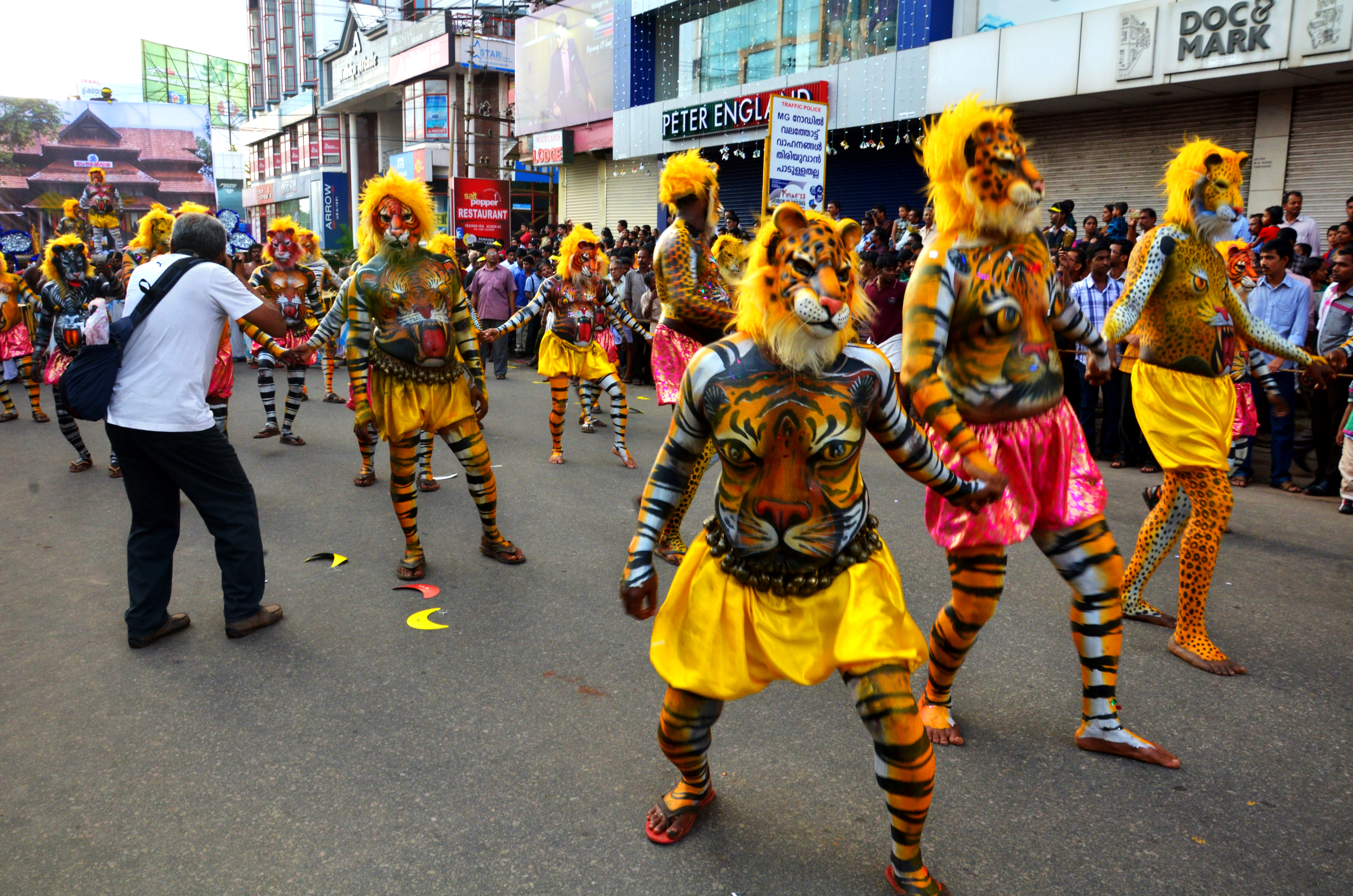
Growing up in North Malabar, I recall waiting for the Puli Kali dancers who arrived during Onam, the ten-day festival. Their bodies were painted in fierce yellow, orange and black to resemble tigers, often wearing masks. Moving from house to house, mostly at dusk, they performed to the rhythm of traditional instruments, such as udukka and chenda. They were mostly local boys and artists whose performances filled the neighbourhood with excitement.
Masks and body painting carry deep significance in performing arts such as Theyyam and Kathakali. Depending on the roles, the costumes and face masks would change. In Kathakali, a casual spectator learns to recognise the codes - Pacha (green for noble characters), Kathi (knife for wicked characters) and Kari (black for evil characters). These costumes and performances were designed to capture the attention of the masses.
From those days of waiting for performances that arrived once a year, we have moved, at the swipe of a mobile screen, into a world where everything from home cuisine to national politics unfolds as endless theatrics. The poet is no longer someone who composes verses in solitude, but a performer of the self on their social media pages or stages. Literature gatherings, which were once spaces for reflection and exchange, have become festivals where the mic is seized for that ‘one minute of fame’, resembling the noisy cross-talk of television newsrooms. Where have the gentleness and quiet contemplation associated with artistic creation gone? Social media has cultivated a curious appetite for display, which we have unwittingly joined. It feeds on narcissistic impulses, encouraging one to live and display continuously before an invisible audience. The steady accumulation of noise repeats the same declaration with subtle variations, “I am here, I am here.”
Arts and literature have always known theatrics and performances that transcend the realm of human experience. However, the problem is not the spectacle itself but the slow erosion of depth at the core of work.
And yet, in the ecology of attention that governs contemporary life, a counterargument exists, too. Those who already occupy positions of cultural authority often do not need to raise their voices to be heard. But new voices attempting to recast the old social order must resort to strategies that make their presence felt. There are also numerous examples where poets, for whom traditional channels of publication have remained narrow, have successfully turned social media pages into an effective tool for garnering public attention for their work.
Yet one also remembers that poetry carries a certain purpose distinct from the public identity of the poet. It exists not merely in the immediate visibility but in its ability to speak beyond the self. The powerful renditions by legendary poets such as Kadammanitta and D. Vinayachandran transformed poetry into a collective experience. The poems of ecopoet Sugathakumari became rallying slogans for the Silent Valley Movement, while the poet herself worked tirelessly on the frontlines without seeking personal fame.
Amid the culture of theatrics and immediacy, one hopes that literature will continue to draw us into its quietude and strength.
Perhaps that is why the memory of waiting for the Puli Kali dancers still lingers. The spectacle arrived once a year, announced by the distant beat of the chenda. It was fleeting, communal, and then it disappeared, leaving behind a silence rather than the endless echo of applause.
Healer
Smitha Sehgal