
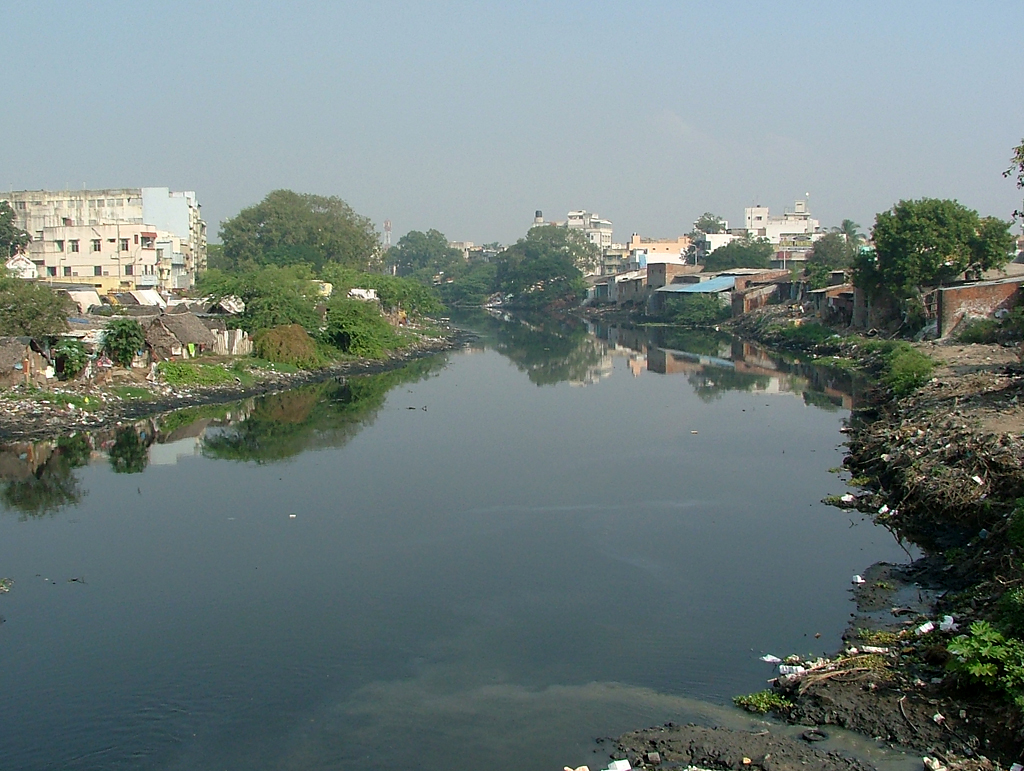
Centuries ago, when the commercial ships of the Romans docked at Manarfa (Mylapore), the first to smile at the merchants inside them was this river — Koovam. In those days, boats could sail far into the Koovam, which now lies like a girdle around the Chennai metropolis before merging with the sea. Not only the Romans who first disembarked here, the Koovam never let even the traders who had visited repeatedly, depart without experiencing the thrill of cruising on its waters. When the Romans disembarked from their ships and boarded small boats to travel deeper into the city, other boats, their bellies swollen with bales of cloth, diamonds, and mixtures of spices, could be seen moving in the opposite direction. Soft, gleaming and fragrant winds blew out of the boats and brushed against the Romans entering the city in the boats. Greetings from Indonesians, Chinese traders, and Sri Lankans floated across the river and reached the Romans moving inland. Fish would leap high above the surface of the water, rising almost to the height of the eyes of the merchants seated on the bulging sides of the boats gliding along on the surface of the river, almost at the height of the riverbanks. Watching all this bustle, the river laughed amid the hissing music of its waves.
“The Koovam is not merely a river, children,” Kayilan Thatha said. “It is history. It is philosophy. It is life.”
Before the children, the Koovam, which was history, thought and life, lay still. Where it touched its banks, the water had turned a dense black, as though its surface had been smeared with oil. Old Bisleri bottles lay crowded together here and there creating obstructions in the tiny rapids in the small channel left for the water to flow. Along both banks stood old, dilapidated buildings housing small-scale industries. From the sewage pipes of these factories poured many kinds of toxic effluents. Because of them, the Koovam had become a stream flowing incessantly carrying the glimmering, multi-coloured sheen of its filthy, chemical-laden waters heavy with lead, coliform bacteria, and other toxins. There was not even a single fish left to spring above the surface of the water. In the foul stream, where there was no trace of oxygen, not even the blue of the sky could find a reflection.
At the edge where the slum ended along the bank of the Koovam, the old man Kayilan and two children were sitting in the midday heat. Ever since the city corporation had finally acknowledged the existence of the slum’s children and had begun herding them into schools, these two children were the ones who stubbornly resisted being swept into classrooms. One of them, about eight years old, was nicknamed Kosu — Mosquito. This plump little boy was the leader. He had earned the name because of a particular skill he possessed. The mosquitoes of the slum — the true Draculas of that place — would attack in swarms. While everyone else tried to find ways to keep them away, Mosquito did exactly the opposite. He had discovered the use of some mysterious substance to attract them. Whatever it was, only he knew. Soon the mosquitoes would find no other way than coming in clouds and settling all over his body. Lying face down, Mosquito would get as many mosquitoes as possible on his back and would suddenly flip onto his back. At that moment, the lives of the mosquitoes on his back would plunge into hell. Then, a new swarm would immediately gather over his chest and belly. Then he would turn again and lie on his stomach. By morning, after many such ‘turns’ in the night, thousands of mosquitoes would have been crushed.
Mosquito’s father, Chinnaraasu, made good money carrying enormous sacks of goods in his wheelbarrow through the narrow lanes of Sowcarpet, delivering them to shops where normal vehicles could not reach. The lion’s share of the money he thus earned disappeared every evening at the arrack shop. By the time he returned home, half his wits would already be gone. Reaching home before the remaining half faded completely, he would begin quarrelling with Mosquito’s mother. That was usually the only purpose of his hurried return. Mosquito took particular care never to get caught between them. If he happened to step in between, he too would get the beatings. His father would shout at him: “You useless fellow — born only to eat!” To avoid hearing such abuse, Mosquito would eat whatever food was available before his father arrived. Then he would retreat for the night to a corner shaded with pieces of sackcloth. There he would lie down, preparing himself for his nightly battle with the mosquitoes.
The next member of the children’s gang was Moottapoochi Suppiramani. Those who knew him closely claimed that he had the strange habit of secretly eating bedbugs. That was how he had earned the nickname. Everyone simply called him Bedbug.
He had no problem of a father, because no one knew who his father was. Only his mother knew. But in the struggle of everyday life, even she no longer remembered such old stories. She made her living selling street food. Early every morning she would leave for Sowcarpet carrying a basket of steaming idlis. By the time she returned, around ten o’clock, not a single idli would remain in the basket. Her idlis and kandi chutney had many admirers. As soon as she returned home, she would feed Bedbug. In keeping with the timing, the boy would wake up only around the time his mother came back. But his puppy, Balu, woke up much earlier. Somehow the little dog managed to secure three idlis from the first steaming batch. Then he would lie down in front of the house, guarding, until the mother returned. As she came back in, Balu would stand at attention proudly like a labourer who had finished his shift, wagging his tail.
Soon after arriving home, the mother would begin preparing fried snacks. In the afternoon she would have to go out again to sell them. As she did not believe in taking anyone’s help in her work, and preferred to do everything on her own, she did not insist that the boy should assist her. Thus, she allowed Bedbug to roam about freely. Once or twice, she had raised the question of sending him to school. He refused. And she did not compel him.
After breakfast, Bedbug would step out with the puppy. They would go around the slum once; Balu would sniff everything along the way, reacquainting himself with the smells of the place, and would always walk close to his master’s feet. If there was water kept outside Shanti Akka’s house in a plastic pot, Balu would stealthily push his snout into it and lap up the water. Then he would raise his leg against the bicycle kept on a stand for repair in front of Ramanan’s repair shop and aim the jet of his pee at it.
As they wandered along like this, they would co-opt Mosquito to join their company.
“Let’s go and meet Kayilan Thatha,” they would decide together.
On the banks of the Koovam, under the shade of a Poovarasu, the Portia tree, Kayilan would usually be sitting. The tree had been planted there long ago during one of the government’s failed Koovam beautification campaigns. The tree stood not far from the bank where the thick black body of the river rubbed against the land. Because of that polluted nearness, the poor tree did not possess the lush beauty that its ancestors once had — since the distant past when it had accompanied the Austronesian maritime traders who sailed from Indonesia and reached this coast. Now the tree seemed to stand there with an unpleasant countenance, staring down at the filth.
Kayilan would reach the base of the Poovarasu tree on the bank even before sunrise. Until dusk fell, he would sit there watching the Koovam. Along the riverbanks stood many small huts that had crept onto the land claimed by the river. Kayilan used to sleep in one of them. The only other resident of that hut was Vaarmathi. Instead of walls, there were sheets of tin, and in some places, old flex boards. In that makeshift shack, Vaarmathi whose youth had lingered on, had been living for many years. From that time until now, the only human support she had was Kayilan Thatha, who slept outside on the small, raised platform in front of the hut. If the Koovam ever came out in full spate, she would certainly lose her dwelling. But the Koovam almost never swelled like that. Only once did it rise in full force — when the tsunami struck. On that occasion the river reclaimed all its banks. Vaarmathi lost everything. When the waters receded, she began reclaiming her little habitat again, with the money lent by the usurers, shaping it once more into a huddled dwelling-place suited to her limited circumstances.
On certain evenings, when the two children sat listening to Kayilan’s stories, Vaarmathi too would sometimes join them and listen. She worked at a place on the other bank of the Koovam. She earned her living in the laundry section of a hotel — a largescale establishment called Riverview. Almost directly opposite the Portia tree, on the far bank of the Koovam, the hotel could be seen standing proudly in the distance, its head held high. If one climbed a little way up the Portia tree and looked across the river, the sprawling lawns of the hotel would come clearly into view. Beside the lawn there was also a swimming pool. The entire hotel complex was surrounded by a massive wall, and on top of that wall ran coils of barbed wire. Outside the wall, on the stretch of land that sloped down towards the Koovam, a grassy mound had been raised, as if to present a pleasing sight to those who might look at it from afar. Using another variety of grass, the name of the hotel had been embossed, landscaped across the lawn. At night, when wedding receptions and parties of the rich were held there, the entire hotel glittered with coloured lights. The music that rose from the celebrations travelled across the Koovam and reached the slum. But the fragrance of the delicious dishes served on those lawns never made its way across. The stench rising from the Koovam stopped it midway, blocking it from reaching the slum. Such was the respect that glamour showed toward poverty!
Kayilan Thatha said:
“There was once a man who knew long in advance that this big hotel was going to come up here. His name was Koovalan.”
“Whoever was that scoundrel?” Mosquito interjected, in the uncivil language of the slum, lighting a beedi. Under the shade of Kayilan’s Portia tree, it was not only storytelling that took place!
Koovalan was someone who knew about the presence of water throughout the Tamil land. He was believed to be a divine spirit — one who could listen, from beginning to end, to the water that flowed beneath the earth, sobbing and sighing under the soil. Whenever the water wished to rise to the surface, it would call out to him: “Koovalan… help me come out.” Then Koovalan would tell the people of the village, where they should dig. But he would not say it directly. Instead, he would suddenly choose someone from among those gathered there and speak through that person. In those days, without Koovalan’s permission, no one dared to dig for water in places he had not pointed out. With Koovalan’s blessing — after the proper propitiation — his divine will would be revealed through the words of a chosen one among the people standing nearby. Through such utterances, the poor people of the soil came to understand Koovalan’s moods — whether he was grieving or whether he was pleased.
No sooner than the first piling for this hotel began, did Koovalan’s prophecy rise: “This should not happen. It will be a danger even to the Koovam itself.”
When factories began to come up one after another, swallowing up the banks of the Koovam, Koovalan kept repeating the same warning. But who was there to listen? Have you ever seen how, when the controlling reins slip from the sun’s hands, the sunlight suddenly runs wild across the earth? Something like that happened here. Everything slipped out of control. Across a stretch of sixteen kilometres, passing through three municipal corporations, the river had to move forward — faltering, stumbling, obstructed on all sides — while every kind of waste was poured into it from both banks. All the poison it carried along its course was finally spat out by its own mouth, where it opened out towards the bay. But even the channel that led to the sea had become completely blocked. The Koovam now lay like a filthy ghost whose mouth had been stuffed with the very rubbish it had carried down. Denied entry by the sea, the Koovam lay stretched out, long and despondent, like Shiva-Neelakantha who had swallowed poison.
As the narration went on, Balu the puppy barked once.
“Shut it, you blasted dog!” Mosquito spat out irritably.
But Balu would not be restrained. His barking did not stop. He kept up the hollering, staring toward a little distance. Bedbug walked over to see what it was. A frog was lying there — a large toad. Bedbug threw a stick at it to frighten it away, but it did not move. He felt irritated. If it had been Mosquito, the matter would have turned into a wholly different game altogether. Only when he looked more closely did he realise what was wrong. The frog seemed to be suffering from something. It could not leap. Had it grown old like Kayilan Thatha? Whatever it was, Bedbug decided to leave it alone. He pushed it gently into a nearby heap of rubbish, and with that Balu stopped barking. After a while, all of them dispersed for lunch.
There was bad news waiting for Mosquito when he returned home. A violent quarrel had broken out in Pettah. No one could clearly say how it had begun. Rowdies from outside were believed to have been involved. Most of those who had started the conflict had slipped away before the police arrived. The police registered a case against the people they could lay their hands on, on the spot. Though Mosquito’s father was not even on the list of the accused, he was nevertheless taken into custody and kept under remand as a suspect. Mosquito’s mother had broken open her piggy bank, and with the help of the neighbours she had rushed out to meet the lawyer who would defend her husband.
Mosquito had returned from home without having eaten anything. He pulled out the fleshy kernels from the jackfruit that Bedbug had brought, and flung the thick outer rind into the Koovam. Thus, Kayilan’s lunch also became jackfruit that afternoon. While eating, Kayilan began to narrate old stories of how Cuddalore jackfruits once used to arrive in boats along the Koovam.
Just then Balu began to yelp again. The frog had reappeared. Wasn’t it enough for it to sit somewhere quietly, enjoying the cool? This time Mosquito jumped down from the Portia tree. With a quick whack he caught the frog in his fist. The next moment he flung it into the Koovam. They watched the frog sink once, then raise its head above the oxygen-less water. The next moment it rose to the surface again — floating lifeless. If the Koovam could kill with a single stroke even a frog that could live both on land and in water, then this river must truly be a poison demon.
“Whose river is this now? This used to be our river. Who took it away from us?”
Kayilan pointed toward the encroachments that had sprung up along the opposite bank.
“The very people who call the river their sacred possession are the ones who are slowly strangling it to death.”
In a tone that mimicked a funeral lament, Kayilan went on, his voice falling somewhere between a song and a chant. As the Koovam moved slowly, floating on its back and staring at the scorching April sky over the city of Chennai, the children stood close together on its banks, looking at the frog that floated there, dead. But suddenly, beside it, something totally unexpected caught their attention. A tiny fingerling was swimming close to the dead frog. They could hardly believe their eyes. How could a fish survive in water that had just killed an amphibian like a frog?
“Kayilan Thatha, look here! There’s a fish in the Koovam!”
What? A fish in this water? In water where even a dried fish could hardly swim? Kayilan floundered. Yet there was excitement in his voice — as though something he had been waiting for a long time had finally happened.
“Hold me, boys!” he shouted.
Both the children held the old man by the hands and helped him to his feet. With his old, faltering steps, he hurried toward the bank of the Koovam.
“Hey, I’m sure that’s an aira fish.”
“An aira fish? But those are found only in Madurai, aren’t they, Thatha?”
Hanging on to the children’s hands, Kayilan peered into the river. Just then, a little distance away, on the broad bosom of the Koovam, a wave raised by the whiff of a hot wind moved across the water. It pushed the frog’s corpse a little closer to the bank. The children felt as though the river itself was bringing it nearer so that Kayilan could see it. The tiny fish, opening and shutting its little mouth, began slowly circling the frog’s corpse. Slightly bent in the middle, the fish glittered like silver. Its head was hardly larger than its body. Its round eyes seemed to roll, appearing almost outside the water. Though they were within the water level, they looked as if they were gazing up at the sky.
“Thatha, is it an aira fish or an aagaaya meen, a “sky fish”?
Perhaps because he was overjoyed and excited, Kayilan, whose legs had long lost their strength, sat down on the ground near the riverbank. He paid obeisance to the little fish as though it were the fish incarnation of Lord Vishnu. Avoiding the frog’s corpse, the fish moved a little closer to the bank. Its silvery sheen lit up the entire edge of the river as it lingered there for a moment. The next instant it flashed like lightning, turned sharply, and dived deep into the depths of the Koovam.
It was only when Vaarmathi returned from the hotel that Kayilan began to narrate the story of the fishes of the Koovam. Whenever Vaarmathi sat before him, the wings of his stories seemed to grow wider and more colourful.
Apart from ordinary evenings when clouds of dust drifted through the air like a light shower, there was nothing particularly different that day. Yet the children felt that the sky held an unusual glitter that evening. As always, the sun sank into the sea without completing something — like the incomplete bindi on Vaarmathi’s forehead. Still, something had changed. The usual pale expression of the sky, like the fading glow on Vaarmathi’s face in the absence of a man’s touch, had definitely changed, indicating something different.
She shared the dishes she had brought from the hotel with the children. They were the leftovers she was allowed to bring back from work. She rarely lit her hearth to cook dinner at home. The children of the slum were especially fond of the non-vegetarian items she brought from the hotel. They would gnaw even at the bones. But Kayilan never touched those dishes.
Kayilan’s dinner was always the same: four idlis and tea from Shanti Akka’s roadside stall.
Every evening Vaarmathi would happily take out the currency notes tucked into the fold at the end of her sari and pay for them.
Vaarmathi’s face, which was naturally like a full moon, would appear darkened when she returned from work. She came back from the hotel carrying not only the leftover food, but also the weight of the abusive words hurled at her there. Bearing that burden, she would come back to the slum. However hard they worked, the slum dwellers were certain of one thing, day and night — they would always be shouted at. It was certain — inexorable, unchanging — like night following day and day following night. There was no escaping it. Though her job was in the laundry pick-up section, she was expected to run about from one stage of work to another in the continuous cycle of its operations. When she checked in at the weight tracking, she would be showered with abusive words even though she had made no mistake. Those who came on the different shifts there were all scoundrels. They were angry with her because she never allowed any of them to touch or fondle her body. The men who worked near the tumble dryers were not so bad. They seemed satisfied just looking at her. In the folding section, things were a little easier. But at the checkout point, being shouted at with filthy words was inevitable. By the time she had gone through all these stations of work, one full cycle would be completed. After that the same motions would repeat again and again until the day ended. By evening she would feel as though she had slept with a repulsive man and risen from that bed again.
Vaarmathi sat silently beside Kayilan on the cot kept on the small veranda outside the hut until the children came out after tearing into the meat dishes. When they emerged after eating, the atmosphere grew lighter, whatever one might say. After all, children are the ones who lighten a tense situation.
It was then that Kayilan would begin his stories.
Between 1967 and 2000, before the failed attempts to revive the Koovam and restore its banks began, there was a grand time for the river. It would flow like a bashful girl gliding along — rising from the village of Koovam in Tiruvallur, spreading green life along both its banks, and dividing the city of Madras into two, with its stream full of wavelets fanning out to either bank. Its waves would swell and spread, and boats would move up and down along its course. Long before the British and their settlements arrived, much before the era of trade, even at a time when no foreign merchants had yet set foot here, the waters of this short river were alive with aira fish flashing up and down across its surface. Their smooth bodies shone with a silvery brilliance that competed with the rays of the coastal sun reflected on the water. Only at the river mouth that opened into the Bay of Bengal was their sheen less visible. The aira fish never frequented that region, for the salt water there meant certain death, and liberation from this life, for them. They were the true inheritors of the river. Even those who set out their boats to catch these fish treated them with reverence. They were caught and taken home, while they were still alive, always with full honour. Not only in the past, but even today, aira fish are put out of their life only after performing abhishekam on them with milk, and then, finished off with a swift sword-stroke.
“Listen, all of you: the fish have sent a prince to reclaim their empire.” Kayilan ended his story most dramatically, thus.
The little aira fish that swam around the dead body of the frog, opening and closing its tiny mouth, not losing its vitality even in the midst of poison—he was in fact the young prince of the fishes who has returned to reclaim the fishes’ empire. If the empires built on the banks of Koovam were claimed by humans, all of them will come under the reign of this prince. Kayilan said that whatever Koovalan was now about to say through the voice of someone among them, that would inevitably turn out to be the commands of the king of fishes. If they did not obey the commands of Koovalan, the king of fishes would open his mouth. The wind that escaped from his mouth would soon turn into a tempest. From that moment on, none of the human settlements would remain standing firmly on the ground.
When the children reached the bank of the Koovam, Mosquito was thoroughly irritated. It was almost certain that the proceedings to release his father from custody would once again be delayed.
Mosquito’s mother had begun the narration thus:
“That useless fellow will never prosper. Let him be ruined. For whatever mistake someone committed, was it my husband who had to be caught and arrested? That wretched rogue, that scoundrel, that son of a whore, that SI—he is one of our own caste people. Without any regard for caste or community, that good-for-nothing sinner of a fellow went and did this. Let his wife and children all be ruined.”
The only person who could handle cases easily like plucking a flower—cases that even advocates fail to solve--was the Ullooru leader Muthuraasa, the councillor. For him it was always a matter of ‘you do something for me, and I will do something for you.’
“And that Porambokku fellow too was a man of our caste. After coming to power, for him it was only money; money mattered more than caste. He abhorred the people coming from the banks of the Koovam. Is it drainage water that is running through our veins, instead of blood?”
That night, with a vengeance, Mosquito killed more mosquitoes than ever before.
Bedbug noted that Mosquito stamped his foot vehemently as he walked towards the bank of the Koovam. The children did not find Kayilan in his usual seat. He was sitting close to the Koovam, on its bank! How did he manage to walk independently up to that point?
The two children left Balu the puppy standing under the Portia tree and got down on the path towards the riverbank. Hearing the noise, Kayilan turned his head around and looked in their direction. His eyes were nowhere there. Inside the stain-spread white of the greying irises, like thunderbolts in the black night, were the bloodshot veins.
At that moment the children saw a strange sight. The aira fish, leaving the muddy middle of the Koovam, had come closer to the bank, and was opening its mouth towards the shore. The children felt as though it were conveying some secret to Kayilan. They looked at each other. As Bedbug observed the way the fish lay in the water, he suddenly felt the urge to urinate without warning. Usually he felt that urge only when he was afraid. He looked at Mosquito. There were changes in him as well. He stood like a soldier, his chest thrust forward.
“Grandfather…” Bedbug called out slowly.
“Who here is the grandfather? I am Koovalan.”
Even hearing that, Bedbug’s chest tightened with fear.
“Grandfather! Don’t do anything to me, you coward.”
The language of some slum dwellers changes even when they are struck by fear.
“Is this how you speak before the prince, you gutter fellow?” Mosquito said.
It was hard to believe that it was he who had uttered those words. It was another kind of voice. In an instant, he had become the Fish Prince’s soldier.
Kayilan had become Koovalan, and Mosquito had become the soldier. Bedbug, so as not to be left out, turned himself into an ordinary subject. To confront his role and experience as a common citizen placed between the king, the priest, and the soldier, he did what was usual for his kind—he obeyed. With the obedience characteristic of his class, he bent his head towards the ground.
“Is this drainage water where the prince of fishes should live?” Kayilan roared as if spitting fire.
Bedbug could not raise his head. He felt guilty—for what, he did not know—but guilty, nevertheless. Superiors can ask such questions. For every common fault or mistake, it is the subjects—the people below—who must face whatever punishment that ensued.
When Vaarmathi entered the scene in the evening, Kayilan rose from the banks of the Koovam and proceeded home. Sitting on the charpoy placed in front of the shack, he made his pronouncements. The prince should be removed from the gutter water as soon as possible. A suitable place must be found for him, and his consecration in his royal seat should be carried out immediately.
Like the day that had passed untouched and was now sliding into the pale dusk of evening, Vaarmathi sank down at one end of the charpoy. She looked as though she might set like the sun at any moment.
“Grandfather, I can’t go on doing it,” Vaarmathi said.
Her eyes were brimming over. It did not seem that the reason was merely the abusive words she had to put up with while going out to earn her daily bread. Life had turned dull and lifeless in the absence of a mate, and the pain of having to live this way had filled her days with ongoing grief. Who else but a woman could endure such a life?
Unlike his usual self, Kayilan sprang up from his bed. Bedbug was filled with consternation, convinced that Kayilan had turned into Koovalan. It was to deliver commands that he had risen. Dramatically swinging over his shoulder, the end of the blanket he usually wore wrapped around him, he stood tall. Unaware of herself, Vaarmathi clutched his legs and wept.
Only Bedbug was witness to the blazing of Vaarmathi’s bindi at that moment—like the morning sun rising in all its colours. Who was she? Was she Kannagi, Theeppaancha Amman, Kamakshi, or Karumariamman?
Kayilan laid out his plan. Until the Koovam is restored to its ancient glory, the prince will not move from here. The great sire will bring down the high-rises that stand in rows along its banks. From now on, in Chennai, it will not be the sun that rises—it will be the flash of this great sire’s ceremonial sword. Until then, the great sire must remain in the waters of the old Koovam. And as for those who have snatched away the good times of the Koovam— from now on, the prince will commandeer the water that is in their possession.
The swimming pool of the hotel where Vaarmathi worked was chosen for this purpose. It was decided that the pool should be taken over as soon as possible. From now on, the prince would live there for some time. When the prince moved across the surface of the swimming pool, gleaming in the blue of its waters, he would sprout new wings. And the silvery light of his scales would rival the glimmer of the sun. For the good people, that light would grant new sight; for the wicked, it would bring blindness. As one watched, the prince’s wings would begin to grow. And with those wings—limbs that demanded the adoration of every onlooker—the great sire would begin to move out. In the sky a tempest would rage. Thunder would clap and shatter like explosions. The dwellers of the town, not daring to step out of their houses, would remain indoors. Then all the constructions, all the dwellings along the banks of the Koovam, would scatter like matchboxes. The rain would come raging. With a swollen belly and a long tongue hanging out, the Koovam would surge forward in fury, swallowing its banks and cleansing them in a single stroke. The next day, the people of the region would behold the Koovam flowing with blue waters, dancing its way towards the bay. And in those blue waters, countless schools of aira fish would swim about, their brightness competing with the sun.
Mosquito, the soldier, stepped forward and stood at attention. “My life is for the prince,” he declared.
Kayilan said that, if they were all ready, they would request the prince to come ashore. Except for Bedbug, the other two signalled their agreement by touching their foreheads to the ground. Bedbug, standing outside the strange world the other two had entered, could hardly believe any of it. The other two needed something that would help them forget certain things in their lives, and for that reason they could believe in what was being proposed. But Bedbug, who was certainly following a lowly kind of life yet had no lack of small comforts, did not need to believe in such a hyper-reality. He preferred to remain within his own body and his own self. Suppose they really managed to secure the aira fish: he would then rather place it in a bottle of water and keep it there as a beautiful thing to look at.
But what happened the next day was something else altogether. Vaarmathi went to the hotel for work as usual. By the time Bedbug reached the bank of the Koovam with Kayilan and Mosquito, the aira fish was swimming close to the shore, as if waiting for them to arrive. Kayilan bent his head in deep obeisance, and as soon as he beseeched the prince to enter the bottle, the prince obeyed the request. Even seeing this, Bedbug was almost overcome with disbelief.
That night, strengthened by Kayilan’s blessing, the three of them crossed the Koovam carrying the fish with them. After crossing the slanting lawn with the hotel’s name embossed upon it, they scaled the wall and entered the hotel’s manicured grounds.
They could not forget that Kayilan had been weeping as he handed over the treasure—the fish that he had kept in the bottle with great devotion in the middle of the charpoy on which he slept. Vaarmathi reminded them about everything that had happened.
“Keep Thatha’s words etched in your minds,” she said. “You must take good care of the prince.”
What they held in their hands was the last king of the Koovam. Bedbug felt overwhelmed by the weight of that responsibility. They had only one chance. If they failed in this attempt, there would never again be another opportunity in their lifetime for the revival of the Koovam.
Although the three of them had climbed the compound wall together, it was Vaarmathi who leapt down first. Only she knew the topography of the hotel compound well. Bedbug and Mosquito remained perched on top of the wall. Before jumping down, Vaarmathi had handed the bottle in which the fish was kept to Mosquito for safekeeping. For a while there was no sound. When he heard a soft whistling signal from below, Mosquito sprang down from the wall in a single leap. Before jumping, he had passed the bottle to Bedbug. A moment later, Vaarmathi lifted up Mosquito by his armpits, and he recovered the bottle from Bedbug’s hands.
Bedbug had held the bottle only for a fleeting moment. Yet he had dared to steal a glance inside. What he saw there was not the almighty prince, but a poor aira fish. Looking at him, it opened its lips pitifully, and Bedbug felt as though it were pleading with him: “Please, do not leave me in the pool.” At that moment, through the muddied water that swirled around the fish in the bottle, the prince of the Koovam revealed—just for Bedbug—a sudden cosmic apparition of his form. It was like the mouth opening in the final gasp of breath when a noose tightens around the neck.
As they moved forward towards the swimming pool after scaling the wall, Bedbug whispered in Mosquito’s ear, “Don’t do this. Hey, let us take the fish back to the Koovam and release it there. The fish is mortally afraid.”
Mosquito flashed a blazing look at Bedbug, as if to incinerate him. They were already nearing the swimming pool. They had to carry out their plan within the brief window of time when the security guards, making their rounds, paused momentarily before moving on. Yet Bedbug had dared to whisper this audacious suggestion just as they were trying to make use of that lull in the guards’ march! They could hear the faint sounds of the guards near the laundry block, and it would not take them long on their rounds to reach the spot where they were standing.
“Akka, quickly,” Mosquito urged her.
The swimming pool seemed to look at them and yawn open its jaws like a Nagarayakshi, the ghoul of the city—its blue waters steeped in the sting of dry acid and chlorine tablets.
At the last moment, Bedbug made a final attempt to dissuade them.
“Hey, don’t do this, da. The fish is frightened to death. Akka, please—let’s not do this.”
In a flash, Mosquito pulled out the stopper of the bottle and poured the water, along with the prince, into the swimming pool. The fish squirmed once as it touched the surface of the water. Though it tried to swim—sinking and wriggling in confusion—it could not move properly. It opened its mouth two or three times and tried to leap up. But the next moment the poor fish floated dead. However, none of them saw this happen. By then, the long beams of the guards’ torches had already stretched towards them and trapped them within a circle of light.