When Ishwara returned to Bhuvanagiri after thirty-seven years, the town had changed so completely that he could not recognize a single thing. The mud roads were now tarred. In the bazaar stood a huge departmental store. Two miles away, a railway station sent trains rumbling through day and night. Tongas had given way to autorickshaws. In the town that once had nothing more than a police station, there was now a magistrate’s court. Where tiled houses had stood, four- and five-storeyed buildings had risen. In the town that had once possessed only two telephones, everyone now carried a smartphone in their hands. When Ishwara went looking for the high school where he had studied, he found that it had become a junior college. The Hanuman shrine, the panchayat platform, the market ground, the tamarind grove that had clung to the edge of the town: nothing remained as it had been before. On the site of the old Srikanteshwara Tent Cinema now stood a vast mall bearing the same name. On a hoarding outside the theatre beside it, two hands were throttling the neck of a young woman whose eyes bulged wide in terror.
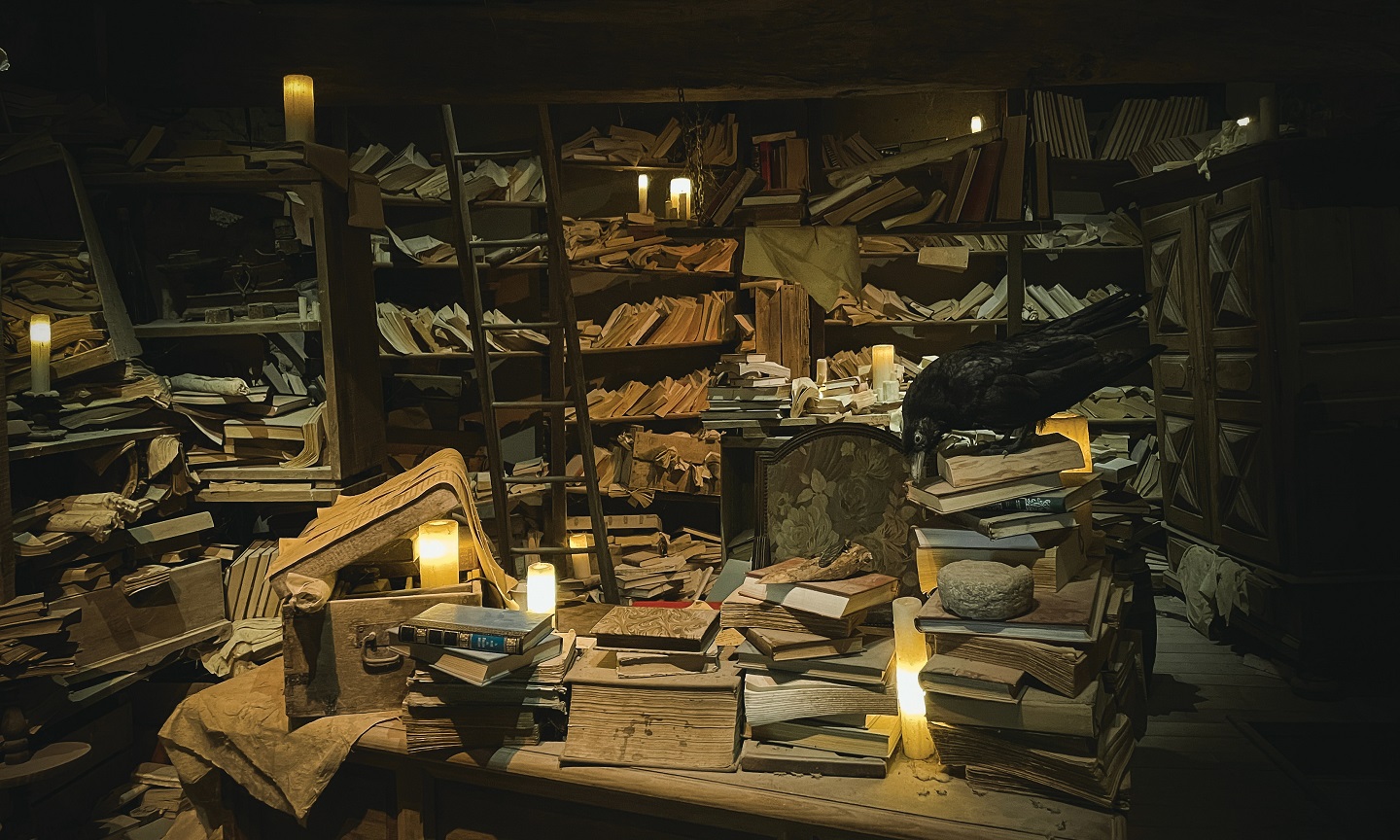
The library that Ishwara had not even gone looking for appeared before him on its own. And it had not changed in the least. It stood exactly as it had thirty-seven years ago. All the readers there seemed to have lost themselves in the dominion of books, surrendered utterly to the silence of books. In the dimly lit library, thousands of books were arranged neatly in cupboards that ran along the walls from floor to ceiling. Some books sat piled one upon another on the floor itself, rising like great towers. It was truly an empire of silence. Until someone walked up to a shelf and pulled out a book, silence remained absolute. In the dull light of a solitary bulb hanging from the ceiling, shadows dozed. Everywhere lingered the same smell from thirty-seven years ago.
Ishwara walked softly to a shelf, pulled out a book, flipped through its pages for a moment, and returned it to its place. Then he blew gently, “uff”, on the dust that had clung to his fingers. After that he took down several books from different shelves and placed them on the table before him. He opened them one by one, glanced through them, closed them, picked up another... Then suddenly he saw Krishnabai, who used to look after the library in those days. More than joy, he was astonished. She was exactly as she had been before. Brushing back the grey hair that fell across her wrinkled forehead, adjusting the spectacles perched on her nose, she stretched out her thin, fragile hands - hands that looked as though they might snap at any moment - and smiled faintly. She seemed a woman born for the sole purpose of serving in a library. Not only did she recognize Ishwara, she even remembered the days when he had studied in high school.
Just as in those earlier days, a dozen or so people still sat in chairs reading newspapers. Others wandered among the shelves in search of one book or another. Ishwara wondered what it was that he himself wanted to read. The next moment, a handwritten catalogue of books appeared before him. Krishnabai brought over a stack of books she could scarcely carry and placed them on the table in front of him. He read out their titles softly but distinctly, and also pronounced the names of their authors. Along with them came memories of those who had once sat right before him reading these very books, years ago. Two old men rose before his mind’s eye. One of them used to read aloud passages from a book to the other so softly that no one ever needed to hush them and say, “Quiet, don’t make noise.”
Today Ishwara had already looked through many books. Some, merely by seeing their covers, he even guessed the stories within. Others he set aside simply by weighing their heft in his hand. Then, absorbed in some thought, he walked towards a few more shelves. There he found Alasingacharya’s Ramayana, and the novels of B. Venkatacharya, Kerur Vasudevacharya, and Galaganatha. There were books by Masti Venkatesha Iyengar, Kuvempu, A. N. Krishna Rao, TaRaSu, M. Ramamurthy, Goruru Ramaswamy Iyengar, Triveni, Sametanahalli Ramarao, and many others. Just as Ishwara was thinking that he could not spot a single book by any of the newer writers, Krishnabai arrived carrying four or five books tucked under her arm and spread them out before him. “Have you read Nisarga? Mirji Annaraya wrote it. Read Baalina Gida, it is very good, written by M. Haridasaraya. Shall I give you Sarasammana Samadhi? That is by K. Shivaram Karanth,” she said in rapid succession. When he shook his head as if to refuse, she continued, “Do you want Gandhiji’s autobiography, translated by Goruru Ramaswamy Iyengar? We also have a commentary on the Gita, by Hosakere Chidambarayya.” As Ishwara absent-mindedly shifted the piles of books before him back and forth, he suddenly felt as though someone somewhere far away had whispered, “Tell me, who writes that well anymore?” He started in surprise just as Krishnabai began reciting more names: Tirumalamba, R. Kalyanamma, Sakkari Balacharya, M. Venkataiah, B. F. Kale. Poor fellow, he had never even heard of any of them.
“I was actually looking for a particular book,” he said.
“Which book?”
“O Baduke Badukisu by Manoj Anjinappa.”
“Who is that?”
“You don’t know him? He’s very famous. Writes very well.”
“If he writes so well, shouldn’t we have his books here too? Why don’t we?” Krishnabai asked, turning the question back on him.
Ishwara’s eyes travelled along the rows of shelves. On the top ledge of one cupboard he spotted a book bound in black. Rising on tiptoe, he stretched out his hand and pulled it down. The moment it came into his hands he thought to himself, ‘Ah, so much dust,’ and blew on it, “uff!” The dust rose around him like a cloud, and the cobwebs clinging to the edges of the book wrapped themselves around his fingers. He looked around for a rag to wipe it with. There was none. For some reason he felt hesitant to call Krishnabai and ask. The handkerchief that usually sat in the back pocket of his trousers was missing. Shaking the book, blowing uff uff at intervals, he finally turned a page or two. Nothing in it stirred his curiosity. Then he pulled out a few more books from the same shelf and dusted them one after another until he had more or less dirtied his shirt completely. As he opened and glanced through each book, one of them seemed almost to call out to him: ‘Come, pick me up.’ It was the annual magazine of the high school where he had studied; 1956 edition. As he eagerly turned its pages, he came upon a full-page black-and-white group photograph. The moment he saw himself standing in the back row, a strange softness spread through his body. No one, it seemed, had opened that volume for years, or taken it out anywhere. Suddenly he wanted to keep it for himself. Somehow or other, he must steal it. But there was no possibility of slipping it away unnoticed under Krishnabai’s watchful eyes. What if he simply tore out that page? Before he even realized it, his thumb and forefinger had tugged at the page. The paper, poor quality to begin with, had withered over the years, yellowed and grown so fragile that it began tearing jaggedly at once. He was frightened the sheet would be ruined.
What if he simply asked Krishnabai for it?
“They don’t give away books like that,” she said.
“I’ll buy it from you. Please give it to me,” he pleaded.
“No, no. Impossible.”
“I’ll pay however much you want.”
But she would not agree at all. “Why has this book come here in the first place? It should have been kept in the reference section,” she muttered, placing it on her own table. Seeing no other way, Ishwara told Krishnabai, “I need to make some notes. I’ll go bring a notebook,” and left the library.
Walking on, he went into the bazaar and bought a notebook and a Seven O’Clock blade from a shop there. As soon as he stepped back out onto the street, he stopped for a moment as though struck by a sudden thought. Then, moving ahead slowly, he began thinking about how he might cut out the page with the group photograph in the darkness between two shelves of the library. Deciding that if he went to a hotel for a while enough time might pass, he entered a crowded darshini by the roadside. Standing among the throng, he ate rava idli, drank a cup of coffee, and then started back the way he had come.
Along one side of the road ran a trench, two, three, even four feet deep, dug the whole length of the street, with the excavated earth heaped on either side. On the other side lay enormous cement pipes, wide enough for a man to crawl into and sit inside. After walking a few steps, he stopped short in astonishment at the sight of a huge four- or five-storeyed building, all glass from wall to wall, standing behind the champak tree he had noticed an hour earlier.
For the life of him, he could not remember having seen that building when he had walked down the very same road from the library. Then he turned into one lane and from there into another. Behind a barricade set up so that no one might pass, the tar on the road had been ripped up and replaced with crushed stone. A little farther away, labourers carried pan after pan of mortar mixed by a huge machine and poured it over the road. Still farther on, the old bungalow he had admired barely an hour and a half ago - ‘What a beautiful house,’ he had thought while passing it, noticing the two coconut trees in front - had vanished without a trace. In its place there was only the foundation for a new building.
None of the buildings he had seen earlier were anywhere to be found. Bewildered, Ishwara stood staring around him. Just then rain began pouring down suddenly, and to escape getting drenched he ran towards a bus stop packed with people. At the very instant he reached it, a bus pulled away. He ran after the moving bus and clung to its doorway, trying to force himself inside through the crowd spilling outwards. In the crush, an old woman beside him, herself unable to move ahead, cursed aloud, “What wretched people! The moment they see a woman they start drooling!” Somehow the tip of the umbrella tucked under her arm jabbed into Ishwara’s stomach. He fell backwards onto the road. After getting up and recovering himself for a while, he searched and searched; but there was no trace of the library anywhere. He asked people. No one knew Kannada. Of the three or four who did, none had even the faintest idea that such a library might ever have existed. “What on earth has happened?” he wondered anxiously, standing still for a moment. Before his eyes, even as he watched, seven or eight men erected a cut-out of a smiling man with sacred ash smeared across his forehead and hands folded reverentially. A moment later, from a short distance away, a huge crowd of hundreds came marching forward carrying placards and waving flags, shouting slogans in unison as they shoved past him. Close behind them came another procession - hundreds of women marching with placards in hand, shouting that the man who had committed the rape must be hanged. Ishwara followed them for some distance. Then he stopped a police constable who was striding about wielding a lathi and asked him which street the library was on. The constable glared at him as though he himself were the criminal.
After walking some ten yards, he came upon a shop where brightly coloured magazines hung on display. Ishwara bought a copy of Prajavani and stood there flipping through its pages. On one page he read:
“Driver murdered after car rammed”;
“Cybercrime: Fake websites proliferate”;
“Life insurance fraud worth ₹4.51 crores”;
“Jewellery theft: Two arrested”;
“Passengers drugged and robbed”;
“Twenty-four laptops stolen: Graduate caught”;
“Floods claim two women in Ojikuppam”;
“Police raid twenty-one spas: 118 women rescued”;
“Accident: Lorry wheel crushes rider to death.”
All this had happened in a single day. That is, yesterday, March 27, 2024. The other pages too were filled with stories of deceit, betrayal, fraud, and violence.
Having arrived burdened with memories of the past, Ishwara now found himself standing in the present, compelled to imagine the future. At last he stood there bewildered, like a missing letter lost from one of the library’s books, as though he himself had lost all trace of his own existence.
Along that same road four men came carrying a corpse. Behind them followed fifteen or twenty others, singing together as they passed him by:
Hanuman, servant of Rama,
Thirupati itself is Vaikuntha…