
Asawari Athle. Around thirty, thirty-two. A fair complexion leaning toward plumpness, like the transient hue of the earth at sunset. Medium height, with a conscious and measured gait. Adept and skilled in her daily routines, but beneath every activity lurked a desolate silence and fleeting traces of fatigue. Her face always bore an expression of tangled pride, so no one dared to stare at her openly; they would defer to look properly next time. She hailed from some village near Nashik. After marriage, she had come to live in Mumbai with her husband Sudhakar and daughter Kala.
By nature, she had been imaginative and introverted from the start. Perhaps that's why she didn't mingle much with the neighbors. She exchanged casual greetings with everyone, but no real closeness had developed with anyone—no sitting for a couple of hours at a neighbor's during free time, nor anyone coming over for tea at hers. Outside in the alley, there was always some hustle: children playing somewhere, a radio blaring elsewhere. From a nearby room came the sound of water being filled or the thump of a rolling pin, and occasionally a woman's call—"Thamb ga, sangtey na!" Asawari passed through these sounds as if observing everything from behind a transparent curtain—neither entering nor allowing anyone in. A fixed distance always remained, like a girl standing at the window watching the rain but not getting wet.
After Kala left for school and Sudhakar for the office, she was left completely alone in the room. This was the emptiest part of the day. The room held a constant smell throughout the day—a bit of dampness, a touch of ghee and turmeric, and somewhere, like old wood, a musty, stale memory. She would take a glass of tea and sit by the window. She did nothing, just sat. Sometimes her gaze fixed on an aluminum bowl on the utensil rack where Kala had stuck a small Doraemon sticker; sometimes she stared at the faint damp spots on the wall. Upon close inspection, shapes appeared in them—a hidden face, a bent arm, an incomplete eye. Occasionally, on the bare floor, her fingers absentmindedly drew shapes—incomplete trees, tangled flowers, or nameless forms.
In the evening, when Kala returned, some movement stirred in the room. She tore pages from her notebook to make frocks for dolls, colored them, and called her mother to show—"Aai, bagh na!" (Mom, look!). Asawari would smile. Sometimes she stroked her head, sometimes sat beside her without a word. Kala's presence was like granting her the chance to hear an old heartbeat within herself again—the same heartbeat she lost all day amid utensils and damp walls.
Sometimes, peering out the window, she remembered her childhood home—the small place with mud walls, where a lamp was lit on the Tulsi platform at dusk. Her mother's soft, slow voice chanting Mantras, the scent of evening-moistened earth, and the descending twilight. In the walls of this Mumbai room, all that had faded. Through the window, amid the visible water tanks and tangled cables on nearby roofs, she kept searching for some sky from the past.
The faint sense of festival preparations was now evident in the alley. One day, when she went out to buy vegetables, she saw colorful flags hanging outside a room. Someone at the paan stall said—"Ya varsh motha mandap ghalnar aahet, Sawant saheb!" (This year they're putting up a big pandal!). She paused involuntarily. Something stirred gently inside her, like an old seed about to sprout under dry leaves. She bought the vegetables and returned home—with a light tremor in her mind, neither fully joy nor anxiety.
Upon returning home, she saw Kala sitting by the wall with an old drawing book open, filling in colors. Light blue, then green. The colors were spilling outside, but the girl was deeply absorbed. Asawari quietly came and sat beside her. After watching for a moment, she picked up the pencil and, rounding the outline a bit more, said—"Here, make it a little circular, see how beautiful it looks..." Kala tilted her neck to look and smiled. Now that green patch looked perfectly balanced. Without a word, Asawari gently refilled the blue shade—this time the color didn't spill. For a few moments, time seemed to pause. She remembered her own mother, who made vibrant rangoli in the courtyard every morning. How precise the lines were, as if guided by an inner voice.
Kala got up to drink water in the kitchen. Her drawing book lay open. Asawari gazed at the pages for a while, then, as if an old instinct arose within her, she pulled the book closer. The colors were good, but the lines were crooked, the shapes raw with childishness. Asawari slowly picked up the pencil and began reshaping the same picture in the empty space—like a mother unbraiding her daughter's tangled hair and re-plaiting it. No harsh lines, no haste. Her hands moved on their own. In a short while, the entire balance of the picture had changed, yet its original simplicity remained intact. Returning from the kitchen, Kala bent over it without a word, watched, then smiled.
That day, Asawari sat by the window until late evening. The sound of distant local trains, children's fights from nearby rooms, and intermittently a radio—"Aala re aala, Ganpati Bappa aala..." She closed her eyes and for a while forgot that this alley, this time, this life was hers. As if sitting in someone else's place, watching someone else's life.
Asawari had always participated in festivals. She observed fasts with the neighborhood women, arranged plates of turmeric and kumkum, hummed along to Mangalagauri songs even if she forgot the words by gently clapping. Until now, every year she joined the neighborhood Ganpati Aarti with her quiet smile and neatly drawn rangoli. Her rangoli was instantly recognizable—straight lines, perfectly shaped flowers, colors without spilling.
This was the first year since coming to Mumbai that the thought arose in Asawari's mind to install Ganpati at her own home. The idea had come slowly, like an old photograph kept in a closed box suddenly appearing before her eyes while handling something else. That day, when Kala, seeing the decorations in the neighbor's room, asked—"Mom, will Ganpati come to our house too?", Asawari had been unable to reply. But in that very moment, something light had stirred inside her, as if an old string had been touched. "Should we install him this year? A very small Bappa..." The thought came, and she herself felt afraid, as if speaking the dream aloud would spoil it. She sat for a while, trying to fathom her own mind. She couldn't remember the last time she had wanted something purely for herself. Perhaps this was its beginning—a slow, moist beginning—when an inner layer began dissolving like color in water.
In the kitchen cupboard, the spice boxes were always arranged in the same order—the red chili on top, turmeric, then cumin, coriander powder, and at the bottom a small steel box with occasional garam masala. To Asawari, this order felt like a syllabus—fixed, unchanging. Like every week's plate with the same bottle gourd, the same moong, the same spoonful of ghee. Sometimes, returning from the market, Kala would ask—"Didn't you bring anything special today, Mom?" And she would smile—"Aaj nahi ga, pudhchya athavdyat baghuya..." (Not today, child, we'll see next week). The next week, like a false relief, always lay a little distant.
In the kitchen corner was a tin box where notes and coins were stuffed under the lid. Opening that box before every festival had become a ritual—without telling Sudhakar, quietly, late at night or in the afternoon solitude. Asawari would open the lid, her fingers searching among the coins, as if measuring her desire. Before Ganeshotsav, that same box held twelve hundred and eighty rupees—thinking this time they'd do something different. But 'something different' sold quite expensively in Mumbai's shops.
These days, once when she stepped out for some work, in Bhaurao's alley, everything was as before yet somehow different—as if someone had unknowingly cast a little light on everyday things. In front of flower shops, piles of marigolds and shevanti were stacked, with flies sitting on them as if in some discipline. Children crowded around a toy cart's circle, where a red light fitted on Ganeshji's head blinked with electricity. At the alley corner, an elderly man from the bhajan group was beating a dholak, and coins were collecting in his plate.
Amid all this, Asawari wasn't just passing by; it was as if she was seeping through them—every color, every scent, every sound penetrating deep into her, forming a soft knot of restlessness inside. This restlessness wasn't new, but today it felt clearer.
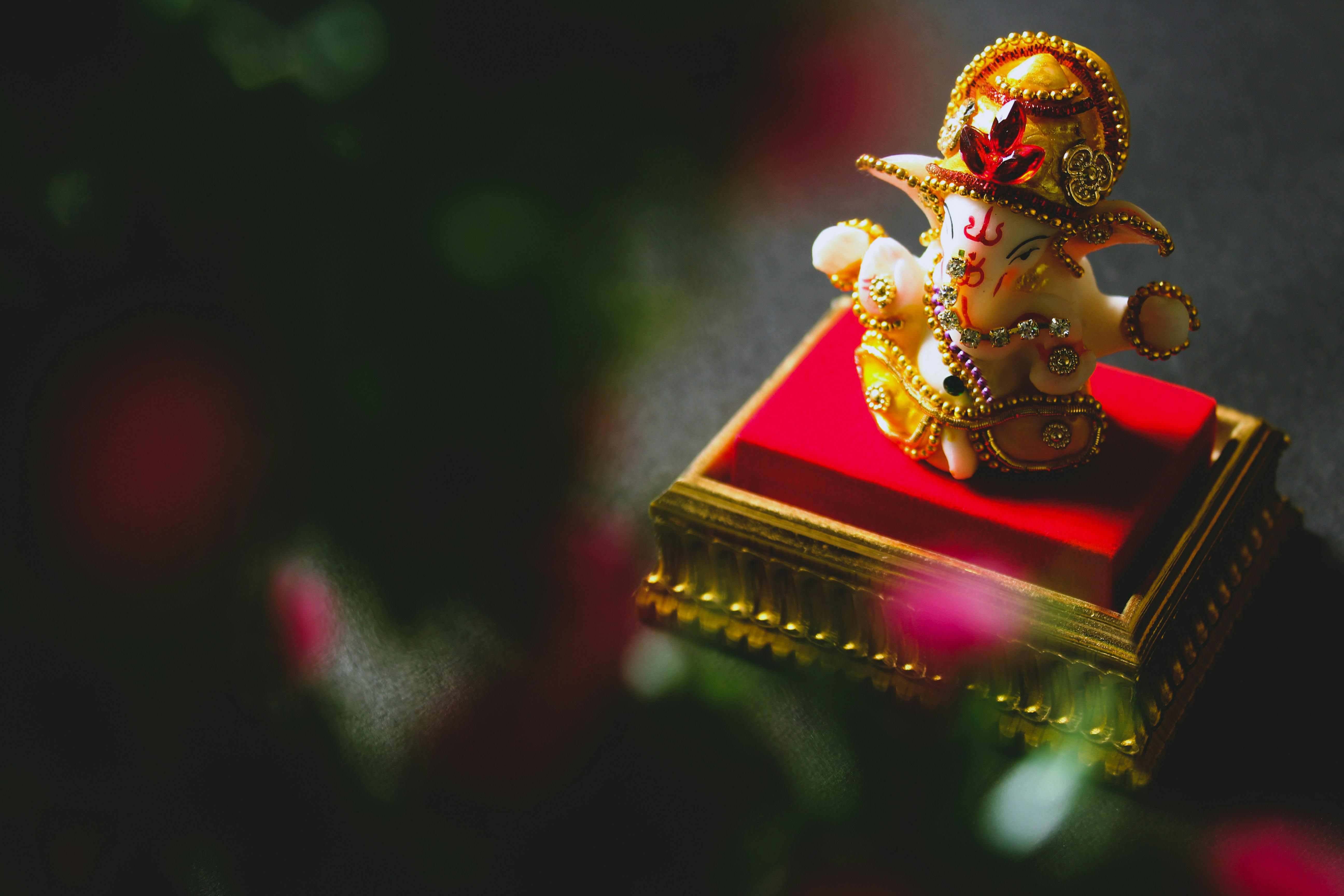
At the stall on the alley turn, a boy stood with long garlands of paper crowns hanging—green, blue, golden crowns embedded with red stars and sparkling beads. Right below the crowns were colorful traditional clothes and Ganesh idols with stitched eyes—some with trunks curved right, some left, some with stillness in their eyes, some with childlike mischief.
Asawari stood for a while—her gaze fixed on a clay idol whose color was the least vibrant among the rest, but its brows and lips were carved with such tenderness as if someone had shaped them holding their breath. She watched that idol for a while. A voice came from behind—"See madam, like this one? Shall I set it aside?"
"No, just looking..." She replied. Her tone was soft, hurt, bowed, but forged on the spot in self-respect.
She stood in front of the idol a little longer. Inside, a thought gnawed—could she really install it in her home this year? In her tiny room, where between narrow and damp walls there was already little space to breathe, could this beauty fit?
From the corners of the house to washing the stuck utensils—she kept doing something all day. There was a thought that found momentum only in her being engaged in work like this. Kala had gone to school, Sudhakar to the office. She kept thinking—was she really ready for this responsibility? Does mere enthusiasm make it happen? After all, she'd have to bring the idol, decorate, offer bhog-prasad, invite neighbors... and then the fear that something might not go right!
Alone in the room, while working, Asawari's gaze kept fixing on that one corner—just inside the door, where an old window adjoined the wall. Below the window lay a table, usually holding clothes, a ration bag, or a water bottle. But now that corner seemed to demand something more—as if it had begun to glow with some other meaning from within.
While sweeping there, without thinking concretely, Asawari removed the items from the table, shifted the bottle aside, and slowly wiped the dust with a torn cloth—the dust more tactile than visible. Light filtering through the window grilles lay like a soft line on that spot—straight, steady, as if time had paused in its dimension for a few moments. She watched for a long time—not thinking, just watching—as if there was a heartbeat in that corner, a slow, mute call rising and looking at her. The window light paused there as if the spot wanted to reveal itself—clear, calm, and strangely expectant. The room's ordinary silence bloomed around that corner—the air there a bit more still, a bit more her own.
That night when Sudhakar returned, she wasn't entangled in the kitchen as usual. While placing water in a steel glass, she glanced again at that corner, which she had cleaned multiple times since morning. Sudhakar said nothing, but for a moment his gaze lingered on Asawari, probing. Then he quietly hung his bag and headed to the washbasin.
At night when everyone was asleep, Asawari sat up. The yellow streetlight coming through the window reached the corner in fragments. She got up and took out an old red cloth from the cupboard. The scent of turmeric and kumkum hidden in its folds still lingered. Holding the cloth, she looked for a while, then gently spread it in that corner. Her hands moved on their own, without any premeditation, as if a line was drawing a picture to its completeness, which she couldn't yet see in full form, only feel.
In the morning, she quietly lifted the cloth again, and kept it aside—as if a child had created something all night and tidied it up in the morning lest someone see. But the corner now looked different. The wall there was cleaner, the floor below shone, and she had shifted the nearby flower pot a bit farther so the direct sunlight would fall right on that spot as the day progressed.
All day amid chores, she kept stopping there. While mopping, while picking up the newspaper, or just leaning against the wall for a moment in fatigue. All this was as if the spot was now tied to her inside with a thread—not too tight, not loose—just stirred. Sudhakar didn't notice, or perhaps he did but said nothing. Asawari didn't want anything said yet either. As if naming it would make her lose something.
Bhadrapad was approaching, and a different vibration was dissolving into Mumbai's rhythm. The old stench from the drains was now suppressed by the mixed scents of incense, camphor and sandalwood oil. Ads increased on TV, newspapers, posters, and hoardings. In the morning haze, distant beats of dhol-tasha could be heard—irregular but continuous, like an old memory slowly returning.
Old saris and sheets were dyed and spread on slum roofs, to become pandal curtains. Below, in the wet mud, children were making mandap maps with their hands, which might not take the form of a temple but would be the first raw shape of devotion. Shop shelves were changing. Idols were carefully brought out. Some faces were still covered with cloth, as if full introduction hadn't happened yet. Flower garlands, colorful fringes, glittering thermocol cutouts—everything was gathering in a raw beauty.
Conversations inside buildings no longer had the tone of everyday life. A special urgency and sharing had entered the words. Voices carried a light chirp, a slightly shiny impatience, as if every word, every question, indicated an approaching grandeur. "Thermocolchya mukhra aanla ka?" (Brought the thermocol masks?)—someone hadn't just asked about decoration; it was like claiming her share in the preparation, in the event. "Taar lavla ka ga, bai?" (Put up the wires, sister?)—this voice didn't leap; it was threaded from one window to another like string. Such voices weren't from separate women in separate homes but as if all were different walls of one mandap, adorned in their parts but woven together. The roofs of each room had become one, and doors opened into a shared courtyard.
Asawari had always watched all this communal bustle from afar until now—a safe distance where the festival's colors were visible but their splashes didn't reach her. But this time, cracks were appearing in the walls of that distance. Sooner or later, the feeling of joining in, of finally letting herself flow with it. She hadn't made any plan yet, nor promised herself anything, but while cleaning the dust from that room corner, the hesitation in her mind was shedding, like a door closed for years slowly opening from inside. With the door opening, an old gust of wind was entering—in which was the scent of turmeric-soaked mud, village echoes, and the fragrance of modaks made by her mother.
The corner, which she had considered just part of her room until now, had become an old veranda peeking from a crack in time, where every year her father had installed a clay Ganesh with his own hands, where she sat for hours making wings in rangoli, where she first tried to match tunes with the bhajan group. In that corner now, light fell from the window—just like it used to in that courtyard, from where memories of the past were slowly returning. She turned to look; the room was the same, walls the same, corner the same, but something had changed inside. The junction of time, as if the present had shaken hands with memory.
She hadn't decided anything, yet inside, something had been decided by now—clear and undisputed.
Asawari quietly got up and took out the tin container from near the gas, where the other day she had counted and put back the twelve hundred and eighty rupees. As she opened the lid, a line of hesitation crossed her face for a moment. Taking out the rupees, she tied them in the corner of her pallu and went straight to stand in front of Sudhakar. He was sitting on the bed with the newspaper spread out, sipping tea. Asawari said nothing. Sudhakar only asked—"Chalna hai?" (Want to go?). Asawari felt a wave of guilt. But before she could say anything, Sudhakar finished his tea, set the glass aside on the tripod, and started putting on his chappals.
How did Sudhakar know where and for what purpose to go? Asawari must have been a bit surprised. Struggling together with deprivations and responsibilities for so many years, their inner selves had become so intertwined that one’s thoughts were fully revealed to the other. This intimacy was beyond words; there was an invisible thread between them that transmitted one’s imagination to the other. Shadows of defeat lingered on Sudhakar's face; he spoke little, always seemed subdued. With poor but patient dignity, he carried something inside—unfulfilled possibilities, and doubts from those crossroads after which life took this direction. But with him, Asawari never felt a trace of communicative void. Sudhakar's gestures held a generous consent, his silence carried care and concern, and in the deepest layers, an unspoken respect for Asawari's unfulfilled desires.
As they stepped into the alley, the outside world, which until now was just a view from the window, walked and pulsed with her. Today, the buildings lining the roads had grown taller and closer than before. The lanes between them had either vanished or become narrow and tangled. The distances between houses and arches held a strange transparency, as if painted on glass. The streets and surroundings had a blinding brightness where no shadows fell. They had crossed Bhaurao's alley and emerged at the corner. Crowds, chaos. The roads were packed with pedestrians as usual. Traffic, horns, etc., sounded like distant wind chimes. The scents of garlands in thalis, incense, spices weighed down the air. Colors' shine and sounds' dense web, where everyone wove their share of preparations.
Sudhakar walked a little distance away, as if knowing this path was Asawari's. He just needed to accompany, not lead. In the crowd of identical idols, each seemed to narrate something unique. Some had elongated ears, some had golden folds on the belly, some had eyes that seemed to see deep inside. One's mudras in hands were lifelike, another's smile held such affection that Asawari's heart could get bound there. She looked at each, paused a moment, then moved on—as if searching for a special one.
So many Ganeshas together—each with the same deity, same power, same auspiciousness. But for the decision, pockets had to be checked. The artisans' crafted differences in colors, sizes, and beauty were now weighed on scales. Some twenty-five hundred, some four thousand. "Le jaiye bai, ghar bhagyashali banega." (Take it, madam, your home will become fortunate.) This sentence had become like a tagline behind every idol.
And then at a turn, a bit aside from the crowd, a small idol appeared—white, simple, unadorned, quietly distinct from the rest, but something in its eyes. It felt like it was looking at Asawari, exactly like some old acquaintance. Its gaze came from far away, beyond Mumbai's seven-eight years, from some distant village. There was no invitation in that idol's eyes, no competition with others. No command, no sparkle of miracle. Just a serene, natural invitation—beyond call and expectation.
Asawari stopped there. The surrounding bustle suddenly slowed. Colors, sounds, sunlight's glare—all blurred. In that moment, she felt her search until now wasn't for an idol, but for that gaze—someone looking at her in a way that descended to her inner layers.
Sudhakar, who had been following her wandering gaze from a distance, knew from her back—this is the one. He came quietly to her, without any question. Feeling his approach, enriched by his presence, Asawari bent a little, as if meeting the idol's eyes. Her eyes, almost new, sparkled when she turned to look at Sudhakar. Sudhakar smiled agreeably. He looked carefully at the idol, then at the small tag hanging below. Four digits etched on ordinary paper—so concise, yet so weighty.
Sudhakar was about to approach the shopkeeper busy bargaining with another customer when Asawari stopped him by holding his arm. Sudhakar said nothing, but his face didn't hide from Asawari. He knew what she was feeling, and Asawari clearly saw what Sudhakar wanted to conceal.
There was no helplessness on his face—he wasn't making excuses, nor trying to find a solution. Just a quiet, honest gaze that admitted the idol was very beautiful, very much their own, but perhaps not yet.
Asawari's eyes filled up. No words burst out. She knew this wasn't just about an idol—the peace in its eyes was what she sought within herself, and perhaps she saw its shadow in Sudhakar's silent gaze. This moment was like a mirror reflecting all the unspoken things of their life, unfulfilled desires, and quiet acceptances. She also knew Sudhakar wouldn't say anything, but he would preserve that desire somewhere inside, as he always had.
Asawari felt the idol wasn't just clay; it hid a part of her, an emotion she had never shared with anyone, not even Sudhakar. And now, when the desire stood concretely before her, the distance between her and that desire wasn't just a matter of price—it was an entire world, layered with daily accounts, responsibilities, and compromises.
She averted her eyes, but a deep tremor remained inside, as if a door had almost opened and closed again. But the echo of its opening and closing lingered inside for a long time.
On the way home, both were silent. Loudspeaker mantras, children running with balloons, young women taking selfies with bought Bappas, crowds, decorations, prasad, sparkling fringes, and paths laden with decoration items—they now moved in the opposite direction, emerging from a deep tunnel, a bit lighter. The whole world was advancing toward the festival, and they were retreating from it, edging away. Each step seemed to say something inside, strengthening a resolve.
Sudhakar walked a little ahead, a small stationery bag in his hand that Asawari had quietly bought from a shop—chart paper, pencils, charcoal colors, etc., ordinary things, but holding something very personal, familiar, and tried, hence reliable. Asawari followed, but not slowly. No clear expression on her face, but a serious focus fixed in her eyes.
Returning home, Sudhakar opened the door. Inside was the familiar darkness—the afternoon sun had gone, but the light wasn't on yet. Asawari came in without a word and went straight into the room without removing her chappals. Sudhakar latched the door and placed the bag on the table.
Kala was sleeping. Asawari adjusted the fan by her head and covered her with a sheet. While doing this, her gaze went to the corner; the window was open, expectation in the surrounding air. Sudhakar stood at the door frame watching her quietly for a few moments, then went to the kitchen to make tea.
When he returned, the room was utterly still. Even the air walked on tiptoes, lest it disturb the focus. Asawari sat on the floor below the table by the window, leaning against the wall joint, without changing clothes. In the room's faint yellow light, around her...
Paper, colors, charcoal, and eraser lay scattered. The pencil was held in her fingers with practiced ease—not too tight, not loose. A thought came from her tip to her mind. That thought was neither fully hers nor entirely from some external thing. Every line she drew felt familiar from before, then suddenly became something else. Something was breaking there, and something new, unseen, was taking birth. With every line, that Ganesh idol was being installed from within her to outside, but in this process, something else of her inside was also suddenly taking shape.
When Sudhakar woke up, how he stopped Kala from going near her, when he made khichdi, when he put Kala to sleep and waited on the bed for a long time before falling asleep himself—she had no awareness of any of this. Sudhakar had come midway to place tea for her, which had now cooled to water. He had also kept her food covered with a plate by the door. The faint yellow light, which once gave the comfort of home in the shape of walls, now gave the illusion of fog swaying in a cave, where Asawari remained engrossed in her work all night, oblivious.
The pencil was no longer drawing a shape but a rhythm. In that rhythm was a light restlessness, and a solitude that took her deeper into herself. A slow pinch of fatigue had descended into her shoulders, but her fingers were still alert, as if operated by another consciousness, tied to another awakening. There was a slight stiffness in her neck, and her palm sometimes trembled. But these were momentary pauses. She would erase repeatedly, step back a bit to look, then smile and proceed. She had touched some secret tone of the self, a hidden spring of nectar had come to hand. A quiet, cool rain within herself—wetting neither the soul nor the body, but somewhere in between, where the boundaries of creation and recognition dissolve.
She felt she was gradually freeing herself from an old symbol. As if a blessing's weight was lifting. Every line, every rub, was erasing a known but blurred memory. Traditions, old habits, beliefs, assumptions were being dissolved. Like melting, without heat.
Morning came, and Asawari was content. The work wasn't finished, but for the first time, something felt complete. The picture was of Ganesh—the same merciful eyes, his trunk with a hint of sanctity, the same steady, tender smile, but now there was something more in it that Asawari had never felt before. What she couldn't buy in the market, she had now obtained with a slight excess. Like an idol, it had no arrogance of being worshiped, no expectation, no demand. It had only an unmistakable presence—and in that presence, Asawari had served all her skill, all her zest for life, and everything she could never say in words. With this creation, she found no satisfaction, no vision, but, a stability going deep beyond fatigue. The satisfaction of completing an artwork isn't exhilaration, nor a victory proclaimed to the beat of drums. It's like a deep, calm breath. That satisfaction might look like a tired smile from outside, but inside it's the pause of an entire journey. A wavering moment when the artist doesn't separate from the creation, yet is ready to hand it over.
By the time Sudhakar woke, Asawari had fallen asleep. Leaning against the table and wall joint. He watched her quietly—the tired lines on her face, the stillness of her sleeping body, her deep, weary breaths. Her hands were still blackened—traces of charcoal dirt and effort still stuck in her fingers. One could imagine her labor all night while he and Kala slept soundly. The smell of colors lingered in the room's air. Tea and last night's food lay untouched. He turned off the light that must have burned all night. Picked up the utensils and kept them in the kitchen. Put on tea and started toasting bread slices. He knew when Asawari woke, she might still say nothing. But something had stirred inside Sudhakar; it wasn't just concern for her, but recognizing for the first time something he had always seen but never like this.
When he reached near Asawari with tea, Kala was there. Standing by the picture holding her breath. Sudhakar came to her. Kala asked in a hushed voice—"When did Mom make this?" There was more than curiosity in her voice, a known awe for something very personal.
Sudhakar stroked her forehead and set the tea glass down. Said—"This wasn't made, it came out from inside her." Then feeling the sentence was heavy for her age, he added lightly, "Like you came out of her belly, so did Ganpati Bappa. By that count, he's your brother."
Kala laughed, careful not to wake her mom with the noise. He had to wake Asawari anyway, so she could have tea and wash her face. Upon waking, for a moment nothing seemed clear to her, as if a fine veil still hung over her eyes between sleep and creation. Sudhakar and Kala stood in front—quiet, cautious, alert, as if someone was walking in sleep and they feared touching.
She tried to compose herself immediately, attempting to sit up. But her body resisted slightly. There was stiffness in her back, burning in her eyes, and her fingers still full of lines' memory.
"Stay seated." Sudhakar said in a soft but firm tone. "Have tea, then go wash your face and hands. Have a light breakfast. You didn't eat anything last night."
Asawari looked at him; there was no complaint, no demand. Just an understanding of deep fatigue, and even more, a quietly echoing admiration that, without being voiced, conveyed so much.
Kala was now chirping, "Mom, we'll keep this in the pooja, right? I'll put flowers too." Sudhakar also nodded in agreement, "This year this is the most beautiful. It's from your hand. No need for another idol."
Asawari remained quiet for a bit. Then she looked at the picture. Not as one looks, but as if remembering an old dream again. It was true she had started making this picture with the intention of worshiping it. But now, as Kala gave shape to those words, she felt like something very personal was being snatched. In the labor of shaping these lines all night, where the 'real purpose' had fallen behind and what new had taken its place wasn't clear yet, but certain enough that this picture didn't desire worship but appreciation.
"No." She said, gaze fixed on the picture. "This isn't for pooja. It'll get spoiled with turmeric-kumkum."
Kala was startled, "But this is Godji's picture. Everyone worships it." Sudhakar opened his mouth to say something, then closed it. He just looked at the picture with a deep gaze, that figure now seeming distinct from every Ganpati until now in the light of Asawari's words.
"Won't worship it?" Kala asked again—a bit confused, a bit innocent stubbornness.
"What better than you keep looking at it!" Asawari said, pulling her into her embrace.
A moist silence spread in the room. Outside in some house, the echo of Aarti resounded—dholak, cymbals, conch. Sudhakar said—"Come, I'm setting breakfast. Kala, wash your face too."
Outside in the alley, it was the din of the final day. The neighborhood's final tableau was emerging—Ganpati seated high on platforms, colorful fringes all around, flowers-gulal, dhol-tasha, firecrackers, people dancing wildly to DJ tunes. Sudhakar and Kala stood at the door. Kala's eyes had the dazzle, as every year.
Asawari didn't want to fold the picture. Just took out a big cardboard and attached it on both sides so the corners wouldn't bend. Then slowly wrapped it in thick paper, as if draping a sari. The picture still held those qualities, those adjectives that had suddenly placed Asawari on some high place that morning. From there, life's lacks and voids seemed meaningless, trivial, impoverished. In all senses, this was its harvest, and only this much. She felt proud of her creation, an experience of inexplicable richness. But today she was pushing it aside like stale food. She had become completely detached from it. Perhaps every artwork gifts its creator such dispassion in later days. Now this wasn't awakening any possibility in Asawari nor fully depriving her.
In the top shelf of the cupboard, she placed it where old papers, diaries, some incomplete sketchbooks, and a small brass bell were kept.
The loud DJ music from outside reached the room, as if something heavy was stirring inside on the beat. Kala said a bit louder so Asawari could hear—"Mom, won't you see? This is the last tableau."
Asawari said in a light tone—"Coming." Then she rose slowly, tired, but weightless inside.
By the time she reached the door, the tableau had passed. The noise was gradually sliding away from the alley. As if a collective emotion was flowing out from every home like water.