
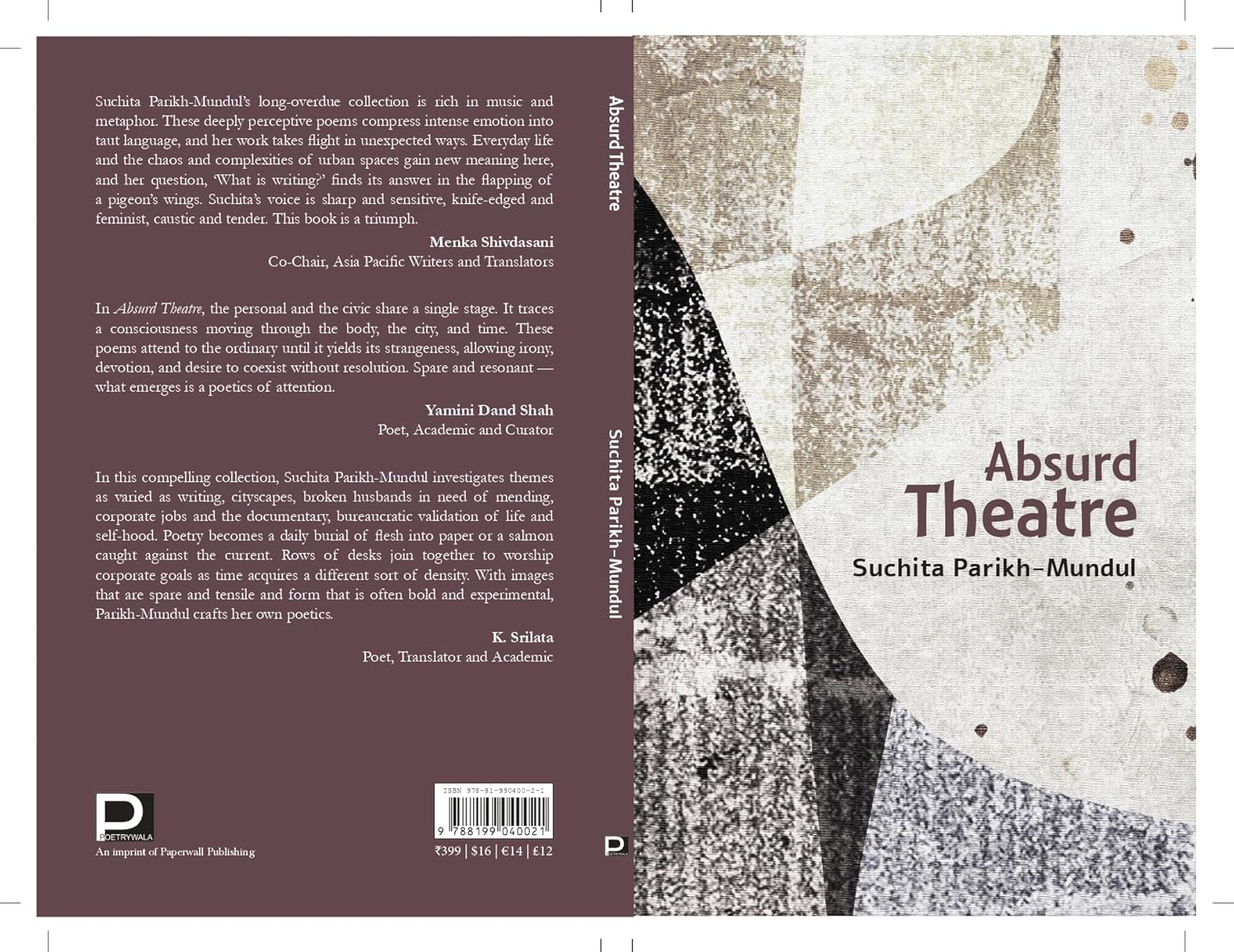
Book: Absurd Theatre
Writer: Suchita Parikh-Mundul
Publisher: Poetrywala, an imprint of Paperwall Publishing
Pages: 102
Absurdity is often imagined as something rare, born out of eccentricity or an unusual way of seeing the world. Yet, in the realm of human existence, absurdity is far more ordinary than we admit. Much of what we do, think, and believe emerges from uncertainties whose origins remain unclear. Our lives are shaped by countless assumptions, contradictions, and impulses, each carrying its own obscure beginning. Whenever we try to define a person, an idea, or a situation, our certainty begins to dissolve. Reality unfolds in ways that may affirm our beliefs or challenge them altogether. What remains is often a meaning we create for ourselves with a source of comfort in an otherwise uncertain world. Even that comfort is neither fixed nor precise; it shifts with time and experience. Yet it exists, and its existence matters. In a world resistant to clear answers, these imperfect meanings are often what make life bearable and significant.
In Absurd Theatre, Suchita Parikh-Mundul engages with the seemingly ordinary elements of everyday life only to reveal their profound significance. From rituals of worship to the intimate caress of a woman’s skin, she traces moments that are often taken for granted and uncovers the layers of meaning embedded within them. What appears relevant on the surface gradually expands into a larger contemplation of existence, where every gesture, emotion, and experience participates in a broader search for purpose. It is through this attention to purpose that Suchita invites her readers to become more observant, conscious, and receptive to the subtle details that shape human life. The minute molecules of existence, those fleeting sensations, habits, and encounters that often escape notice, are treated not as insignificant fragments but as essential components of our being. They demand attention, and more importantly, they deserve it. By carefully illuminating these overlooked particulars, Suchita creates a rich microcosm that reflects the complexities, contradictions, and quiet wonders of the larger world.
In the poem What is Writing?, the poet’s meditation begins with the flight of a pigeon. What might seem like an ordinary sight gradually transforms into a source of reflection, as the bird’s resilience and quiet courage seep into the poet’s consciousness, helping her navigate the uncertainties of the day. The pigeon becomes more than a mere image; it evolves into a symbol of endurance, movement, and possibility. In an age increasingly defined by binaries, where people are compelled to identify with one side or the other, Suchita’s poetry seeks the shades that exist between black and white. She draws a sliver of colour from the pigeon’s determination, from the memory of its fallen wing, and from its persistent will to continue. Through this act, the poem resists easy conclusions and embraces complexity. It becomes an exploration not only of writing and its origins but also of the circumstances that give birth to a poem. As the poet observes the pigeon, she simultaneously examines her own act of observation, allowing the external world and the creative impulse to merge. What emerges is a layered reflection on how poetry is often born from the smallest encounters, transforming fleeting moments into enduring questions about perception, meaning, and existence.
…when I saw its grey wings
against the barrier, flapping over
and into a yard full of colourful
things waiting to be explored.
In the poem Worship, the poet invites us into the intimate world of daily devotion, guiding us through the familiar rituals of offering prayers to a deity. With warmth and quiet attentiveness, she leads us beyond the outward acts of worship and into their emotional core, revealing how personal faith is often intertwined with a longing for comfort, meaning, reassurance, or transcendence. The ritual thus becomes more than a prescribed practice; it emerges as a deeply human attempt to reach an emotional and spiritual state. Yet the poem does not remain within the comfort of devotion alone. As it unfolds, the poet gently questions the nature of this exchange between the believer and the divine. Are the faithful truly satisfied with what they receive, or does the act of worship conceal deeper desires and uncertainties? By raising this question, Suchita creates a space for reflection rather than judgment. The inquiry feels particularly relevant in a time when exchanges, whether social, political, or spiritual, are increasingly marked by visibility, transaction, and even violence. Against this backdrop, the poem recalls a gentler possibility, one rooted in introspection, tenderness, and love. This poem, at the end of the day, becomes not only a meditation on faith but also an examination of what human beings seek when they surrender themselves to belief.
A diaphanous invocation follows like a whirlpool
of love, sustaining the heart till it’s
full. Is the hunger satisfied? I wonder.
The capitalist cacophony finds a voice in Suchita’s poem Corporate Job. While reflecting on the nature of corporate work, the poet navigates the restless yet deeply mundane rhythms of a capitalist world, where endless cycles of productivity and delivery often seem to lead nowhere. Tasks are completed, targets are met, and achievements accumulate yet a sense of fulfilment remains elusive. In this relentless process, individuality is gradually eroded, often without leaving any visible trace of what has been lost. However, the poem is not merely a critique of capitalism’s exhausting machinery. It is also an exploration of personal agency within it. Amidst the noise of deadlines, expectations, and perpetual motion, the poet turns towards the possibility of choice. She consciously creates room for silence, allowing moments of stillness to interrupt the chaos. It is through this silence that the complexities of modern life begin to unravel, making space for reflection, clarity, and self-awareness. By balancing critique with introspection, the poem becomes a meditation on survival in an increasingly mechanised world. It reminds us that even within systems designed to consume our attention, the act of pausing, listening, and reclaiming one's inner quiet can be a profound form of resistance.
…while I, in the office chair, work
against its progress, glaring
at the computer’s slow rise
from outdated sleep.
The spirit of protest finds one of its most powerful expressions in Suchita’s poem How to Get a Life (approved by the government). Taking citizenship as its central concern, the poem examines the ways in which state power increasingly shapes, regulates, and often intrudes upon the lives of ordinary people. Through irony and sharp observation, Suchita exposes the uneasy relationship between the individual and the institutions that govern them, revealing how belonging itself can become a contested and conditional experience.
Reading the poem brings to mind a line from the song Jaadu Maya by the band Indian Ocean where Rahul Ram sings “Yaha bando ne bando ki laasho pe sarkaar banai hai.” The resonance lies in the poem’s recognition of a system that often appears indifferent to the very people it claims to serve. The absurdity of this condition is that resistance rarely arrives with a clear resolution. One either grows exhausted from the struggle or continues fighting despite the exhaustion, knowing that silence may come at an even greater cost. Yet the poem is not merely an expression of despair. It functions as a necessary confrontation with reality, compelling readers to acknowledge the structures that shape their lives. In doing so, Suchita transforms protest into reflection, urging us to question the systems we inhabit and the price we pay for acceptance within them. The result is a poem that is both politically charged and deeply human, offering a stark but essential reality check.
10. When your existence is authenticated, you are officially free to live. (Keep in mind: an overt celebration will raise suspicion.
Distance is a tender and meticulously crafted meditation on love, longing, and the spaces that separate lovers. While distance can be measured in miles, hours, or journeys, the poem suggests that its emotional weight cannot always be compensated for through practical solutions. Personal circumstances, responsibilities, and the realities of everyday life often create barriers that remain difficult to overcome, no matter how strong the desire to bridge them. Through this exploration, Suchita moves beyond conventional notions of romance and passion. The poem presents love as a presence that persists despite separation, inhabiting both sleep and waking dreams, memory and anticipation. It is a feeling that refuses to be confined by physical boundaries, continuing to grow in moments of absence as much as in moments of togetherness. What makes this poem particularly moving is its recognition that not every separation can be resolved. Yet rather than diminishing love, this incompleteness deepens it, revealing how affection often survives through patience, imagination, and hope. Suchita captures the quiet resilience of love, reminding us that emotional proximity can sometimes endure even when physical closeness remains out of reach.
…the years between
us producing waves that approach
and recede
like the ache of loss, like the constancy
of love.
Absurd Theatre is a thoughtful exploration of the quiet absurdities that shape everyday life and the wisdom hidden within them. Rather than seeking meaning in grand events, Suchita Parikh-Mundul turns to the ordinary, uncovering the significance of moments that often go unnoticed. Across the collection, she examines how our lives are shaped by what we write, how we choose to live, the ways our minds are conditioned to think, and the urgings of a conscience that compels us to speak. Moving between the personal and the political, the intimate and the collective, her poems reveal the complexities that define contemporary existence. At its heart, the book is a meditation on finding meaning within uncertainty. Through sharp observation and quiet reflection, Suchita reminds us that even the smallest absurdities of life can illuminate larger truths about ourselves and the world we inhabit.