
Planning a trip to Kochi
I had been curious about the Kochi Biennale since 2022, the year in which it had its 4th edition after the gap of the pandemic. I read about in magazines and Instagram updates, heard experiences of those who had visited, and then saw a presentation on it and some of its artworks by the curator, Shubigi Rao, at the Experimenter Curator’s Hub in Kolkata in 2024. I was eager to experience the edition in 2025 (it didn’t happen in 2024).
I planned the trip in October 2025, for March 2026, because Holi break was the only time that was feasible for me for a visit, during the Biennale’s 3+ month duration between mid-December and end-March. I wanted to make the most of it, with an aim of writing about it. ‘Making the most of’ – has always been my mantra while travelling. But of late, I’m divided between that and the desire to slow down, of choosing places to relax than spots to tick off. During my two-day stay in Kochi, I felt the same.
When I’d planned the trip last October, I was looking forward to it with great excitement. I couldn’t wait for the five intervening months to pass. But within two weeks, my life changed. My father was taken critically ill and hospitalized… and in another 10 days, left us. Within a week of that, I fell ill with Typhoid and Dengue. There’s a lot to deal with when a parent dies. There’s no time to mourn. The ritualistic and social aspects aside, I found myself dealing with more paperwork than usual, for various reasons. And I was also trying to recover, which was slow and uneven, because I hardly had the scope to rest. I completely forgot Kochi then (just as I forgot my newly-published memoir, Coming Out Solo). Whenever I was reminded of the trip, I felt irritated. I didn’t feel like travelling, didn’t feel like doing anything beyond the strictly necessary—which was already a lot. At one point, I thought of cancelling the trip, and then overcame that and managed to find a reason to look forward to it once again. After losing Baba, I felt spending time by myself would allow me to heal the wound brought about the loss.
There was also something unique about this trip – my birthday fell within it. Being in Kochi during my daughter’s Holi break would mean not just a solo trip, but also being alone on my birthday. A first, for me. I already knew that in October. But I’d made my peace with it by thinking of a celebration immediately after my return – dining out with my daughter and visiting my father.
That was not to be.
There’s been a virtual ritual to my birthday the past half-decade. On March 3, I post a photo on Facebook (Meta) and a ‘Thank You’ note the day after for the wishes that come my way. This time, the ‘Thank you’ note included a post on my visit to Kochi:
I had the most unusual birthday, immersing myself in art, in Kochi -- beginning with Gulam Mohammed Sheikh & ending with a Kathakali performance, with some regional pride thrown in with mass Art. My first, brief experience of the Kochi Biennale was both intense & enriching! I need time to mull over all that I've seen & the innumerable photos I've taken before I can write about it.
The birthday was indeed that – interesting and enriching. But between Gulam Mohammed Sheikh and Kathakali, there was something else. I had begun the day a bit late, crossing the backwaters to see the veteran artist’s exhibition at Durbar Hall. In the afternoon, I returned to see more in Fort Kochi, having an idea to look at other elements on show at the Biennale
Jew Town was one of the densest locations of the Biennale. I saw a number of exhibitions there – curated by Ina Puri, Riyas Komu and massArt. Just as I was about to call an auto after seeing ‘Durga Puja Art’ at the JRC Marine, I spotted another Biennale Parallel – ‘Lilies in the Garden of Tomorrow’, by Sarah Chandy, a most fascinating show.
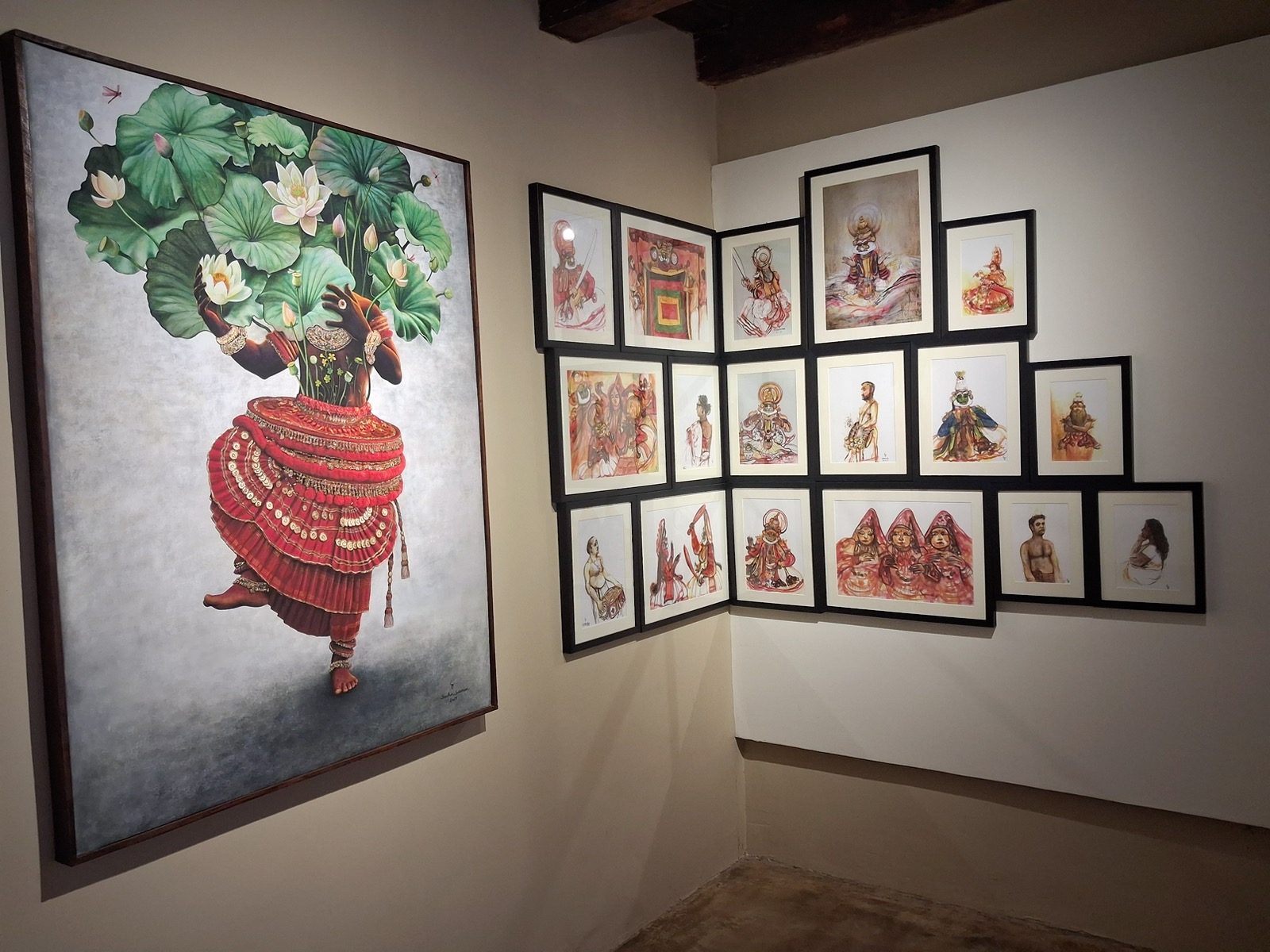
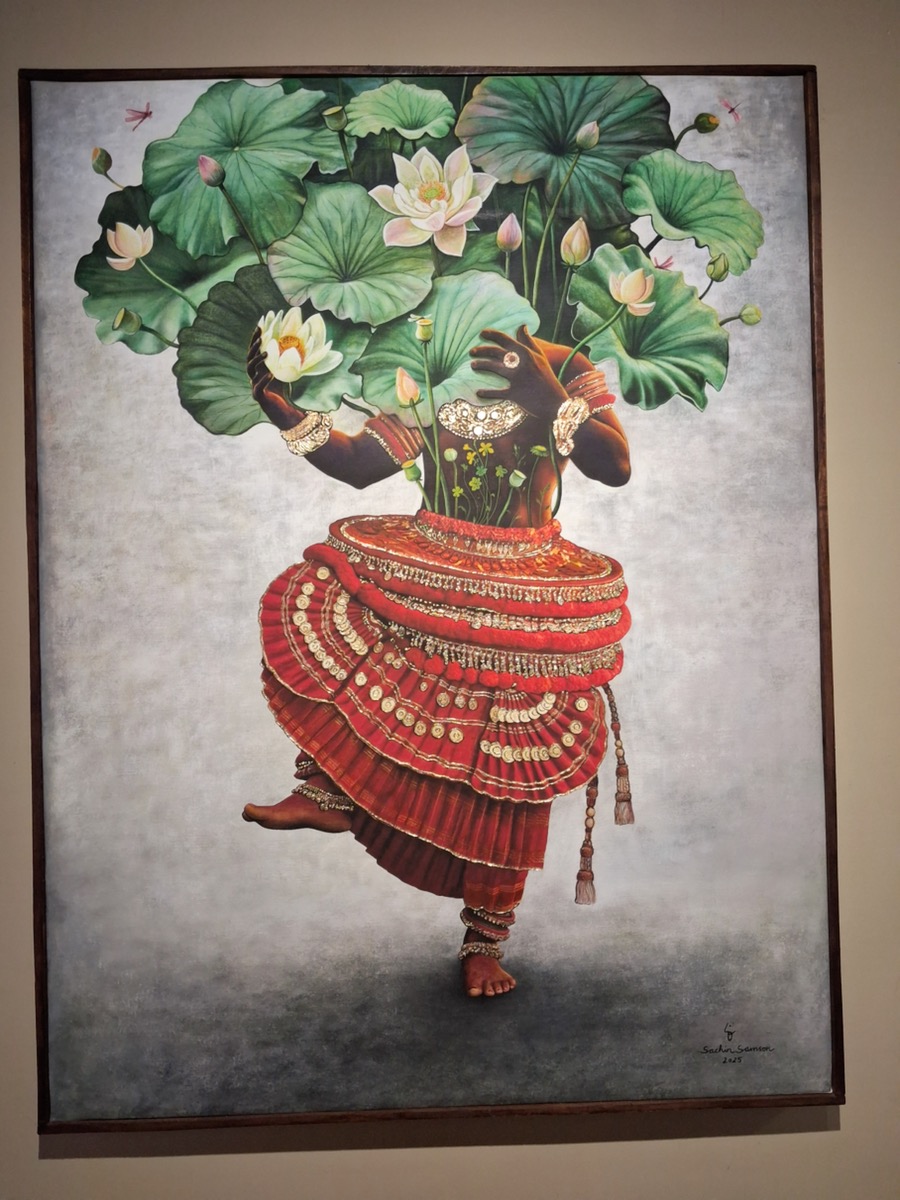
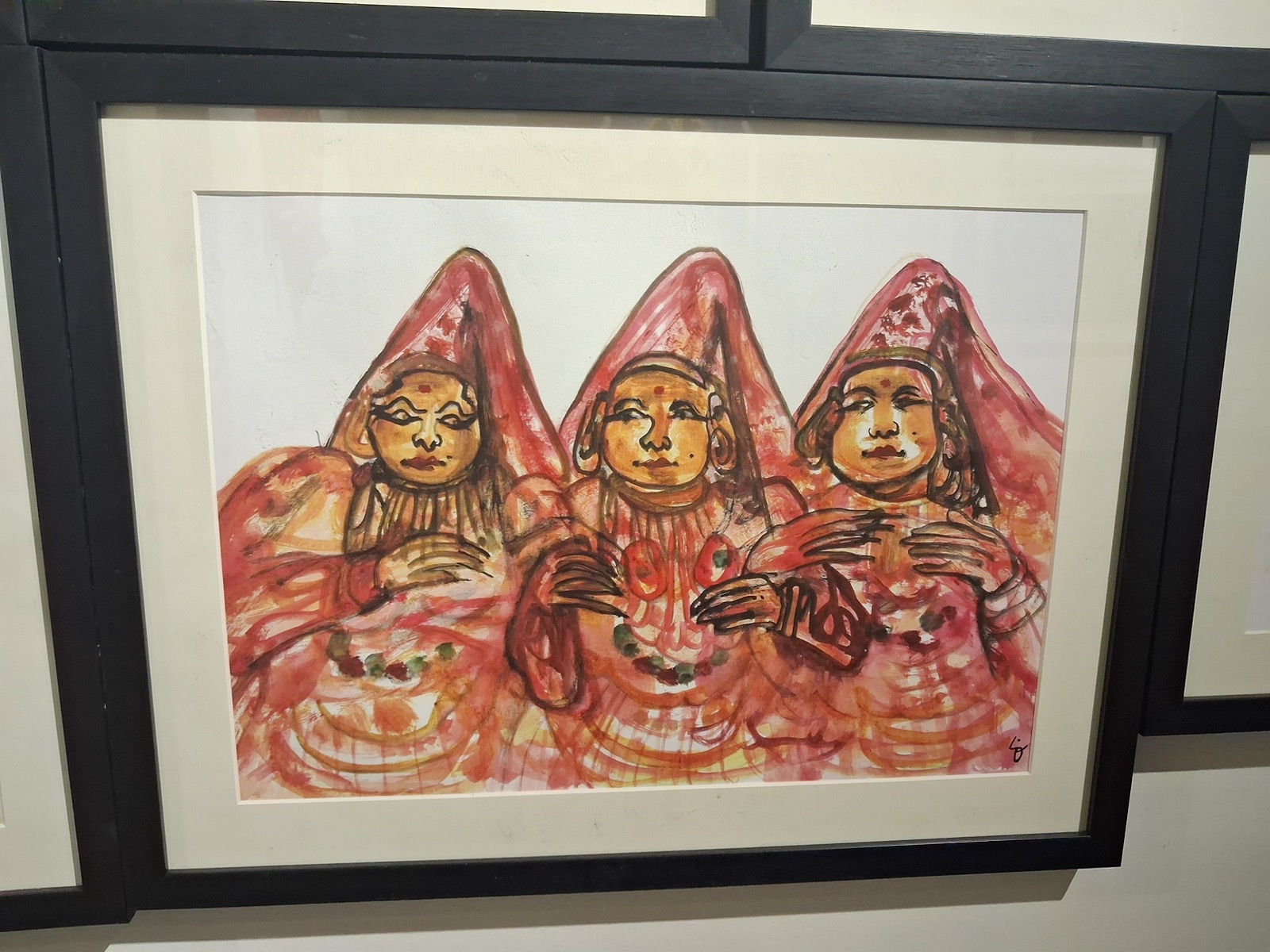
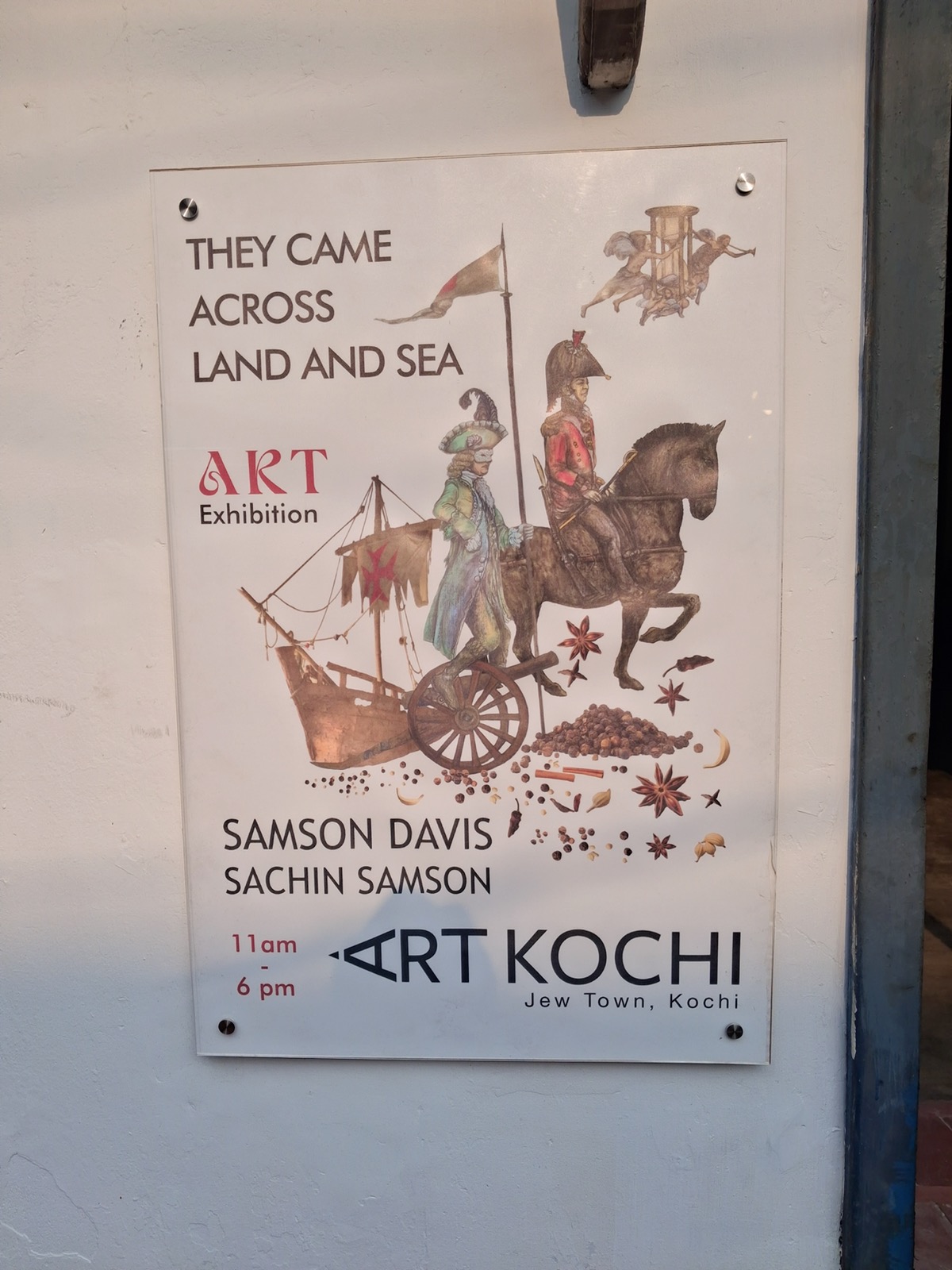
There was another exhibition right beside it. I thought it was another Biennale show. But it was not! It was a small, independent gallery (Art Kochi) showing a two-person show – ‘They came Across Land and Sea’, by Samson Davis and Sachin Samson. It caught my attention and pulled me in. As I entered, I saw something glinting on a wall right in front. It was a Kathakali dancer in motion, his dhoti glinting with gold highlights, his torso bursting forth with vegetation; half-man, half-plant – symbolizing both the cultural heritage and lush greenery of Kerala. This (standalone) portrait accompanied a whole series of watercolours on Kathakali performers. A gentleman standing nearby told me those were done live, while watching the performances. He was the father of the artist and the proprietor of the gallery. He took me upstairs to the first floor, where the show continued. With an installation of a ship, placed centrally in a huge room; and a wall mural that stretched in an L-shape, on two sides of it, on the left, which told the story of the colonialism that Kerala has experienced down the ages. As one entered, stained-glass windows looked out on the street below. Dappled light streamed in, the mellowness of the late afternoon sun tinting the room with a rosy hue. Experiencing that light in that quiet room was one of the most beautiful moments of my trip.
It was serendipitous that I should chance upon an exhibition portraying Kathakali dancers just before setting out to watch a Kathakali performance! My homestay had booked tickets for me beforehand. Hence, I didn’t have to stand in the serpentine queue in a narrow alley that led visitors from the street to the auditorium (on the first floor) of the house where it was performed. One had to walk quite a bit to get there. I was surprised to find a spacious hall upstairs after negotiating a cramped space on the ground.
The performance started at 6 pm, but one was allowed to go in and sit by 5 pm and watch the performers do their elaborate makeup. I had reached by 5 pm, when visitors had just started coming in and the hall was relatively empty (though the queue below was long). None of those who, like me, were well before time, were on their seats. They had all gathered in front of the stage, taking photos and videos of the prep. It reminded me of celebrities posting reels of their makeup before awards shows!
The artists on the stage seemed immune to all that intrusive gazing. But even as I thought so, it occurred to me that it was not intrusive at all – for the invitation to come by 5 pm was expressly to share the ‘process’ with the audience. I felt obliged to take a few photos, but my enthusiasm didn’t match those of the others – who were mostly white foreign tourists.
I took a quick nap instead and found that awfully refreshing. I could be immune to the presence of others, too, I realized!
I was feeling cold in that hall. Before the nap, I went down and requested for a stole. I got a fresh towel instead! Which I wrapped around me throughout (cursing myself for leaving a stole I’d been carrying in my homestay and thinking of my daughter, who always needs to be wrapped in one when she watches movies in the theatre). By the time I woke up from my nap, the hall was not only full, but overflowing – every seat on the floor I was in and the balcony above were occupied. There were some men from a TV channel crew who came to record that evening. They were shooed away from the middle, since that position obstructed the view of others. Without batting an eyelid, they instantly split in three different directions and got ready for the show. ‘That was cool’, I thought.
Finally, the performance began.
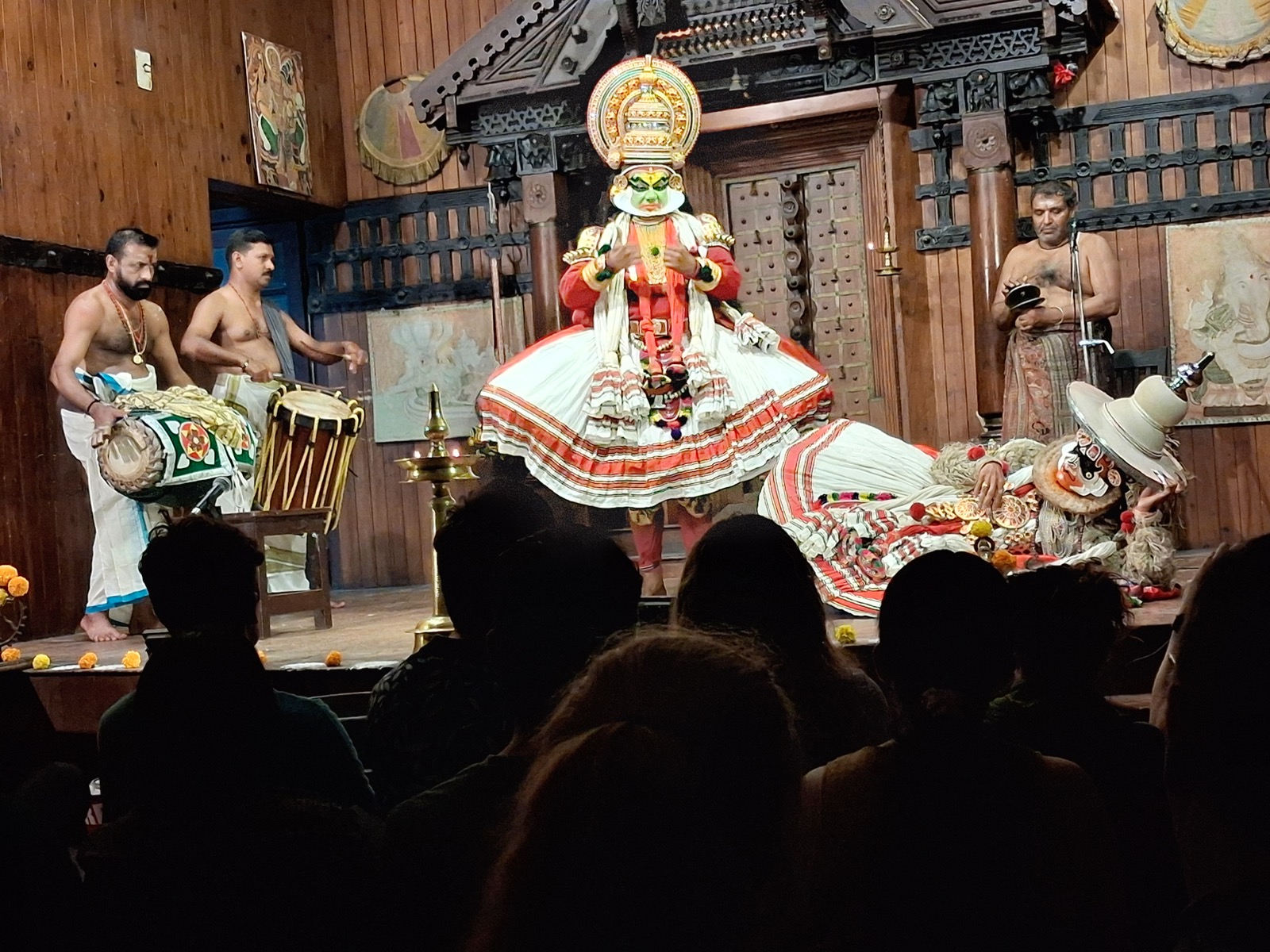
It was a well-known episode from the Mahabharata, from its Vana Parva (Book of the Forest), involving Draupadi, Bheema and Hanuman. For the uninitiated in the audience, there were handouts. This is how the story goes – Draupadi is enticed by the beauty and fragrance of the Saugandhika or Golden lotus and asks Bheema to fetch more for her. Bheema, ready to oblige, sets out in search of the flower, but is obstructed in his way by a frail old monkey, who refuses to budge and asks him to push his tail aside instead of moving away himself. Bheema thinks it’s child’s play, but to his great surprise, finds he simply cannot move the tail, even with both hands. The monkey then reveals himself to be Hanuman, who teaches the great Bheema a lesson in humility.
The two percussionists on stage played a musical prologue to this act, followed by a narrative introduction by the singer, with cymbals, after which the dancers appeared. Kathakali dancers wear huge puffed-up costumes and men play the parts of both men and women. In this act, the characters mostly came one by one and (except for a short while) were never more than two at a time on the stage. Most likely because there were already three other performers - the accompanists - standing on the stage throughout.
The most interactive part was when the dancer impersonating Draupadi was demonstrating the mudras and key expressions in this dance form, including the foundational nine emotions (navarasas) outlined in Natyashastra. While it was being narrated in a flat tone, it was being acted out by the dancer with an evident sense of humour. The audience was most engaged during this part, laughing loudly at the most humorous parts (the gestural enactments of “come here” and “go away”, which the dancer seemingly addressed directly to the audience). What followed - the actual dance - was very interesting and hushed the audience. It was remarkable how an episode from an Indian epic, acted out in elaborate costumes, in a language very few understood, could hold the attention of the audience for a considerable amount of time. And the audience, in this case, was overwhelmingly foreign.
There is not much physical movement of the body in Kathakali, compared to other Indian classical dance forms. Rather, the movement of eyes, facial expressions, and gestures of hands, are more important. All the three dancers were excellent in these. But I was actually more impressed with the percussionists, who prefaced the act and performed right through to the end – unlike the dancers, who came and went in episodic fashion. The narrator was the multi-tasker of the team – endowed with phenomenal energy – narrating, singing, playing cymbals and at one point, blowing a huge conch. He was also the make-up artist before the show. He announced three more performances for the evening (and a roster of all the other activities of his institution through the week). While we’d had our fill of Kathakali, their evening, it seemed, had just begun!
I had been careful to keep my day diverse and busy, so that I had no time to ponder on the ‘birthday’ part. It was my first birthday without my parents. For many years, I’d been used to not having my family with me, in person, on March 3 – accepting that as my default normal. But they were there, virtually. Calls, later video-calls, birthday card from my father, poems from my mother, bouquet and cake by courier from my sister filled the void of their physical distance. After my mother left us in 2016, birthdays were never the same again, even virtually. This year, nothing was left. Not even the voice of my father wishing me good health (he never wished anything else). While I kept that thought at bay, all through the day, it came crashing down at night as I had my dinner alone in a beautiful little café just a few yards from my homestay. I had a delicious sandwich with French fries and a salad, which I enjoyed far more than the biryani I had for lunch in a much-recommended restaurant. While I sipped my tea, I missed my sister’s couriered cake – the cake I would have had, had I been in Kolkata. I missed her consciously only then, though I’d thought of her while watching the Kathakali performance… had thought back to her Bharatnatyam classes at home in her school years, and the DD programs on Indian Classical Dance that we watched together.
I missed Baba terribly while having tea. Having tea was both obsession and sacred ritual for him. While the number of cups had reduced over the years, getting restricted to just two cups a day – morning and evening – to have it right remained important for him right till the very end. In the years after his retirement, he was given to making tea himself, and bemoaned being served by domestic staff after he fell ill and was confined at home. Nothing tasted like his tea, he would tell me. I remembered that and smiled to myself in that café. And then finally allowed tears to well up.
Baba’s death has left a profound desolation within me, different in nature from the one I felt when Ma was gone. I’m not sure when I’ll overcome this phase, whether I’ll overcome it ever. I carry his absence with me – wherever I am, wherever I go, whatever I may do. The tea that evening was one of the very few instances where I missed something specific about him. Otherwise, mostly, missing him is simply a gnawing emptiness within that defies description. Yes, I miss his voice – the way he called my name… and I miss his touch – the way he entwined his palms in mine, how I rested my head on his shoulder when I visited him. But mostly, it’s an unfathomable void within.
No one will ever love me like he did. I will have to live with this truth for the rest of my days.