
I was in search of the wild when I encountered Chalchala, literally let’s-go, a village that came on my way to Dhanaulti. Chalchala evoked the traveller in me: where could one go off his mind? And how far? Dhanaulti is a hamlet appealed for Surkanda Devi, an awoken Goddess in Uttarakhand, India. But more than that Dhanaulti is where rhododendron in late spring burnt the Himalayan slopes in luminous red. In Garhwal, pahadi people call them burans. It took me a while to realize burans and rhododendron were the same. Chalchala, Burans and Dhanaulti – all remained unknown to me until Ruskin Bond, on whom I was doing my doctoral research and befriended, told me about them. It was early 2015, when Dhanaulti’s faith in promoting eco-tourism had just emerged. My purpose to visit Dhanaulti, beside the suggestion and popularity, was however different.
On my way, I took a window seat in an inter-state bus and my fear of the steep valley, a little up on the mountain road, accelerated. When, after a two-hour journey, I finally reached Dhanaulti, it was mid-day. The sun was up. The sky took a clear contagious blue. It seemed to wipe out all other colours from the mountain-sky and I immediately felt restored.
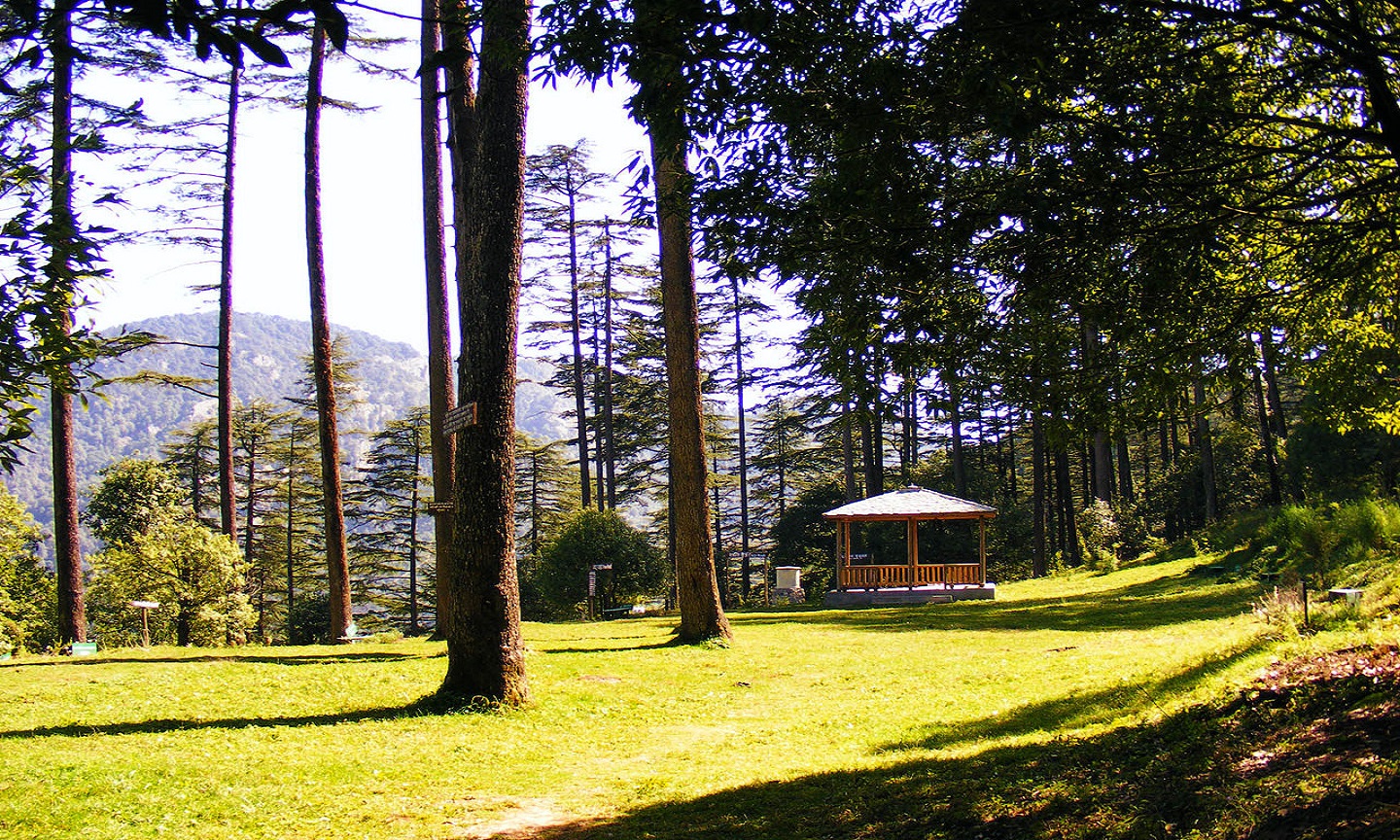
My travel was at a time when winter was turning into spring. I entered Amber, a wilderness-turned-ecological-park run by the Uttarakhand Forest Department. This cannot be a park, I said to myself, it cannot be a botanical garden. The information that it has emerged out of naturalness to help eco-tourism and to build human-nature affinity relaxed me. In Amber, the presence and dominance of deodar trees astonished me. Everything is built around them. They are clustered, as if in a solid-hold. They are together as a team looking down at us from their giant heights reaching almost upto two-hundred-feet. Deodar is from Sanskrit devdaru, meaning ‘tree of the gods’ or ‘divine tree.’ Botanically cedrus deodar, they take Christmas shape while it snows, white and luminous in light, infectious green in rain, mystical in fog. Deodar is native to the Himalayas, where people feel intimate in calling them as their own. In their entirety deodar can live up to one thousand years. That’s more than more than twelve human lives. The information that the oldest deodar in India is almost 1600 years old affirms that they hold more wisdom than the humans around them.
A little up and inside, the forest went deeply intimate, allied with the slopes of the Himalaya, non-digressed; hymning and blessing the hostile rocky surface. Everything around seemed to be at ease with the forest’s embodied existence. Trees enjoyed full liberty to be free here. Trees, I suppose, are the earliest inspiration to mountain climbers whose feet move up against the slippery floor directed by the promise of exhilaration of conquering terrains. Trees are literally down to earth. They are connected to the soil. When they dance, they dance with their feet stuck in soil. They respond to the throbbing womb of earth, confronting and embracing each other underneath the soil as a community. They are the holders; us the erasers. Trees are also the earliest detectives of soil-life. They dig to be saved by earth; dig to draw earth’s attention, or what is about earth; dig to find warmth; dig to be remembered. Before poets and meditators, they practiced self-digging.
I went there with a preoccupation that was alien to raw nature; this was what thrilled me most: a tantalizing paradox between refinedness and wildness. I took time and sat under a deodar, trying to be naturalized and earthed. Suddenly in a trance, I went into the deep interior of the woods – into its antar, inside. Antar is something that hides something from worldly affairs. ‘What does a tree conceal?’ I asked myself. Shyness? How does a tree behave when she is shy? Or afraid? Afraid to be left out? How does a forest look like if a tree is left out? Or when it gets cut or falls dead?
From where I sat, I sensed the forest’s immeasurable vastness. The forest is quiet about the accumulative knowledge the trees have gathered. When there is enough wind in deodars, a winged moment follows. The stunning barks, brown and soulful, are always alert and remembering. They remember how weather has lost its way up here; how wind sounds coalesce with birds’ chirping; how clouds wash and wet the dryness of leaves; how sun is mellowed by dense branches, generating thin sparkling shadows; how long grasses whisper the old memories of historiographers who camped and researched here.
A straight, fast sight into the trees reminds me of their dark untold recess. , The old-grown forest goes upward to the sky. Through their branches, the sun holds a rapturous pause. Who is the hearer here? Who is humming, echoing internal activity? Who is running along the emerald bouncy slopes until the distant end of valley? This denseness forms an endless dramatic floor, turning it to a personal ground to eye-travel. Its echo matches with the Zen gong: long hush. A voice so calm that it owns a distinctive expression. What is this voice? What does it carry? How much it owns what it owns? And what resilience it creates, I wonder.
I wonder at its support and exercise; its botanical conflict; its privation and disguise; its occasional disappearance into fog; its ancient faith in supporting white peaks; its exercise on air; its exploration on clouds’ contours; its gaze on rain; its curiosity for remote unfamiliarity; its trust on ground; its strength and pronouncement; its intense navigation of the surrounding; its geographical knowledge; its injury and vulnerability. All rushed over me as I climbed up its grass filled top. I was bitten by the spirit of the place.
I walked further through a thin-lined path, filled with buzzing insect sound and wild green smell. The forest’s trails, its lure, its capaciousness and conjuration, abrupt turns, lifted spirit, gusto – all sang together: What is intimacy other than seclusion! What is insight if not clearness! How shall we dabble in the mundane to find ecstasy? I wanted no answers now. I wanted this realized moment.
In Dhanaulti, tree-paths are shy because of the forest’s profound pause, which overwhelm and intensify one’s fear of the jungle. Though there is nothing to be afraid of. No leopard, no bear, no elephant, no visible threat. Fear arises from the less trodden green company – from the untraversed. Its telling effect galvanizes one’s total existence. I noticed myself as a witness, and felt a part of me doesn’t find enough scope to be revealed. In this deep suspension of man-made sounds, I encountered a human voice that appeared from behind. A bright young man called out as I stood facing a steep valley. I would have perhaps fallen given the proximity of the voice. Akash is an avid walker and searcher for old forest ways. Besides a resident scientist at Dehradun Forest Research Institute, his trust lies with the toil of travel on feet. Akash’s intention was to walk as long as he could feel his body-walk.
Akash has been trekking for last fifteen years since he was a school kid. His forest experience has taught him how to recognize pathways, ancient and abandoned, that are now disappearing. He has devoted his life in finding such pathways in Garhwal. For this, he follows his directional intuition. Sometimes he walks into remote areas where GPS service is unavailable. He has lost his way quite a few times, but his nautical sense was such that he always found the living through water resources. When he takes a direction he does it so emphatically that one takes it unhesitatingly even if it may be wrong, I got the feeling that this must be the most exciting way to feel ancient and wild.
Akash’s enchantment over how nature defies human encroachment by growing weeds and tumultuous plants was fascinating to see. His reason for walking manifests the human primordial tendency to keep the path open, to discover lost walkways and more curiously let them hidden as they are. This ecologically alert young man showed me how path-language could be studied.
Thin pathways, which might be called freeways by appearance, carry some delicate poetic messages. They are put in such a way that none could miss. One among them, I was personally invited to, intones how trees have a final say and carry the perception of forest: Trees are poems/that earth writes on earth, so wrote the Lebanese author Khalil Girban. Amber, as the reserved forest of Dhanaulti is called, is decorated with plenty of such poems, borrowed or written for a great purpose, to reveal the massive growth of trees and their intelligence; their embodied experience and vividness; interactions and touch; their creativity and curiosity; their memoir; their claim to stay on earth. What Amber was to the trees, I was to Akash, both accompanying our confidence.
Year on year, between earth and sky, there are trees, being the natural medium to sear up. They stand on the ground reminding the sense of being lifted. As I looked at them with filled eyes, the forest seemed absolute from both tangible and intangible aspects. Akash is one who cannot draw a line between life and forest. He told me of tree intelligence: how they feel, memorize, feel wounds, make decision, experience surrounding, and perhaps screams while thirsty. He added, ‘if we don’t humanize the forest how could we feel them? And without feeling how could we call ourselves human?’
Our camaraderie grew on mutual interest in Bibhutibhushan’s novel Aranyak (Of the Forest). I was drawn to Bibhutibhushan for two reasons. First Bibhutibhushan’s readership in translation is unwisely limited outside Bengal despite his bold universal appeal, and second, only a few considered him as a real travel writer despite his remarkable geographical perceptibility that he has proved in another classic Mountains of the Moon. Akash hasn’t read Aranyak but he knew of its availability in translation, and so he was eager to know the original feeling. A fair proposition in a multilingual country, where most of our mother tongues aren’t the same.
‘Bibhutibhushan,’ I begin my version of Aranyak to him, ‘is a poor but curious man. He went to a desolate aranya (forest) as an estate manager forced by economic crisis on personal level. He went into the forest of Purnia, located in Bihar, and was smitten by the wilderness. His travel continued for next four years before he had to return to city with an unrecoverable heart. When Bibhuti voyaged through the congregation of trees he was struck by the forest’s stillness and human scarcity. It is this stillness that, in the course of four years, would change his outlook towards civilization.’ Here Akash glared at me, condensing himself towards me. ‘Many micro narratives happened in between.’ Bibhuti’s negotiation and acceptance of the faraway, learning of horse riding, getting lost among poverty-ridden people, witnessing an immense drought and forest fire and a rage-filledsummer, and so on. There he would learn how a part of India survives with almost no eatable food, the coexistence of simplicity and evil, the administrative maneuvers despite being a writer, a life in the periphery whose existence is foreign to the concept of Bharatbarsha, amazement at moonlight, bewilderment at drought season, puzzlement in winter. Among all this, Bibhuti was attracted to and befriended a man whom people considered a madman. His only interest was to save the forest, and he dreamt to make it a reservoir by collecting different plant species from neighbouring places. With him Bibhuti too would dream of making it real. A few winters passed meanwhile and his initial uneasiness about his life in the woodland was now gone. He had been smitten by the forest once, but now it was replaced by amazement. He forgot how to behave like an estate manager, a highly ironical job in a writer’s life, when he felt more like a forester, a reservoir, an environmentalist.’
This is what pulled Akash into a spell. He was so far enchanted with John Muir and Edward Thomas. He had heard of Chandi Prasad Bhatt, the founder of Chiopko Movement. But never had he been so awestuck. He gave me all his time, wanted me to go on eternally. In the forest of Dhanaulti, I was speaking of a forester in Bihar to an environmentalist. The human bond with greenery is present everywhere, across borders, through time, I realised.
Akash enquired about the whereabouts of the ‘madman’ Bibhuti wrote about. His name was Jugalprasad, I told him, a man whose life was marked by neither fancy or whimsy. A profoundly sad life, never recognized, nevertheless he owned an almost divine quality to disregard his fortune. He was a man who never considered himself to be neglected, unrecognized, sad, although he has nothing and none has ever accepted him the way he is.
But I forget to tell Akash that the protagonist of Aranyak is Satyacharan, not Bibhuti. But this factual misplacement never altered the course of our story. Who is concerned with facts and temporality, when we are deeply moved by the meaning of existence? Who would limit their efforts on the surface when we find the inner gold? We, too, didn’t bother on facts; hence our discussion was as informal as is to be expected between two curious hearts who wanted to see though the other eye. Curiosity makes us scientists; the same curiosity makes us innate. Akash and I talked of this innateness, forgetting surfaces, outer layers.
When Akash listened to me, he looked into my eyes, and I looked away into the mysterious airy waves of deodars. I have always wanted to be a storyteller taking inspiration from them. Their experience on earth must be larger than ours. I feel I always need to note down whatever I felt they were trying to mean. Between what the deodars said and what I understood may have a long gap. That, too, may be fulfilled in a time when I will not be sitting here. The invisible wind inhales and exhales of deodars through generations. Their breath must be green. Inhaling the air would be green-breathing. I would be green. I would like these trees exhaling many unperceivable tales, and I would not regret.
We sat on a large fallen deodar – fallen but not dead, and thus remained uncut. It was one fine mystery I recently learnt. This giant tree-body lay on the ground as if hugging a lost friend, being smeared by the soil beneath it. They were each other secret sharers.
The fallen stump of deodar was little wet despite the sun. Did she overhear our conversation? Did she cry in joy in finding one possible bridge of communication?
Akash told me many secret things about plant life. He told me how forests are dependent upon mother trees and how these trees, as old as forest, want other small trees, which they consider their children, to be firmly rooted to the soil to avoid future calamity. He told me about the social life of plants, their easiness to live in a familiar community. But among everything, I was readily hooked when he told me about the secret life a dead tree. ‘A tree may survive five hundred years even after it is cut or destroyed from the surface of the ground. She is provided food through roots by neighboring trees, with whom she has already built a secret community underneath.’ Akash informed this was no recent phenomenon, this has been, as many researchers assume, the culture and within the life-ethics of plant nature.
Underworld. It must be a deep, dark land, full of mystery, where the secret communication of trees is kept hidden from humans.
Akash’s life-spirit, his penchant for story-telling, his geographical eye, his fascination for nature, his eagerness, his curiously, his wonder, his awe, his endless interest in others and his willingness to communicate makes him Satyacharan – the truth seeker. With him walks a forest. As I still looked at the invisible airy waves among the deodars, a thrill ran through me. I cannot fathom what I am noticing. I am noticing what I am not fully seeing, and would one day totally see. We are briefer than trees, as Akash said. We don’t know what trees know. We might have to wait our full life, or a few more generations, to know their bountiful dialogue, their elegy, their syntaxes, their moods, choices, stories, sleeps, consideration of existence. They have always been misunderstood.
My longing for distant places reposes in Dhanaulti, where weather calibrates the mind. Calmer thoughts rush to my head. Farness turns restorative. I am so full that I start to believe self is a place where we can hold much more than sites.