
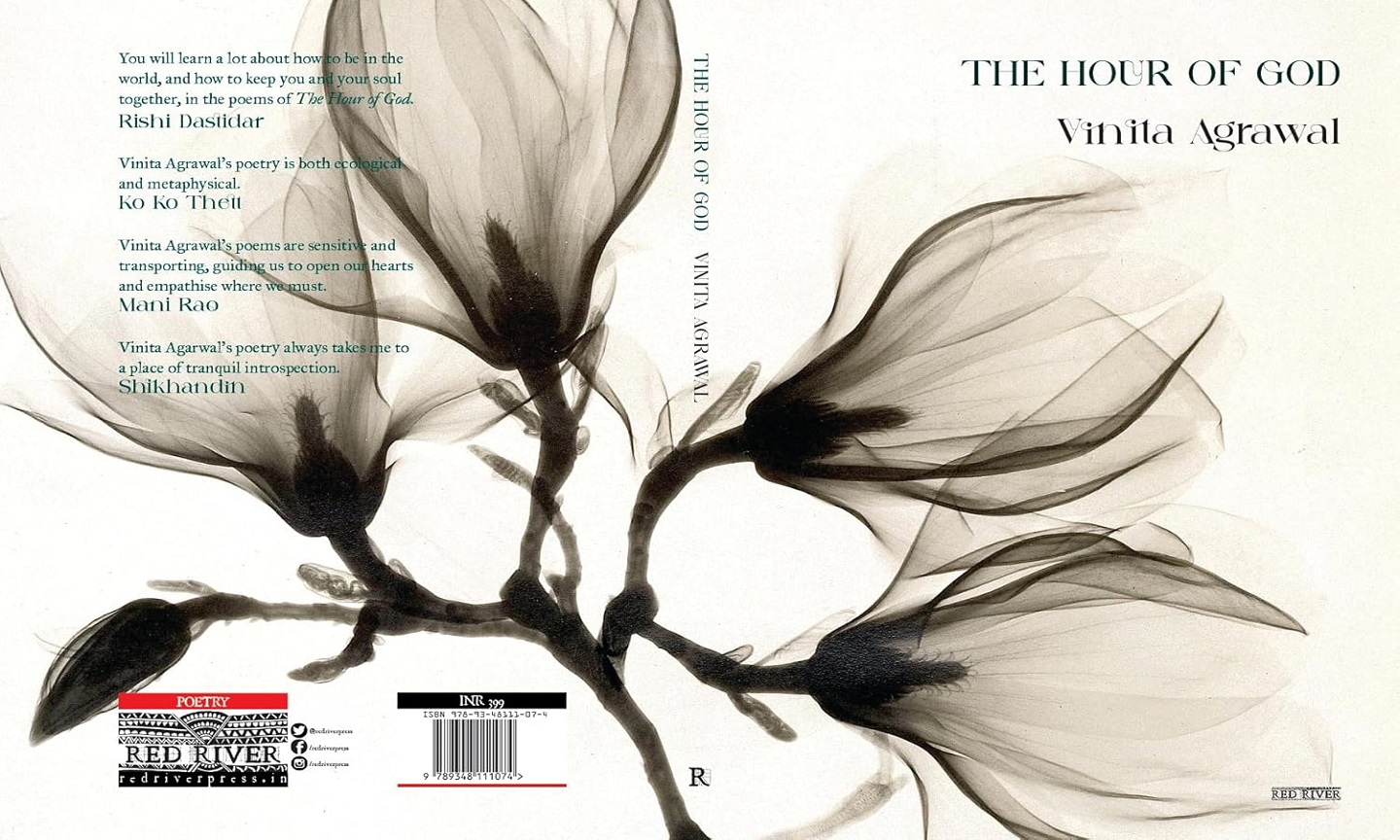
Book: The Hour of God
Writer: Vinita Agrawal
Publisher: Red River, 2026
Review by: Shabnam Mirchandani
The Hour of God by Vinita Agrawal is a thing of beauty. The visual allure of the cover is itself a meditation on the art of seeing. It features an x-ray image of magnolia blooms (Rijks Museum collection) weaving a floral sutra of sensual mystery—an ebullience of petals, like diaphanous hieroglyphs sketched on the pages of time.
The poems in this collection are a cartography of trails through the loam of existential wilderness. Vinita traces breath’s sojourn through earth’s body with the vibratory resonance of ancient mantras, an archive of human longing scripted into its invisible membranes. Like salt in tears, word crystals flow with trembling quietude as each page unfurls its message in baptismal ink. This alchemical covenant of poesy stems from a strangely holy abandon, where liberation of fugitive instincts enables her soul’s soaring choir to defy the ontological traps of consumerist modernity. Such is the inspirational trance that drives Vinita’s poetic inclination to part semantic veils and taste the feral lineage of silence. Vinita’s utterances then emerge fire-winged, out of subterranean grief. Riding flames of melancholic intensity, they cascade luminously in the form of emotionally charged epistles to the universe: a cadenced spectrum ignited by a mesmeric constellation of revelations. This mosaic of choice and chance, with its tortured witnessing of oppressive socio-political hegemonies, and its fractured spiritual light forms her praxis of radical healing through poeisis. As an eco-satva attuned to the archetypal matrix, Vinita channels her greenly fertile lyrical energy, drawing from the hermetic wisdom of creaturely minutiae, the sensorial caverns of memory’s dimly lit pathways, and the silken mysterium of the heart’s tender hope.
The collection opens with a tremulous memorial to an ancestral home where “the light is a blade of memory” and silence watches through a “pond’s blank eye” (Before the Ancestral Home). A self that is made pliable by suffering recalls the shock of a father’s loss and a mother’s last days, evoking the spirit’s claustrophobia induced by such reversals (Is that You, God?):
That night when I unlocked the door
to an empty house, when loss palpitated
in the dark rooms and the parchment of grief
cracked in every molecule of air,
you came disguised as a whiff of mother’s perfume, God.
A slow song of becoming unfolds, revealing a kinship cultivated not by self-referential positionality, but by a collective ministry of remembrance through epiphanic vibrations (Of Joys):
Gratitude is this: not the feast, but the crumbs,
not the symphony, but the hum
of a single string, plucked and trembling.
The patina of time holds in its muted echoes a soft pulp of awareness, which awakens Vinita’s intuitive sense of sedimented realities hinged to illuminative imagination (Conversation with a Seed):
But here, in this damp silk
of shaded afternoon,
we touch the quiet.
A seed’s eternal tempo is heard in the “rot’s warm sigh” as Vinita recognizes ancient wisdom sprouting from the hidden bowels of the soil (Undergrowth):
It is the patient braiding of potential,
filament by filament,
in the secret dark.
The dynamic between sound and silence in the poems feels to the reader like an amorous waltz through audible imagery, rich in synesthetic harmonies (Alchemy of Trees):
Beneath the sky’s endless breath
they stretch -
green tongues tasting sunlight,
drinking the fire that does not burn.
Moods echo through Vinita’s fluid lines, giving a luxuriant patina to the rhythms that anoint her thoughts. Wandering through liminal mists of memory, Vinita honors Jayanta Mahapatra: “…the roots are saying something / in a language older than sound” (How to Listen to Trees). She seeks anchorage in fleeting moments which carry biocosmic truths, such as a vignette of deer caught in the headlights’ glare, unperturbed in the mystic habitat of “rooted stillness” as they feed on grass (Homebound, Dusk). She confronts her own unmoored heart in a brooding meditation on cataclysmic discord, as she reflects on brokenness and suffering in a world fraught with conflict (Survival):
The air is thick with the unsaid,
the unasked, the forbidden arithmetic
of survival.
As a poet of visionary expansiveness, Vinita’s rhetorical dimensionality is exemplified in the composed grandeur of her provocative evocations. She seeks to decode the elemental opulence of starlight in every atom, the life-force in instinct, and the grand question/answer of luminosity as agency (The Light Phenomena):
Is the explosion of life
at conception, why we look for
something luminous to guide us
after death?
The radiant purity of omnidirectional light is rendered with semiotic power by Vinita, showing her deep understanding of shifting dialectical relations with natural phenomena. In a field usually governed by convention, subjectivity, or chance, she creates hypnotic juxtapositions to convey mystically real experiences (Beyond Body):
Usher your breath
Into a clean channel;
the flute of your spine
Watch the rainbow explode
Watch your soul bloom
A constant flowering, realm after realm.
Measured and grounded, yet probingly experimental, Vinita conducts a visual interplay between matter and energy and comes up with quantum optics that mesmerize in “moist flowers / woven from colored dew” (Dimensions). Vinita’s rich glow of expressivity is contained in stateliness and poise, even through the lush cascade of vivid reminiscences. The edge of the void is evoked with tactile detail (Phantoms of Portals):
Each curve and twist, artful as a historian’s quill,
hues of greens, staining the rhyme of time.
Language rises in sepulchral mists from silent palimpsests, a poignant reminder of what awaits us in the vault of collective memory (Haboob):
Amidst the sand dunes,
caterwauls of an old pain
rise like whorls of sound
from a singing bowl
Vinita’s aesthetic registers range from quiet music of sequined tongues to ominous beat of raven wings like semantic quicksilver - such is her artisanal virtuosity. Diasporic distances are covered in shadowy settings sculpted by light. This fluid improvisation prompts readerly agility which delights and challenges. It involves some neuronal diplomacy to to step into her vistas which wander through the shifting topography of ephemera (Comfort):
Disengage the shadow
from the self.
Watch it float away
Into a sea of blurred colours.
A wounded deer inspires an imagistic meditation on death, where Vinita confronts a visual nemesis, consigned to a vast star-spangled silence (Constellation deer):
I spot her in perfect silhouette,
in a cluster of stars
on the canvas of navy sky.
We employ all manner of intellectual reckoning in dealing with expiration, but there is no spiritual compensation to be had in such a sterile framing. It takes a splendidly curvilinear symphony arising from geological strata that gives us the arc of ancestral eloquence in its journey to a post-human stage (Effulgence):
Each star is a pentacle assuaging grief.
Life’s heaviness mutating to light.
A heavenly embrace of the flash
we were, for one stark moment in time.
As the Romanian sculptor Constantin Brancusi said, “Beauty is absolute equity.” The most radical celebrities that the aesthetic force of contemplation bring to us though these poems are gloriously verdant (Spring):
Seeds speaking
to the terracotta fragrance of soil
bursting into a language understood by all.
The hegemonic grip of hyper globalism and fossil fuel contamination of waters is poignantly referenced in birds struggling with the “heavy drape of slime” (Oil Spill). “Singing to water” signals a way out of the existential blackhole as “sound / unfurls its garden” (Aqua Botanica). A “lonely flower in the wild” becomes the ensouled intimation of spiritual emergence (Daisy).
The cultural aristocracy of today’s tech bros would be uncomfortable in the earthy salons of eco-warriors such as Vinita. Environmentally oriented poets perform a vital service, since their concern over biospheric urgencies, and a decline in civic health is carried in the sinew of their verses, reaching mainstream audiences that are aesthetically inclined. This tribe’s voice is the magma of creative ferment, simmering with beauty and potential (Fragile Lexicon):
Sun’s first light wrote on water,
the reed’s ink bled sideways,
clouds bartered their shapes,
the bridge forgot its math-
then the animals stepped forward
with their pockets full of dawn.
Vinita schools us in the art of reading through the physicality of bodily viscera. The travails of migrants, prisoners of ideological wars, exiles, rivers, birds, and family members are all addressed employing a range of senses that tap into lost presences, cultural ecologies, and voices. Naming is a way of dedicated witnessing, and Vinita does this with fierce fidelity by “picking out the full-stops / nailed to our voices” (Relic of Silence).
A scintillating glimpse of Vinita’s haptic flavors appears in evocative rhythmic resonances, as she beseeches the spirit of a legendary bard (Ballimaran, Delhi):
I make a wish to the full moon, Ghalib
Come share your pen, your ink with me Ghalib
The same shamanic tenor is found in Vinita’s veneration of a sage’s enlightenment when “Time paused and felt its own velvet” (The land of the Tathagata), and in her clarion call to a vendor from Kabul memorialized in Rabindranath Tagore's story to “Answer the plea / in those calico-cat eyes” (Kabuliwala Retold). Figures like Yashodhara and Draupadi who have been subsumed by myth, are embraced with empathy by Vinita as she taps into their audible silence, exposing the misogyny that gets glossed over in the dominant narratives about their situations. Birds as emissaries both mystical and real, take flight in an airborne consonance with this gyre of “unsung hymns” (Teach me, Bulbul).
In this age of the digital confessional whose emotional apex is a soundbite, it is intensely refreshing to experience imagistic phraseology that distills the poetic intensity of longing (Unholdable Love):
I have memorized the scripture
of your absence –
the way your laughter leaves
a bruise in the air
The fraught relationship of poetry and political strife yields a complex harvest of rhetorical activism these days. One often confronts bumper sticker shrillness when poetic gesture devolves into hysterical flexing of the populist muscle. Moral intuition then gets inexorably muted, and subtlety becomes a casualty. In the face of this anarchic proliferation, it is a spiritual imperative to preserve an imaginative infrastructure that nurtures affective literacy, honors ancestry, and values plurality of being. In this context, the vernacular of belonging is truly Vinita’s super power, as her poems emanate from her luminous interiority, and alight in a reader’s heart as a stirring tryst with the cosmic hum of en-chantment. Her expression is marked by a tempered urgency to address the raging angst of the contemporary zeitgeist, as well as an expansive poetic lens which allows for dreamscapes to manifest. The result is a unique kind of philosophical pantheism laced with a rewilding instinct, and the lavish radiance of deeply felt truths.
The final poem Guard the Hour of God is an aspirational aria to omni-essence, draped in the sacred mystique of pre-dawn stillness. Vinita speaks of this time as a “clearing,” an “aperture.” and a “truth.” She advocates protecting it “fiercely from the name “God” itself.” This stewardship of nature’s tantalizing portal implies an awareness of the dark as a meditative threshold into light-filled immensity. This subliminal motif of a seeker’s spiritual vocabulary is the signature of Vinita’s poetic personhood.
In conclusion, The Hour of God is a transformative readerly experience, compelling as a forcefield of tangled sojourns where there are no easy arrivals. The poet orbits valleys of inner stillness, and casts her far-reaching gaze at the vast abyss of history where absences speak in a collective blue sigh. Even while living, she seeks life with febrile intensity. This existential paradox defines much of Vinita Agrawal’s searingly creative journey through the tectonic ache of loss, as well as the passionate outreach towards a pro-active heaven.