
Fakir Ghosh Lane, in the Dunlop area of North Calcutta, was the home that housed Amma’s first kitchen. It was on the first floor of a large building. That kitchen had, till then, been one used by bachelors. It had the basic requirements for a kitchen and a Laxmi Deluxe gas stove with a gas connection, not a common feature in those days. The year was 1969 and this was Amma’s first proper acquaintance with a kitchen that she would have to manage and use. This was also her first foray into a different part of the country, to a city whose language and culture were completely unfamiliar to her. She often spoke of her first encounter with the kitchen and how she had to negotiate with it. More so because she had never tried her hand at cooking before. If there was something that characterised Amma in whatever she did, it was a quiet resolve. That stood her in good stead when she found herself in the city of Calcutta that would become home to her.
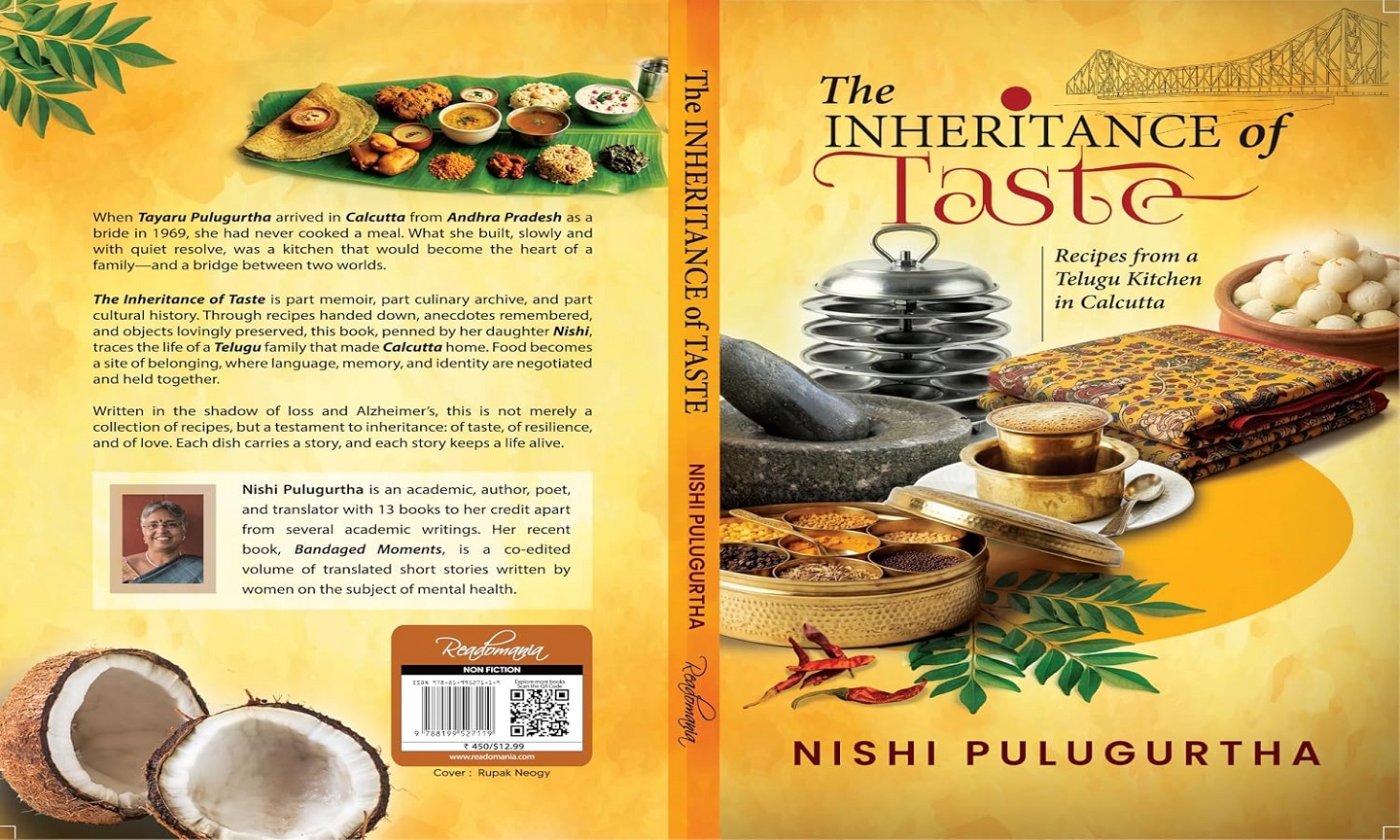
Amma, my mother, Tayaru Pulugurtha (nee Duriseti), got married in October 1969, she quit her job with the then Andhra Pradesh government and moved from Hyderabad, where she had been working, and relocated to Calcutta. There is one story that she always told us sisters—before she came to Calcutta, she never cooked. She began working at the age of 17. My maternal grandfather died very young, leaving behind his wife and their six children. Amma was the eldest. She got a job at the Treasury Office in Kakinada, Andhra Pradesh, her hometown. It was initially a temporary position, but then it soon became a permanent, full-time one. She joined evening college in Kakinada and took her B.A. degree. She then went on to do her Master's in History from Andhra University through the distance learning mode. It took her a much longer period to complete her Master's as she was transferred to Hyderabad. This was her first move to a new place. There, she stayed with her cousin for a while before moving into a Working Women’s Hostel. Amma loved watching films, and she often told us that it was in the new city that she got the chance to watch Hindi films. While she was working in Hyderabad, a colleague of hers brought a marriage proposal for her. He had been in touch with her family in Kakinada about it.
* * *
Appagaru, my father, Hari Pulugurtha (P. Srihari Rao), had been living outside the then undivided Andhra Pradesh for some years by then. He was born in Jeypore in the Koraput district of Western Orissa and lived in Visakhapatnam before moving to Bhubaneshwar and then Calcutta. Even when he was in Bhubaneshwar, he often came to Calcutta on work and liked the city. He was Secretary to the geneticist John Burdon Sanderson Haldane. After Haldane died, he did toy with the idea of relocating to Hyderabad and even Port Blair, spent some time in both places, but did not like them. Calcutta it was to be for him. He had met Prashanta Chandra Mahalonobis several times before, and once he was in the city, he was offered a job by the eminent statistician to join the Eka Press at the Indian Statistical Institute, Kolkata.
* * *
On her frequent trips back home to Kakinada, she began to learn more about recipes and ways and means to work her way through the kitchen in Calcutta. The inland letters from her mother had recipes too. It was this negotiation with the kitchen that led to her interest in reading recipes that appeared in English magazines that she got in Calcutta, and she started making cuttings of them. One magazine I remember her reading was Femina. She would keep these cuttings carefully in folders. Later on, Appagaru would get all of them bound into volumes. There were many such bound volumes of recipes that Amma had collected over the years. I recall her going back to these bound volumes and reading them. She consulted them to cook and read them at times, just for the sake of reading. On a trip to Kakinada, Amma got Malati Chandur’s Vantalu Pindi Vantalu, a Telugu cookbook that she regularly looked up. I also remember her buying cookbooks at the Kolkata Book Fair every year.
* * *
My sister and I became an integral part of Amma’s kitchen from a young age. She did not want us to struggle the way she had in the kitchen. So we learnt how to cook very early. All of us cooked at home. Appagaru made dinner as Amma would get home late from work. When we were able to cook, the mantle for rustling up dinner fell on the two of us. It was my sister, Usha, who was the faster learner and the better cook, too. She was the one who would experiment and create wonders. For me, it was more of a utilitarian thing at that point.
As the lockdown set in, in March 2020, a number of my friends started asking me for simple recipes that form a staple of Telugu cuisine—many of them were trying their hands at cooking. The lockdown had given many a whole lot of time on their hands. I started sharing recipes with them and heard their cooking stories. That was also the time when I started penning down recipes for this book. I also did something else along with this. I started writing about our life in Calcutta—the life of a family from Andhra Pradesh (then undivided) that had made Calcutta (now Kolkata) its home. Of the way in which food and culture are intertwined. Of the amalgamations and holding up that were a part of the lives of the Pulugurthas in Calcutta.
In February 2021, my mother bade us goodbye. Alzheimer’s Disease had made her a different person altogether. Her taste buds had changed completely. For someone who loved the tangy, hot things, she began to prefer sweeter dishes. Appagaru had passed away many years before her, in 2008. Their stories remain.
This volume is divided into sections. Each section has a brief description of the nature of the recipes that form part of the section. Each recipe is preceded by a personal anecdote, a memory drawn from the life of the Pulugurthas in Calcutta.
* * *
Pulusu is a kind of gravy, thinner than what a gravy would entail and is usually mixed with rice as part of a meal. One could also probably think of it as a soup or a stew. There are several varieties of pulusu. Tamarind forms an important aspect of the pulusu, except for the ones made using curd, where the sourness that characterises the pulusu comes from the curd.
Pesarappu Pulusu / Pulusu with Yellow Lentils
Pappu Pulusu / Pulusu with Pigeon Pea Lentils
Mukkala Pulusu / Pulusu with Vegetables
Bachhali Koora Majjiga Pulusu / Pulusu with Curd and Malabar Spinach
Anapkaya Majjiga Pulusu / Pulusu with Curd and Bottle Gourd
Popu Majjiga / Pulusu with Curd and tempering
Kakarakaya Pulusu / Pulusu with Curd and Bitter Gourd
Kobbarakaya Majjiga Pulusu / Pulusu with Curd and Coconut
Tothakoora Pulusu / Pulusu with Amaranth Leaves
Vankaya Pachhi Pulusu / Pulusu with Roasted Brinjal
It was so nice seeing young girls wearing a langa jaaket, also called a parkini, which was like a long skirt with a top to go with it. As children, on our visits to Kakinada, Amma got some for us. We wanted them since we saw our cousins wearing them. We wore them during our stay there. However, back in Calcutta, we did not wear them much. We even had Kaanjeevaram silk ones that Amma got for us on one of her trips to Hyderabad. Teenage girls wore what is called a half-saree, a langa, with a blouse (like the one worn with a saree) and a piece of cloth that is draped like the saree pallu. It was nice seeing girls wearing that dress. On my visits, I always wore my cousin Valli’s half saree when I felt like it. I never had a half saree of my own. I think I felt I would be out of place if I wore one in Calcutta.
PESARAPAPPU PULUSU / PULUSU WITH YELLOW LENTILS
Ingredients
150 g yellow split gram (Serves 3)
20 g of tamarind /1 teaspoon tamarind pulp
6 garlic cloves
¼ teaspoon cumin leaves
2 red chillies
½ teaspoon cooking oil
1 sprig of curry leaves
Salt to taste
Method
Soak the tamarind in a little water and leave it for about 30 minutes. Alternatively, one could use tamarind pulp as well. Cut each garlic pod into two.
Boil the yellow split gram in a pressure cooker
Take a frying pan. Add the oil. When the oil is hot, add the garlic and fry. As the garlic becomes brown, add cumin and red chillies broken into pieces too. Fry for a minute. Now add the boiled lentils and the tamarind pulp to it. Add salt and mix well. If the consistency is too thick, add some water and mix well. The consistency needs to be runny. Let this boil for about 10-15 minutes. Pulusu is ready. It is had with rice just like any dal.