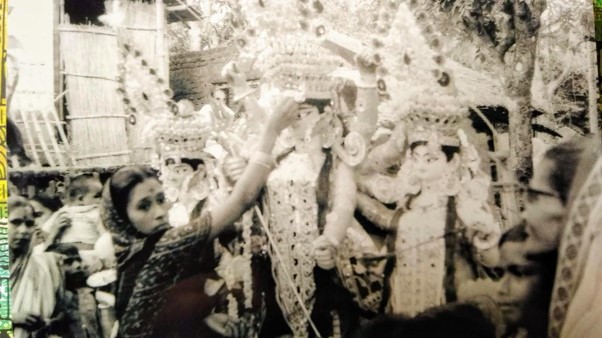
I have never climbed a tree. It’s best to say that I could not. Right from my childhood till I became an adult I never made friends with any tree. I should say there was no such friendship. I could not even ever say, ‘This is my tree.’ And yet at our Bally residence, there was a large money plant occupying a wall. When we ate ripe mangoes and tossed the pits into the tank that had been filled up with earth, how they would unfurl their green leaves during the monsoon, looking like tiny umbrellas. Dada and I used to think that the plants there would start bearing fruits as soon as they grew a bit. What fun it would be then! We would pluck mangoes and eat them and there would be no need to go to any shop. But no sooner had the monsoon ended than the sweeper, Ramsharan, would pull them out in order to clear up the space before Durga Puja1. Together with those, he would also take away the tiny jackfruit plant which had sprouted dark green-coloured leaves. The sprouting root of the palmyra seed kernel. The seedling of jamun2 that had sprouted tender leaves. They all seemed to vanish in front of our eyes even before one could make friends with them. Much after that, it was Gora Kaku who used to take away all these plants carefully. He never let them get destroyed by Ramsharan. After all, there were afforestation drives in neighbourhood after neighbourhood. As if it was a great festival. “Come, young guests, little saplings, into our midst / Partake of human affection and care, come, come to our home.” Reposing faith in Rabindranath, at the height of one monsoon, Gora Kaku and Gandhi Kaku got together and began planting saplings on both sides of the road. It was not at all the case that they alone did all the sapling planting. They involved all the kids in the neighbourhood. They brought so many kinds of plants from the forest department. Krishnachura, radhachura, jarul, and there was mango, jamun and jackfruit as well. We kept a sharp watch over Harikishan’s meek, helpless and yet know-it-all buffaloes. Over Bhola-da’s ever-hungry cows. There was nothing belonging to the people of the neighbourhood that they had not tried to taste. For that matter, they had eaten up Malati Mashi’s3 new Palmolive soap as well. Bini Pishi’s4 most mischievous two goats too were not to be left out. The moment they entered anyone’s house at any odd time, there was panic. Things vanished even before there was the sound of any outcry. All of them were warned fiercely before the tree planting commenced. That was like a fun job for us. The saplings were watered and bamboo laths were planted around them. From time to time, the soil at the base of the plant was dug a bit and cow dung was added as manure. If there was no rain for long, they were watered from above the protective barrier.
There were no CCTV cameras on the streets of neighbourhoods, like there are now. No one suspected anyone so much. If there were quarrels, they resolved it themselves. If someone lost something, everything joined together and found it. There were no loud notices on walls and hoardings, saying, “You are under CCTV surveillance.” Instead of cameras then, a few hundred eyes kept watch over each other. Like how elders kept a watch over the young. And in exactly the same way, young folk over the elders. And everyone collectively kept watch over the saplings. The outcome was tremendous. Within three or four years, the streets took on a green visage. At the end of spring and in summer, the krishnachura turned red. The jarul flowers rained down and filled the streets. Most noticeable was the guava tree. Poltu almost achieved the impossible. He counted how many guavas there were in the first tree that fruited. He used to write the number on the wall beside. As if it was his own tree. He counted everyday. He wrote the number each day. And each day there were two or three missing. The people of the neighbourhood had to put up with quite a bit of bickering in this regard. The situation was on the verge of turning into a regular brawl. The tree was bare even before the guavas were semi-ripe. And so, the famed guava from Kashi that had been obtained with much difficulty was finished even before it could turn red inside. In comparison, Bijoy Kaku’s jamrul5 tree was saved for a while. For one, it was on the bank of a pond, and besides, it was a marshy place. There was fear of snakes and suchlike. No one went very much to those parts without a second thought. So the tree had the leisure of going from flower to fruit.
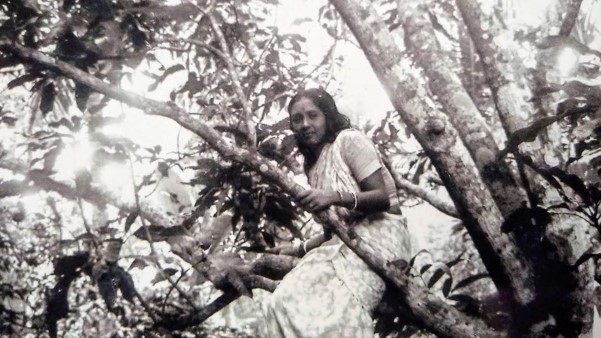
But then as soon as someone spotted it, everything was finished within a few days. It was as if locusts had come, laid the tree bare and gone. None of the screams of the master of the house and his curses and threats to cut down the tree could halt the kids who plucked the fruits. No one could change the manifesto, as it were, notwithstanding complaints to the Citizens’ Committee and making an uproar, as they gulped down one clay cup of tea after another. And so, just like Lenin on the wall always gazed solemnly at the cobweb, the owner of the jamrul tree used to storm out of the local youth association’s clubhouse with a grim face. Come the cyclical change of seasons, there was not the slightest change anywhere. Only the trees grew, and became bushier. The blooming flowers became even more beautiful. There was fruit. Nonetheless, even after all the commotion and uproar in the neighbourhood, neither Dada nor I really grew up with trees, in the way Ma had. She had roamed around from one branch to another like a bird. She had smeared the fragrance of trees on herself.
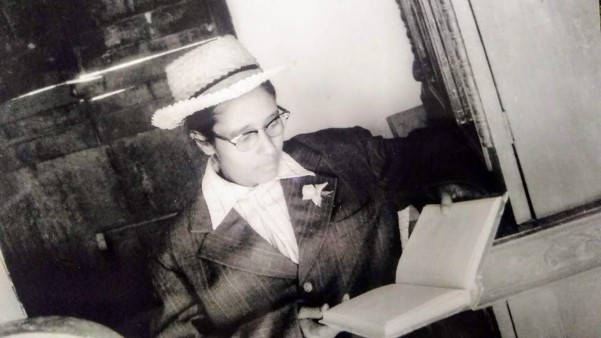
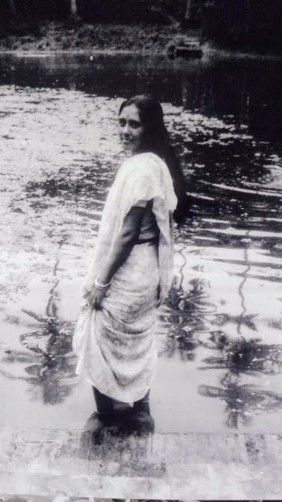
Swimming underwater in the pond. Climbing trees. Going with a lantern at dawn to forage mangos in the midst of a gale. Whenever we went to the village called Arbeliya, in North Twenty-four Parganas district, a different Ma was revealed to us. After all, that was our Mama’s6 house. A bit of space that she was fond of, where she could breathe. It was here that she was born. Both my Mamas too. It was to this remote village that Dida7 had come as a bride ages ago from the neighbourhood of the nawab’s palace in faraway Murshidabad. It was here that Dada8 and I had first witnessed how the wind made the field full of paddy ripple. How peas clung to our legs. Warm smoke rose from the surface of the pond in winter. The crow pheasant calling out, kub, kub. The woodpecker busy right from early morning pecking a tree trunk with a tuk tuk sound and making a hole. The early morning sunlight touched its colourful crest. It was as if the entire Sohoj Path9 lay scattered on the streets of the village.
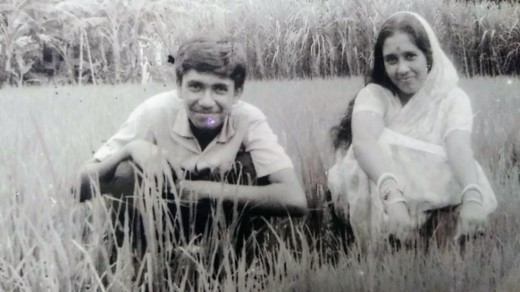
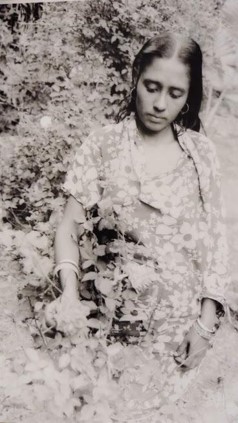
In its household affairs. And so, whenever I was asked to construct a sentence, I returned to my Mama’s house. I sit down beside Dida’s wood-fired stove. The aroma of hot, steaming rice wafts over my face. A wood-fired stove, a small stove resting on date-palm leaves, and a coal-fired stove – my Dida used to light all three and cook. And when it came to the cooking, there was such a variety that one could not keep a count. Where was her only daughter then? It was very difficult to find her. Perhaps she was sitting on a tree late in the summer morning. Gone to forage wood apples to the pavilion of Goddess Chandi under the canopy of wood apple trees. Or else she had sat down with her legs stretched out on the earthen veranda of a very old friend’s house to chatter. The Ma that Dada and I knew in the confines of the two rooms of our house in Bally – Ma was the complete opposite of that in Arbeliya. There was not the slightest smattering of the label of Robi Master’s wife on her when she was there. It was as if the hardship of so many people living in two small rooms suddenly vanished into nothingness at the whisper of a magic spell. The daughter-in-law of the Lahiri household used to become the little girl of the past and roam around the village all day and all night. Baba’s10 Yashica camera used to know a bit about all that. How would it become a story if it did not? And how would I too have known a different Ma of mine?
Every village had a different colour of its own. A fragrance. There are various ingredients to remembering that. Even now, when I look at the photographs, I feel as if I am lying in that village itself. The hazy sunlight has begun to peep through the gaps between the leaves. The drowsy melody of the non-stop chant of the Lord’s name through the eight watches of the day and night comes wafting from some faraway village. The mango, jamun and jackfruit trees are bent down, laden with fruits. Just beside the window. Attracted by the aroma of ripe fruits,wasps hover around making a buzzing sound. A parakeet calls out from the lichu11 tree,
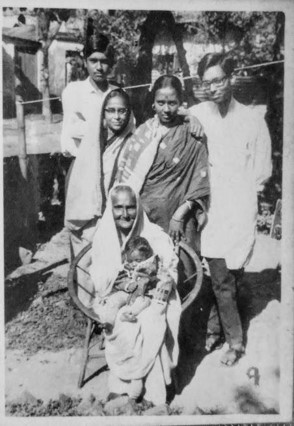
striking a sweet melody. The noise of buses, lorries and the marketplace of Grand Trunk Road is nowhere around me right now. There is no hurry to go to school. To bathe quickly. Eat. Only after coming to this village, Arbeliya, did I realise how joyful it was to lie quietly on one’s side. So the school’s summer and winter vacation meant insisting that we go to Mama’s house. And Mama’s house meant a whole lot of freedom. The square piece of sky in the Bally residence faded into the horizon once I was in Arbeliya.
Thamma12, Moni and Boro Ma13 were ousted from one country and they had to leave their homestead and come away to another country overnight, only with whatever they were wearing. They had to begin everything anew. Never had something like that happened to Ma. For that matter, not even to her ancestors. And so there wasn’t really any grief of being uprooted in Ma. Whatever was there was on account of leaving a large house and being stuck in two small rooms with so many people. I never heard her speak about that. Not even with all the scarcity, penury and inconvenience. But the older I become, the more I understand bit by bit. Like Baba, Ma too had to struggle hard to make this household stand on its feet. Or else would her habitual attire ever be as colourful as a mendicant’s patchwork robe? Studying first at Arbeliya Balika Vidyalaya14, and finishing her schooling at Gyanbikashini Uchchavidyalaya15, Ma then had to go to Basirhat to attend college. The whole state of West Bengal was on fire then. The girl attended college regularly even within that fiery situation. Travelling a considerable distance. Overcoming many obstacles. She observed how the people all around her were changing rapidly. The environment around her was changing. The language of expressing one’s opinions too. Whatever she had considered as ideals so long were shattering with a clatter, like fragile glass. The walls all around were clamorous with slogans. With demands for rights. Aiming for a change of times. Going for the first time to exercise her democratic right, meaning, to vote, she observed how even that got sold. The girl was astonished. A long time after that she had narrated small, scattered fragments of stories about those times of hers. A change came about somewhere along the way as regards the simple and straightforward way in which she had viewed life. Yet she never lost the touch of simplicity.
Ma had lost her father when she was very young. Three siblings had to grow up under their Thakuma and Ma. Clenching their teeth. In the midst of a lot of adversity. The family was not exactly well-off during those fractured times. ‘Didn’t you ever feel like doing a job?’ Sitting in front of the photographs after a long time, when I asked Ma that, she was silent. I know Ma wanted very much to take up a job. Quite a few of her friends from the village were getting trained in nursing then. Apparently, if one did a bit of studying and took an examination, you could get a nurse’s job in big public hospitals in Calcutta. Ma’s Pishe Moshay16 had found out about everything. He lived in the quarters of the Calcutta Port Trust in Majerhat. The only connection to speak of then between Arbeliya and Calcutta was this residence of Ma’s Pishi in Majerhat. The small quarters of those times in Majerhat seemed a lot like islands. There was a small garden with a fence in front of each one of the rows of houses. Verandas with red floors. A connoisseur’s cane-seat and table there. With a teapot and cups. As if you would think that someone had just finished a tea gathering and gone inside the house. Beyond the veranda and the garden was a broad road in front. There was a wide space at the rear of the house too. A hose was fitted to the mouth of the standpipe there to fill the large tank at the rear with water. Its gurgling sound made you think that a river was flowing somewhere nearby. Ma’s Pishi, that is, our Dida in Majerhat, used sandalwood soap. The whole house seemed to be suffused with the fragrance of sandalwood soap. Once the evening sunlight slanted diagonally over the banyan tree, darkness descended. When nice food was prepared on the Sunday holiday in all households, there was never really any bustle regarding cooking in this house. Because there was a musical soiree in the house that day. Someone used to bring a sarod, someone a tanpura, a set of tablas and a pakhwaj from the nearby houses. There was song and instrumental music right from morning. Dida and Pinaki Mama were accomplished singers. Their riyaz17 used to continue till late in the morning. The environs of the house somehow made it seem like it was the 25th of Boishakh18 that day. Once all this was over, the neighbourhood was quiet and still. Nothing was heard in the daytime other than the sound of the tank being filled with water and a train’s whistle from time to time. If one pricked one’s ears late at night, the horns of the ships at the dock could be heard every once in a while. It was this house and this neighbourhood which drew Ma as she prepared to leave the village and move to the city. Much after that, quite a few nostalgic memories from Dada’s and my childhood were scattered around this house in Majerhat. Coming to Calcutta from Bally meant going to Dida’s house in Majerhat. With Dada and me tucked into her waist-fold, Ma used to board the No. 54 bus from right in front of our residence in Bally. All one had to do to reach Majerhat was to alight in Howrah, go through the subway, and get into the Behala-bound mini-bus at the Calcutta bus-stand. After many years, when Dida was no longer around, with Mama having settled in Goa much earlier, and I wasn’t really in contact with anyone, I had suddenly got off the bus while crossing Majerhat bridge. I wanted to see the island of my childhood. As I was walking on the road, I realised that sometimes returning somewhere was not right at all. When the scenes that are preserved in the innermost recesses of the mind are ruined it is the mind that is most harmed.
Once Ma completed college, she did not waste any time whatsoever. She prepared herself mentally to go out to work. A few years before Ma was thinking about setting foot outside the
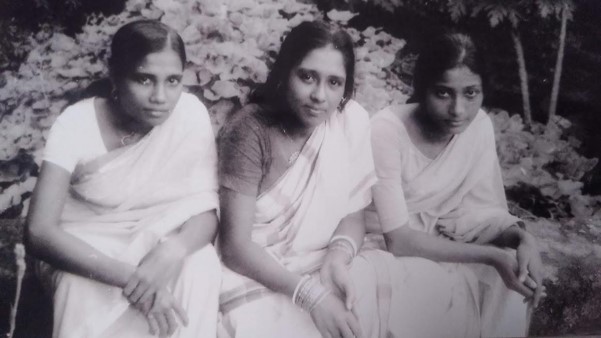
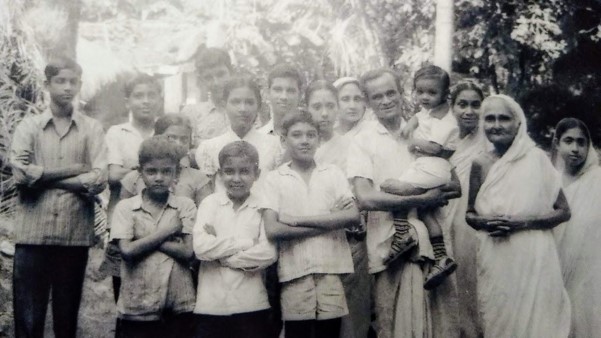
house, a girl named Neeta had already been giving tuitions all day in an attempt to cover up the gaping cracks caused by poverty and hardship in her family19. When her father fell ill a little later, the immense responsibility of the entire family fell on her shoulders. One day, after the family was standing on its own feet, when everyone’s work was done, we found that girl as someone unwanted in the outhouse. It seemed someone began singing, in a roundabout way, the songs of welcome and departure of Goddess Durga, ‘Aay go Uma kole loi, Come dear Uma, let me take you in my lap.’ At the very moment blood was gushing from the girl's mouth, her father arrived and told her to leave, ‘You’re redundant today ... they pity you, child ... they dream about building a first floor ... you needn’t stay today ...’ When Neeta is leaving the house and going away in the midst of a rainstorm in a terribly melodramatic lash of the whip that pierces through the screen, Ritwik Kumar Ghatak then sets the stage for the narrative, arranges the plate, bowl and glass, and stands with a whip in his hand in order to deliver a hard blow on the backs of Bengalis. Seeing such a grotesque, naked display of the deformity of humanity right before my eyes, did the thought of Ma not cross my mind even once? Of Tuku-di20? Moni? Thamma? Of thousands and thousands of such faces, whom I had never seen and yet who represented a time. For that matter, even now. There is a notion in
currency, which has become a matter of belief for many. That it was only girls from East Bengal who went out to work after having come across to this side21. And the girls of West Bengal remained quietly at home. That was not the case at all. Girls from West Bengal too had to go beyond the confines of the house in search of livelihood. They had to leave those they knew far behind and be among strangers. Leaving behind the orderly life of a village home for the grimy, soot-stained and squalid dreams of the city. Satyajit Ray completed his first film, Pather Panchali, in 1955, rendering a destitute family homeless, uprooted from their village, and stripped of their ancestral homestead. And Apu22? His situation was even more grave. In the city whose dreams had adorned his eyes like kohl, he eventually had to live in the attic of a mildewed house in a cramped slum. In Ghatak’s film Subarnarekha, Sita had to stay in a place where one night her own Dada arrived as a customer. Malati too, in Mrinal Sen’s Baishe Shrabon23, could not save herself. She ultimately had to pay the price for the dream she had nurtured, of raising a family with her husband, by sacrificing her own life. This final blow truly weaves a scarred and tattered nokshikantha (an embroidered quilt) over the everyday lives of Bengalis. They could never be like how they were before.
This twisting of the wick of the crisis of the ordinary Bengali middle-class lifestyle had, of course, seemingly begun much earlier. The fairy-tale narrative told to the people at the dawn of independence also seemed to crumble into dust. For that matter, even the first Five Year Plan could not really show the way to bring improvement in the lives of ordinary people in villages or cities. In the meantime, the decade of the nineteen sixties was overwhelmed by the food movement24 and some more battles. The Indo-China war, the Indo-Pak war, and the splitting of the Communist Party of India into two. Those who had been one’s ideals for so long, who the youth looked to as a means of survival – various questions began to arise among them regarding their modus operandi. The picture of independent India that people had drawn in their imagination, and nurtured for a long time seemed to face the prospect of collapse. And the more it collapsed, the more the unrest that was witnessed. One group raised questions about political awareness. They left to take up a completely new direction. The reflection of the severe jolt of Naxalbari occurred in the streets of Calcutta, in Purulia, Bankura, Durgapur, Asansol, Krishnanagar – almost everywhere. The villages were not excluded either. There was no food for everyone in the country that “abounded in wealth and blossoms25”. No employment. Finding even a bit of place to rest one’s body was uncertain. And so it became necessary for women to go out to work along with the men. But, after all, it was not possible to find work, or a job, at the drop of a hat. Examinations had to be taken. One had to go to the city. Ma too was getting ready bit by bit like many of her friends. She had to look after her family comprising her two small brothers, her Ma and her Thakuma. She wanted to do something so that it would help. But there were many obstacles even then to a girl from a household doing the job of a nurse. The male guardians who were the heads of the households did not like it at all. There was no way for the two helpless, destitute widows
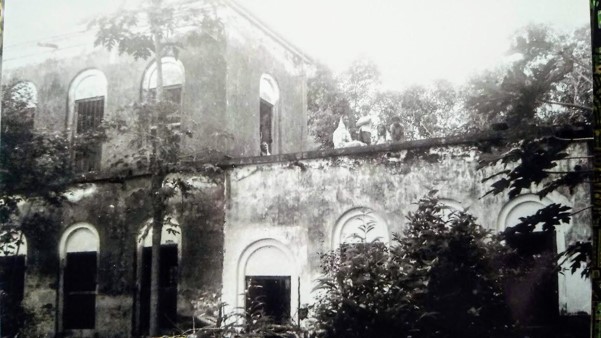
(my mother’s Thakuma and Ma) to disregard the opinions of those heads. And so the song of departure for Ma leaving Arbeliya rang out. The two-storeyed, long, spread-out house was left behind. The bank of the pond. The branches of the trees. Swimming underwater across the pond and back. Vast paddyfields. Fields of sugarcane. Betel-leaf plantations.
When, many years after all this, with eyes laden with sleep, I would enter this house, I would see a small field in front of the house. The pavilion of Goddess Chandi was on the left side of the field. An Annapurna Puja26 takes place annually there. Everyone in the family gathers there on the occasion of this puja. Wherever anyone is, they all come running. It is as if the house bustled and hummed for a few days. Like a fairground of joy. A net is cast in the pond and fish are caught. A cook is brought from outside and sweetmeats are prepared. My Mamas sometimes indulge their fondness for theatre and erect a pandal27 on the field and stage a play. Everyone in the village has a meal together. There is a lot of commotion and excitement. If you went past the Goddess Chandi pavilion and walked to the right side of the field, there was a veritable forest of jackfruit and lichu trees. Leaving that behind and advancing a bit, you came to the main entrance of the house. Going in through that and walking a few steps, there was the large kitchen on the right. A dug well. The external sitting room. A large courtyard in front. A rose bush in the courtyard. A shiuli tree. Hibiscus. A gardenia peeps into the window. Going up the three steps on the left side of the courtyard, you reached a long veranda. Rooms laid out in a row beside that. Past the rooms was the staircase leading to the first floor. A large hall of one’s dreams. A spacious terrace attached to that. A terrace surrounded by a shamiana of many, many trees. Walking further ahead along the courtyard of the house led you to the pond. The shadows of dusk had fallen on the pond. Crickets had begun chirping. Bidding farewell to everyone, my Ma, who had just completed college, was now leaving for Calcutta. To her Pishi’s house in Majerhat. The house where there was the constant sound of water gurgling. The horns of ships. The whistle of the train. In that house she would meet a boy who had roamed far and wide, from Khulna to Kolapota, Bally and Shibhati. A boy who was twelve years older than the girl. He takes a lot of photographs, chews paan, and teaches in a school. He has a large family at home. A family that he pulls along all by himself. The boy talks about himself in fragmented snatches of conversation – ‘The salary is very little. Do you feel like living in such hardship?’ I don’t know what reply Ma had given. One can’t hear everything. They have to be left loose. Like the holy water during tarpan28, that time slips away through the gaps between one’s fingers. The stories. The moments. A wave of joy washes over the boy’s tiny two-room residence on Grand Trunk Road. An auspicious event in the house after ages. A new person was going to enter the household after a long time. A poultice would cover the sorrows of people who had lost their homeland and homestead. An urge to build something new would awaken. Had Bismillah Khan’s shehnai played that day? It certainly did. Raag Todi. In teen taal.
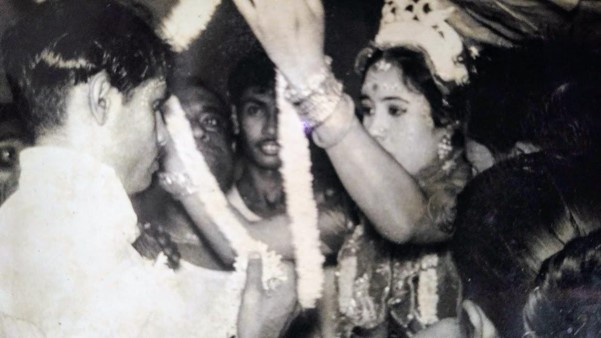
The two of them had exchanged garlands at dusk on the day of Buddha Purnima in May 1970. There were not very many people, nor any commotion or uproar. A few relatives and some friends were the witnesses of that event. There was another witness that day. The Yashica camera in a pinewood box that had lived with Baba for a long time.
The person I first learnt to recognise from the time I opened my eyes was my own Ma. But was that from the moment I was born, opened my eyes and saw the light of day? Or was it much earlier, as a foetus in her womb? Whatever Ma ate then was what we ate. When Ma was unwell, we too were unwell. We felt like laughing when Ma laughed. Crying, in sorrow. Merriment, in joy. After all, Ma’s body was our own body. One in blood, flesh, bone and marrow. After all, my blooming was from the body, which protected me from light and darkness, winter-summer-rains, hunger, sorrows and everything ever since I was born. Ever since I woke up. The body that I would thereafter be constantly destroying through my life. I would grow up. And on that cruel journey of growing up, two bodies would gradually separate. Two people would be separated. Two minds. After that the distance between the two people would grow despite living in the same place. Sometimes being a thousand miles away. That person had one day placed her nipple in my mouth with utmost tenderness when I screamed out in great hunger. The one who fed me as she narrated stories. She taught me what I should do, how I ought to walk, write, read and talk to others, all with utmost tenderness. The heat of the tragic sorrows she carried did not affect us very much. Or even if it did, we never mentioned it. Again and again, sitting quietly by the door, near the window, beside the phone, waiting a long time just to hear the call, ‘Ma.’ And yet the responses did not come, the way she had wanted or dreamt about. It’s true she never did a job. But she had pulled a family, that was being washed away, out of the water and raised it in her own fashion.
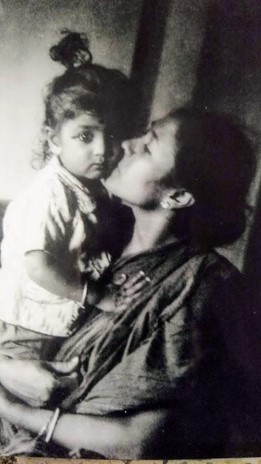
The person who I thought I knew very closely all my life – at the final moment, with the arrival of many unknown things, everything was turned upside-down. I did not know who I would genuflect and pray to for forgiveness. Everything remained elusive. Did the photographs I sat down with to fill that blank space provide any hint of a narrative? Was I at all successful in writing what I wanted to? Or did a person lie devastated right before my eyes, the one in whose company I find peace? Get the smell of trees. The tranquil, cool, shady bank of the pond. I was then staying up nights on the pretext of writing a different story. A paddyfield stretching to the horizon lay sleeping before me. A poem from my long lost childhood comes wafting from far away. My little Dada recites that tunefully. That melody meanders in an afternoon that has long since passed. To a jetty of memory that has turned grey. Encircling me. In a lost frame of the Yashica camera.