
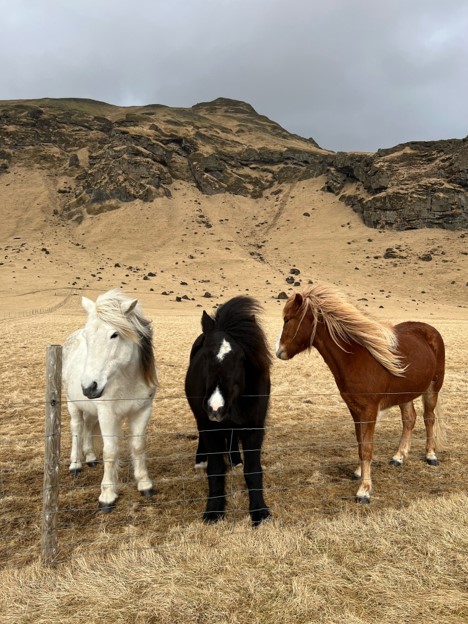
We cannot selectively numb emotions. When we numb the painful emotions, we also numb the positive emotions. - Ray Hunt
I was a student of horses for a time and I loved them deeply, but they also unnerved me.
Horses are unpredictable. Sometimes they shy and rear up at a paper bag skittering by in the wind. Or they may not even notice it. There is a biological reason for this. Horses do not possess a prefrontal cortex. They cannot decide what they want to do tomorrow. They can only live in today. They only know what you are projecting right now and are incapable of predicting what you are going to do at any other time. Horses use their shadowy memories to deduce, and those memories are like flashcards that they shuffle and discard. They cannot reason that the paper bag skittering across their path now will be harmless tomorrow or was innocuous yesterday. They only know the bag flying in front on them now exists.
Horses can recognize faces. They are adept at reading facial expressions, not just in each other but in us as well. They can read us. In fact, they can read two of us at once because each of their eyes can focus on a separate thing simultaneously and process that information. Their hide is so sensitive they can feel a fly, so sensitive they can feel the quickening of your heartbeat through your crotch when you are on their backs, thus enabling them to tell if you are nervous. Their sense of smell is as good as a dog’s and they are pack animals at heart, staying together and protecting the youngest, smallest and weakest at all times. One of them is always looking out.
But that is not what this is about. I’m going to tell you why I stopped riding.
It wasn’t the girl who got kicked in the jaw, forever altering her face, when she passed unthinkingly behind a horse we knew was volatile. He was young and we knew him to be almost always scared almost all of the time. Coldly, correctly, I believed this to be her own fault. We had been taught and told over and over again, put your hand on one flank and then the other as you pass. Let him know. Otherwise bad things might happen.
It wasn’t the girl who got thrown. Her horse stopped short and she went careening over his neck right into the bushes, breaking her wrist.
It wasn’t even getting thrown myself. The details escape me now, but I remember getting shakily to my feet in the ring, and silently berating myself for being so stupid. I did not break anything but I could have.
It wasn’t the monotony of dressage or the stupidity of putting their manes into intricate braids while their eyes seem to say, For fuck’s sake, what are you doing, child.
It wasn’t the constant work, hosing and brushing and shoveling mountains of steaming shit, even in the dead of winter, my fingers frozen and my nose burning. The work I liked. I liked washing them and scraping out their hooves. I liked petting them and chatting with them. But I hated seeing them in their stalls. It made my breath quicken and not in a good way. I hated putting a saddle on. And worse, the bit. Sorry, I would say. Sorry, I’m so sorry. I’d get side eye but then once I got on all would be forgotten and I’d have a great time, although a funny little tickle in my stomach would tell me my horse would probably rather be doing something else. Anything. I just happened to be the paper bag and my horse was in the moment. It bore me no ill will but also no love either. The tickle started to get worse the more I rode and the more shit I shoveled. The more time I spent with them in their barns, just hanging out and feeling their breath on the top of my head or letting them follow me around the corral, the less I wanted to ride them. I didn’t know how to articulate this feeling until many years later, when I had not ridden in over two decades, when I finally saw and understood them as how they should be.
My son and I went horseback riding in the hinterlands of Iceland, and we rode two very experienced and mellow horses. Icelandic horses differ from regular horses in that they have an extra gait. A fourth gait, somewhere between a canter and run. It is unique to their species. When you go to Iceland, it is expressly forbidden to bring any gear that may have touched a horse in any other part of the world. This is because Icelandic horses are not vaccinated. They don’t need to be. They have lived healthy and bacteria-free since the time before 900 AD, when they were brought by Viking settlers from Norway and the British Isles. Since 1882 foreign horses have been banned from entering the island and any Icelandic horse that is exported is forbidden to return, thus ensuring the purity and vigor of their species.
There has been the occasional mistake. According to local lore, sometime in the 1980s an Englishwoman brought her riding gear to Iceland and unknowingly infected an Icelandic horse, setting off an epidemic that killed hundreds of them. This is not entirely true, but in 2010, a respiratory epidemic borne of the Streptococcus zooepidemicus bacteria did indeed sicken hundreds of horses, infecting them with a raspy, hacking cough. It spread to dogs and cats, and even to several people. Few animals died but the offending material that kick-started the whole thing was, in fact, believed to be a piece of contaminated riding clothing brought from abroad.
Icelandic horses are fabulous. They are unlike any other horse in the world. They are furry, stocky and curvy, with wide, flat rumps and impossibly glorious cinematic heads of hair. They are gentle and curious. They will come right up to you, trotting across the frozen ground just to look you closely in the face. They are hearty and clever. They stand in a circle when they are in a herd, the youngest and oldest members in the middle, so the strongest can protect them from the wind. They are also fiercely opinionated, as we were soon to learn.
We rode through the tundra that blank grey afternoon, marveling at the lavascape before us, our guide explaining the terrain. Soon we were approached by a group of semi-feral young horses. Most horses there are semi-feral. They have no natural predators, they are revered and cherished by Icelanders, so they live a dreamy kind of fairytale life, wandering from barn to barn, hobnobbing, snacking, playing.
This group, they wanted to play. They started snorting and tossing their heads, nipping at the thick overalls we wore to shield us from the biting wind. We kept on. They followed. My son had only been on a horse once before and his elderly mare was moving slowly, choosing her steps wisely. But that funny group of teenage horses would not leave us alone. They started nickering. They pulled at my son’s coat. They made a racket. And in an instant, my son’s horse, previously easy-going and sweet, changed her mind about the proceedings. Clearly she felt the quickening of his heart rate and smelled the sweat beginning to form under his clothes. Rapidly she decided to abandon her duties of following the path and protect him instead. She took off like a shot towards the barn, faster than I have ever seen a horse that old move. She stood in the corner of the corral, my son still on her back, with a look on her face that said, I’m not moving, don’t even try me. It took us 20 minutes and four carrots before she would consent to bring him back. Even then she did so grudgingly, cutting the widest berth possible once we passed the young horses again, snorting and stamping her feet at them. My guide laughed and said she was protecting her young charge, because she plays with those horses every day. They are her friends. But in this moment, my son was her paper bag. She was reacting only to him because she was in the moment with him, incapable of being anywhere else.
The openness and goofiness of those Icelandic horses stuck with me. My son would get so frustrated; I was constantly pulling over to the side of the road to take pictures of them. At meals I’d stuff my pockets with apples and sugar and he’d roll his eyes and shake his head. Go feed your horses, Mom, he’d say.
But then, when I pulled the car over, we’d laugh and laugh. They amble right up to us. They’d puff and snort in our faces, totally unafraid. I loved seeing their square furry bodies silhouetted against the unpredictable Icelandic sky. I loved seeing them in their weird circles, or standing on a hill, like they were posing for a portrait. Mostly I loved seeing them stare right back at us from underneath their Barbie bangs.
My son was dozing in the passenger seat somewhere between Vik and Selfoss and I pulled over yet again to take a photo of a Charlie’s Angels trio — one red, one black, one white — in front of a mossy hill. I got back into the car. This is how you should be, I said aloud. You don’t belong to us. My son woke up when I closed the door. What did you say? he asked. Nothing, I said, staring after them. Nothing at all.