
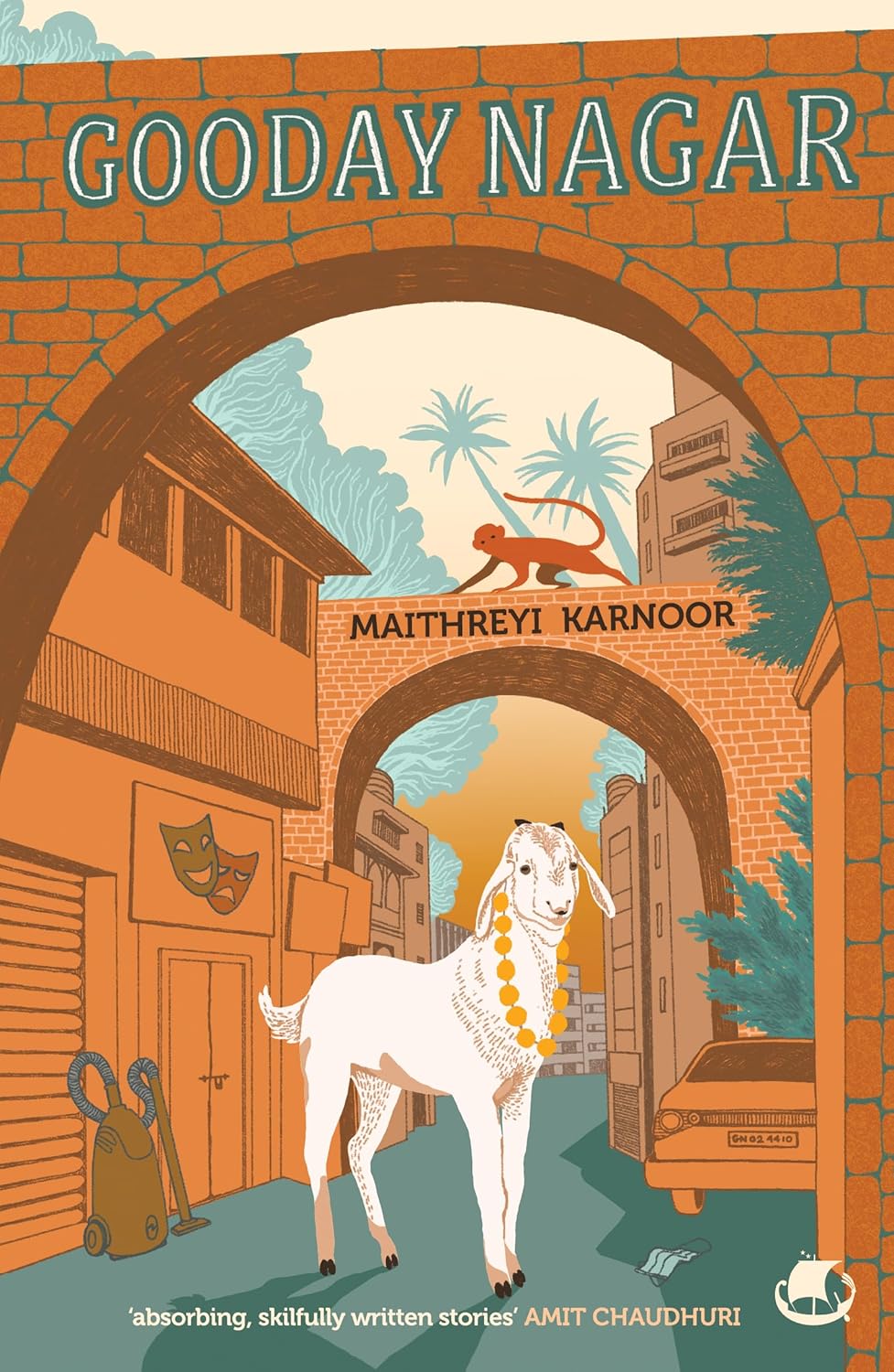
Book: Gooday Nagar
Writer: Maithreyi Karnoor
Genre: Fiction
Publisher: Tranquebar, 2026
Pages: 234
The odd cohort of a garlanded goat, an imposing monkey, a pert vacuum cleaner, as also, masks (both surgical and fancy-dress!), and the rear of a car welcomes the reader to the ramparts of a city whose exotic name (even by an Indian reader’s standards) awakens attention. Having read something of Maithreyi Karnoor before, one instinctively braces up, in most of her lines, for some linguistic punch or another. This remembered, the title is scanned carefully for probabilities.
With its clear use of ‘Nagar’ (even though the world of nomenclature had lain open before the book), one notices that it seeks to firmly establish itself in the Indian socio-cultural milieu. Gooday recalls a popular Indian biscuit brand by Britannia but more than that, it seems to recall contemporary India’s nationalist vision of ‘acche din’ or ‘good days’. Taking up the passionate writer-citizen’s patriotic duty of documenting these ‘good days’, Karnoor spins through ten bustling, unorthodox stories, an entire town called Gooday Nagar, bringing to her readers, with rather intricate and chucklesome reportage, varying portraits of a country caught between farmer suicides and the bullet train,
Gooday Nagar has full potential to be read as a kind of Malgudi (even the linguistic resonance in the names strikes a connection) but it does not stop there. Gooday Nagar is a shape-shifting locale. It is mohalla, village, town, province, mofussil and metropolis by turns. It can be experienced but not sampled; it can be lived in but not mapped. Within it can exist both proximity and anonymity, interference and distance, amity and rancour, memory and amnesia.
Gooday Nagar, in fact, does not set out to be taken for a real place on the map. It is sufficiently concrete to afford familiarity while also being sufficiently remote to defy identification. Like the cities in Italo Calvino’s Invisible Cities, it begins as a real place and does not end as one, morphing gradually from the certain to the uncertain. To use the writer’s own words from ‘The Bachelor of Artsy Fartsy’, the effect of Gooday Nagar on readers can be thus described: “The meaning teased them; when they thought they had grasped it, and the jigsaw of the story was forming a picture in their minds, it drew just out of reach and broke the image in their heads into nebulous abstracts.” Through story after story, Gooday Nagar continues its evasion of morphological scrutiny till it becomes an everywhere--the paragon of mundane suffocation and the dystopia of inevitability; in other words, a manifestation of civilisation on planet Earth.
Karnoor’s characteristic style as a writer lies in her irresistible wit, her itch for puns, and her sharp satire. Her language travels easily from the good old English children’s stories of the last century to postmodern speculative fiction in a world of Gen Z and AI on the one hand, and from pithy, humorous and light-hearted prose to densely poignant, poetic prose on the other. Through all its fluid shifts across moods, her language remains alert, sincere, full-throated, and ingenious in the way it relentlessly reflects upon and responds to itself.
The interweaving of the realistic and the fantastic is an essential aspect of Karnoor’s fictional universe, and while she effortlessly manages to make both meaningful, she is equally successful, when she wishes, in reducing both to utter absurdity. As one of her characters in ‘A Writing Competition’ states, “…reason is obsolete.” However, absurdity in Karnoor’s world, has a purpose of its own—it acts as a silhouette to reveal the absurdity and pointlessness of our own workaday world, reminding us of our own hypocrisies as well as our own divinity.
In ‘The Man Who Dreamt He Was Gobhi Manchurian’ for instance, the only reason that Puppy Kicker seems to come to his senses and attempt to make a life for himself is that he finds his love for writing being responded to condescendingly by Maitresse who he believes is none other than his new intern at work, Maithili Rao. For Puppy who seeks integrity and meaning in the world through art and ideas, self-respect matters less than respect for art. His interest in both writing and eroticism stem from the same curiosity and admiration for the wonder of art, and hence, Maitresse’s curt reference to his writing in her delayed response to him, robs her of all her mystique.
Similarly, in ‘The Bachelor of Artsy Fartsy’, the aspiring playwright Jayesh manages to write a whoppingly successful play and yet, has to give up playwrighting forever, choosing, on an impulse, to opt to make soan padi instead. While the pace, variety, events, characters, and intended inanity of narration make the story utterly hilarious, at the heart of the story lies a sombre truth—the lack of distinction between appearance and reality or what Yeats (in ‘The Second Coming’) describes as the best lacking all conviction and the worst being full of passionate intensity. Jayesh’s play which is intended to be gibberish appeals itself so much to the audience that when, as a part of the play, a fake audience protests against this gibberish, the real audience beats it up for protesting, bringing thereby, the play and Jayesh’s literary career to a standstill.
The depressed Jayesh recovers only when he accidentally opens a packet of soan papdi which is, by popular cultural consent, meant to remain unopened and simply exchange hands during Diwali. This disruption in the economic and cultural cycle of the country or in other words, the refusal to follow the herd, leaves Jayesh with an interesting business idea and that is how, in Gooday Nagar, for all its mediocrity and absurdity, sincerity and integrity remain well-rewarded.
If Karnoor can regale and overwhelm her readers with laughter, she can also, with little effort, usher them into the sublime zone between understanding and tears. In some of the most masterly stories of the collection like ‘Mapmaker, Mapmaker Make Me a Map’, ‘Ringa Ringa Roses’, ‘Uncity’ and ‘Ladies of Lore’, the carefully plotted narratives, deft characterisation, and the fine balance of pain and cheer offer a window into worlds that we often fail to see—the dread and determination of a poor girl inflicted by vitiligo, the trauma of a middle-aged wife whose lover-husband has betrayed her for a far younger woman, couples who realise that to be true and in love, they must be cities for each other unto themselves, and a family of thumri singers whose daughters inherit incompleteness as a legacy. As the stories in the collection grow deeper and darker, one realises that humour too, is an existential device to foster a sense of belonging in the world, for genuine humour can only arise out of mindful attention and it is in those moments of attention that one can lay claim upon a world which remains, otherwise, a stranger.
This is a book of stories as Indian as Indian can be, and in many distinct ways, it cannot help but remind us of Nissim Ezekiel’s poems in ‘Very Indian English’. The wit and instinctive understanding of the quirks of Indian culture that underlie Ezekiel’s character-portraits in his poems, loom large over the world of Gooday Nagar. Writing between countries and cultures gives Karnoor an effective grasp on realities that, in the eyes of the routine participating inhabitant, bleaches itself of all oddities. Here, one finds typical Indian middle-class parents eager to make a show of their children’s academic excellence in front of guests. There is the superstitious mother convinced that a random goat is a visiting guru and an equally rational child who argues that if the visiting goat could be a guru, so could the child himself. There is the Indian preoccupation with loud gossip, ritual, hypocritical hygiene, and home-cooked food; the friendly and not-so-friendly mother-daughter confrontations; and the open-minded search of young Indians for freedom, sincerity, and meaning in their lives.
Given the ideological weight of our times, it is refreshingly liberating to read a collection of stories sans -isms or agenda. Certain stories in the collection could have been compressed in the interests of the tight plot of the well-made story but all stories in the book remain remarkably well-told. There is not a single, dull moment in the collection, partly because of its vociferous variety, and partly also, because, the author seems to set out, chiefly, to offer a good time to her readers rather than to drive an idea or a theory home. If the measure of a good story is the joy that readers derive from it, and the promise they make to themselves of returning to it again, soon, Gooday Nagar wins hands down as a book which leaves the corridors of the heart ringing with a certain wisdom and a whole lot of mirth.