
[This article is the second of a two-part series, based on Lakshmi Gopal’s visit to the World Congress of Philosophy 2013 in Athens. You may read the first part, here.]
Of Canons, Cannons and World Cultures
The strong dominance of analytic and continental methodologies in academic discourse precludes genuine diversity and rigorous engagements with alternatives frames of thought.
Many philosophers have failed to consider that the current problem with philosophy might not be in its practice or its inability to live up to past ideals or singular scientific standards. Instead, it might be the restricted ideals themselves that are a cause of concern. These ideals stand as guardians to change and insist that there are only a few ways of doing philosophy and thinking philosophy that will be considered legitimate for the purposes of the academy. You cannot get a PhD in Philosophy today without a very specific kind of grounding in Western Analytic or Continental philosophy. You cannot think of issues outside the pre-conceived boxes provided by the philosophers of Europe’s crumbling and Imperial Epistemic Kingdom.
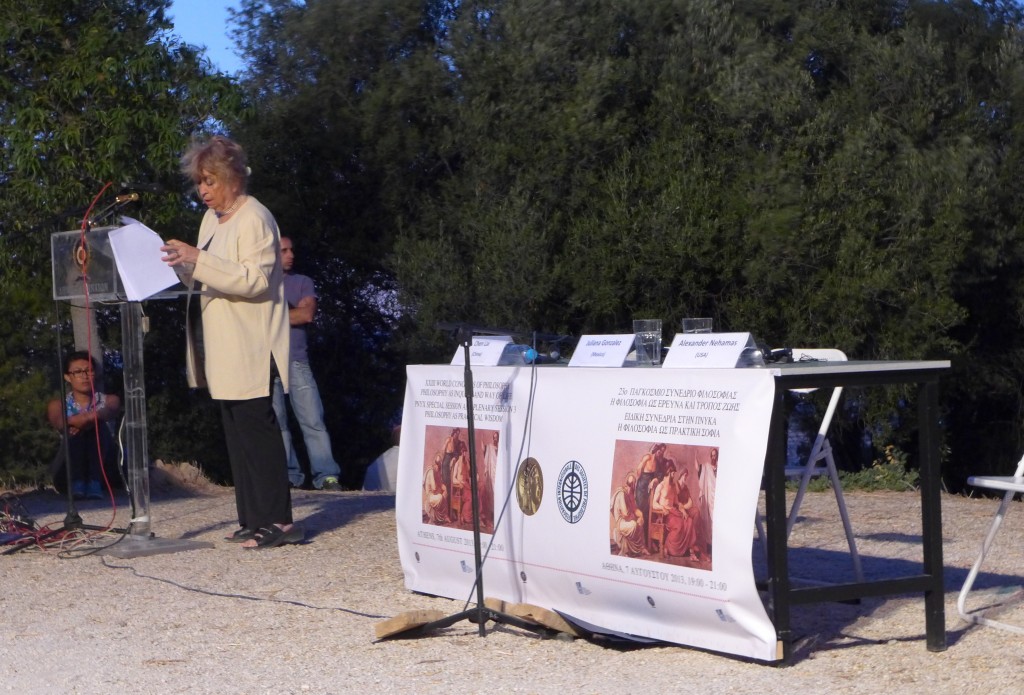
Session at the Pnyx
The Congress participants formed a diverse group across national and class lines. There were a small number of invited contributions made by African, Indian Chinese and Japanese origin scholars, as well as an encouraging number of women scholars. Still, the Congress’ most prominent and prestigious podiums were dominated by white Euro-American males. This was perhaps not only a reflection of an underlying Imperial hang-over that pervaded the Congress, but additionally a reflection on the current demographic crisis in academic philosophy.
The Congress presented a variety of papers on a broad range of topics, including papers presented by Jain and Buddhist monks, presentations on Advaita, the Bhagavad Gita, Lao Tsu, Confucius, and various Sufi traditions. However, few of these presentations managed to overcome the challenge of speaking in their own terms. Discussions were either forced within contemporary frames or pitted against them. While societies such as the Afro-Asian Philosophy Association were dominated by women philosophers, the topics discussed were limited to superficial surveys of over-studied materials. Particularly with regard to Indian philosophy, engagement remained superficial and limited to a range of topics that were popularized by Indologists and promoted through the presence of the British regime in India. Additionally troubling was that most papers on Indian philosophy stayed largely within the fold of caste-Hindu ideas.
The diversity of philosophical approaches at the Congress seemed like a blast from the past. The very same papers from India, China and Africa that were presented at the conference this year could have been presented thirty years ago with very little alterations–despite the fact that these very regions have changed more in the past three decades than they have perhaps in the last century. Additionally, each nation–or more appropriately each region with the exception of Europe and America, was represented by a very restricted sample of ideas. Notably, few of these ideas presented any real challenge to Euro-American frames. For example, Islam was represented, purely, by its Euro-America approved face: Sufism. India, to a similar vein was represented by Hindu thought. African debate also took part in Sufism and skirted the strong post-colonial critiques on persistent violence and interference in the continent’s affairs. Chinese scholars, present in full force, pontificated on the future of Marxism and communism and the importance of Confucius and Lao Tsu. Greek philosophers ruminated over Socrates, Plato and Aristotle.
The so-called diversity of the Congress made the world of human ideas seem small, suffocating and repetitive. Where were tribal ideas? Where was the Dalit perspective? What about Marcus Garvey, W.E.B DuBois, Malcolm X. Martin Luther King Jr. and the rich ideas about humanity that emerged from the struggles of African American communities in America and Europe? Where was the dissent? Where was the disagreement? One could argue that the call for civility chained demands for dissent. However, the complete void of any ideas that genuinely challenged either the west or western epistemic hegemony indicated that civility was merely an excuse to preserve the status quo.
Thus, though the Congress made claims of universality and plurality, and though it brought together a diversity of peoples and ideas, the contents and treatment of plurality, within the traditional homogeneity of academic philosophical discourse left much to be desired. Diversity was thus transformed into a dangerous form of tokenism. It is dangerous because here the token stands divorced from its original context and therefore stands to represent the whole of which it forms a mere part. For someone who is not acquainted with Indian philosophy, the highly limited palette of Indian ideas available at the conference would seem like a veritable smorgasbord. When caste-Hindu ideas become projected on the global stage as “Indian” ideas, divorced from alternatives and dissent, the call for diversity at the global sphere translates into the empowerment of hegemony at the local and the national sphere. For this reason, diversity itself must also be deeply interrogated.
If philosophy continues to embrace its traditional canon, it is unlikely to have a robust future. Nonetheless, even if philosophers embrace diversity and break down walls to allow the circulation of a broader set of ideas, the path remains arduous. Today, philosophers have the capacity to construct new and more inclusive epistemes. The work becomes harder than what has been done in the past because it demands creativity, craft, attention to detail and precise interdisciplinary expertise. Such global conferences offer a starting point for such hard work. However, unless attention is given to continuously broadening the debate (especially beyond participation on the quixotic terms of nationhood) then this attempt at the creation of a global community of philosophers could quickly dwindle into cliquishness.
This challenge does not mean, as McIntyre does, that the very existence of philosophy is under threat. This seems like a tall claim. Philosophy pre-existed its academic institutionalization. It persists and arguably, so long as human beings have use for systematic thought, will continue to persist. However, for all practical purposes, it has ceased to be housed in conventional philosophy departments. Instead, new ideas are being made in Gender Studies, Film Studies, Sociology, Anthropology and, as a noted legal scholar remarked in courtrooms and policy making forums. A myriad of other disciplines have developed thrived in the contemporary void of relevant and engaging philosophical discourse. Ironically, one could argue that philosophers are no longer at the cutting edge of philosophy. The natural question that arises then is: “Who is?” The most likely answer is no one, and this is where the threat to philosophical analysis lies–not in the disappearance of philosophy, but in the persistent practice of shoddy philosophical analysis.
Breaking the Philosopher’s Shell
The tendency towards introversion, of philosophy as a discipline and philosophers as a community, is exacerbated by the isolating structures of the modern academy, which has widened the chasm between the philosopher–self-imprisoned in the academic ivory tower, and hard ground realities of the conditions of human life beyond these walls.
In order to avert the current crisis, many conscientious philosophers have attempted to engage in interdisciplinary thinking. However, in most cases, instead of applying the strengths of philosophical analysis to the findings of other disciplines, philosophers have tended to adopt the conceptual ambiguity of other humanities disciplines. This has served to further dilute the perception of the worth of philosophy in other disciplines.
The Congress suffered greatly due to this trend. Like Habermas, several other speakers either presented a recycled narrative of borrowed ideas or seemed disconnect from broader contemporary debates–in most cases both. Dorothea Frede, an adjunct professor at the University of Berkely, California, presented a paper on “Aristotle on the Importance of Rules, Laws and Institutions.” Delivered at the historic site of Aristotle’s Lyceum, her presentation of the topic was reminiscent of a first year undergraduate philosophy lecture, and her knowledge of the discourse on rules, laws and institutions was superficial at best. Another paper presented at the same panel, “The Strengths and Challenges of Aristotle’s Ethics,” by Theodore Scaltsas, professor at the University of Edinburgh advanced an interesting (but often heard) thesis on the role psychology in ethics. The argument failed in its heavy reliance on the superficial presentation of well-used case-studies from experimental research in behavioral sciences.
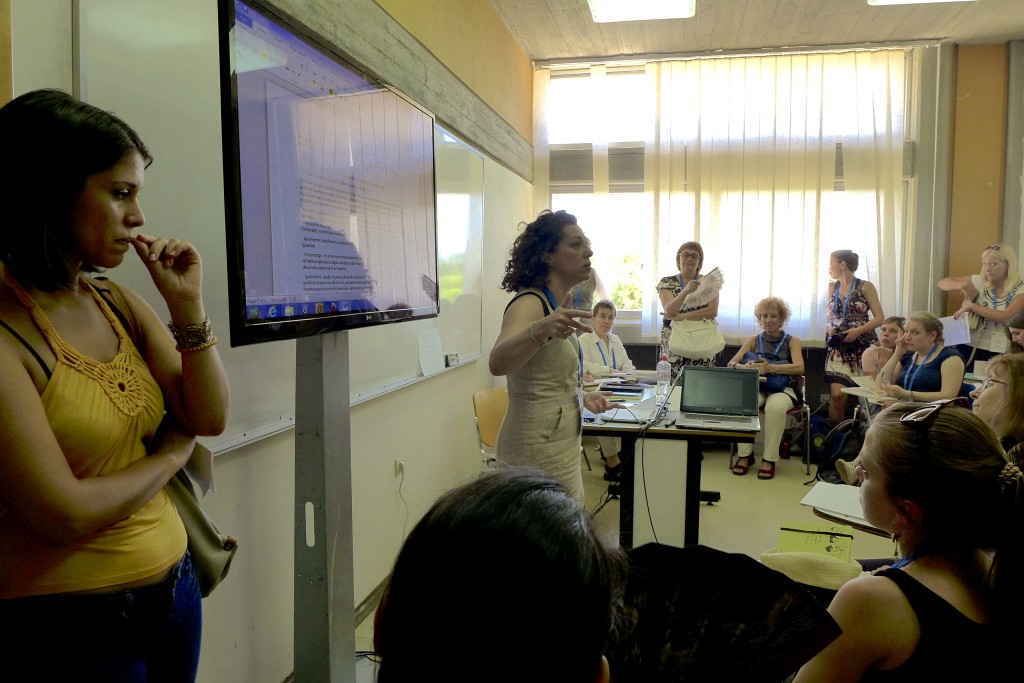
Session on Women in Philosophy
Again, as with Habermas, Scaltsas’ shallow engagement with disciplines beyond philosophy not only made the talk amateurish at best, but also signaled a dangerous cocktail of arrogance and ignorance that seems to be a hallmark of a large proportion of philosophical debates today. These discussions try to force together the two branches of the philosopher’s fork by propelling the same old canon into a new world. The outcome of this ill-fated experiment is, of course, null and void and partly responsible for the current malaise of the discipline.
Granted, expecting philosophers to possess specialized knowledge in every field that their enquiry touches upon is a stringent and likely impossible demand (thought not entirely unreasonable). Nonetheless, if philosophers choose to engage in other fields of discourse and borrow language from other disciplines and methodologies, without even the most basic understanding of the context in which these ideas function, not only will philosophical argumentation suffer, but it will be difficult, as McIntyre asserts, to expect non-philosophers to take philosophical methods seriously.
The central problem is this: While a methodological rigor and precision persists in philosophy departments, philosophy departments are largely disconnected from the the world–so their rigor is rarely tested against the constraints and boundaries of practical experience. The problem is not so much intertwined with either the practical utility of philosophical discourse or its contemporary relevance. Instead, it is related to the coherence and descriptive capacity/potential of philosophical ideas. Philosophy, in its current academic form is something of an anachronistic dinosaur. Philosophers are neither observing the world as it is today, nor are they undertaking careful analysis of the world as it was. They are simply circulating around a small bevy of privileged ideas, ad nauseum.
On the other hand, while the discourse in other fields of the humanities offer robust and dynamic engagements of issues of contemporary and historical human concern (at the social, individual and at times spiritual level) little attention is given to pinning down terms and describing and understanding fundamental concepts in a precise and rigorous manner. As a result, there is little clarity on the purport of the meaning and ontological context in which discussions take place. This lack of clarity has considerable consequences on the communication and exchange of ideas. The great advantage of philosophical precision is that people can communicate clearly with each other (verbally and/or otherwise). However, philosophers are speaking only to themselves (and within this sub-group largely only to those philosophers with whom they share agreement). Where there is precision, there is precious little engagement. Where there is engagement, there is no precision.
A Philosopher’s Crisis is Everyone’s Crisis
The lack of diversity amongst philosophers and within the philosophical canon, as well as the isolation and narrow focus of philosophical methodologies has resulted in a net loss of rigorous inquiry. As it turns out, the crisis in philosophy might actually be a criss for all disciplines, as much as it is a crisis for all peoples and societies.
As McDowell suggests, what philosophy offers the world that is irreplaceable is a variety of approaches to thinking and understanding. In its totality, across history and time, it offers people alternate means of considering almost every aspect of life. These approaches are constructed through a multiplicity of forms of argumentation, which include ontological positions, metaphysical and epistemic beliefs and much more. The central challenge for today’s philosopher is that the language of the contemporary academy remains unable to harness the potential of this diversity.
What events like the Congress contribute to the shaping philosophy’s future is uncertain as the Congress reflects the challenges of the discipline as much as it reflects the hidden opportunities. However, such mass meetings often give people the opportunity to examine the bigger picture and contemplate future possibilities in the face of current realities. If philosophers engage in this reflection, beyond cosmetic concerns, then the future of philosophy remains bright.
The path that academic philosophy takes will ultimately depend on the path of academic philosophers. Academic philosophers are at a fork in the road. Current understandings of Philosophy and the canons that support it have reduced the academy (and thereby the academic philosopher) to a locus of the guardianship of outdated ideas. There is a natural conflict between critical thinking and such defensive postures, genealogies and methodologies. If the traditional canon is saved, there is no doubt it will come at the cost of academic philosophy. If academic philosophy survives, its canon will be unrecognizably transformed in the next half century.
The series ends here.