
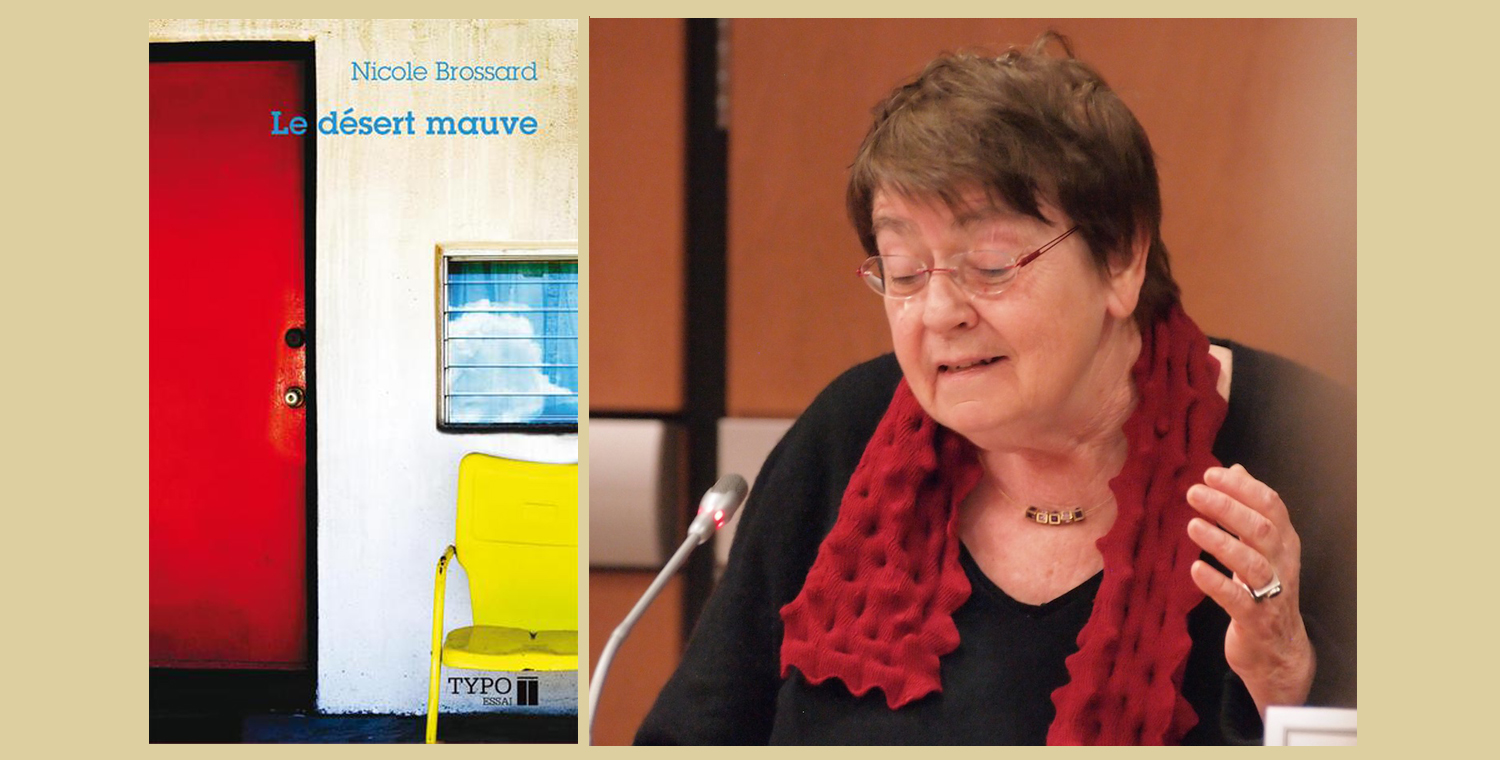
What then is the desert? …Earth, dust, a landscape without windows, without shelter. Observed land of silence, preexistent beauty, the desert is indescribable. (Brossard Mauve Desert 138)
…let her translate
my mouth, synapses spiral, in her service (Brossard Picture Theory 67)
The Feminist Imperative: Language and the Politics of Identity
Debates around the language of discourse and the discourse of language have been central to post-modern feminist politics. Irrespective of the heterogeneity of identity politics and the resulting specificities of feminist intervention, post-modern theories of the feminine acknowledge the role of language in and as representation. Language in feminist understanding is thus not just the currency to transact with/in social and cultural institutions (as is clearly understood in patriarchal contexts to a large extent) but a networking of discursive structures whereby institutions themselves are constituted.
Language is a pre/text to both alienate as well as uniformly whitewash differences between the two sexes constituted ideologically. Feminist critiques of language challenge the assumption that the two categorized sexes share a common language and identify language as a powerful patriarchal device for identification through categorization. Post-modern feminist discourses naturally spring from the vantage point of identity politics. In the context of categorization, language becomes interestingly at once, both an act of ‘labeling’, through which it creates labels (Identities) and the blurring of the act of labeling (a process of rendering certain identities, ‘non-identities’). For long, feminist politics has problematized this tradition of defining female/feminine aspects as either negation or total opposition of supposed male/masculine counterparts. Extending the phallogocentric polarity of man vs. woman (man as the species and woman as the feminine of the species), feminists have challenged juxta(op)positions that work towards identifying female/feminine as contradiction. Some ‘classical’ divides for feminist introspection have been: Culture/Nature, Day/Night, Rational/Emotional, Mind/Body, Intelligence/Intuition. In most instances, the first denominator is either privileged over the second or defines its ‘counterpart’ in direct opposition.
Gender marking and sexual differentiation on one hand heighten the arbitrariness of language and on the other foreclose interpretation by assigning arbitrary meanings that do not necessarily work the same way for the categories of men and women. While English assigns gender in terms of identifying the masculine as given and the feminine as an exception to or in the least, extension of the masculine, French as a language marks gender more overtly by assigning the mute E to the feminine. ‘Dog’ and ‘Bitch’ for instance do not bring the same connotations to an understanding of the masculine and feminine of the species. The species or group is without doubt understood and accepted to be Dog. The same instance applies to almost all generic categories. Without exception, the male of the species is the species. In the instance of Dog and Bitch, not only is gender differentiated as One and the Other, but sex is also implicitly qualified by traits that are more often than not ascribed through the sexual and mapped through the language of the body. Language that denotes gender also invariably connotes sex inscribed though notions of the male and female body. One of the basic premises for feminist discourses of language therefore is the discursive element of language – a process of signification that consistently establishes implicit cultural significations through explicit established signifiers.
Feminist recognition of what Cora Kaplan terms “the social nature of female identity” (54) in her essay Language and Gender reinforces the link between language and women. In what she terms “acquisition of subjectivity through language” (55), Kaplan underlines the paradox of feminist pre-occupation with identity whereby women should use the language of men, the very same set of devices that has disowned them and rendered them voiceless to reclaim identities. Language thus becomes the most central and critical question of a majority of feminist discourses as it connotes both a defiance of denial and an affirmation of feminist identities.
In Extracts from Man-made Language, Dale Spender terms language as “…both a creative and an inhibiting vehicle… we resist, fear and dread any modifications to the structures we have initially created… a language trap” (95). What Dale Spender calls resistance is often transcended in feminist theory by a strong advocacy for women’s writing. While language on the one hand, as Dale Spender puts it, is “already circumscribed” by itself to a certain extent (55), women’s writing has opened up possibilities for the feminine/female subject to contest established significations through language.
In their response to Dale Spender’s essay, Maria Black and Rosalind Coward emphasize that it is crucial for feminists to establish the distinction between language as system and language as discourse (101).Post-modern feminist writers and critics alike have challenged the primacy of language as system by responding to it and appropriating it as discourse. The foundations for a feminist discourse therefore lie in dismantling the notion of language as a ‘construct’ and working from the dynamic, fluid space of language as a process of ‘construction’ where so-called established realms of signification can be displaced for the emergence of women’s subjectivities.
Translation and the Discourse of Feminist Intervention in Nicole Brossard:
Language as a radical process of creating meanings as against a set of codes arranged to hold a mirror to so-called reality is central to most feminist discourses. Feminist practices around language have sought to trace how and why ideologies have been time and again constructed in language in terms of gender identification through sexual difference. The seemingly perpetual enactment of identities through ideologies, constantly understood by feminist linguists as naming, an attempt to re-establish rules already in place, is a continuous process of fixing meanings through re/presentation. Ideologies worldwide, including sexist discourses, are legitimized by re/presentation. What in other words is simply understood as ‘common knowledge’ is a set of ideologies made legitimate by covert processes where meanings become naturalized and normalized. Translation by virtue of its innate quality of be/coming, not be/ing is language in process, language that constantly eludes meaning and shifts from fixed understanding to discursive methods of making new meanings. Imbued with such multiplicity, translation, in lesbian feminist contexts, such as those of Brossard, lends itself to the dynamics of recreation of meanings, thereby re/presenting to break the imperatives of re/presentation.
Beginning with the idea that there can be no ‘actual’ experience in writing, and that writing is only a translation of experience, all writing amounts to translation. One set of linguistic tools (available to the author at the time of translating the ‘actual’, in effect, recalled experience) constitutes writing at a given point of time. Given the fact that so many or only as many linguistic tools were available to the ‘author’ at a given point of time, writing is never ‘original’ or ‘complete’. Feminist translation in the Brossardian oeuvre is a reciprocal project whereby the ‘feminist intertext’ (Harwood 62) deconstructs the linear hierarchical relationship between author and translator and makes way for a collaborative practice of ecriture au feminine (writing in the feminine). In a networking of negotiations with language, Nicole Brossard and translators of her works (chiefly from French to English) constitute a feminist collective which reiterates and re/in/scribes feminist identities in subversive acts that appropriate the classical patriarchal device of constant invocation to fix meanings.
Nicole Brossard is one of the most prominent avant-garde writers of Canada who emerged as a writer from the volatile nationalist movement of modernity in the aftermath of Quebec’s Quiet Revolution in the 1960s. In the throes of new-found motherhood, Brossard came out as lesbian which meant to her, writing not just her body, but a body in relation to women’s bodies. Brossard believes that the act of em/bodying oneself in language as a lesbian is also an act of bodying forth. Hence her writing on the one hand articulates the desire for women and her translations on the other take the desiring body forth into a collective attempt at reiterating woman. Feminist translations of Nicole Brossard not only derive from her writing, but feed into it. Translation becomes an act of departure from the ‘original’ to arrive at shared feminist negotiations with meaning.
Nicole Brossard is not only one of the most widely translated lesbian writers; her translations into English have opened up dynamic spaces for feminist translation theory. Translation is a conscious feminist act in Brossard, a creation of women’s space in writing that makes living in a woman’s skin, speaking from a woman’s tongue, an experience accessible to varied linguistic and cultural understandings. One of Brossard’s collection of poems titled French Kiss connotes the fluidity of Brossard’s texts in terms of the free libidinal space of writing and the melting of meanings. The process of translation becomes the act of touching a woman’s body, a sliding of meaning, a tasting of the grain of one’s experience as woman on another woman’s tongue. The process of writing in turn becomes the act of translating oneself as a woman and the act of translating, a process of writing oneself. To this effect, writing and translation are inextricably rendered into one process.
Feminist translation in Brossard, by virtue of being a feminist act is not just women translating women, but the act of women writing women. In Le Desert Mauve, Nicole Brossard pushes the frontiers of the translat/ability of experimental feminist writing by self-translating the first part of the book, symbolically and interestingly into the same language in the third part and subverts conventional notions of translation, displacing linear understandings of identity and experience. Furthermore, the two parts are interspersed by a series of pictures, a visual re/presentation of the character Longman who features in both versions of print on either side. Meanings literally get displaced on either side of patriarchy in this work which translates itself. Brossard captures the fluid nuances of the lesbian body in the arbitrariness of language that constantly deludes itself and has to be made sense of by a constant revoking of meanings through translation. Le Mauve Desert, later translated into Mauve Desert further renewed the cyclical process of writing as translation in a certain seamless rendering of translation into what Susanne de Lotbiniere-Harwood, the translator, terms as a “re-writing in the feminine” (Harwood 62). Mauve Desert in essence becomes a feminist work that evokes the power of translation to re/create meanings for women in four different texts which, to borrow an ideology from Erin Moure, “transelate” (Sheep’s Vigil by a Fervent Person: A Translation by Eirin Mouré) one another in the new found(ed) joy of lesbian identities.
Brossard’s Baroque de L’aube, translated with the title Baroque at Dawn finds Brossard donning her own character in the novel, bodying herself forth within the pages, uttering the guttural idea of the text as a process of voicing, writing and translating oneself in one’s own terms.
English translators of Brossard’s feminist works in French have sought to de/rivet sexist underpinnings of the English language while at the same time drawing attention to what is normally assumed to be the more sexist of the two languages, namely French. Susanne Harwood, for instance creates the word ‘auther’ (60) to underline the fact that she is translating a woman from the subjective position of a woman and the term ‘He-man language’ (112) to denote sexism in English which she believes is just as sexist as French, if only covertly so in its hidden constructions. Brossard herself appropriates a curious intermingling of English and French to create her idea of ‘the integral woman’, namely the ‘essentielle woman’ (The Aerial Letter 127). The binary opposition of source and translation is effectively crippled through such discursive acts where women translate each other to inscribe each other’s subjectivities. And translation effectually occurs in little acts of identification rather than in the workings of a different language.
Both Feminism and Translation are bi-lingual acts. The supposed ‘virtue’ of voicing one’s subjectivity as a woman in a man’s language is what essentially makes a feminist a translator. Feminists transact with ‘given’ patriarchal codes of language precisely in order to divorce the unhappy alliance with language that denies them the act of creating meaning as subjects with agency and voice. To break up established circuits of meaning, to disrupt phallogocentric acts of signification, to appropriate language to articulate identities that by default fall into the realms of the inarticulate, a feminist has to necessarily trans/act with language on her own terms. Feminists, whether theorists, activists or writers, are constantly giving voice to women’s subjectivities through a language that essentially gives them the agency to find their own meanings, communicate their own perceptions of reality. This entails using a language that is not essentially their own, but on their own terms, an act that comes closest to translation in terms of language. In being undefined translators, feminists come to be/ing – an understanding of their own subjectivities as women. In doing so, they change the very dynamics of translation, for in the act of translation as feminist, there is no source language and target language, no quint/essential author to please, to follow, to live up to. The act of be/ing feminist is a departure from the text in an attempt to move away from the ‘original’, not return to it as the point of reference. It is not a coming to be, but a be/coming, an arrival at the source of language as a negotiable text that is a departure from all ‘source’ texts.
Unlike most feminist linguists, writers and critics who fall back upon a linguistic feminist tradition that essentially looks at women’s engagement with phallogocentric discourse as problematic and fail to recognize it as a means of mediation, Québécoise feminist translators locate themselves with/in a feminist collective consciousness of negotiation with language that seeks to find agency within the process of articulation, not essentially in relation or with reference to the matrix of phallic signification.
Feminist translations of Brossard have succeeded in creating the dynamics of re-writing through translation (albeit in a different language) as a means of reinforcing new meanings that come from a collective feminist enterprise of shared understandings. Feminist translations of Nicole Brossard’s works emerge from and work towards establishing an understanding that feminist translation is a system of re/presentation of women capable of producing multiple possibilities for feminist identity.
That Nicole Brossard is one of the most widely read feminist writers in translation today is testimony to the far-reaching implications of feminist translation. Godard’s quote from Brossard’s journal entry sums up the promise of the Brossardian aesthetic of feminist translation as not just analysis, but intervention, a process far removed from that of the translator admiring the ‘original’ text from a ‘distant’ language, located either at the margins, or between the lines, or worse, lost in translation:
To be translated is to be the subject of an inquiry not only into what one believes oneself to be, but also in the way of thinking in a language, and the way we are thought by a language. What law, what morality, what landscape, what picture would come to my mind then? And who would I be in each of these languages? (Brossard 197)
Brossard’s Québécoise feminist translation practice thus signifies major breakthroughs in both translation practice and theory, areas defined and dominated primarily by patriarchal understanding. Brossard’s texts question the gendered and sexist positioning of women in language and sustain their feminist discourse through a collaborative practice of translation as reading and rewriting in the feminine. Further, by theorizing the feminist implications of women translating and being translated by women they articulate feminist questions of language within a larger, more inclusive rubric of plurality.
Works Cited
Brossard, Nicole.Baroque at Dawn. Trans. Patricia Claxton. Toronto: MClelland & Stewart, 1997. Print.
___. Baroque d’aube. Montreal: l’Hexagone, 1995. Print.
___. French Kiss or A Pang’s progress. Trans. Patricia Claxton. Toronto: Coach House Press, 1986. Print.
___. Le Desert Mauve. Quebec: Editions de l’Hexagone, 1987. Print.
___. Mauve Desert. Trans.Susanne de Lotbiniere-Harwood. Toronto: The Coach House Press, 1990. Print.
___. Picture Theory. Trans. Barbara Godard. Toronto: Geurnica, 2006. Print.
___. The Aerial Letter. Trans. Marlene Wildeman. Toronto: The Women’s Press, 1988. Print.
de Lotbiniere-Harwood, Susanne. Re-Belle et Infidele/The Body Bilingual: Translation as a Rewriting in the Feminine. Toronto: Women’s Press, 1991. Print.
Godard, Barbara. “The Translator as She: The Relationship Between Writer and Translator.” Feminine: women and words/les femmes et les mots – Conference Proceedings. Longsppon Press, 1983. 196-197. Print.
Kaplan, Cora. “Language and Gender. The Feminist Critique of Language: A Reader. Ed. Deborah Cameron. 2nd ed. London &NY: Routledge, 1998. 54-55. Print.
Maria Black and Rosalind Coward. “Linguistic, Social and Sexual Relations: A Review of Dale Spender’s Man Made Language.” The Feminist Critique of Language: A Reader. Ed. Deborah Cameron. 2nd ed. London &NY: Routledge, 1998.101. Print.
Mouré, Eirin, and Alberto Caeiro. Sheep’s Vigil by a Fervent Person: A Transelation by Eirin Mouré. Toronto: House of Anansi, 2001. Print.
Photography Courtesy: Pearl Pirie (pesbo on flickr) © Some Rights Reserved