
1. Introduction
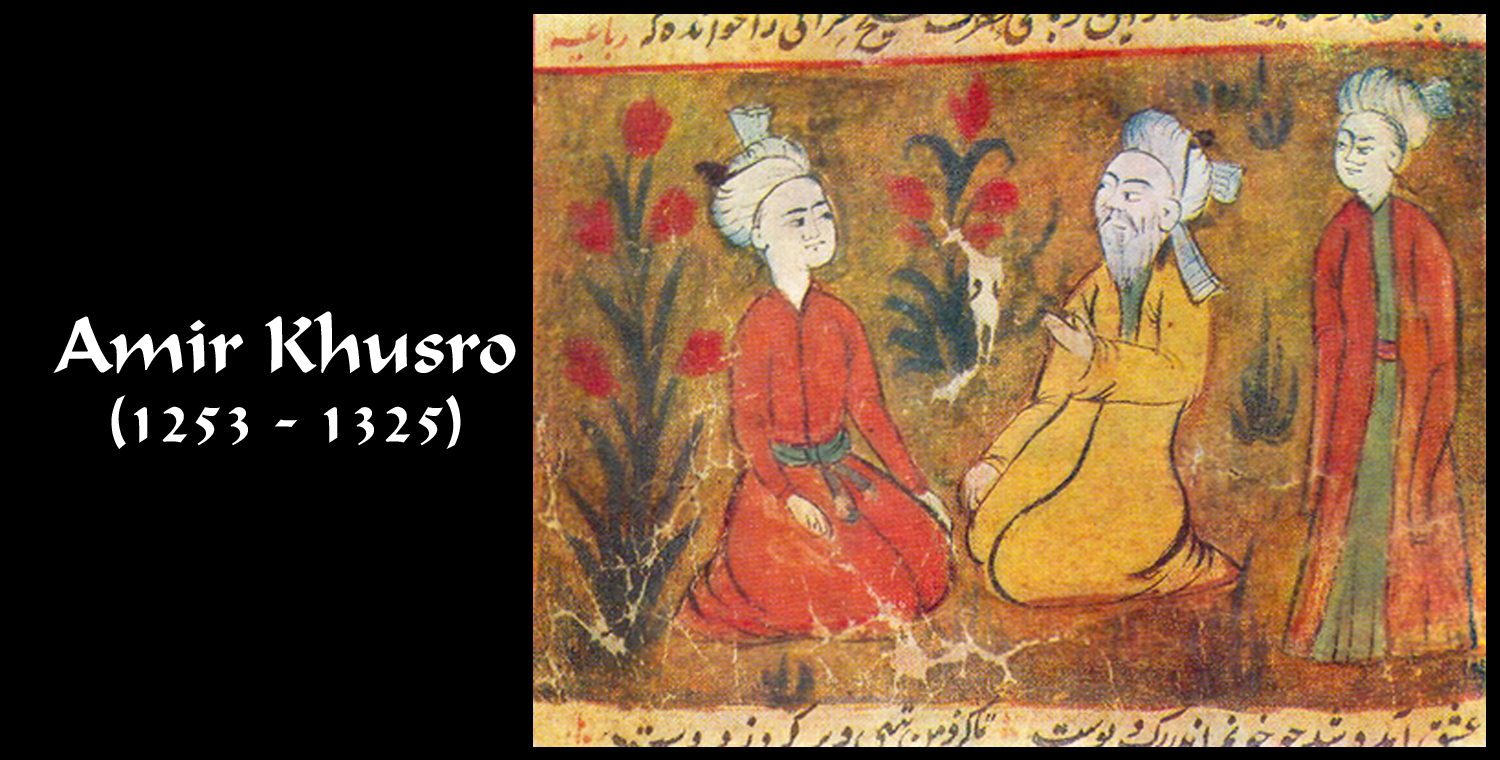
Hazrat Amir Khusro was born in AD 1253 and died in AD 1325. In these 72 years, he made seminal contributions as a philosopher, mystic, scientist, historian, diplomat, tactician, and above all, as a poet and musician. Much of this is either lost or remain only in manuscripts confined to library shelves. His poetry and music, however, have spawned not one but several living traditions that flourish to this day.
In respect of music, Amir Khusro is today credited with a bewildering number of inventions and innovations. According to many, he created musical instruments like the Sitar and the Tabla, composed new Ragas like Yaman and Zeelaf, Talas like Chakka and Soolfakhta, and created musical forms such as the Qawwali, the Khayal, and the Tarana.
2. The Chishtiyya Sufi Order
The Chishtiyya order began around the 10th century AD. The story goes that Abu Ishaq Shami, a native of Syria, once met a Sufi mendicant who directed him to settle in Chisht, a small town near Herat in Afghanistan. From then on, he became known as Khwaja Abu Ishaq Shami Chishti, and it is from him that the Chishtiyya order is derived. Khwaja Abu Ishaq died in AD 940.
Ultimately, the order reached India through the efforts of Khwaja Moinuddin Chishti, popularly known as Gharib Nawaz, or ‘protector of the poor’. Born in AD 1138-39 in Sajistan, Iran, he took to mysticism early in his life. Legend has it that once, when he was in a trance, he felt the Prophet Mohammed himself order him to settle down in Ajmer, which he did in 1190. The Chishti order thus took roots in India, and continues to flourish to the present day. It boasts some of the most exalted Sufi mystics of all times, including Khwaja Qutubuddin Bakhtiar Kaki, Khwaja Fariduddin Ganj-e-Shakar of Ajodhan (the present-day Pak Pattan in Pakistan), and Hazrat Nizamuddin Aulia, the mentor of Amir Khusro.
Hazrat Nizamuddin was born in AD 1238 in Badayun, a town near Delhi. In his early years he aspired to become a qazi. A chance meeting with a musician led to his hearing for the first time the name Khwaja Fariduddin, for whom he developed an inexplicable reverence. In his eighteenth year he went to Delhi and met Khwaja Fariduddin’s brother Sheikh Najibuddin Mutawakkil. One day Nizamuddin asked the Sheikh to pray so that he may become a qazi. The Sheikh remained silent. On Nizamuddin’s repeating the request, he said, ‘God forbid that you become a qazi; be something else!’ Shortly afterwards, the call of a muezzin awakened something in him. He promptly set off for Ajodhan, without even taking any food with him.
At Ajodhan, Khwaja Fariduddin had already received a premonition of Nizamuddin’s arrival. He readily accepted Nizamuddin as his disciple, and eventually made him his successor as the khalifa (head) of the Chishtiyya order. Hazrat Nizamuddin then went back to Delhi and on divine inspiration, set up a khanqah (or monastery) at nearby village called Ghiyaspur. He gained renown for his piety, learning and wisdom, matched with an overwhelming compassion for the poor. In this compassion he was stubbornly resolute, which earned him the wrath of emperor Ghiyasuddin Tughlaq himself. The emperor even threatened to destroy Hazrat Nizamuddin’s monastery when he returned to Delhi from a campaign. The saint is said to have merely murmured ‘Dilli door ast’ (Delhi is far away). Sure enough, before the emperor could reach Delhi, a canopy collapsed and killed him. In the same year AD 1325, Hazrat Nizamuddin also died.
It is beyond dispute that Khwaja Moinuddin Chishti and Hazrat Nizamuddin Aulia made seminal contributions to the establishment of Sufism in India. This school of thought quickly attracted followers, since people perceived it as a relief from the strict rigidity preached by the Hindu and Islamic orthodoxy. Indeed, the Sufi tradition in India represented a confluence of the best that either religion has to offer, and due to its syncretistic and non-prejudiced outlook, it has been instrumental in promoting harmony between the Hindu and Muslim communities.
The fundamental beliefs of Sufism concern love as a path to spiritual salvation. It lays great stress on ishq-e-majaazi (temporal or erotic love), as a means to ishq-e-haqiqi, or divine love. Inevitably, adherents of Sufism have written some of the finest love poetry ever. Sufis also emphasise the notion of dikr (or zikr), which literally means ‘reference’ or ‘remembrance’. This entails invocation or contemplation of the divine.
Different sects adopted different methods of dikr. Unlike the Suhrawardi and the Qadri, which found music objectionable, the Chishti and a few other orders laid emphasis on samaa, that is, dikr through ecstatic singing, dancing and so on. It is from this spiritual context that Amir Khusro’s monumental contribution to literature and music emerged.
3. Amir Khusro’s Life
Amir Khusro’s father was an immigrant from Turkey, forced to flee his home due to repeated Mongol invasions. He settled down in Delhi and soon acquired a position of prominence. He married the daughter of Imaad ul Mulk, an Indian by birth and a nobleman in the court of emperor Ghiyasuddin Balban.
Khusro’s Indian ancestry exposed him to the greatness of Indian culture, especially its music, for which he developed a special liking. He was never an attentive student, but discovered an abiding love for poetry at a very early age. This, coupled with his equally strong spiritual inclinations, led him to Hazrat Nizamuddin Aulia at the tender age of eight.
There exists a legend that he was initially reluctant to go to the saint’s khanqah, and his mother had to literally force him to accompany her there. When they reached, he refused to enter the monastery, and instead, remained standing outside its gates. He then composed in his head the following lines:
Tu aan shahi ke ber aiwan-e qasrat
Kabutar gar nasheenad, baaz gardad
Ghareeb-e mustamand-e ber der aamed
Be-yaayad andaroon, ya baaz gardadYou are a king at the gate of whose palace
Even a pigeon becomes a hawk.
A poor traveller has come to your gate
Should he enter, or should he return?
Hazrat Nizamuddin, sitting inside the khanqah, read the thoughts in Khusro’s mind. He immediately dispatched a servant to read out to the young boy standing by the gates the following:
Be-yaayad andaroon mard-e-haqeeqat
Ke ba ma yek nafas hamraaz gardad
Agar abla buvad aan mard-e naadan
Azaan raah-e ke aamad baaz gardadO man of reality, come inside
So you become for a while my confidant
But if the one who enters is foolish
Then he should return the way he came
Khusro was so impressed that he decided forthwith that he had found his spiritual guide.
Over time the love between mentor and disciple grew to such sublime proportions, Nizamuddin even declared that had his religion permitted it, he would have wished for Khusro and himself to be buried in the same grave. This bond between them also formed the inspiration behind the finest of Khusro’s poetry. Written in both Persian and Hindavi (the tongue spoken by Indians in and around Delhi), his works speak of his erotic love for his mentor, through which rapturous state he sought to access the divine. Indeed, rapture is the fundamental characteristic of his poetry. Once, he chanced upon a dhunia (cotton carder) at work. The rhythmic twanging and buzzing of the carding instrument led him to compose:
Darpai-jana jaanhum raft, jaanhum raft, jaanhum raft. Raft raft jaanhum raft, aihum raft-o aanhum raft, aanhum raft, aanhum raft Aihum aanhum, aihum aanhum aanhum raft, raftan raftan raftan dah . . .
The words make little sense literally, but the repetition of the same words over and over, coupled with the strong underlying rhythm, heightens and reinforces the sense of ecstasy that is the objective of Sufi worship. According to some, this ecstatic repetition is what coalesced into the tarana form of classical music.
Amir Khusro was also an astute politician and tactician. He served no less than eleven kings spanning three important dynasties. Clearly, his diplomatic skills were of a very high order, for he managed to remain in royal favour even in such turbulent times.
Hazrat Nizamuddin Aulia died in 1325 at the age of 95. Khusro was in Awadh at that time. When he came to know of his mentor’s demise, he was inconsolable and declared he would not live long either. Within a few months his prediction came true, and a still grief-stricken Amir Khusro joined his master in the other world.
4. Khusro and Music Theory
Just as Amir Khusro was born at a decisive juncture of history, so did his music lead to a decisive phase in the development of North Indian music. Historically, the evolution of this art form has been characterised by deviance from traditionally acknowledged principles. For example, the great scholar Sarangadeva, writing just prior to Amir Khusro’s birth, commented that the music of Bharata and Matanga had become extinct.
Similarly, it seems that by Amir Khusro’s time, Sarangadeva’s precepts themselves started losing relevance. One controversial issue was his division of the octave into 22 shrutis or microtones. This was compounded by the fact that he took as the fundamental note of the octave not the first but the fourth microtone, referred to as chhandovati. (Willard 1834: 43) Such an arrangement produces a musical mode or scale featuring flattened third and seventh notes, corresponding to the present-day Kafi thaat. (Bhatkhande 1990: 28)
Amir Khusro realised that this convention was outmoded. Accordingly, he adopted as the fundamental note of the object the first shruti, called teevraa. This yielded a scale comprising seven natural notes, which is familiar to us as the natural scale or the Bilawal thaat. According to many, musicians in the South continued to follow Sarangadeva’s system, which led the northern and southern streams of music to gradually diverge and coalesce into self-contained musical systems in their own right. Therefore, it seems Amir Khusro’s innovations have played a critical role in shaping Hindustani music into what it is today.
5. Khusro and the Origins of Ragas
Khusro is also regarded by many scholars as the creator of Raga Sarparda, or Sarparda Bilawal as it is now known. A characteristic feature of this Raga is that it uses only the seven notes of the natural scale. This lends credence to the belief that the practice of using the natural scale began with him.
Apart from Sarparda mentioned already, Khusro is popularly credited with having devised Ragas like Yaman, Zeelaf, Sazgiri, and so on. He himself mentions in his magnum opus Ejaz-e-Khusravi several names like Hijaj, Jangula, Sarparda, Ghaaraa, Mujeer, Eman (Yaman), Farodast Waakhrez, Farghanaa and Husaini. (Das 2004: 213) Interestingly, he himself does not claim credit for their creation, and instead modestly states that they already existed in Indo-Iranian music.
Nevertheless, subsequent scholars consider Khusro to be the creator of a number of them. They point out that the Ragas mentioned are actually blends of existing Indian and Persian melodies. Yaman, for example, is an amalgam of the Indian Hindol (as it existed then) and the Persian Nairez or Nairiz. Similarly, Saazgiri comprises the ancient Indian forms of Purbi, Vibhaas, Gaud and Gunkali along with the Persian Ahang. (Ibid.)
Of these, only Yaman remains popular in today’s day and age. Sarparda is performed only by members of selected Gharanas. Hijaj and Zeelaf are performed only very rarely. Saazgiri is even more obscure. Others like Farghanaa and Farodast Waakhrez have disappeared altogether.
6. The Qawwali
The origins of this musical form are shrouded in obscurity. Some scholars maintain that many forms of Qawwali existed much before Khusro’s time. At the same time, there is little doubt that he played a seminal role in propagating and popularising Qawwali. Many compositions of Amir Khusro remain as popular today as they were in his own time.
However, Khusro’s contribution to Qawwali is so extensive that it deserves a separate study in its own right. Here, we shall confine ourselves to the impact of this form of music on classical music.
Amir Khusro is said to have created six forms of music, namely Qaul, Qalbana, Khayal, Tarana, Naqsh, and Gul. The last two have lapsed into obscurity. On the other hand, the Qaul remains ever popular. Many consider it obligatory to begin a Qawwali recital with a Qaul. There are some who believe that Amir Khusro did not exactly create this form, and that it had been incorporated into Sufi traditions much before Khusro’s birth.
In essence, the Qaul comprises of a Hadith (saying) of Prophet Mohammed, to which are appended certain apparently meaningless syllables such as nom, tom, yalali, yalala, ta na na and so on, which are today identified with the Tarana form. These syllables actually carry considerable mystical significance, and are used by Sufis as incantations to be repeated over and over.
In the cotton-carding-inspired poem, we saw the same semantically significant words repeated over and over in such a way that all syntactic meaning is lost. The vocalist Ustad Amir Khan has contended in many places, including his seminal 1966 article, that Tarana syllables originally did hold semantic significance, in that they are actually corrupted forms of Persian and Arabic words. Over time and rapturous repetition, however, they were corrupted in a way that obscured their meaning.
The Qaul ‘Man Kunto Maula’ attributed to Amir Khusro is by far the most popularly sung. Its lyrics are:
Man kunto maula,
Fa Ali-un maulaDara dil-e dara dil-e dar-e daani
Hum tum tanana nana, nana nana ray
Yalali yalali yala, yalale
Yalalala yalalala lalalala le
The meaning of the first two lines, a saying of Prophet Mohammed, is as follows: ‘Whoever accepts me as a master, Ali is his master too.’ It is followed by the mystical syllables discussed above.
The Qalbana is now performed much less frequently. In fact, it has faded out of public memory to such an extent that its very characteristics and contours are a source of controversy.
Structurally it is not unlike what is called a Rubaidar Tarana. Its first stanza, the Sthayi, consists of mystical syllables, the next (or Antara) incorporates a Persian couplet. An important distinction is that it makes use of several different Talas. The present example, for instance, begins in Firodast, changes to Ektala, Jhaptala, Teentala, and then returns to Firodast.
7. Khayal and Tarana
The word ‘khayal’ literally means ‘thought’ or ‘imagination’. Ejaz-e-Khusravi contains several references to this term. However, little inference can be made as to how such Khayals were performed in that era. Certainly, it cannot bear a close resemblance to today’s iteration. The noted Persian scholar Shahab Sarmadee has put forward the conjecture that Khusro used the term in a more general sense, that is to say, in its literal meaning rather than as a reference to a musical form. (quoted in Miner 1993: 19) Others have speculated that in Khusro’s time Khayals and Qawwalis used to be sung together, and only later did Khayals acquire the status of classical music.
Nevertheless, several musicians sing Khayal compositions whose words as well as music they attribute to Khusro. A prominent example is ‘Piya Navelara Paya’, a composition in Raga Poorvi.
Amir Khusro’s putative associations with the Tarana run much deeper. One of the most persistent legends of Hindustani music relates to the encounter between Amir Khusro, who was then associated with the court of emperor Allauddin Khilji, and Gopal Nayak, court-musician to the king of Devagiri. Allauddin commanded Gopal Nayak to present the Raga Kadambak for six evenings running. During the entire performance, Khusro lay concealed under the emperor’s throne, and stealthily absorbed all that the Nayak had sung. On the seventh day, he astonished everyone present in the court by reproducing all that Gopal Nayak had presented. However, since he couldn’t follow the Nayak’s language, he substituted the text of the compositions with meaningless syllables. And that is how the Tarana was born! (Willard 1834: 121)
Modern scholars, however, are quick to dismiss this story as an urban legend. One reason for this is that the Raga Kadambak is such a complex composition that assimilating its intricacies merely by listening is virtually impossible. (Mishra 1990: 16-17) At the same time, especially given the significance of such apparently meaningless syllables to Sufi practices, and given also the structure of the Qaul and the Qalbana, we may safely contend that Khusro did indeed play a significant role in the ultimate emergence of the Tarana as we know it.
8. Khusro’s Influence on Contemporary Musicians
The last eight hundred years have done much to erode Amir Khusro’s contributions to music. This is so much so that today we have no way of distinguishing his own work from later interpolations in his name. Hence, unlike in the field of literature, for instance, as a musician Khusro continues to remain an indistinct, even legendary figure.
Nevertheless, throughout these years, he has been a source of inspiration to musicians. Many have attributed their own creations to him. Some have sought to revive obscure Ragas traditionally ascribed to him. Then again, the manner in which people have sought to incorporate his poetry into contemporary musical forms makes for a fascinating study.
The composition Hazrat Khwaja Sang Kheliye Dhamaal is a classic example. For centuries, Qawwali and Khayal exponents have presented this in their own respective styles. Traditionally, it is associated with Raga Bahar.
Rubaaidar Taranas are a special type of Tarana, where the second stanza incorporates a Persian couplet or quatrain instead of the usual mystical syllables. Some feature a few lines of Urdu, Hindi or even Sanskrit. Many musicians of the present era, notably Ustad Amir Khan, have used Khusro’s Persian poetry for their Rubaaidar Taranas.
Consider the Ghazal ‘Khabaram Raseeda Imshab, Ke Nigaar Khwaahi Aamad’. Within it, we find this quatrain:
Ba labam raseeda jaanam / Tu biya ke zinda maanam
Pas azaan ke man na maanam / Ba chekaar khwaahi aamadMy life hangs on my lips, come so that I may live again
For if you arrive after I am dead, your coming shall be pointless.
9. Bibliography
‘Early Sufis in the Chishti Order’, available online at: http://www.chishti.ru/order_of_sufis.htm.
‘Khwaja Gharib Nawaz’, available online at: http://www.chishti.ru/o_gharib_nawaz.htm.
‘Khwaja Moinuddin Hasan Chishti’, available online at: http://www.chishti.ru/order_of_sufis.htm.
Anwar, Khwaja Khurshid (1976) A Gift to Posterity, (originally published in The Pakistan Times), available online at: http://films.hindi-movies-songs.com/a-gift-to-pro.html
Baba, Gudri Shah, ‘Hazrat Nizamuddin Awlia, r.a.’, available online at: http://muslim-canada.org/nizamuddin.pdf
Bhatkhande, VN (1990 reprint) Leading Music Sytems of the 15th, 16th, 17th, & 18th Centuries, Delhi.
Das, RK (2004) Ameer Khusro – the Great Indian, Delhi.
Khan, Amir (1966) ‘The Tarana Style of Singing’, available online at: http://caferisko.ca/ak/tarana.html
Miner, Allyn (1993) Sitar and Sarod in the 18th and 19th Centuries, Delhi.
Mishra, Susheela (1990) Some Immortals of Hindustani Music, Delhi.
Saeed, Yousuf (2001) ‘Excerpts from Khusrau’s Persian Poetry’, available online at: http://www.alif-india.com/love.html
Saeed, Yousuf (2001) ‘Some Anecdotes from Amir Khusrau’s Life’, available online at: http://www.alif-india.com/legend.html
Saeed, Yousuf (2001) ‘Some Qawwalies and Folk Songs of Khusrau Tradition’, available online at: http://www.alif-india.com/lyrics.html
Willard, NA (1834) A Treatise on the Music of Hindoostan, Calcutta.