
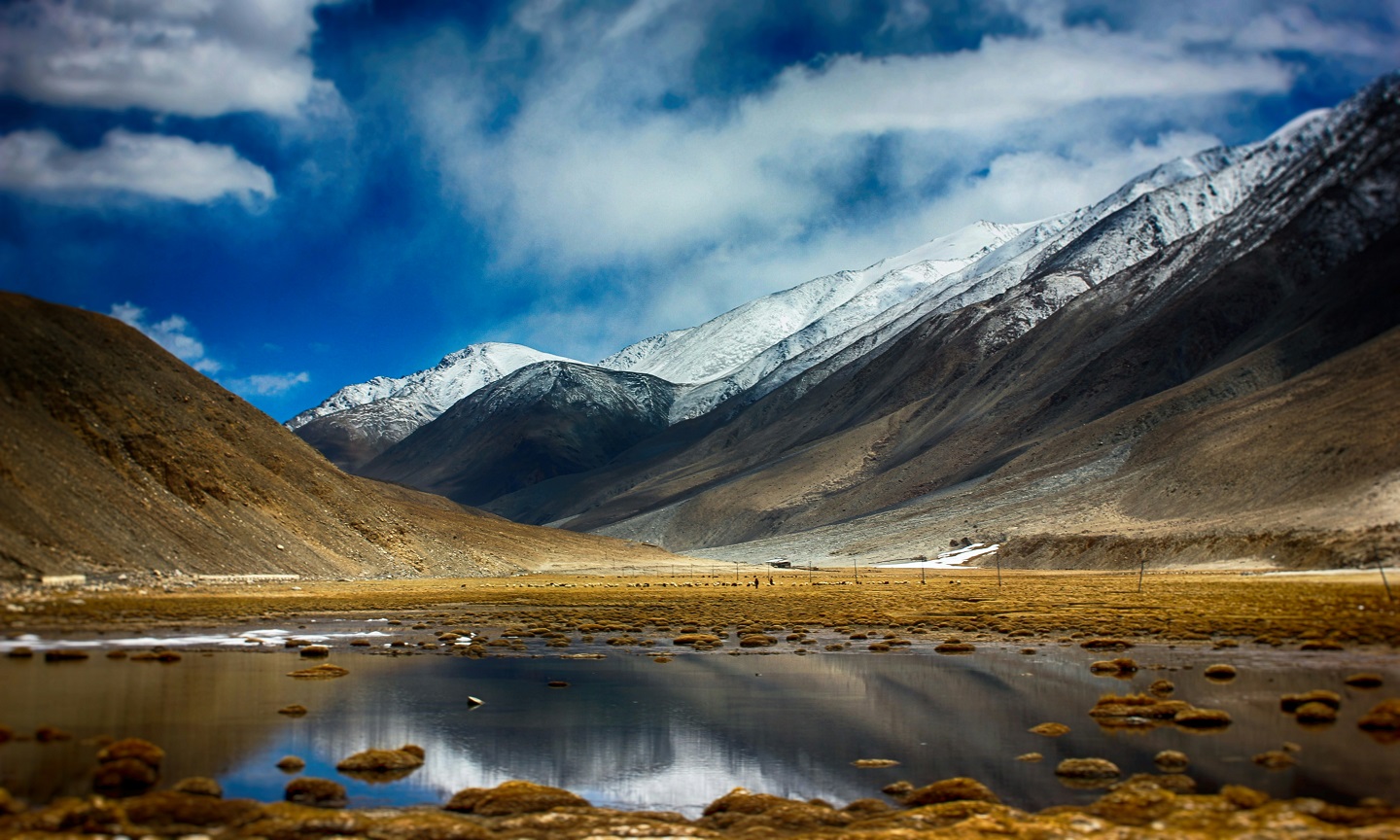
Nubra
On a bright and dry afternoon, I am standing beside a motorable road, staring at a clear blue sky while the wide mountainsides of a Himalayan desert stare back at me. I see huge machines around me. Down on the asphalt and at the edges, the road meets dust that will eventually eat into it. On the road, there are construction leftovers: machines and tools, splattered with a dark, chemical matter.
A tail of black smoke rises behind a big metal structure, leaving a strong stench of chemicals in its way. Drops of black tar are everywhere, baked onto the sides of the road like dark stars in a dusty sky. They are spread out on the ground, on the tyres, under my shoes, under the shoes of the workers, and on the sides of the truck walls.
When the trucks move, the stones scratch on the road, and when we walk, our footwear talks. When I near a big stable rock, I deliberately brush my shoes on its sharpest corners to clear the soles.
It is like the road is leaving an imprint on me.
This is a border road in Ladakh’s Nubra valley. It is a road, and because it is incomplete, it is also becoming a road. But then a road is never complete here. As it is being built, it, in some portions, is also being fixed. It is the same story every year. New roads are built, and old ones are fixed.
They require constant caring and the Border Roads Organisation (BRO) brings that care. Several units of the BRO, called detts, and camps are spread across the region, where road workers employed at nearby construction sites reside. During landslides, rains, and environmental change, these workers are mobilized,and, loaded onto dust-laden blue BRO trucks, are rushed to the damaged sites.
One morning, a road was damaged due to landslides. On both sides of the damaged section were people waiting for the road to be opened. I was among them, and we all looked out for the blue BRO trucks among the arriving vehicles. We stared at the workers who eventually became moving shadows as the clouds hid the sun. We witnessed the clearing as the vehicles queued up behind us and on the opposite side. All engines were turned off and many commuters and tourists stepped out and filled the gaps on the road. Soon the chatter grew louder as the rain-filled Shyok river roared downstream.
Two hours later the road got cleared and the traffic finally moved. As our vehicles picked up speed eager to reach their destinations, only the rearview mirrors witnessed the mountain curves embracing the shadows of the workers.
On many fieldwork days, the workers shared their meals with me. I sat with them and enjoyed their company. They asked me questions about what I did, what a PhD was, and why I was talking to them—answers which I was seeking myself.
I asked them about their lives in Ladakh, I asked them about their health, I asked them what they did when they were not working and I heard about their disposability in return.
On a day spent with some workers from Dhumka (Jharkhand), I was invited to their tent for lunch.
It was afternoon, and only a few workers with non-construction tasks involved in some chores were present near the tent. The tent was big with a thick sheet of plastic as its cover. At the entrance was a make-shift kitchen with two stoves, a gas cylinder, many large utensils, and a cook huddled into the corner to my left. The entrance was partly open, and a sunray seemed trapped inside the big utensil simmering with vegetables,spices and oil, while smoke escaped through the same route. The workers and I sat opposite the cook on what looked like a storage section: mattresses, bedsheets, vegetables, and other things, all piled together.
We made space for ourselves on top of small packets of spices and lentils, and huge sacks of wheat and rice. The kitchen was messy, but the rest of the tent was not. It had a free middle space for moving in and out and two symmetrical lines of multiple mattresses next to each other. Our chatter woke up two unwell workers who were resting in the tent. They joined the rest of us in our conversation as we handed out ingredients to the cook.
My conversations with trekkers were different.
Many tourists were thrill-seekers for whom camping was exciting and adventurous. We would talk about how they packed, how they rationed, what they left, what they wished they had left, and what they wished they had taken. They talked about the landscapes, their beauty, and the excitement of the remoteness from the urban.
But the road workers had different things to talk about—how they were always tired, sick, exhausted. A younger road worker once told me that his dream of visiting Kashmir had brought him there: “For the first few days, I was constantly staring at the mountain peaks and distant hills fading behind the thick films of fog. Now I am always tired.”
Always working, always building. As if they were constructing roads so they can get back home quicker.
With much interest and curiosity, the workers always asked me where I was coming from and where I was going. And about how those places were. When I asked some of them about the places they had visited in Ladakh, they said, “nowhere, except the construction sites, but sometimes we go to the nearby villages to buy some things, and to get Chhang!” Chhang is a local alcoholic beverage of Ladakh. Locals make it at home for personal use and sometimes also make extra for the workers who ask for it.
One time after spending the day with road workers when I was heading back to my homestay, three of them hitchhiked on my rental bike to a nearby spot for some chhang. With the four of us, the bike’s engine was doing the heavy labour for a change, and I was trying to keep the bike stable.
To manage a smooth mountain ride, I kept the engine between the first and the second gears to get maximum power. As the white Himalayan 411cc crawled through the road built by them, we chatted. They told me that they were planning to have drinks that night, so they were going to a small hamlet on a hill. It was an unsafe bike ride on tricky mountain roads and managing the bike was not easy, but the conversation made it a memorable ride for me.
I was not a researcher then, just a guy passing by who happened to give a lift to some other guys passing by. The crossroads had brought us together. I dropped them at the foot of a hamlet with a barely visible path up the hill. One by one they hopped off the bike, and pointed toward their destination at the top, before beginning their uphill trek.
Uninvited to the chhang party, I continued toward my homestay down the road, but this time on the comfortable fourth gear as my bike roared through the smooth tarmac .
Turtuk
One time in Turtuk village in Baltistan, I was trekking up to a waterfall. There I met a few workers from Nepal. They were setting up pipes to carry water from the fall to the parts of the village with minimal access to water.
The thekedar (labour supplier) told me he was in India for the first time, and that he brought his workers there because he found a good and well-paying contract. Turtuk had a lot of construction work going on at the time, so he moved there with his family and relatives, many of whom were working with him at the site. He showed me a picture of his son standing next to the waterfall taken the previous winter: a boy in his school uniform standing on top of the frozen waterfall. Red cap, red-white shirt, blue pants, and a smile. He studies in Turtuk now. The thekedar and his family had spent two years in Turtuk while some of his relatives and other workers had left.
I met him in the sixth month of the waterfall project. He told me about the working conditions there: “It is difficult working here. At this height, with so little space to move and do things,my workers struggle to do many tasks.” Some of these workers were living in the village downhill, and some were staying near the worksite in a tent on a hill nearby —braving windy nights, more than three-hundred meters—an hour away from the village.
When I met them, they were working while their lunch was being cooked in a pressure cooker covered in black soot from the wood-fire. The mountain rocks around their makeshift corner-kitchen had also turned dark.
On returning from the waterfall, I sat with the thekedar again for a brief chat. I learned about how they work on the mountains, and how difficult it is to “retain” labour at such high-altitude construction sites. Five of his people had left without any notice. The altitude, the work, or perhaps the environment did not suit them. I was told by many that this is common.
A lot of people bring workers to places like Ladakh selling them dreams about easy work, bigger wages, and its beauty (or rather the famed beauty of Kashmir). But when the workers arrive, their unacknowledged laboured breathing takes the spotlight, walking is never straight, work is exhausting, and food tastes different.
Some find something to hang on to, but many find nothing even to hold on to.
We continued our chat, while the rest carried on. I remember how my eyes were fixed on the workers mixing cement with some kind of sand, carrying rucksacks on their backs, and even carrying seemingly heavy pipes up to the construction site. They all looked visibly tired but continued their work, while the thekedar proudly told me they are Pahadi (hill dwellers) and have more stamina than those from the plains.
He was right. But they were exhausted, their skin burnt from hours under the harsh sun, their disintegrating shoes screaming for a break.
*
Roadbuilding in the Himalaya is unthinkable without workers like these. They are the bedrock of infrastructure in Ladakh. The increasing pace of road building has brought improved connectivity but at a cost paid for by their bodies.
The workers are necessary, their presence temporary, yet their labour has a permanence to it. It is needed regularly to maintain the Himalayan roads. They stay on-standby, like pieces of frozen snow waiting to be melted into nation-building. They turn malleable, hammered into the corners of the region.
The workers are the infra of the structure, and the infra of the infrastructure: so essential that their bodies merge into the roads, forcing connectivity into a prolonged existence.
Ladakh roads are border roads—veins of national security infrastructure, connecting the ‘periphery’ to the ‘centre.’ If the armed forces are the blood, then the road builders are the pumping heart of this project. Their labour provides a flow of life into India’s borderlands.
Road workers in this way become the backbone of the economic integration and consolidation of the nation. Yet, they neither feature in the rhetoric of nationalism nor in the boastful numbers of economic progress.
They cut, eat, and breathe these mountains as the dust catches-up and begins to gather on the dark asphalt sky.
Is the connectivity even possible without them?
Are they the infrastructure?