Temporary and Permanent
Addresses have slippery loyalties.Elopers with time, they whisk awaydrafts of air, sunshine from a courtyard,faceless friends. Trick you into lettinggo of them but hang around likeapparitions with missing ID cards.
Some become friends. Stalkersfor life. #658 in the government colony,where I first learned what a newborn babyand a curfew looked like.
There are those that mimic thecalendar—2011—and become outdatedyearly. Then fade out. Streets,blocks, gullies form new alliances. Findfresh candidates to choke with fear. OrSection 144 of the Indian Penal Code.
My permanent address had an ‘/C’ stuckto it—a tethered, tiresome appendage.The troubles that skinny slant caused us,far from oblique. Postmen spurned the slashand left my exam results elsewhere. Deliveryboys rang a different doorbell, the seekhkabab they brought deflating inside acold polythene parcel.
In the gully behind this house, my brothergot the name Hari (not because of his godliness butbecause his cricketing pals wanted him to‘hurry up’ between the wickets).
My grandmother gave us her village addressnoted with peripheral markers. Spatial jigsaws.Sprawling fruit orchards, a pond ‘as big as a river’.The temple my brother foundpieces of when he visitedthe village years afterGrandma diedpining for it.
Some address trespass time’sunpatrolled fence to become permanent(even when they are temporary). Theirfoggy chimera blurs one’s vision.
***
Returning to Taj Mahal
Before landing here, I think about it for months.In my mind, where all travellers’ dreams gather,new lists, menus for future entertainment, stewevery day. When I finally step into this walled fieldof spices, greens, fish and sweets, this impossibleexcess of home, intimate like daily grass oncehad been, I’m lost. To be in a Bangladeshistore is to re-emerge to the noise and sweat ofhome after eons of submersion under pasty ice.
This tiny, packed-to-the-gills monument ofmasalas, of fish from Padma, of pointed gourdand Rangpur lime, paralyzes me. Inert, I readthe Bangla print on cardboard fish boxes.Tapasi, koi, batashi, rui, ilish, kachki.Deciphering the letters, recommitting them tomemory lets me cross over my foremothers’rivers. The fish is foreign to my tongue, itsbirthplace, the lineage that entraps us both.
At home, my counter displays exhibits fromanother Taj Mahal visit. No marble miniatures,no iconic photographs, not even a picture postcardthat would yellow with age. I open plastic bags todraw out syrupy sweets, tropical fruits, pickleswimming in mustard oil. Fish cleaned, frozenand stamped with Padma certification. Spices failingmiserably to measure up to the singularity of Rangpur lime.
Conjuring up new lists, I vow to keep returning to this monument of love.
Note: Taj Mahal is the name of a Bangladeshi grocery store in Mississauga, Ontario
***
Cumin
Taste is the original rebel. It resists being caged inclosed jars or steaming woks. Like a minstrel’s callusedfeet wandering in search for the divine, the ridged beadsof cumin journey the world seeking new tongues.In her kitchen, the seasoned cook remains patientfor the oil to reach just the right heat.
That moment when the jeera seeds for the daal tadkacrackle is the cadenza her eager ear waits for. Her nosesmells the warmth of sweet sweat releasing from the seedbeads’ oil canals. The scent of earth itself rising. Like jokes,which never remain what they were when they travel tonew lands, cumin creolizes into fresh flavours and sounds.
Gamun in Sumerian cuneiform, kamûnu in Akkadian, cuminoin Italian, jeera in Sanskrit, the humble seed is a master oftravelling light and charming palates. Crushed coarsely into fouland hummus, spluttered whole in spicy lentils and the ambrosiaof curried meat, roasted and crushed for the magic bhaja-moshlatouch that transforms a pedestrian ghugni to a gourmet pièce de résistance.
Even without the delicate ellipse of a cardamom pod, cinnamon’slanky superiority and a clove nail’s stud-like poise, the cumin wins.Unlike a monarch and like monarch butterflies,cumin rejects borders and bigotry and makes new tongues its own.
***
Light and Lightness
On listening to Nawang Khechog for the first time
After eons, an echo. Unflappable, distilled.Mountains grow limbs when they sense
your need to be healed. The hollow of valleysenters a long-haired man’s flute and holds
your nerves when they’re too riddled to holdthemselves. In another instant, the rooted
tangles of ochre dread threading your veinsloosen and tear apart. The bamboo swathes
your mind’s map with cascades of frosty mist.Featherlight. Ablutionary. Pulsating.
Propelled by the flute’s vibrating guidance,your ears are now eyes. They see light,
beams of softly dancing dust stars. A lonelymemory passes by, one you don’t mind
divorcing after all. Light and lightness, theflautist’s twin notes, sluice you from hole to whole.
***
Notes:
How the poems — and my thought process — evolved
The poems in Nostalgic for a Place Never Seen came about in a spontaneously serendipitous way. Until a few years ago, I was primarily a prose writer — dabbling mostly in creative non-fiction and the occasional short story. In August 2020, my debut novel, Victory Colony, 1950 was published.
In the spring of 2021, a friend who hosts a poetry-writing collective every April for the National Poetry Writing Month, invited me to join. This was at the peak of the COVID-19 pandemic — we were housebound — and true to the cliches associated with poetry and solitude, the moment lent itself well to self reflection. I enjoyed writing poetry in a collective — we read and shared feedback on each other’s works. This not only provided me creative stimulus, it also brought camaraderie and connection at a time when we were dealing with isolation, anxiety and tragedy on an epic scale.
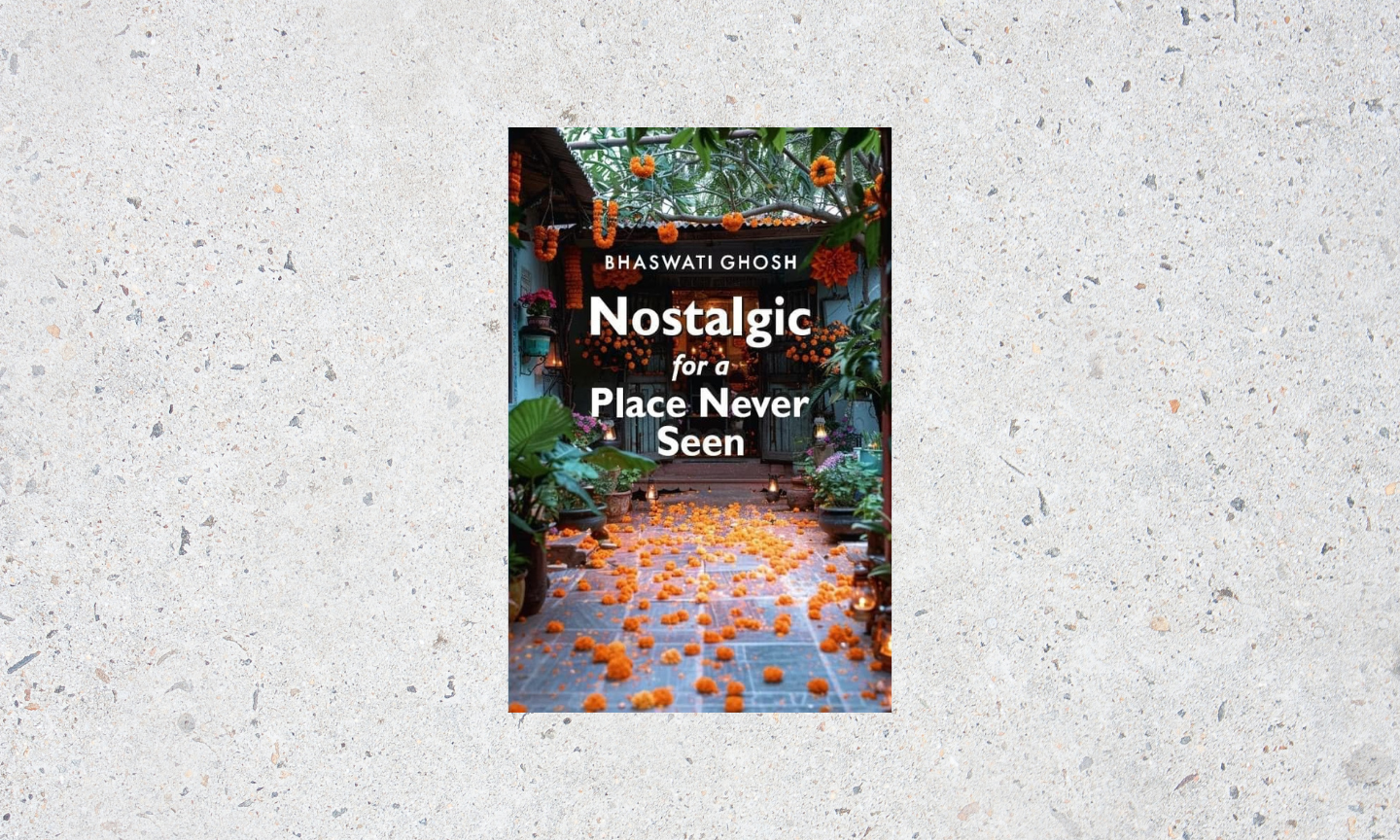
This exercise of writing a poem daily for a month for three years gave me enough poems to think of a collection while also allowing me to hone my craft and learn from fellow poets. Eventually I could see certain patterns and themes in the poems. The book’s title derives from one of the poems in the collection bearing the same title.
Several poems in the book do deal with the idea of location — both temporal and figurative. This made the idea of being nostalgic for a place that’s not merely physical but encompasses more — histories, memories, dreams, longings — pertinent.
A lot of the poems in the collection do relate to physical spaces — dwellings, markets, villages, cities, hills — straddling between continents, atmospheres, cultures and time periods. They raise questions like whether dislocating from one place and relocating to another can really be permanent, except maybe in material terms. The collection contemplates on city life with all its paradoxical oddities and inexplicable pulls. It wrestles with the manner in which the demands of the here and now contend with the salve and cushion of memory. It unlatches the many dimensions of love and takes in with curiosity its lessons for the soul. It observes movement and seeks to inhabit the in-betweenness of journeys.