
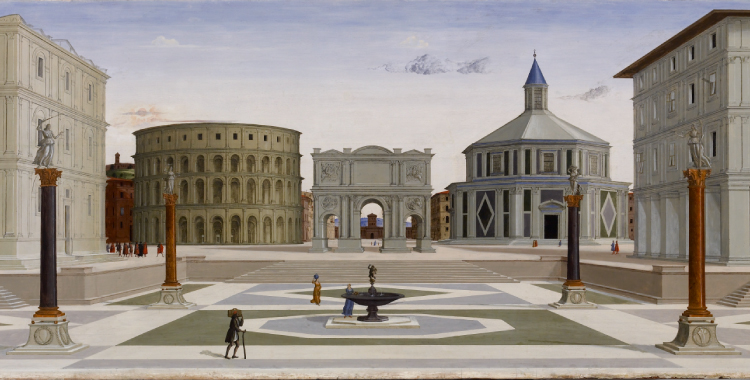
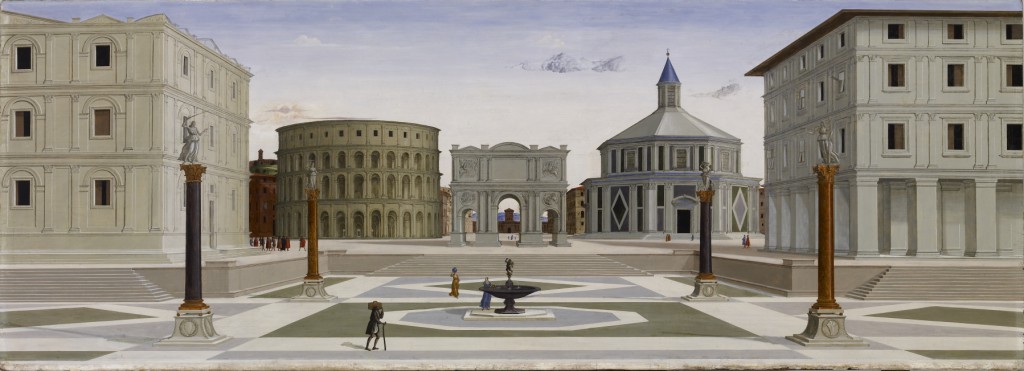
The Ideal City (c.1480), Walters Art Museum, Baltimore
I stand before a painted City and vanish right where it hangson an old museum wall, unconsciousof the noise in Mount Vernon Squarebelow, its studied perspective and funneled point of viewhaving sucked me into roam a plaza almost entirely empty
of people, the gray sky overhead long-emptiedof clouds. Not far from me, a few small figures hangabout four symmetrical columns, hemmed inby Palladian houses, unconsciousof how their City imposes a particular political viewwith its strictly gridded square.
In the distance, Constantine’s Arch attempting to squareclassical virtues almost emptiedof religious and civic meaning—perhaps a previewof how much our present situation hangson rethinking the unconsciousof modern man, how much he fails to rest in
either Ghilberti’s octagon or the Coliseum inRome, his naked soul let loose in the public square.Bereft of string, chalk or pin, and only semi-consciousof the guards, I ride an imaginary ray, emptiedof any direction but true, and hangmy eyes on the City’s horizon. No two-sided view
is allowed by this unknown artist’s hand, no re-reviewof reality’s motion or time exists inthis silent room where centuries pass without a re-hangin perfect stasis. No one doubts this limned double squareonce was true, a window into a world all but emptiedof the tremblers in our subconscious.
Neither sacred nor profane, I’d rather my unconscioustook a more cosmopolitan view—not too hopeful or grim—while our polis emptiedof sense continues its bickering and toeing in.If only I could draw a circle to mate with the square,not think where the republic’s new victims will hang.
Meanwhile I stand before an Ideal City, conscious of yieldingto its empyrean view: a gridded squarealmost empty of people where a residue of good still hangs.
***
Image: Attributed to Fra Carnevale [Public domain], via Wikimedia Commons