
I have always been fascinated by historical watersheds, by how the events of a single decade or a single year turned out to be the pivot on which the destiny of the world took a decisive, often irreversible turn and changed the course of human history. Most people with even a passing interest in history will be able to single out at least one key year or decade in which, in their view, everything changed decisively. While for some, that year could be 1939, when the Second World War began, others might mention 1947, when a new India was born – and so on. In my own reflections on global history, I have arrived at a list – revisable, of course – of some 20 such “watershed” years and decades, which, in my view, had a far-reaching impact on all later history. For the sake of this article, I have decided to choose one of them for a somewhat detailed analysis: the year 70 AD and the events which it witnessed in Palestine, which, then as now, was a region imbued with tremendous geopolitical significance. My focus will be specifically on those events which led to the breaking away of Christianity from its parent religion, Judaism, and the way Judaism re-invented itself in response to the very same events.
A close observation of the two religions will reveal that Judaism can be understood without any reference whatsoever to Christianity, but it is impossible to understand Christianity without reference to Judaism. In fact, until the year 70, Christianity, in the place of its origin, Palestine, was no more than a sect within Judaism and it was only after that year that it began its evolution into a separate religion. For the greater part of subsequent history, Christianity was sadly on a collision course with its parent faith. It will be interesting to see how all this unfolded across time.
Let us begin with the status of Judaism in the decades leading up to our watershed year. Even as far back as that, Judaism was a religion that claimed the adherence of a few million people of West Asian ethnicity who called themselves Jews, a considerable number of whom lived in what was known as “the Diaspora”, outside their Palestinian homeland. Judaism distinguished itself from the other religions of the ancient world by its firm commitment to monotheism and to the rejection of any attempt to represent the “one and only God” in the form of idols or pictures. On more than one occasion, this brought the Jews into conflict with the succession of foreign rulers of Palestine beginning with the Assyrians in the 7th Century BC and ending with the Romans, who were the colonial masters at the time under discussion here. Most of these successive powers – the Assyrians, Babylonians, Greeks and the Romans – were (with the exception of the Persians, who had briefly succeeded the Babylonians) followers of polytheistic religions with a strong element of idol-worship.
At the dawn of the 1st Century AD, the core beliefs and practices of Judaism had been in existence for at least 600 years. The first emergence of the religion into the light of secular history is roughly in the fifth century BC, when a significant number of Jews were released from captivity in Babylon by the new Persian emperor, Cyrus, who permitted them to re-build the Temple in Jerusalem, which had been destroyed by the invading Babylonians a century before. The Jerusalem Temple, the only shrine dedicated to their God, Yahweh, was believed to have been built by the legendary King Solomon in the 8th Century B.C. After its restoration by the liberated captives, this “Second Temple” continued to be the centre of Jewish worship right up to AD 70. Under the rule of Herod the Great, in around 20 B.C, it had even been expanded and renovated.
The Jews saw themselves as a people with whom Yahweh, their God, had entered into a covenant. This covenant bound them to uncompromising obedience to a code of beliefs and observances that Yahweh had revealed to them through the prophet Moses in the distant past. According to the covenant, Yahweh had promised to prosper their national life and protect them from foreign rule as long as they obeyed his commandments, known collectively as his Torah. But barring the golden age under David and Solomon from the fabled past, (when Judah was part of the once united nation of Israel), it was the fate of the Jewish nation for most of history to be a pawn in the games the big empires played with each other. Far from blaming Yahweh for letting them down, the Jews attributed their sociopolitical catastrophes to their own failure to honour their part of the covenant with Yahweh. A long line of prophets – Isaiah, Ezekiel, Jeremiah and Amos, among others – who claimed to speak on Yahweh’s behalf, reinforced this belief by scolding them for their unfaithfulness and appealing to them to return to Yahweh and seek his forgiveness. They assured them of Yahweh’s commitment to restore them to greatness if they re-affirmed their loyalty and obedience to him.
From 516 BC to 70 AD the Temple in Jerusalem was at the centre of Jewish life. A large group of priests, whose offices were hereditarily passed on, officiated over an elaborate system of ritual animal sacrifices as prescribed by the Torah. They were under the headship of the High Priest, who alone was permitted to enter the innermost sanctum once a year to plead with the God Yahweh to forgive the sins of the entire nation. The Temple was a beehive of activity especially during the great festivals of Pesach and Yom Kippur, ( Passover and Atonement) with surging crowds of worshipers, supplicants and pilgrims from all over Palestine and the far-flung lands of the Jewish Diaspora converging there to seek Yahweh’s blessing.
While for a long time the Temple was the only pillar of Jewish religious life, historical and cultural factors soon led to the emergence of another pillar, the synagogue. The synagogue was an institution that evolved in the context of the great dispersion of Jews across the whole of West Asia and North Africa that came to be known as the Diaspora. Not long after Palestine’s incorporation into the Greek empire, large numbers of Jewish emigrants were living in cities as far apart as Alexandria in Egypt and Damascus in Syria. These Jewish communities in the Diaspora soon began to feel the need for a more immediate religious life than the meager once –a- year visits to Jerusalem that distance had restricted them to. By gathering together in a hall every Sabbath, hearing the sacred Torah read out and expounded by learned rabbis, and by congregationally reciting their psalms and prayers, Jewish communities established the second great institution of Judaism – the synagogue. By 132 BC, the entire Jewish scriptures (the Torah, the Prophets, and the Writings) had been translated into Greek, because by then there were large communities of Jews in the Diaspora who had lost all contact with the Hebrew language of their ancestors and knew only Greek. This Greek translation, famously known as the Septuagint, was, much later, to have a great shaping influence on the texts that were to be collected together to form the New Testament of the Christians.
Despite the common core of beliefs and observances that united the Jews of the time, both at home and abroad, the Judaism of the First Century AD was far from homogeneous. Differing responses to the political situation caused by direct or indirect foreign rule under a succession of powers down the centuries led to the formation of fairly divergent schools of thought. Most of these had their origin in the early years of Greek rule a couple of centuries earlier. The increasing influence of Greek ideas and cultural patterns on the Jewish population led to new doctrines during that era. The essentially Platonic ideas of the immortality of the soul and of an afterlife now became integrated into Jewish theology for at least one group of Jews, later to be called the Pharisees. The priestly aristocracy rejected these as foreign borrowings unsupported by the Torah. This group came to be known as the Sadducees. One Greek ruler named Antiochus Epiphanes thoroughly humiliated the Jewish people by desecrating the Temple and burning a pig as an offering to the Greek god Zeus in the inner sanctum, the holiest shrine of Judaism. Many Jews were martyred for daring to resist his depredations. This dark period spawned a wave of writings that came to be known as apocalyptic literature, full of coded symbols and metaphors pointing to the end of the world and prophesying the coming of a powerful personality named the Messiah, who would be born into the ancient King David’s royal lineage and be used by Yahweh to drive out the oppressors and re-establish an independent Israel. As it turned out, someone nearly fitting that description did appear and was successful in overthrowing Antiochus. His name was Judas Maccabeus and the independent Jewish kingdom he established lasted for a hundred years – until 63 B.C. Then the Romans took over and Palestine once again came under foreign rule. Once again, the longing for the Messiah sprouted in Jewish hearts and many Jewish sects were imbued with this messianic expectation. They struggled on in eager expectancy of the great liberator, the Messiah, who they believed would be born among them and be used by God as an instrument to drive out the hated Romans, re-establish Israel’s lost greatness and usher in God’s just rule over the whole world.
The years dragged on, however, and the yoke of Roman rule only became heavier but the Messiah was nowhere in sight. The Romans, for their part, were aware of the subversive potential of all messianic movements and were always alert to the possibility of frenzied Jewish mobs declaring some rabbi or other to be their Messiah, particularly during the Passover festival when crowds of Jewish pilgrims from home and abroad thronged Jerusalem. They always believed it prudent to nip such popular aspirations in the bud. Many messiah claimants appeared briefly in the limelight every once in a while, but movements around them were brutally put down by Roman administrators in Jerusalem whenever they cropped up.
It is within this contextual frame that we must view the life of one of the most influential personalities in all of history: Jesus of Nazareth. It is one of the great ironies of history that for all the tremendous influence he has cast over the centuries, there is virtually no account of him by contemporary historians or biographers who assess his life from a neutral observer’s point-of-view. A handful of such accounts do indeed appear from approximately five decades after his death, but these are rarely more than a few paragraphs in much larger works of history, such as those by Josephus and Tacitus – merely passing references. This leaves the secular historian with little choice but to attempt to infer the details of Jesus’ life from sources written decades afterwards by those who chose to see him as an incarnation of God (Yahweh), indeed, as God’s “only begotten son.” These sources are what we today know as the Gospels and the epistles of the apostles of Jesus. Since they were written with propagandistic intent, the professional historian cannot but be skeptical about their neutrality and objectivity. Nevertheless, scholars over the past three centuries have been able to mine both the canonical and the apocryphal gospels in their attempt to re-construct the historical life of a man named Yeshua of Nazareth (Jesus’ original name in Aramaic) as distinct from the Christ persona that was later ascribed to him when Christianity became an independent religion and he came to be worshipped as God incarnate.
As the canonical gospels themselves attest, Jesus was a practicing Jew. The gospels mention his circumcision as a child, his frequent visits to the Temple and to synagogues and his affirmation of the eternal validity of the Torah that Yahweh had revealed through Moses. He attracted disciples to himself as an itinerant rabbi by attempting to shift the emphasis from a joyless ritualism, based on a literalistic interpretation of the sacred texts, to a celebratory universalism based on the Messianic variant of Judaism and its spirit of expectancy of the imminent arrival of God’s just rule, God’s “kingdom”, which would replace the prevailing corrupt world order. It is very likely that he eventually saw himself as the one authorized by God to initiate a series of events that would hasten the end of the prevailing world order and usher in the glorious kingdom of God, a kingdom that would be characterized by radical compassion and universal justice. On what turned out to be his last visit to Jerusalem during the Passover season (of, most likely, the year 30 A.D), his disciples and a significantly large crowd of followers from his home province of Galilee, began boldly raising slogans in public, hailing him as the Messiah. Not surprisingly, the Roman authorities quickly had him executed by crucifixion to prevent further political instability. For his followers, who had believed that God would miraculously intervene to decisively end Roman rule the moment Jesus was apprehended, this was a terrible disappointment. The gospels record that most of the disciples were in hiding when Jesus was being crucified.
Not long after Jesus’ execution, however, his disciples re-emerged in Galilee and in Jerusalem. They now made a bold claim: Jesus was indeed the Messiah and although his execution was unexpected and apparently contrary to the texts of messianic Judaism, God had “raised up” the Messiah to heaven and was soon going to send him back again, this time not as the non-violent Jesus, who had allowed himself to be martyred, but as the powerful “Christ” (the Greek word for Messiah) who would drive out the Romans and rule the whole world from his capital, Jerusalem. Soon, this group of Jesus’ followers came to be seen as a new sect within Judaism, under the leadership of James, the brother of Jesus, and with their headquarters in Jerusalem. They also referred to themselves as followers of “The Way.” Some scholars call them the “Ebionites”. They have been variously referred to by other scholars as the “Nazoreans”, the “Jerusalem Church” and as “Jewish Christians”. The sect thrived from the late thirties of the First Century until the crucial year 70. It would be completely anachronistic to refer to this “Jesus Movement” as Christianity, because all its members were practicing Jews, observing the Sabbath, attending synagogue services, visiting the Temple on the Jewish holy days and observing the dietary strictures prescribed in the Torah. The only thing that differentiated them from their fellow- Jews of the mainstream and of other sects was their belief that the Messiah had already appeared once in order to be martyred, and was now about to stage his “Second Coming.” They gladly propagated their faith, welcoming non-Jews into their fold. They made it clear to these newcomers that they were essentially being converted to Judaism and that they had to undergo circumcision, observe all the Jewish practices mandated by the Torah as revealed to Moses, and believe that the crucified Messiah, Jesus, was soon to return. It should be noted that they did not view Jesus the Messiah as God incarnate. All the Jewish scriptures pertaining to the coming of the Messiah saw him as no more than a unique human being commissioned by God to restore Israel to greatness and to rule the world on God’s behalf. The concept of God becoming incarnate in human form has always been completely alien to Judaism. Jews have historically viewed incarnation as a pagan belief. In fact, there is not a single verse anywhere in the Hebrew Bible (the Old Testament, to use Christian terminology) that even remotely hints that the Messiah would also be God incarnate.
There were however other schools of thought in the Roman Empire with very different views on the significance of Jesus. There were, for example, several groups of “Gnostics”, who viewed Jesus as a spirit being who came to earth disguised as a human in order to reveal (to a carefully chosen group of initiates) secret knowledge (“Gnosis”) about the way to immortality. However, none of them had the far-reaching impact of a man named Saul of Tarsus, who never knew Jesus in the flesh but claimed that he had had a deep mystical experience in which Jesus revealed himself directly to him. Saul had until then been a zealous Jew of the Pharisee sect, and a militant opponent of the Jesus movement in Jerusalem. Following his conversion, he called himself Paul and allied with the very Jesus movement he had hitherto persecuted. He, however, did not stay in Jerusalem, but embarked on a series of missionary journeys, claiming to be an emissary of Jesus, and seeking converts all over the Roman Empire, primarily in the cities of Asia Minor (now Turkey), Greece and Italy. He largely avoided the Jewish communities of the Diaspora and focused instead on the gentile (non-Jewish) population. In a matter of a few years, he had succeeded in establishing “ekklesias” (originally meaning ‘assemblies’, but eventually coming to be known as ‘churches’) full of gentile converts, whom he kept instructing through a series of letters. Those of his letters that survived were eventually destined to form the earliest segment of the scriptures of Christianity, known as the New Testament. Although he kept maintaining that he remained a Jew, his letters are full of instructions to his gentile converts that they should not accept Judaism, but see themselves as believers in Jesus as their savior from sin, the one who puts them right with God and the one who assures them of eternal life after death. This soon brought him into open conflict with the Jerusalem group and it is extremely likely that he was censured by its leadership, especially by James. The Acts of the Apostles, a later Christian text, claims that there was a compromise agreed upon at the “Council of Jerusalem” under the terms of which Paul was permitted to waive most of the requirements of the Jewish observances for his gentile converts. It soon became evident to any independent observer that “Pauline” Christianity was already beginning to diverge from the ‘Jesus movement’ within Judaism.
Until the year 70, these two “Jesus movements” co-existed, albeit not without friction between them. It is to the major events of that pivotal year that we must now turn in order to see why both Pauline Christianity and mainstream Judaism survived, while the Jesus-honouring Jewish sect led by James simply vanished from history.
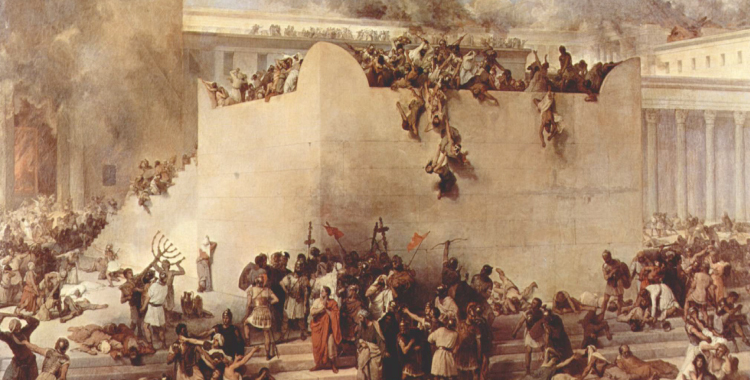
In the year 66, Jewish groups committed to armed revolt against the Roman colonial regime, chiefly the group known as the Zealots, managed to launch a surprisingly effective military campaign and took control of both Jerusalem and large areas of Galilee. Vespasian, the Roman general specially commissioned by the emperor Nero to put down the revolt, soon recaptured many areas in Galilee. By the middle of 69, the deranged Nero was assassinated and Vespasian rushed back to Rome to stake his claim to be the next emperor. He succeeded in his ambition and was crowned emperor that same year. Meanwhile, he handed the command of his military operations in Palestine to his son Titus. In 70, Titus laid siege to rebel-held Jerusalem. It was a long and bloody campaign which finally ended when the Roman forces breached the walls of the ancient city in late summer. What followed was carnage on a scale rarely witnessed in Jewish history. The Temple was looted of all its sacred objects and razed to the ground in a devastating fire started by Roman soldiers who didn’t hear Titus’ command calling for restraint. The complete demolition of the Temple brought down, once and for all, the central pillar of Jewish religious life. Many thought that Judaism as a religion would not survive so grievous a blow. Surprisingly, it did – thanks to the other great pillar of Judaism, constituted by the worship practices of the synagogues functioning all over the empire, wherever there were Jews.
Judaism, post-70, survived primarily because it re-invented itself by replacing Temple-based ritual sacrifices with a worship system based on the public reading of the Torah in the synagogues together with commentary and interpretation by the rabbis and meticulous observances of the Torah’s instructions on everything except rituals connected to the Temple. By shifting the focus from the geographically fixed temple to the eternally portable Torah, Jews readied themselves for their long journey through history as refugees.
The Jewish sect that believed in the messianic role of Jesus began to die out in the aftermath of the cataclysm in Jerusalem. Its leader, James, was assassinated during the days of the Jewish revolt and the remnant failed to survive the other traumatic event that befell Palestinian Judaism in AD 136, when, following another failed uprising, the Bar Kokhba revolt, the Romans expelled most Jews from Palestine. Judaism thus ceased to exist in its own homeland and survived purely as the faith of the Jewish Diaspora for the most part of the next two millennia. As for Pauline Christianity, it remained largely unaffected by the events of 70 and eventually became a separate religion based on the divinization of Jesus of Nazareth as elaborated by doctrine of the Trinity, which was evolved by Christian theologians in the Fourth Century AD. Its success was due in large measure to its emphasis on God as a loving and readily forgiving being whose fatherly compassion embraced the repentant sinner. Christianity offered a life of dignity to millions of marginalized people, especially those condemned to a life of servitude and slavery under the Roman Empire.
The Jewish Diaspora soon spread across Asia and Europe. For Christianity, the Council of Nicaea, convened by the Roman emperor Constantine in AD 325, proved to be an all-important milestone. At Nicaea, Trinitarian Christianity was declared the orthodoxy, while all other variants of the religion were declared heresies. What began as Pauline Christianity had thus evolved into the official religion of the powerful Roman Empire. Following the collapse of the western half of the empire in the Fifth Century, Europe was converted into the realm of Christendom. In the centuries that followed, Christian hostility towards Judaism increased. Intense pressure was brought to bear on Diaspora Jews living in most Christian lands with the aim of getting them to convert to Christianity. Christianity presented itself as the fulfillment of the aspirations of the Jewish faith and as its continuation and replacement. The refusal of most Jews to accept Jesus as their Messiah and their outright rejection of the Christian claim of the divinity of Jesus incensed Christian religious leaders time after time, resulting in waves of persecution directed at helpless Jews down the ages. Finally, following the near total genocide of European Jewry at the hands of the evil Nazi regime in Germany from 1940 to 1945 (better known as the Holocaust), Christian denominations, both Catholic and Protestant, began the process of reconciliation and dialogue between Christians and Jews. In 2000, Pope John Paul II visited Israel and sought forgiveness for the centuries of misguided Christian hostility towards the Jewish people. Many Jews, understandably, saw it as Christianity’s finest hour. The fallout from the events of AD 70 had thus taken nearly two millennia to settle.
A NOTE ON JEWISH-CHRISTIAN DIALOGUE TODAY
Today Judaism itself is pluralistic as there are many different sects within it. Some of them go right back to ancient times while others are of medieval origin and a few have only been around for a couple of centuries. They range from extremely conservative to very liberal. There is even a sect called “Jews for Jesus”, which argues that Jesus is the Messiah that Jews have been waiting for. Orthodox Jews completely reject the claim and call the sect a protestant evangelical missionary group in Jewish disguise. Most modern Jews attempt to blend the more humanistic elements of their traditional faith with the best of modernity. Many are content to be Jews by culture rather than by religious practice.
Jews look back on a long history of persecution in the realm of Western Christendom. Over the centuries beginning with the medieval period, all kinds of attempts were made to convert Jews to Christianity. When Jews refused, they were often persecuted. As far as Jews are concerned, the survival of their ancient faith despite centuries of suffering in a Europe dominated by Christianity is nothing short of miraculous. Thankfully, for Jews the rampant anti-Semitism that characterized most European societies and which climaxed in the holocaust, is now largely a thing of the past.
But, what really are the sticking points between the two faiths? Well, much of it has to do with the Jewish rejection of the Christian claim that Jesus Christ is God in human form, the same God (Yahweh) that Jews worship. Allied with this is the Christian assertion that the Christian sacred scripture, the New Testament, renamed by Christianity as the Old Testament, is a continuation of the Hebrew Bible. Jews object to this nomenclature because they are sure God made only one covenant (testament) with the Jewish people and clearly declared that it was to be an eternal covenant that would be valid for ever, never to be modified or replaced by another. When Christians point out to certain sections of the Hebrew Bible (notably the 53d chapter of the Book of Isaiah) and argue that these are prophetic references to Jesus, the “suffering Messiah”, Jews are quick to declare that those sections are misinterpreted by Christians. In the case of Isaiah 53, for example, they point out that the preceding chapters clearly establish the fact that the figure of the “suffering servant” is the nation of Israel personified and not some sort of prophetic code for Jesus.
Besides, there are clear differences, say Jewish rabbis, between the Jewish teachings about the Messiah, (who will one day be born among the Jewish people and bring about God’s universal justice for the world) and the Christian attribution of the title to Jesus. According to Judaism, the Messiah is not destined to suffer but to triumph. All those passages that Christians claim to be about Jesus as Messiah, such as Isaiah 53, are, according to Judaism, clearly not messianic but about Israel as God’s suffering servant, as made clear in the previous chapters. And when it comes to the question of the Messiah also being God in human form, Jews strongly disagree. They point out that there is not a single verse anywhere in the Hebrew Bible (the ‘Old’ Testament to Christians) that makes such an assertion. Judaism declares that the doctrine of ‘incarnation’, God taking on human flesh, is completely alien to Judaism. According to the rabbis it is an entirely pagan concept and Jews should have nothing to do with it.
Jews have, by and large, no problem with pluralism and respect for the rights of people to follow their own religion. Devout Jews only demand that they be allowed to practice their own faith without interference from governments or other religions. Most of them are quick to recognize the positive elements of other faiths including Christianity and willingly enter into any process of inter-religious dialogue that is based on joyful affirmation of common elements between faiths and on respect for the right to differ.
Jewish interest in inter-faith dialogue has been active since the middle ages. The 12th century Jewish teacher Moses Maimonides taught that Jews should honour all Gentiles (non-Jews) who live ethical lives. All gentiles who follow the Seven laws of Noah (sourced from the Talmud) are to be considered “righteous gentiles” according to Judaism. These “Noahide” laws are simply broad ethical principles devoid of specific religious injunctions. Thus Judaism has never felt the need to proselytize people of other faiths as it believes that God honours all non-Jews who are ethical in all the departments of life. Neither does the Jewish faith present perfection as the absolute requirement to please God. It emphasizes the fact that God honours true repentance and readily forgives those who admit their mistakes, ask for mercy and make a commitment to turn away from the ways of injustice and evil. According to Judaism, God does not need anyone to die as a sacrifice for the sins of humanity, in order for him to release forgiveness. Long before Jesus Christ, the Hebrew Bible clearly declared that God would amply forgive the penitent sinner and the one who came to him with a contrite heart. The Hebrew Bible sums up all this in the words spoken by the prophet Micah: “He has showed you, O man, what is good. And what does the Lord require of you but to act justly, and to love mercy and to walk humbly with your God.” (Micah 6:8) As far as Jewish – Christian dialogue is concerned, what can be more emblematic of its spirit than the famous words of the Jewish philosopher Martin Buber: “I do not believe in Jesus; I believe with him”!