
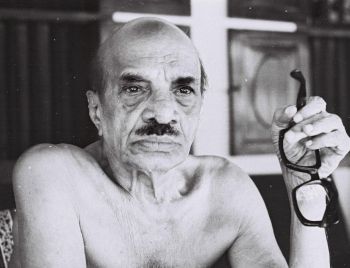
Muhammad Basheer of Vaikom (commonly known as Vaikom Muhammad Basheer or the Beypore Sultan) needs little introduction. As a writer, he is remembered for his cutting and incisive attacks on political, social and religious malpractices, his rhythmic, lyrical and evocative prose, and his revolutionary use of common idioms and conversationalist rhetoric.
There can be no mention of Basheer without mention of revolution. He was as much a product of his revolutionary times as he is a product of his rebellious spirit. It was, perhaps, the potent marriage of the two that gave birth to his unique genius.
Given the strong political and philosophical undercurrents of Basheer’s work, it is essential to understand his oeuvres in the context of the social and political change in Kerala that preceded him, to which he found himself often responding:
Basheer, Narayana Guru and the Kerala Literary Renaissance
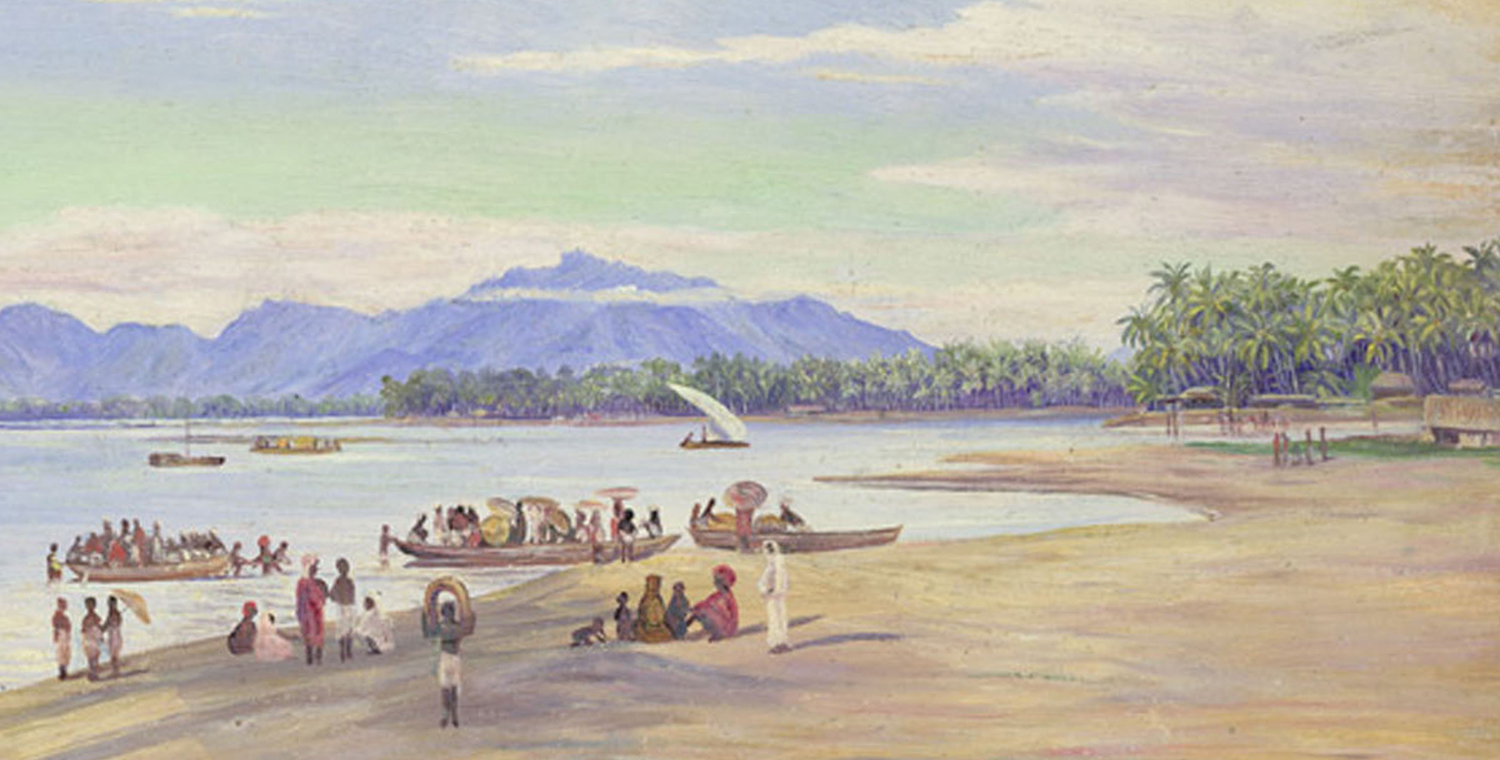
Basheer’s visage and prose verse have become synonymous with Kerala’s famous egalitarian renaissance that began with Narayana Guru’s social revolution at the end of the 19th century. As such, he was not only one of the leading figures of Kerala’s acclaimed Literary Renaissance, which took place in the first half of the 20th century, but additionally, he was a direct beneficiary and descendent of the seminal political and social egalitarian revolution that was fought in Kerala under Guru, a revolutionary social leader.
On considerably scant financial resources, Kerala has achieved social indicators on par with some of the world’s most developed and wealthy nations. Most scholars recognize this exceptional phenomenon as the direct result of the social revolution fought by Narayana Guru during the second half of the 19th century. This revolution was maintained and rejuvenated by important figures such as Basheer.
Guru crafted the equivalent of a religious and philosophical plain language movement that had a substantial impact on Kerala’s culture and cultural production. Using commonly employed Malayalam and Tamil words, he crafted an entirely new philosophical movement that was based on fundamental human equality and the denial of difference between people. Guru’s ethos was simple: he held that all men are equal in essence and, most importantly, in intellectual capacity. There was no high caste or low caste, and no high culture or low culture. Knowledge was for everyone, and equally attainable by everyone. This ethos had a substantial impact on Basheer and other modernist writers in Kerala.
Before the advent of Narayan Guru, language itself was highly stratified. Words were restricted by caste, class and gender. For example, there was an upper class word for salt and a lower class word for salt. The penalty for lexical transgression for the poor man was often death. There were invisible but unassailable barriers to cultural production. Language was a strong force of social and cultural division, with the cloistering and regulation of Sanskrit and its related episteme at the epi-center of cultural hegemonies. Malayalam-language Arts and Literature were also carefully regulated by complex restrictions on meter, rhythm, and register of language.
Guru’s careful intellectual revolution successfully reversed these divisions. He argued that thinking was the most fundamental and essential characteristic of human beings and, therefore, all human beings must have equal access and right to tools of rigorous reflection. He reinvented mass culture and inculcated it with new philosophical methodologies that depended upon the most common tools of analysis, such as observation and formal description. In so doing, he destroyed the very basis of feudal caste orders, which deemed careful thinking, critical observation, philosophical analysis and pontification as society’s most highly regulated practices. Guru deemed these practices as universal and, there by, opened them up for all people–regardless of social caste or social background.
Guru’s revolution forms the essential backbone of modern Malayalee culture. It was a pre-requisite to the extraordinary social change the state experienced in the last century. Guru’s prolific writings and his plain language movement serve as the essential backdrop for understanding figures such as Basheer who motored the Kerala Literary Renaissance.
Basheer proclaimed that Guru “was the greatest human being, born in India during the last 500 years. We have not understood him properly yet.” Guru’s revolution set the stage for Basheer and his contemporaries to experiment new techniques and modes of linguistic expression, to escape the literary trappings of caste and class, and to pen a new democratic mode of language. As a key member of the Kerala Literary Renaissance, Basheer used his pen to strengthen the growing culture of egalitarianism in Kerala. Through his writings, he brought a sea of change to the landscape of Malayalam Literature.
Basheer, Kerala and the Malayalam Language
Basheer is amongst the world’s greatest modernist writers. No writer understood the tonality and rhythm of spoken language quite as he did. No experience trumps reading him in his original tongue – Malayalam. With Greenberg-esque ferocity, his pen brings language in direct confrontation with its essential materiality.
In addition to a truly contemporary understanding of the social and political context of his writings, Basheer also possessed a deep historical intuition about the spirit of the land. His prose carry the legacy of an ancient land with the same ease, recklessness and abandon that allow young children to play football through sacred ruins. He recognizes Kerala’s history, but understands that worth for humans does not lie in clinging to some corroding past, but in staying true to the forms and passions of the contemporary moment. As was for Narayana Guru, for Basheer either everything is sacred or nothing is sacred. Imagining gradations of the sacred seemed laughable, at best.
His prose are hyper-aware of the slurs and slants of colloquial speech, as well as the officious pomp and ceremony of oration. Though he is a writer, his posture to his instrument is fundamentally skeptical. He finds frustration in the hegemony of language and the various hegemonies that the differentiations in the registers of language generate. He stood outside of human hierarchy, observing and recording with dry and perceptive cynicism.
One of his popular short stories, Vishwavikhyathamaya Mookku (The World Renowned Nose), takes an officious tone to describe the fate of a man with an exceptional nose. The narrator describes, with documentary seriousness, the tale of a man who rises and sinks through fame to infamy on the merits and demerits of his nose and the human circus it generates. The motif in this case is merely a sleight of hand (or a perhaps a sleight of nose). It deflects the reader’s attention momentarily while Basheer spins a more intricate tale about the real protagonist of the story: fickle human nature.
Basheer understood the Malayalam language as never before in literary circles. He understood it as it functioned, as it was received, read, heard – not merely as it was prescribed, proscribed or meant to function. He had little concern for notions of language that accorded with grammatical ideals. For him, writing was a vehicle for communication and description. He used the tonality of language itself to push against the materiality of writing – its sound, its cadence.
In Basheer, the presentation or form of a phrase or a word is never enslaved by convention. It is deeply rooted in close attention of register and personality. He privileges function over form; stylistic honesty over formalism. By rejecting the non-descriptive formalities of linguistic convention, he penetrates deeply into the space that his language aims to evoke.
To this end, he is abrupt, incoherent, enigmatic and at times even vague. He fashions singular words into sentences more potent than paragraphs. There is no immediate continuity from these one-word bombs. The reader reads, then pauses as she tries to take it all in – all the meaning of a word that seemingly burst into text like an orgasm. In less than a phrase, he brings the entire movement of his thought to full form. The cadence is complete. The reader pauses just to catch up with him. In that moment, his cadence has forced a deliberate silence.
It is hard to say which is more potent: Basheer’s curt formalism or the masterful and rhythmic silences that follow the absolute isolation of some of his sentences. His full stops bleed a heavy tyranny. They stop the heart and soul in their tracks across his page. Basheer’s silences are not empty. They are brimming to the seams with enigma, uncertainty, death. Some would argue that his pauses are placed in such a way that they force the reader into some primordial nothingness.
There is beautiful simplicity and lyrical cynicism in his verses. Still, the moments between his verses, the forced pauses he skillfully executes through the sheer force and control of his medium, these moments speak of the unknown, isolation, the ignorance of the human condition, the ignorance about the human condition. They hint of the unspeakable, the unknowable. In these pregnant pauses between his words, the beauty and lyricism of his words seems to disperse – as quickly as it came. His words, like life itself, for a moment, seem fleeting.
No matter how many times you read Basheer, he evades you. His pauses, his sarcasm, his brevity – he could mean one hundred things, and with each horizon onto his writing each new meaning seems more resonant and profound than the last. He is fleeting, yet firm. Mysterious, yet reassuring.
Basheer uses language, but transcends it all together. In his firm grip, language is no longer merely a tool of communication or information. It is a channel of transport that is deployed to carry the reader into an emotional vortex. For a moment he is silent, and suddenly, it feels as though the reader can understand the true meaning of love or the enigmas of life. He continues only to defy his own certainty.
Basheer’s words are not meant to stand still. They are impatient, some might suggest even explosive. They mean to push you – over the edge of convention, past the boundaries of identity and certainty, into a Sufi realm of the eternal mysteries. The world and all its pettiness is meant to look ugly. It is meant to look awkward. The false grandeur of life is erased by the sheer strength of his descriptions of life’s contradictions, its insouciant injustices.
His writings demonstrate the revolutionary power of the word in the context of the everyday. He held grammar in contempt. He was a loyal student of the colloquial tongue. Through him, grammar was subverted to slavery under the master of common place language and the everyday.
He was a writer. He was more still: he was a visionary, a freedom fighter, a socialist, a particular kind of humanist and universalist. He bridged the gap between the common man and critic – bringing to the world a high art bathed in the experience of un-privilege. The Beypore Sultan remains one of India’s greatest writers.
A Brief Synopsis of Basheer’s Life
Basheer’s life is as restless as his prose. His stirrings for revolution began from a young age. He left high school to join the freedom movement. He went to Malabar to take part in the Salt Satyagraha. He was imprisoned, promptly, even before he could participate. His inclination landed him in jail for three months. He was released in 1931, after the Gandhi-Irwin Pact. He continued to support the freedom struggle and edited a revolutionary journal. When a warrant was issued for his arrest, he left Kerala.
His flight from Kerala marks the beginning of a unique, Sufi-esque journey of discovery. He traveled throughout China and Africa, across the length and breadth of the pre-Indian nation. He wandered for years, keeping starvation at bay by working a variety of odd jobs. He worked as a daily wage laborer, a cook and a newspaper man. He lived with Hindu ascetics and Sufi mystics – following their customs and practices.
He returned to Kerala in the mid-30s. Here, Basheer came to writing in desperation. After years of trying to find a steady job, he walked into the office of a small newspaper. It was a poorly funded one-man operation that promised to pay Basheer for a story. His first story was a path breaking romantic fiction, Ente Thankam (My Precious). Its unconventional female protagonist was a hunchback.
Basheer continued to write prolifically. He authored several novels and countless short stories. Most popular amongst these are Balyakalasakhi (My Childhood Friend) – a tragic tale of childhood love, Shabdangal (Sounds) – a story of the life of a World War-II soldier, Mathilukal (Walls) – about love that blossoms between two prisoners who never see each other, Janmadinam (Birthday) – narrates the difficulties of a young man while trying to eat on his birthday and Anargha Nimisham (The Limitless Instant) – a collection of short stories that deal with philosophy and spirituality. The first piece of The Limitless Instant is a prose poem of the same name that speaks of self-annihilation that can be interpreted equally as a Sufi/Bhakti description of love/longing for God or a romantic description for longing for another person. It is translated below.
From the fact of you and me, in the end, you alone will remain. You alone.
The time for travel has approached very near.
Like a monsoon cloud on the verge of rain, this sobbing memory bursts from my inner-soul.
My friends do not know of this condition. Sometime somewhere they approach me; they push me to spin tales to make them laugh.
For their sake, I tell a tale of some kind or the other. I am laughing with them. They do not hear the din of the pain within my laughter.
Here I am going to fuse into oblivion.
Oblivion.
An unimportant event. Or of the utmost importance? Something … happened–is that important? No matter what, I am the limitless instant between the two. A past tense tucked into the hem of the present tense.
A today ready to fuse completely into yesterday. Millennia…Ions…Never-ending…permanent yesterdays
Are taking their leave.
Finished–No, about to finish
From the next instant I will be fused into forgetfulness into the millions upon millions of yesterdays
There are so many who scattered. So many have already gone.
Where were they headed?
The countless millions who went before me–Memory aimlessly heads to touch the beginning. Beginning…!
It is as though I have merged into the unknowable border of vastness, mystery. There, a din..The endless endless chaos of primordial stirring.
Are you attentive?
All these years, with limitless compassion, you loved me. You tolerated me. You know everything about me. I am like an light novel you can effortlessly read again?
For me you remain a great secret.
Even after all these years … I was not able to learn anything about you. I loved you without knowing you. Without knowing, I hated you. Knowing fully well, did I cause you pain?
Even still, even still you loved me.Tolerated me.
I have also told you many secrets. And you have seen all my actions. Will you make me an object of ridicule?
I am leaving.
You must understand it is because I loved you. When did you and I meet? Did we meet? I tried. In the end, I only learned to love. No. If only I could learn properly one more time. Ignorance. I did not know anything of significance.
Just like I came, I am returning alone.
The time for travel has approached very very near.
From the fact of you and me, in the end, you alone will remain. You alone.
Close to two decades after his death (he died on July 5, 1994) and three decades since he was awarded a Padma Shree by the Indian Government, Basheer stands as a towering figure of critical insight – both for Keralites and for Indians in general. His writings have been translated into numerous languages and inspired innumerable plays and films. His writings and the struggles they emerged from speak to the various hopes and challenges that forged the Indian nation during the early part of the century. His observations and his clinical cynicism coupled with his faith in fundamental values are perhaps far more valuable today than ever before. His message seems vital: while we cannot lose hope in the the fundamental truth of human equality, we must always stand as careful observers to the insanities and injustices of the human condition. Equality and fairness are things that we must always strive for. They are never freely given. He cautions repeatedly: so long as there is more than one human being on earth, there will always be cause for conflict. Regardless, we cannot surrender our critical faculties. We can sacrifice all else, but we should never sacrifice our minds.