
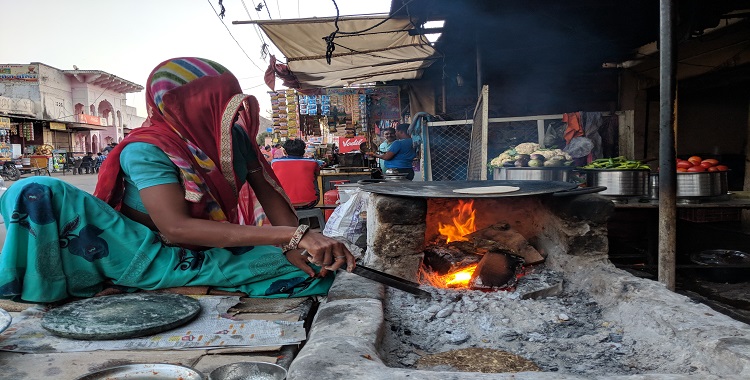
Her cooking is the honeycombthat keeps him succulent.He is seated, King Kong, at the head of the table,she is unseen, in the kitchen,sweating in holy profusion, sanctified byself-sacrificing labor,the okra is fried to perfection, has been soakedin tamarind juice, the sesame seeds pounded and groundto a paste, poured exactly five minutes before the flame is turned off,simmering, turned side to side, not too brittle,supple, gleaming in grainy white coats,she smugly concedes periphery jobsto a daughter-in-law,who is allowed to chop and measure out,forbidden from the fine act of cooking in this goddess’s kitchen.
There is a hushed silencein the sanctity of this evening ritual,the primary steel plate for rice,the quarter-sized plate for sides like papadamus,chutneys and avakai and a second vegetable,a katori for the sambar or kutu, or perugu,into the meal, this plate might be a repositoryfor chewed drumsticks, avakai bone, tamarind,the paraphernalia of supporting herbsthe flotsam and jetsam of ingestible food.
He eats, connoisseur of gastronomy,she sends him sidelong glances ascertaining his judgement,every scooped slurped bite is a religious act by a God,he keeps his face impassivecareful not to spill out too marked an appreciationkeeping the possibility of pride in check,doing her a favor multiplying her virtue.She understands his face as a farmer knows his soil,displeased, his face can turn dry and cracked as a drought-land,as a linguist know phonemes and syllable—a twitch, a blink, pause, measured stareand silence are signs signifying things:a refill of sambar without the vegetables/a refill of sambar with the vegetables/a refill of sambar with only the bottle gourd/the need for raw onions/not enough salt/he scrutinizes the rotis, tad over burnt, he says,she is mortified; chastised she hurries to re-make onemore perfect round moon in this perfect harmony.
And I watched always exiled from thissoundless solemnity for a decade,wondering, why,I could not see the beauty of it.
***
Photo by Aarti Krishnan from Pexels