
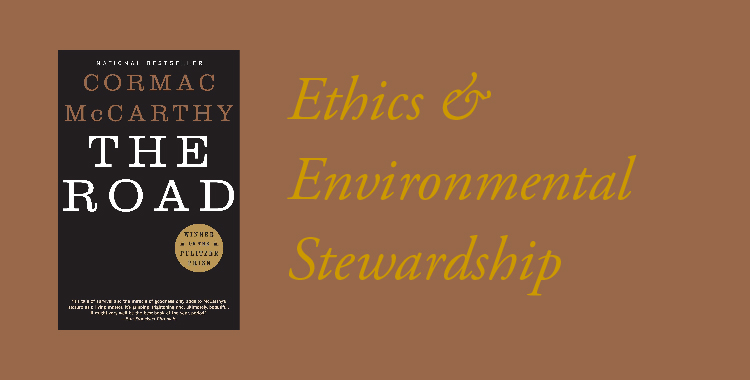
Cormac McCarthy’s The Road can best be described as an exploration of human complexity in the wake of life-threatening conflict. It follows the story of a father and son, both of whom grapple with difficult questions about meaning and morality as they search for safety in a post-apocalyptic wasteland. (Spurgeon). Critics have often claimed that the novel promotes an angle of moral ambiguity, as there are recurrent moments during which characters are faced with significant ethical dilemmas (Lilly). Yet, although there is undoubtedly morally ambiguous symbolism present within The Road, that doesn’t mean that the overarching ethical stance of the novel is one of moral ambiguity. In fact, one might argue that the novel takes an objective ethical stance, specifically regarding humanity’s treatment of nature. After analyzing The Road using the theories of ecocriticism, psychoanalysis, reader-response, and deconstruction, it becomes clear that McCarthy’s novel, while feigning moral ambiguity, conveys an objective message about ethics, the environment, and what will become of the world if either is neglected.
Before contemplating the novel’s moral implications, it is important to know a bit about McCarthy himself. Although McCarthy is now hailed as one of the greatest writers of the twenty first century, he was once quite obscure and unappreciated. His novels, while critically acclaimed, only sold a few thousand copies and failed to infiltrate the literary scene at large. Additionally, many readers found his earlier works to be needlessly gritty and disturbing. Yet, towards the late 2000’s, McCarthy’s work began to gain traction in the literary community, even climbing to the top of best-selling lists (Cremean).
Although McCarthy was born in Providence, Rhode Island, he likely draws a large portion of inspiration from his upbringing in the southeastern United States. When McCarthy was young, his family moved from Providence to Knoxville, Tennessee where McCarthy’s father worked as a lawyer. Fascinatingly enough, as a boy, McCarthy was never fond of school work, but instead invested his time in a myriad of hobbies and interests, the most notable of which was nature and the environment (Cremean). It is no wonder, then, why so much of his work is set in the southeast, his descriptions vivid and evocative of natural albeit charred landscapes. Mindfulness of McCarthy’s biographical background will be greatly beneficial moving forward in the analysis (Cremean).
Transitioning into psychoanalytic criticism, the man in the story makes for an interesting spectacle of inner turmoil. All throughout the novel, he can be observed ruminating over tough moral questions. Specifically, towards the end of the narrative, when he and the boy seem to be encountering more wandering survivors than ever before, he struggles to determine how exactly he is to interact with them. To put things in Freudian terms, the man’s id clearly wishes to cause harm to his fellow fugitives, even people who seem innocent or who don’t have any resources left. Nevertheless, it is the man’s son who acts as a filter for the man’s moral decisions. As the boy becomes upset nearly every time the man threatens a wandering traveller, the man is often faced with a moral dilemma: will he follow his survival instincts and do harm to the people they encounter, or will he allow them to escape? Although the man harbors ill will towards nearly everyone he and the boy encounter, he usually chooses not to go through with the desires of his id. In this way, the boy acts as a catalyst for the man to listen to his superego rather than his id, and the boy himself functions as the man’s ego, filtering his actions with moral convictions and expectations.
In keeping with the theories of Freud, it is worth noting the various dreams that the man has throughout the story and contemplating the meanings behind said dreams. The man’s dreams are primarily presented in two forms: tranquil and horrifying. He dreams of peaceful landscapes and pleasant memories shared with his wife and son, while at other times dreaming about death and destruction, often envisaging the rotting corpse of either himself or his son. Fascinatingly enough, the man seems to possess a certain awareness of the meanings behind his dreams, and they are not what one would expect. Rather than making the assumption that the pleasant dreams are a good omen while the disturbing ones signify danger, the man assumes just the opposite. In fact, he warns the boy not to succumb to pleasant dreams for, according to him, pleasant dreams are a symbol of surrender to and acceptance of death. One could argue that this interpretation of dreams as warnings about death is a result of condensation, as single images are attached to meanings that would normally seem unrelated. Whatever the case may be, it is clear that the man sees great value in his dreams and tends to use them as a guide for making decisions and exploring his unconscious thought.
Although the man in the story undoubtedly experiences the most inner turmoil of the two protagonists, there is merit in examining the boy’s psychological state. As Loren and Dent suggest, there is much more to a person’s psychology than mere conflict, and the sum total of a person’s life experience is to be carefully considered when conducting a psychological analysis (Dent). Upon the boy’s introduction to the story, it becomes quickly apparent that his arc revolves not around his own inner struggles, but around the inner struggles of others. The boy himself seems to have a very clear-cut view of morality, as exemplified by his reactions to the violence enacted by both his father and other characters. Take, for instance, the man and the boy’s interaction with Ely, an old man they encounter while venturing down the road. When the man seems extremely hesitant to offer Ely any food or clothing, the boy becomes extremely upset, even though it is obvious that the man does not lack compassion and is only trying to protect his son from potential danger (McCarthy 162). Needless to say, the boy holds little regard for the intentions one may employ in order to justify their actions. He cares only about the objective goodness or evil of an act and, in this way, he seems to exhibit little to no moral conflict in the story.
Thus, it has been demonstrated that the man undergoes a significant amount of inner turmoil while the boy retains a morally black and white perspective. Yet, what does this demonstration say about the moral implications of the novel itself? Before answering this question, it is worth noting the role that the boy plays in the man’s life. The man himself admits at the beginning of the novel, in rather cryptic terms, that the boy is his life force: “If he is not the word of God God never spoke” (McCarthy 5). Keeping this in mind, perhaps McCarthy is suggesting something about the nature of ethics in the boy’s moral objectivity. Given the fact that the boy serves as the man’s sole source of hope throughout the novel and even ends up surviving, there is something to be said of his grounded moral perspective, which stands out in a world full of moral ambiguity. If moral ambiguity seems to end in destruction in McCarthy’s vision, then what is implied by the survival of the ethically objective person?
When it comes to ecocriticism, The Road lends itself to a surplus of fascinating landscapes and images. One such example is its portrayals of charred trees, rotting human corpses, and masses of land desecrated with multiple layers of ash. Upon reading such graphic descriptions of environmental demise, the reader is naturally prompted to question what event led to such a disastrous outcome. Yet, interestingly enough, McCarthy only ever hints at the nature of the novel’s apocalypse, never revealing the cause outright. While so few details are given, it can be inferred that the apocalypse likely came about due to natural causes, as everyone on earth seems to be affected by it and all the devastation seems organic in nature. This being the case, one has to wonder why McCarthy chooses to write about a naturally occurring apocalypse rather than one that came about due to war or some widespread human conflict. Favoring a natural apocalypse is doubtlessly an intentional choice, and it stands to reason that McCarthy wants to make a statement about humanity’s treatment of the environment.
One of the most prominent exemplifications of McCarthy’s message can be found within the descriptions themselves, which give human-like characteristics to nature and trigger the reader’s empathy. “The country was looted, ransacked, ravaged. Rifled of every crumb” (McCarthy 129). These powerful adjectives evoke the image of a landscape that is in ruins not only because of an apocalypse, but because of the greediness and savage inclinations of human beings. The earth groans out in response to having its landscapes pillaged for the sake of human profit. If narrative can serve as a glimpse into the symbiotic relationship between man and nature, then McCarthy’s imagined earth is doubtlessly an adverse one in which humanity rummages and nature punishes (Oppermann).Perhaps McCarthy is refuting the old rationalist idea that nature owes humanity its resources and should be dominated.
One technique that McCarthy utilizes throughout the novel is the subversion of the traditionally “sublime” and “pastoral” scene. He accomplishes this feat by taking what has the potential to be beautiful imagery and turning it on its head. Take, for instance, this description of land that the man and boy encounter while making their way to the coast: “The land was gullied and eroded and barren. The bones of dead creatures sprawled in the washes. Middens of anonymous trash” (McCarthy 177). This description serves as the opening statement of a paragraph, setting the scene for the next plot point to run its course. It is at the beginning of a scene when most writers take the liberty to flesh out their settings, often doing so by conjuring up serene imagery that pleases the senses. Yet, rather than depicting beautiful scenery, McCarthy paints a setting that is better described as bleak and unsettling. While it can be argued that this description is a natural response to the type of landscape that McCarthy chooses to display as part of his dystopian vision, it is worth noting that his carefully chosen words are all too reminiscent of pleasant depictions of nature. “It was a beautiful day,” “the sun hung high in the sky,” and similar phrases are employed far too often in writing for this choice of words to be a mere coincidence. McCarthy’s phrasing is certainly a stylistic choice that further encourages readers to ponder the whereabouts of the devastated natural landscape.
At its core, The Road can be thought of as a commentary on the maltreatment of the environment. Since there are so few characters present within the novel, one might argue that nature itself serves as a key narrative component, often pushing the man and boy to continue on in their travels. In more ways than one, nature takes on the role of a villain, and the struggle between man and nature is frequently highlighted. Oftentimes, it is not another human being which threatens the lives of the two protagonists, but the environment, which is littered with ashes and smoke and contains little to no natural resources. Thus, the man and the boy find themselves in a nearly constant battle against nature for survival and wellbeing. Through this constant battle, McCarthy is likely making the point that, if humanity takes advantage of or mistreats the environment, then it should not expect the environment to be kind in return. Further supporting the notion of a symbiotic relationship shared between man and nature, The Road serves as a wake up call for people to be better stewards of the environment.
When approaching The Road from an angle of reader-response, it is important to consider the “horizon of expectations,” specifically when it comes to the genre in which McCarthy is working. One can go about this process by first identifying the themes and attributes that are commonly found within the genre. More often than not, dystopian literature carries with it a tone of intense bleakness and hopelessness, one that tends to linger until the end of the narrative. Nevertheless, The Road while still undoubtedly taking on a bleak tone, emits a remarkable sense of hopefulness. Regardless of what the man and the boy are faced with, both characters possess a powerful fighting spirit and will to live, something the man refers to as “carrying the fire (McCarthy 278). Even when the man becomes very ill and knows he will die soon, he travels on down the road with the boy, still doing everything in his power to protect the boy from others they may encounter. Likewise, even after his father’s death and he is left all alone, the boy chooses to carry on in his survival attempts and joins a new family. He never gives up. In response to the unique tone found within The Road, which somehow manages to emit hopefulness while retaining its bleakness, readers should feel pleasantly surprised and have their expectations subverted. In other words, McCarthy actively combats the “horizon of expectations,” successfully conveying a tone that is rarely found within dystopian literature.
In adhering to the conventions of the transactional analysis model, it is important to consider the ways in which one’s own experiences might affect the reading process, specifically in regard to tight-knit familial relationships (Purdue Owl). For instance, an adult, especially a male, who has a son, daughter, or child whom they are close to is likely to appreciate the story’s father-son relationship more than someone who doesn’t. By the same token, readers who have an estranged relationship with a parent or child are likely to be skeptical of the novel’s themes of familial love. This particular inverse relationship shared between reader and text proves to be a strong one. As a result, certain readers might not be able to pick up on McCarthy’s moral message as easily as others as they are likely to feel alienated by the novel’s fascination with the father-son relationship. This may not be the case if the story had more areas of focus besides the father-son relationship but, because there are so few characters and dialogue is used very sparingly, there is not much else to ponder beyond the greater implications of post-apocalyptic life, which are seldom explored.
Having said all that, what might a reader be able to infer about McCarthy’s meaning based solely on the text itself and personal life experiences? It would not be far fetched to interpret The Road as being a testament to the endurance of love in the midst of life threatening situations. After all, even when faced with brutal environments, starvation, and bloodthirsty travellers, both the man and the boy possess the willpower or “the fire” to withstand hardship till the very end. Arguably, the only reason either possesses this willpower is because they have each other. The man even tells the boy at one point that if the boy was to die, then he would want to die as well (McCarthy 11). In the same way, at the end of his father’s life, the boy admits that he would rather die with his father than go on living (McCarthy 278). Yet, because he knows that his father will be with him in spirit, the boy chooses to carry on the fire. It is a deep love for each other that enables both the man and the boy to survive for so long (Hamilton). If they did not have each other, they never would have made it half as far as they did.
Regardless of the way in which a reader interprets a text, there is no denying that a reader’s personal experiences will inevitably either enhance or stifle their comprehension of McCarthy’s moral message. Readers who have had positive experiences with familial relationships are likely to be more accepting of this message, while readers who have not had positive experiences may feel alienated by it. Whatever the case may be, it stands to reason that McCarthy is a strong proponent of the notion that familial love is powerful enough to overcome almost any hardship. This idea is supported by the fact that the entirety of The Road focuses in on a singular tight-knit familial relationship, and it is this relationship that ultimately pushes both protagonists to survive until the end of the story.
Finally, after having analyzed The Road using the theories of psychoanalysis, ecocriticism, and reader-response, one can begin the more challenging task of deconstructing the work. One of McCarthy’s most stylistic choices is realized in his own deconstruction of language and grammar (Culler). Rather than adhering to the traditional conventions of punctuation, and the separation of dialogue via quotations, McCarthy forgoes these conventions altogether, turning The Road into a broken albeit compelling reading experience. Additionally, this choice influences far more than just the tone and formatting of the novel: it serves as a metaphor for the breakdown of reality (Wielenberg). In more ways than one, the man and the boy live in a sort of “post-world” existence. The norms and conventions of the previous world have all but ceased to exist and, in this new state of existence, no one is quite sure how they are to handle themselves (Wielenberg). As food and resources are in short supply, the remaining travellers on earth are desperate to survive no matter what the cost. As a result, morale is negated, and human beings are willing to fight, murder, and even cannibalize each other. Breaking the rules of grammar and punctuation is a fascinating way to highlight this moral decline. It calls into question why there are rules set in place to begin with, and this haunting idea translates beautifully into the existential pondering that appears all throughout the narrative.
Upon contemplating the themes of The Road, it becomes quickly apparent that one of the novel’s most compelling concepts takes on the form of a binary opposition: meaningfulness vs meaninglessness (Hamilton). This concept can be found all throughout the narrative, especially when the two protagonists interact with other survivors. Take, for instance, this moment in which the man and the boy discuss evidence for the existence of God with Ely: “I guess God would know it. Is that it?” asks the boy, followed by Ely’s somber response: “There is no God.” After having struggled to survive for years in a post apocalyptic world, Ely is visibly jaded and believes that life is meaningless. In contrast, the boy, who is relatively naive and inexperienced in life, carries with him a subtle belief in God and the greater good (Hamilton). This is just one example of meaningfulness vs meaninglessness, manifested in the boy’s optimism and Ely’s borderline nihilistic outlook (Spurgeon). The presence of this binary opposition within the novel should prompt readers to question for themselves the reality of their own existence and contemplate whether or not commonly held beliefs about such a matter can be trusted.
Ironically enough, whereas the aporias of other works tend to signify the point at which a text loses all meaning, the aporia of The Road arguably signifies a deeper meaning hidden within the text (Hamilton). Due to the debase morality that humanity exhibits time and time again, the broken grammatical conventions utilized, and the grim nature of the story, many readers assume that McCarthy is arguing in favor of nihilism (Culler). Yet, these readers fail to consider the story’s ending, which radiates hope rather than meaninglessness. If McCarthy truly believed in the bleak worldview conveyed by the rest of the story, then he would likely choose to end his novel on a more despondent note, perhaps killing both the man and the boy instead of having the boy carry on with his life. Yet, he instead not only allows the boy to survive, but offers him a second opportunity to be part of a family (McCarthy 282). This hopeful ending contradicts the bleak tone perpetuated by the rest of the novel. As a result, The Road takes on an entirely new meaning, one that falls in line with the moral message that McCarthy is trying to convey beneath the themes of existentialism and ambiguity.
Having said that, what exactly is McCarthy trying to convey with his contradicting themes and worldviews? Ultimately, despite the noticeable presence of postmodern thought found within The Road, McCarthy is conveying the idea that life does indeed have meaning (Ghaderi). Not only does it have meaning, but each and every person, regardless of circumstance, is called to a specific purpose: to take good care of the planet and the people living on it. The apocalypse that occurs before the beginning of the novel is heavily implied to have been caused by either nature itself or some widespread human conflict. It stands as a testament to what the world is liable to become if people ever decide to stop taking care of it (Spurgeon). This idea extends to both nature and humanity itself. Through the various bleak plot points that occur throughout the book, the reader can feel sure about two things, if nothing else: first of all, the reader can feel confident that, if humanity doesn’t take upon itself the responsibility to be good stewards of nature, then nature is likely to overtake humanity (Oppermann). Secondly, mistreatment of fellow human beings will often result in one’s own undoing. It is vitally important that each and every person take care of each other lest everyone succumb to their own selfish desires, resulting in humanity’s collective demise.
In conclusion, while the themes of existentialism and nihilism are indeed explored within the novel, The Road conveys an objective moral message about humanity’s place among both nature and its own kind. Simply put, if humanity chooses to misuse and scour the earth and its inhabitants, then it cannot expect either to be kind in return. Additionally, McCarthy utilizes this rather drastic warning to communicate an appropriate response: the idea that love is powerful enough not only to withstand hardship, but to unite human beings with each other and nature.
***
Works Cited
Cremean, David N. “Cormac McCarthy.” Critical Insights, 2013. EBSCOhost, http://eds.b.ebscohost.com.dsc.idm.oclc.org/eds/results?vid=0&sid=da75e90c-3619-4c63-9383-5fabedfbcf7a%40pdc-v-sessmgr05&bquery=Cormac%2BMcCarthy&bdata=JnR5cGU9MCZzZWFyY2hNb2RlPUFuZCZzaXRlPWVkcy1saXZlJnNjb3BlPXNpdGU%3d.
Culler D. Jonathan. “On Deconstruction: Theory and Criticism After Structuralism.” Cornell University Press, 2007. EBSCOhost, http://eds.b.ebscohost.com.dsc.idm.oclc.org/eds/ebookviewer/ebook/bmxlYmtfXzg4MTY4MV9fQU41?sid=da75e90c-3619-4c63-9383-5fabedfbcf7a@pdc-v-sessmgr05&vid=1&format=EB&rid=1.
Dent, Loren, and Christian, Christopher. “The Shifting Prevalence of Conflict in Psychoanalytic Literature: A Brief Report of a Corpus-Based Text Analysis,” Psychoanalytic Psychology, 2019. Educational Publishing Foundation. GALILEO, http://eds.b.ebscohost.com.dsc.idm.oclc.org/eds/ebookviewer/ebook/bmxlYmtfXzg4MTY4MV9fQU41?sid=da75e90c-3619-4c63-9383-5fabedfbcf7a@pdc-v-sessmgr05&vid=1&format=EB&rid=1.
Ghaderi, Ali, and Taghizadeh, Ali. “Faith and Reason in the Mad Subjectivity: Cormac McCarthy’s Post-apocalyptic Narrative ‘The Road.’” GEMA Online Journal of Language Studies, Vol. 16, pp. 173-185, 2016. Literary Criticism, http://eds.a.ebscohost.com.dsc.idm.oclc.org/eds/detail/detail?vid=3&sid=ee507ebc-1fda-45d3-82ba-817bf15cd8ee%40sdc-v-sessmgr05&bdata=JnNpdGU9ZWRzLWxpdmUmc2NvcGU9c2l0ZQ%3d%3d#AN=116434946&db=ufh.
Hamilton, Geoff. “Something to Be Done: The Road, Beckett, and American Autonomy,” Canadian Review of American Studies, 2017. GALILEO, http://eds.b.ebscohost.com.dsc.idm.oclc.org/eds/pdfviewer/pdfviewer?vid=3&sid=6c019d57-9cf8-48fb-a70a-9fa310ad8b7f%40sessionmgr101.
Lilly, James D. “Cormac McCarthy: New Directions.” University of New Mexico Press, 2014. EBSCOhost, http://eds.a.ebscohost.com.dsc.idm.oclc.org/eds/detail/detail?vid=1&sid=b8906099-dd3d-4430-8a78-7e8e81098cb8%40sdc-v-sessmgr01&bdata=JnNpdGU9ZWRzLWxpdmUmc2NvcGU9c2l0ZQ%3d%3d#AN=686739&db=nlebk.
McCarthy, Cormac. The Road. New York, Random House, Inc., 2006.
Oppermann, Serpil and Iovino, Serenella. “Material Ecocriticism.” Indiana University Press, 2014. EBSCOhost, http://eds.a.ebscohost.com.dsc.idm.oclc.org/eds/ebookviewer/ebook/bmxlYmtfXzEwNDk3MTNfX0FO0?sid=b8906099-dd3d-4430-8a78-7e8e81098cb8@sdc-v-sessmgr01&vid=2&format=EB&rid=4.
“Reader-Response Criticism.” PurdueOwl, https://owl.purdue.edu/owl/subject_specific_writing/writing_in_literature/literary_theory_and_schools_of_criticism/reader_response_criticism.html.
Spurgeon, Sara L. “Cormac McCarthy: All the Pretty Horses, No Country for Old Men, The Road.” Studies in Contemporary North American Fiction, 2011. EBSCOhost, http://eds.a.ebscohost.com.dsc.idm.oclc.org/eds/ebookviewer/ebook/bmxlYmtfXzM2ODUxM19fQU41?sid=b8906099-dd3d-4430-8a78-7e8e81098cb8@sdc-v-sessmgr01&vid=3&format=EB&rid=1.Wielenberg, Erik T. “God, Morality, and Meaning in Cormac McCarthy’s ‘The Road’”, The Cormac McCarthy Journal vol. 8 no. 1 pp. 1-19, 2010. jstor.org/stable/42909407.
***