
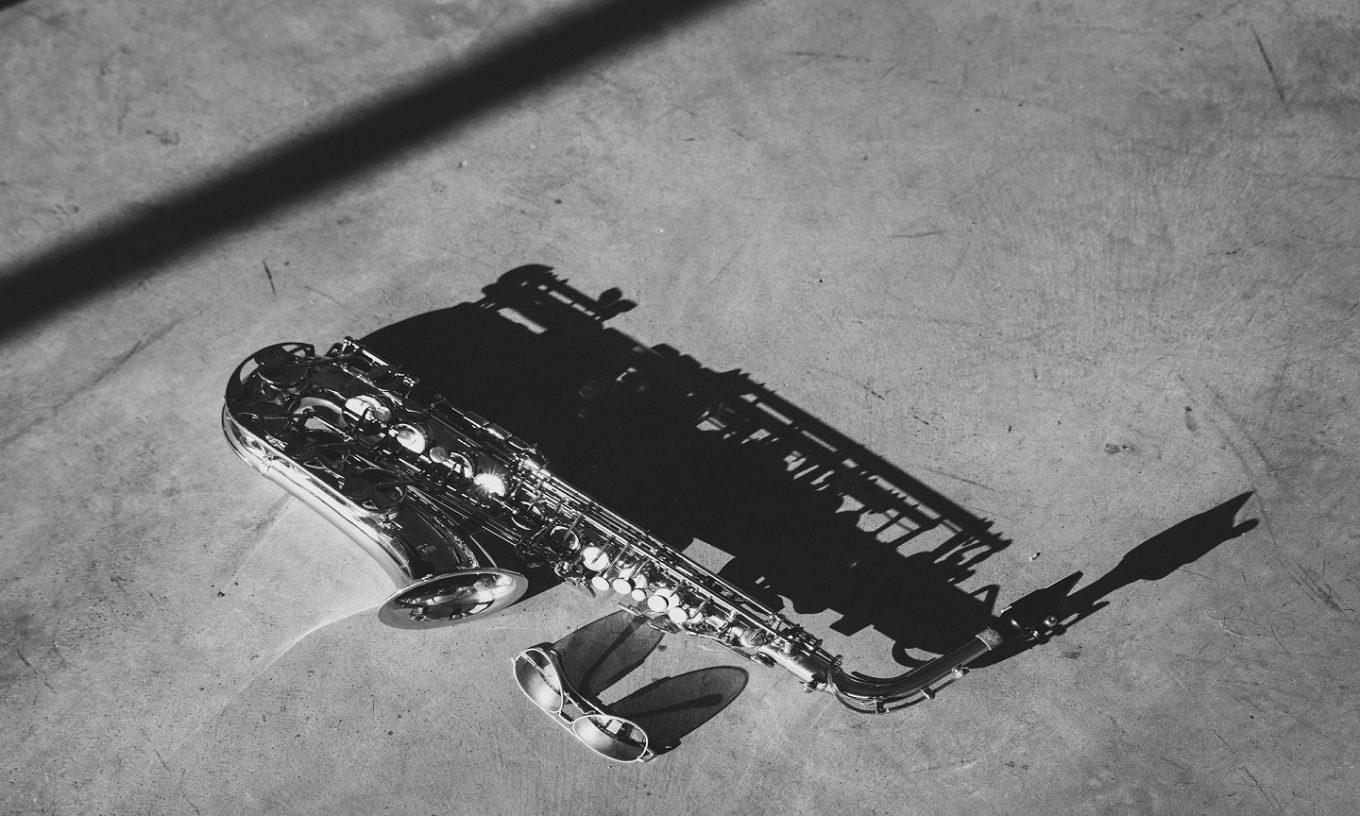
For a sax player it’s easy, she thought, you carry your instrument with you wherever you go, even on a plane. But if you’re a pianist, you turn up to the gig and play whatever they give you. No doubt the piano here will be good, maybe even a Bosendorfer like last year, very likely brand new, that’s all, not seasoned, the sound a bit too clean and clinical for jazz.
The seatbelt sign came on with a soft ‘bong’. The note of the engines changed, the aeroplane tilted, and through the oval window she saw a grid of white and orange lights wheeling under the edge of the wing. A city, Frankfurt, waiting for them on the dark earth below.
So once again I am about to land in Europe, she thought. Even after five years of touring here, I’m still astonished to see my name – Ivy Chen at B-Flat, or Tygmont, Friday, The Ivy Chen Trio – pasted up in the streets of these famous European cities, amongst the ancient cathedrals, the galleries and bridges and monuments. And people come to the gigs, they applaud enthusiastically and line up afterward for me to sign CDs. Of course, they think a Chinese woman playing jazz is a curiosity, almost a trick. They try not to let that show, but it does show, and if I don’t concentrate and shut them out, their heavy, patronising stares numb my shoulders and deaden my hands when I play. But all the same, Europe, to be playing in Europe!
A bump came up through the seat, another bump. They had landed. A string of runway lights gliding past, then a row of blue and orange Lufthansa tailplanes, and finally the bright greenish-white glow of the airport buildings under the black night sky. One more announcement, too quick for her in German but repeated in English, please stay in your seats with your seatbelts fastened until the aircraft has come to a complete standstill, before at last the jets whined to a stop and people were standing, stretching, reaching down their bags from the overhead lockers.
A long walk through a metal corridor, her red passport inspected carefully, but no questions, no obstacles, the process of arriving in Europe so smooth that in a few minutes she was sitting in a cream Mercedes taxi, heading into the city. When the hotel bellboy put her bag down in her room, she looked in her purse for a tip and realised she had only Chinese yuan. Too embarrassed to give him one of the bright red notes, she could only nod thanks, smile tightly. The youth left, closing the door quietly behind him.
She drew back the stiff brocade curtains. The room looked over the river. A chain of white lights ran along the riverbank; a small cluster of red and green lamps shone from a boat out on the black water.
The soundcheck was the next afternoon, and they would come for her with a car at two. Until then she was alone and free in Frankfurt. In Germany. In Europe.
Europe. It had been her grail ever since she was a teenage girl. As a piano student in the Shanghai conservatorium, she studied the great Europeans, Bach and Liszt and Chopin, but it was not so much Europe’s music that had bewitched her, as its art. For her sixteenth birthday, her parents gave her a big glossy book, European Art of the Early Twentieth Century. She had been mildly, respectfully interested in the Chinese artworks that surrounded her at home and at school, but these Western paintings first shocked her, then gripped her with something like a fever. Their vigour, almost violence; their boldness of colour; their sheer bursting life. She stared into the book for hours, trying to see the Europe that she was sure lay beneath each page.
She loved Chagall and Kirchner, because of their humanity, but most of all she loved Max Beckmann. The Europe she dreamed of was the Europe Beckmann painted; its sharp-edged buildings, its handsome, vulnerable and twisted people, its obscure but potent symbols, its elusive light. Beckmann’s paintings had made her determined to come to this Europe, to walk in it, to breathe it. And now she was once again here in Beckmann’s own city, Frankfurt.
She wanted to go outside, get some European air, convince herself she was actually here. She gathered her overcoat and scarf and put the big plastic hotel keyring in her purse. The swift, silent lift took her smoothly down to the lobby, and then she was on the street, looking at the river and the long concrete bridge, dotted with orange lights, that stretched out over the dark slow-moving water.
As she stared, entranced, a fine rain began to fall, smudging the detail of the buildings lining the street. She tied her scarf over her head, but stood, breathing the soft damp air, watching the lights blur in the misty drizzle. She could smell the river and the earthen footpaths that wound along its banks. It resembled the smell of the Pearl River in Guangzhou, her childhood home, but there was something else here, the particular scent of an old European city under rain; wet mediaeval masonry, wet sooty chimneys, wet cobblestones, wet, rotting linden leaves.
She turned her back on the river and set off toward the city centre, the ruby-red lights of the television tower her guide. Ahead, a patch of low cloud was lit up from beneath, and rounding a corner, she came upon the Hauptbahnhof, the main railway station. To her delight, in the rain and under the yellow arc lights, the station precisely matched Beckmann’s painting of it, the broad central arch sweeping, clean and dignified, across the canvas under a dark purple sky.
The sound of her footsteps on the pavement intoxicated her. It was joy to be walking in these rainy, darkened streets, alone, unrecognised. Free to walk all night if she wished, past the blank-faced apartment buildings, the shops, the cafés and warehouses and parking-lots and churches that made up this city. People have walked in these very streets, looked up at this night sky, smelt this river, since the time of Charlemagne, she thought. And as they walked, they had music running through their heads. Wandering troubadours’ ballads, concertos, military marches, opera, jazz, but always music. Music justifies a city, it justifies a nation, a people.
Her walk took on a life of its own. She was charged with energy. She didn’t care that her hair and clothes were dampened by the misting rain. Cars hissed past her, their red taillights starring in the air. She walked without thought, drinking in the city, its angles, its light, its atmosphere. She wanted to draw it all in, absorb this Europe into the core of her being.
And as she walked, abandoning herself to her impressions, the idea for a new composition began to appear. It started with the clack of her shoes on the pavement, like a ride cymbal. Over that rhythm a theme emerged, a theme in block chords, solid as the dark, square buildings around her. A lot of left hand, a repeated bass figure. In a minor key, reserved but strong, like the deep currents of the ancient river Main. She let all the shapes and symmetries of the city run unfiltered through her mind; glass office towers, curving tram-tracks cut into cobbled streets, ziggurat-edged old houses on the Römerberg, Gothic church spires shaped in grey stone but still somehow lighter than air. The river, always the river. As she walked, contemplating the colour and shape and movement of all these things, a melody began to form itself.
Before, she had always composed sitting at a piano, a few bars at a time, writing staves on a manuscript pad and scratching them out again, a slow, academic process. But this piece was unfolding as clearly, as inevitably, as in a dream. It had a stark, gloomy feel as it began, but then grew in vigour and colour, like Europe itself once you explored it; understated, almost melancholy, but strong, rich, enduring, deep.
And as she walked, keeping the rhythm with her steps, she imagined her solo, splashes of treble notes, fractured like the headlights and streetlights reflected by the shiny wet paving stones. She heard, without planning it, how the piece would resolve, the coda repeating, then ending with the correctness, the finality, of a train pulling in to the Hauptbahnhof on time.
I have it, a new, original blues, she thought, it’s good, and I should name it for this city that gave birth to it. Not Frankfurt Blues, too pedestrian. Iron Bridge Blues, maybe, for that pointed bridge across the Main that Max Beckmann painted. Ah, but if I’m going to summon up Beckmann, why not call it Beckmann’s Blues, no, better, Blues for Max Beckmann, my homage to him. And perhaps it’s not entirely unworthy of him; dark, with those bluish minor chords, but with melodic beauty too, like the strong, warm portraits he painted of his wife.
She peered at her watch; half-past eight. She had been walking for more than two hours, and she was suddenly footsore and very hungry. She was standing in a narrow alley. Ahead, the high walls on either side of her framed a slice of a broad boulevard under yellow streetlights. A red and cream tram sped across the gap. She recognised the street; without choosing any direction, she had returned to the riverbank, not far from her hotel. She walked to the corner, crossed the street, and in fifteen minutes was sitting in the hotel restaurant, a bowl of thick vegetable soup steaming in front of her.
The club was full from the start. The buzz of conversation hushed respectfully when she came on stage. Sitting under a blue spotlight, she couldn’t see the audience, but she felt them out there. She didn’t introduce herself, didn’t speak at all, simply began to play.
From the first notes, the music unfolded smoothly, ideas flowing out through her hands without need for thought. Growing in confidence, she improvised new harmonies, new chromatic colours, riding an unspooling thread of invention and adrenalin, scarcely giving them time to clap before attacking the next song. An hour vanished like that, and now, riding a wave of applause, she had come to the last tune for the night.
From her very first gigs in Europe, five years ago, she had always played John Coltrane’s Giant Steps. It was the only cover version she did these days, but she couldn’t abandon it. She told herself she must always play one piece from the canon, to show respect, to measure herself, and allow herself to be measured, against the great masters.
And it had become a kind of trademark of hers to play Giant Steps as the final tune of every gig. She knew people in the crowd were expecting, right now, to hear the five descending chords that began it, waiting to applaud to show their recognition. She could hear those five chords in her head. But her hands remained motionless above the keys.
The new blues. She hadn’t played it yet, not even in rehearsal; the music had never undergone the alchemical transformation from conception into audible notes, physical vibrations resonating in the air. But she was here in the city that had created the piece, and if she could not cut herself free from the old standards tonight, would she ever? Concentrating, she sat still, summoning up the shape and structure of the composition, letting its mood enter her as the audience waited. ‘Giant Steps,’ somebody in the darkness called out. There was a ripple of appreciative laughter. She took a deep breath. Then she struck the strong, dark opening chords to her new song, her new signature tune, Blues for Max Beckmann.
Photo by Andrey Linchenko on Unsplash