“I too believe that editing a journal is an attempt to make the world a better place.”
-Prafull Shiledar in conversation with Maitreyee B. Choudhary
TBR: Tell us a bit about the magazine you edit in Marathi.
Thanks, Maitreyee for inviting me to this conversation. I have been editing a Marathi literary quarterly called ‘Yugvani’ since last eight years. ‘Yugvani’ is one of the oldest running literary journals in Marathi, in publication since 1946 from Nagpur and we welcome Marathi writing from all over the world. We try to showcase the best new writing in Marathi. We have young readers and veterans from all over the country.
Marathi as a literary language, has had a long tradition of various kinds of magazines and journals. Every year more than three hundred ‘Diwali Special’ yearly issues are published in Marathi. But the readership for a literary journal has been always a petite. It’s always been a non-profit making endeavour demanding lot of commitment from the editors and publishers. I know, in the past, there used to be the Marathi journal ‘Jnanprakash’ (1849-1951) which was published for a period of 103 years. Since last few years, periodicals have become ephemeral due to several constraints like finance, reduced readership, etc. Despite this, ‘Yugvani’ has managed to garner a growing readership in recent few years. In fact, many of our issues have had readers from overseas too.
TBR: Tell us about your role in editing Yugvani, and how has this journey been?
I started editing Yugvani since April 2018. My idea of a literary journal is not restricted to literature and literary criticism. I try to be inclusive of writing on different kinds of art forms, and their relation to literature and life. This is a journal for nurturing creative minds, and a humble attempt to expand the vision of both writers and readers. I believe that a writer should be aware of the world of different fine arts and performing arts. Editing is my way of trying to connect these worlds.
A journal is mostly judged by its editorial policies. A wise editor can take the journal to new heights. There have been some luminous examples of this, like Poetry, (since 1912) edited by a series of editors like Harriet Monroe and Joseph Parisi. Then there’s also an example of the Hindi journal Pahal, edited by Gyan Ranjan. We can see that such journals have influenced and shaped up contemporary literary scenes in the languages. A good editor can give shape and sharpness to the body of a journal with his vision. Acquiring good writing is often not enough to keep the journal relevant.
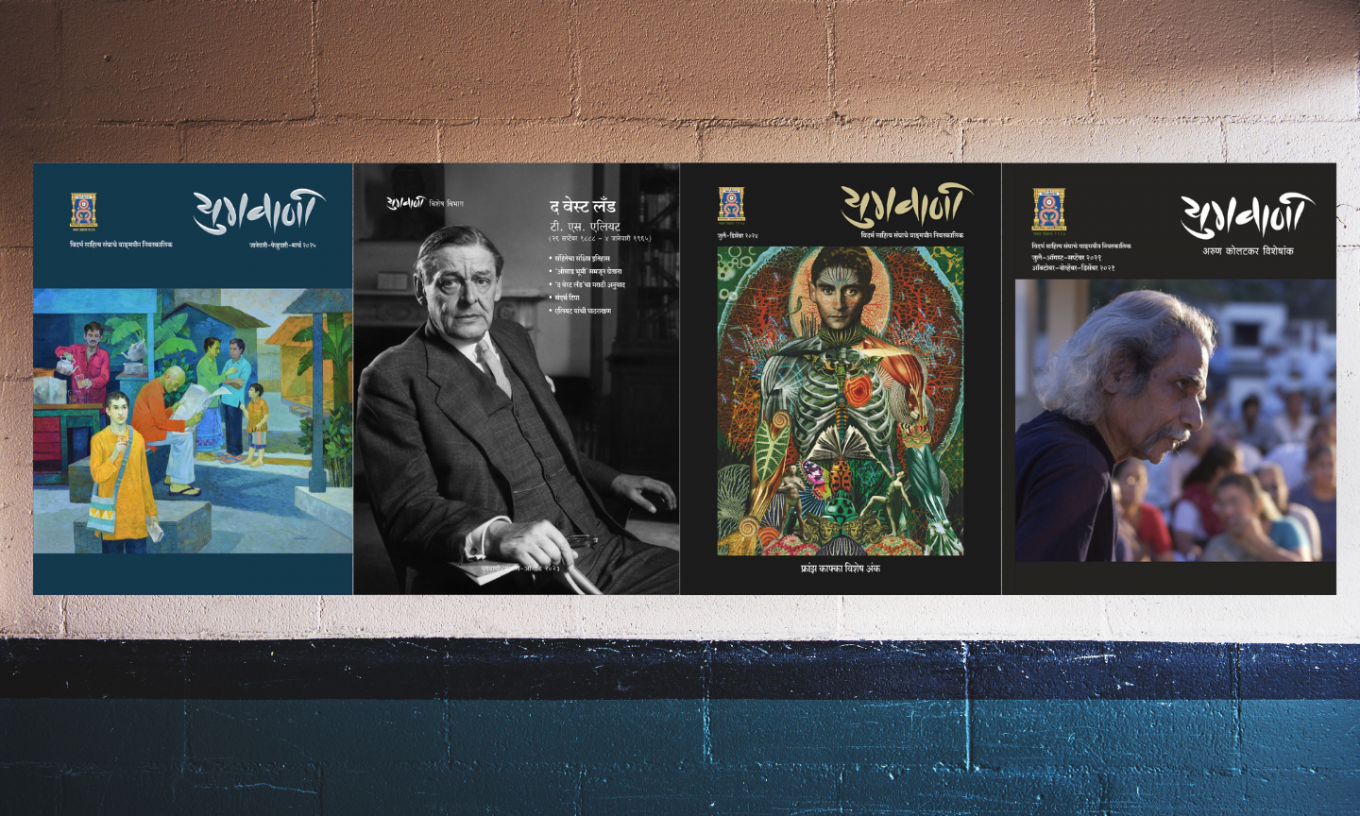
As my editorial strategy, I am trying to keep a focus area in every issue apart from the other writing. For example, we had an issue with a focus on Gandhi. In that issue, there were articles by veteran thinkers like Dr. Abhay Bang and Justice Narendra Chapalgaonkar. Apart from this, I could get images of Gandhi paintings from Atul Dodiya from his shutter series for the cover page of the issue. These paintings are a commentary on Gandhian thoughts. Thus, we can connect Gandhi in literature with Gandhi in paintings. Likewise, some of the focus areas in other issues were veteran writer Kamal Desai, painter Sayyed Hyder Raza, playwright Jayant Pawar, painter Sudhir Patwardhan, writing from Goa (with cover image by none other than Mario Miranda), special writing on Covid period with a photo series by veteran photographer Sudharak Olwe, and so many. I also make it a point to take care of the visual aspect in the inside pages. The visuals not only compliment the text, but they have their own narrative too.
I should also mention here about special issues of Yugvani that were fully dedicated to Sharachchandra Muktibodh, Arun Kolatkar, a contemporary Marathi Theater special issue, Franz Kafka special on his death centenary etc. All these issues were well appreciated, widely read and enthusiastically purchased by Marathi readers. In fact, our issue on Arun Kolatkar was so appreciated that we had to reprint it thrice. Now this issue has come as a wonderfully designed hard-bound book with rare color photographs which is none less than a ‘collector’s item’ for all Kolatkar lovers. This Yugvani issue is now admitted in the archives of Cornell University’s ‘Rare and Manuscript Division’ as a part of the ‘Bombay poets archive’ curated by Anjali Nerlekar.
Apart from the creative and critical writing from new and earlier generations, we have published some interviews that were especially obtained for ‘Yugvani’. In recent times, we have also tied up with The Paris Review. We are publishing the Marathi translation of the recent long interview of the well-known Kenyan writer Ngugi Wa Thiongo that appeared under the Art of Fiction series of The Paris Review. We will also go for publishing other interviews in future. In one of the earlier issues, we had published a new Marathi translation of T. S. Eliot’s master poem The Waste Land along with more than fifty reference notes and the textual history of the poem on occasion of the poem’s centenary.
We have an ongoing column for poetry in translation – Kavitantar – wherein we regularly publish Indian and world poetry in Marathi translation. For this, I need to be equipped with a pool of dedicated translators who are willing to translate the classic texts into Marathi. I think, widening of meaningful content is a real challenge for the editor of a literary journal.
TBR: What according to you has been the role of magazines such as this in the growth of Marathi literature.
Literary magazines help in the growth of literature by creating a conducive environment, giving opportunities to new and old voices, a platform for debate and discourse. So, it happened in Marathi also. Magazines are the live streaming of literature. There’s one example I would like to cite from my own journal. Recently I edited and published a Dalit autobiography in Yugvani written by Raju Baviskar, who is a well-known painter. The writing is a collage of the various personalities that came in his life since childhood. It is a biography written in the form of personality sketches. His language is dipped in his own beautiful dialect. The way he wrote was very different, so much so that, in a way one could say that it changed the view about how an autobiography could be presented. We serialised this autobiography in ‘Yugvani’, and this initiative was very well appreciated by our readers too. Later, it went on to be published as a book and even won many prizes. But the fact that this journey was facilitated by a journal, gives it an added dimension to the process of literature finding its way to books through the medium of a literary magazine.
One more point I have noted that the translated text that we publish also does make an impact on the writers and readers. I hope this should help in widening of the literary sensibility of both. Translated text should be taken seriously though it never comes under the egis of literary criticism in a language.
In the list of Marathi journals, that have had either a pure academic or literary interest over the years, are Anushtubh, Satyakatha, Asmitadarsh, Abhiruchi, Kavitarati, Marathi Sanshodhan Patrika, Samaj Prabodhan Patrika, Lalit amongst others. Over a period, these magazines have shaped the reading and literary culture of the Marathi language. For over a century now, the curiosity and hunger of the Marathi reader for both new and innovative literature, has been catered to by innumerable magazines of varied oeuvres. And even though, many of them might have vanished over time, but their work and impact can be seen on our literature and culture till today.
TBR: Does your role as an editor influence your writing in any way?
I am hesitant to say that editing a magazine adds up or influences the writer within you. On the contrary, the writer within you may often give a good shape to the magazine that you edit. But the skills required for both these works are different.
But I can say that I am enjoying the process of editing. Vidarbha Sahitya Sangha – the organisation running this journal – has given me a free hand in terms of making editorial decisions for the journal. At the same time, it is a time-consuming job. Your time for your own work decreases. The time devoted to reading others work increases manifold. You have to read a lot to decide about its publication in the magazine. Apart from this, you need to connect with people, communicate, and respond to queries too, that you may never do for yourself.
I get involved in this work wholeheartedly and passionately. Apart from all this, it’s a pleasure to see the first print copy of the journal, and hold in your hand, this labour of love. When things work out well, it always gives a creative satisfaction. Which is why, there is joy in editing a magazine in good way.
Every creative individual, whether a poet, writer, painter, musician or film maker attempts to make the world a better place to live through their creative endeavours. In the same vein, an editor also works, with the same hope in their mind. I too believe that editing a journal is an attempt to make the world a better place to live.
TBR: In your opinion, what is the role played by small/little magazines in the growth of different languages and shaping or giving literature direction.
The spirit of little magazines lies in its avant-garde, anti-establishment sensibility. The literature that is not acceptable to the establishment or the established literary canons, finds out a way through the little magazines. The unconventional or experimental writing gets a path through little magazines. The editors of the little magazines are open to the off-bits and experimentations. This slowly changes the main literary scene of the language. Many little magazine writers eventually become mainstream authors later. It’s a progression in the literature. This was a global phenomenon. In post-World War II period, little magazines emerged in many numbers in Europe and USA. There is an archive of 7000 issues of American little magazines from fifties onwards in the University of Wisconsin’s Memorial Library in USA curated by Susan Barribeau. Unfortunately, we have no such archive of Indian little magazines.
Marathi literature had a profound literary sensibility shift through the little magazine movement in the post sixty era. Similar movements were taking place in other Indian languages like Bengali, Gujrati, Kannada, Telugu, Hindi and others. Unfortunately, though this movement didn’t last for too long; even though it made a deep impact on the literary sensibility of the writers of that era and onwards in respect of modernity, realism and micro-use of the language. The dogmas in Marathi literature – like Satyakatha journal writers – were distressed by this movement. It helped to liberalise the literati. New literary streams like Dalit Literature, literature of the mofussil (writing from smaller, rural & tribal regions) or literature engaging in urban sensitivity emerged from this movement. Today we don’t have little magazines. But the avant-garde or anti-establishment voice does exist. It gets place in many small press journals and web-journals. Yugvani, despite its long historical background, is open to experimentation.
Magazines do play an important role in development of literary criticism also. There are some journals dedicated to a particular literary stream, a particular period or even a particular study area like women studies or Dalit literature studies. They play a vital role in nurturing literary traditions.
TBR: You have been writing in Marathi for a long time, tell us about your journey as a writer, and how it has changed over the years given the political and cultural scenario in the country.
I started writing poetry in post eighties. In nineties I started translating, that too mainly poetry. I still feel that I have a lot unsaid. This feeling makes me write. I can notice the changes in my writing over a period of years. I am a part of the confluences of cultures across the globe. It’s become difficult to stick up to your past socio-cultural identities for a long time. We can see that very often people from all around the world migrating for some or other reason. The writers are uprooted and displaced from their own land. Only memories sustain. The texture of the literary and cultural soil that he possesses also changes. It’s difficult for a writer to remain rooted in one place and confine within a specific environment and culture. We can see some of the finest writings in the present time coming from a place of displacement, from the migrants, or a refugee, or being in exile. Even though I find myself rooted in my language, culture, and the geopolitics around, I feel psychologically in a continuous state of displacement. While writing, every time I look at the language differently. The meanings of the words are slowly changing over a time. The language we are using is continuously losing its shine in certain ways and gaining new layers of meanings on the other hand. There are some words that might completely lose their meaning, even become redundant, and some unwarranted words are getting stronger due to changing socio-political scenario around us.
I am aware, time flows continuously and the world changes unstoppably. Every moment is an experience. You don’t remain the same person that you were. Your thoughts undergo changes. As such, each time when I start writing, it seems to me as if I am encountering a different world. My memories show me a path that I should move ahead with, and I feel that I need to grasp this feeling because this journey then becomes a race with time. As such, catching time in a word-net becomes a task before me.
A writer or any creative soul is in need for a free space around him. As Rabindranath Tagore says in his poem: Where the mind is led forward by thee / Into ever-widening thought and action / Into that heaven of freedom, my Father, let my country awake. He has written these lines years ago, and yet it seems as relevant to the current context we witness in our country today. The religious and ethnic identities in our society are being sharpened by the politicians with inflammatory tools. We are weaponizing our society with hatred. We are digging out fragmented parts of the past, in what seems to be a deliberate attempt to jog public memory through historical controversies, while letting go of the syncretic nature of the present, plunging into a seemingly partitioned future. We are lagging as a civil society with democratic values. It’s a time to wake up. I can see some of the artists coming together and raising their hands for sake of democratic values. In what might otherwise seem like a dialectic world, we often find struggle, hatred, war, displacement, inequality occupying a central place even in every corner of the world. A writer doesn’t strive only to give a soulful experience through his writing to the readers, but he tries to show the unseen and ignored, to communicate, to dissent, to spread love and keep the world bound together through his words. That’s perhaps the only thing he possesses to alleviate.
***
Yugvani issues can be digitally accessed on: https://notnul.com here.
***
Prafull Shiledar is an Indian poet writing in Marathi, a translator and the editor of the Marathi literary quarterly ‘Yugvani’. He has four Poetry volumes in Marathi, two in Hindi, one in Kannada, one in Odia, six translated books, five edited books and a book of collected prose. ‘Scratching the Silence’ is his poetry volume in English translation. He has read poetry at literary forums in India, Europe, USA and Middle East. He was invited for poetry reading in ‘Ars Poetica 2013’ Europe’s International poetry festival in Bratislava, Slovakia and as a fellow writer to Art Omi: Writers, an international writer’s residency, New York, USA in Spring 2025. He can be reached at shiledarprafull@gmail.com.