

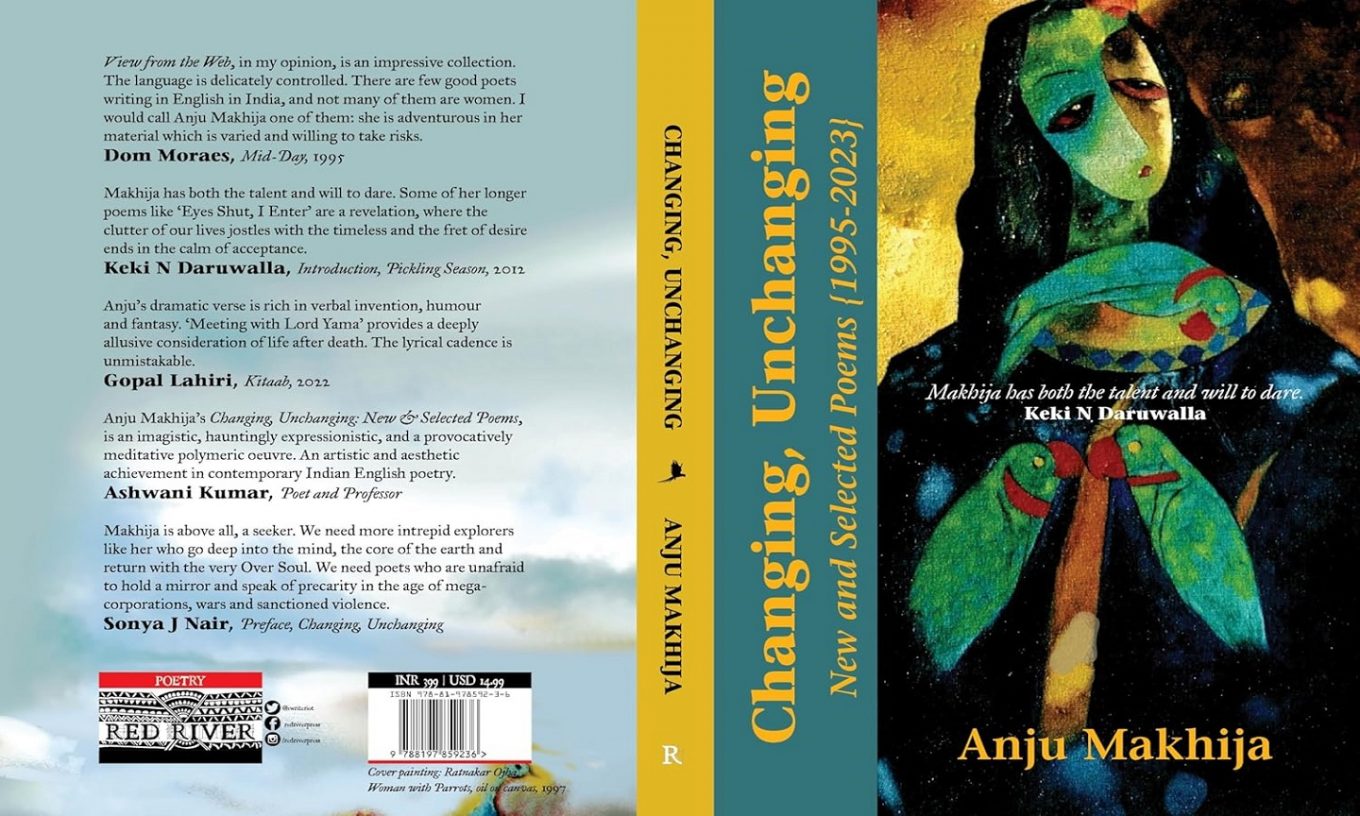
Title: Changing, Unchanging New and Selected Poems (1995-2023)
Author Anju Makhija
Publisher: Red River
Year of Publication: 2024
Extra-linguistic resonances fly like sparks out of Anju Makhija’s recently published collection of poems. These inflamed vibrations bring their fire to the wandering quest of a poet who has brought existential torments to the page, the stage, and the discursive spaces where minds congregate to find meaning within emptiness, rupture, and unfulfilled longings. Her poems burrow deep into the heart of embattled endeavors to simply exist and express oneself in a world where receptivity is an increasingly rare phenomenon.
Anju’s early poems compel the gaze to pause and sink into them when they confront the senses with their raw, open-wound quality. Shifting awareness is intimately related to location as in Abandoning the Farmhouse, which describes a painful departure in graphic terms:
Leaking pipes, cracked tiles,
broken shelves, patchy walls,
decay and death extended
their vicious arms.
Life closed in.
Anju has been an unsparing witness over the years to the volatile conversation between politics, piety, revisionist mythology, all happening in the service of the reigning ideology dominating the zeitgeist. Her intimate encounters with mystical theology and her exploratory journey into Shah Abdul Latif’s Risalo make her familiar with the idiom of passion as the only viable expressive instrument in the bare bones state of a seeker’s vulnerable nakedness. The lament embedded in a Sufi wai where the spirit wrestles with its own revelations finds a voice in some of her utterances, which are then shrouded in loaded ellipses. Kutch Visions features such a setting which casts a violent massacre in an oblivion of paradoxical beauty:
Flute music stirs hearts,
silhouettes bare chests,
The assassin shoots arrows.
The mokhi pours wine,
the desert becomes a tavern
in the celestial sphere.
Poems such as Spirited Machine, Vanishing Text, and Blank Page, show language at war with itself. This reaches a poignant crescendo in the poem When Words Falter:
Alphabets shrink,
Boomerang erratically,
Strangle me slyly.
There is an overarching sense of spiritual darkness in Changing, Unchanging made even more potent by the caustic humor and edginess that Anju brings to her zingers. The poem Foresight ponders the aftermath of a pandemic-induced pause:
Will we let the earth rest?
Or Amazon our way
Into ordering
the next fatal bug?
Anju gives a new twist to writing as a contact sport in her dramatic verses, where we get to witness a flirtatious sparring with between Yama, the god of death and a kindergarten teacher, forcing her to contemplate the wildly paradoxical nature of her assumptions. Her musings start to dwell in vacillating truths:
Most things work in twos,
So does love…and hate.
While dealing with diverse subjects, the poems reveal in common, a pulsating desperation at the heart of superficial constructs which modern humans employ to preserve and justify their swaggering ignorance, or their willful submission to corporate fascism. The Last Train winsomely renders a conversation between fantasy-driven schemers who dream of mass marketing a “people-proof door” to credulous consumers. Bicycling Home shows hapless survivors fleeing a plague, and Laxmi is a graphic elegy for a trapped elephant who died within the confines of a temple. All these are relentlessly authentic facts of complacent philistinism that passes for legitimate discourse, resulting in casualties that often do not make the front pages of news, but do contribute to our devolution.
The poems featured in the section 1995 – 2012 comprise an aesthetic tapestry where Anju exposes cringe-worthy reductionist conventions which trap women in a cozy lie about the licensed malice they are constantly subjected to. Anju’s linguistic versatility is demonstrated in her digs at bohemian affectations which prevail among the intelligentsia, her stripping bare of closeted sadists who pay lip service to equality protocols, her gritty realism in dismantling accepted hermeneutic notions of equality, and her touching gaze at the elemental loneliness at the heart of it all. Her famous poem Pickling Season is a potent metaphor for the transformative legacies of the imagination, spiced up with interrogations about its radical provocations, and its vulnerabilities in the face of stealthy rigidity and resistance.
Then on to peeling, chopping, salting,
Boiling, spicing, bottling…
Will the sorcery work?
Hipster fantasies of happily-ever-after don’t stand a chance when etymologically murky recipes are applied to them in the hope of brazenly untethering paradigms of power. Like the silently witnessing mango tree, the fates subvert frivolities, “rarely bewitched.”
Anju’s path is paved with homages to mentors and family elders who survived the ravages of partition, and to other lost loves consigned to liminal mists. The sensual saturation of grief’s imprint on the body and environment is movingly rendered in poems such as The Blank Page dedicated to Nissim Ezekiel.
His forgetting seems to be
A way of saying goodbye –
His thoughts have run off the page
And the notepad is full.
Minor Voices features excerpted dramatic verses from Anju’s plays from her collection titled Mumbai Traps. Her remarkable immersion into the miasma of the slum world uses the power of suggestion to reveal a seamy enterprise of cheap labor, exploitation, and violation exemplified by the image of a body covered with “sweat ‘n shine.”
The 1990-1995 set of poems is dotted with city images of traffic stops where expensive cars careen past beggars, and pristine sea views are sullied by pollution. There are forays into western shores, and the dream getaways to rustic havens. The inevitable emptiness at the end of it all is poignantly expressed in Is Anyone There?
Cold. The midnight jolt.
Slithering into the night
Like reptile.
The sky thorns open,
Cawing of crows, again and again…
Minor Voices rise again at the conclusion of the collection – a breathless dark void populated with child laborers, street performers, corrupt incompetents, flood survivors, and abused children who linger in festering silence after the words have landed. Anju confronts toxicity that is normalized by denial of inconvenient truths with her starkly visceral idiom. A radical reframing of the cameo is a distinctive device throughout the collection. Her protagonists are not celebrities, but underdogs who animate the canvas even amid squalor, deprivation, and silenced yearnings. The glitzy world of the well-heeled as a backdrop is filtered through a lens that has delved into the collective id, and unleashed its familiar monsters. Anju brings us this unsettling panorama with lyrical intensity, aphoristic force, and uncompromising clarity.