

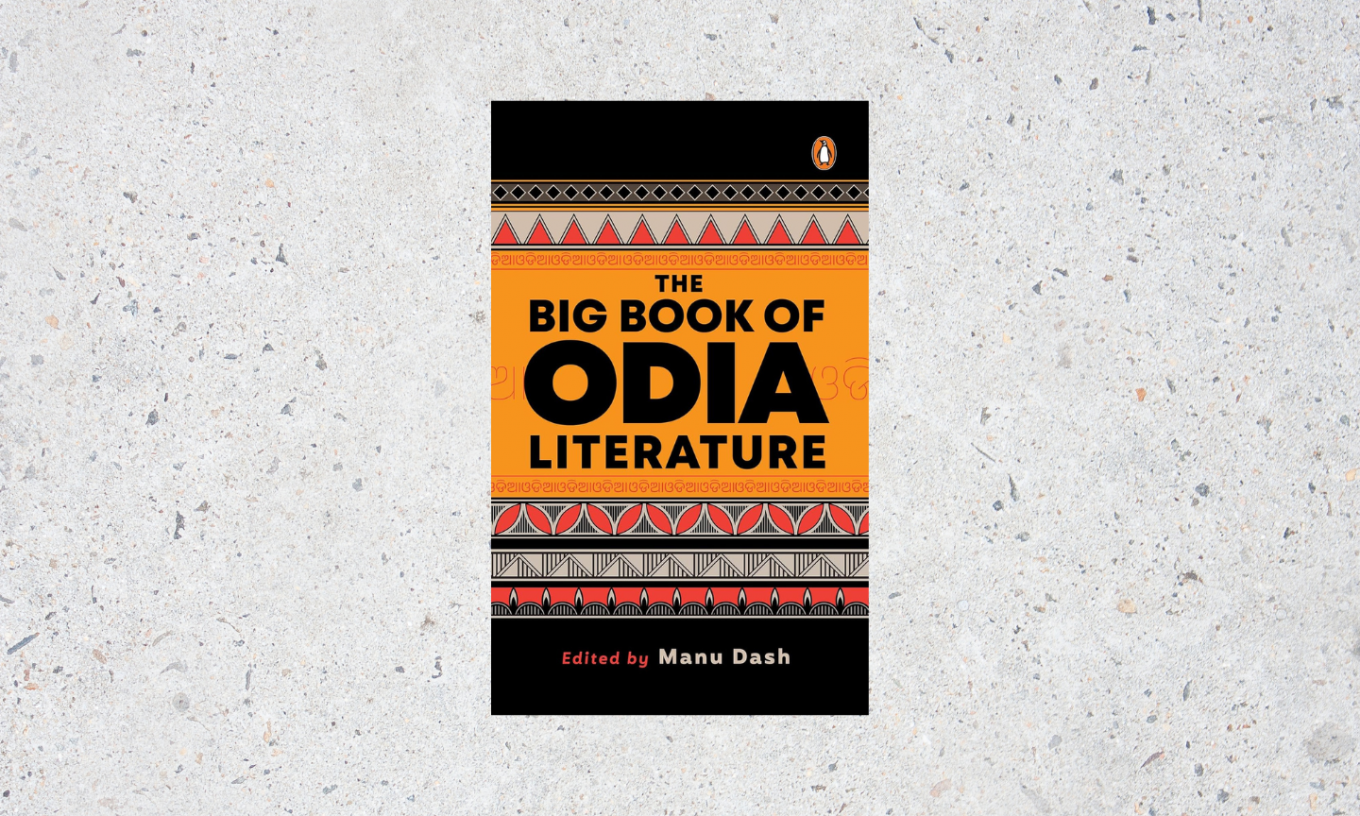
Title: The Big Book of Odia Literature
Editor: Manu Dash
Publisher: Penguin Books
Year of Publication: 2024
A Glimpse of Treasure
No compilation of literary works can hope to do justice to the literature it seeks to represent. They can only seek to provide readers with a glimpse into the legacy, and by doing so, tempt them to ask for more. In India, the publishing world has, in recent years, brought forth many such compilations. The Big Book of Odia Literature edited by Manu Dash brings to the table a rich array of works from Odisha’s vibrant literary history from the 10th to the 21st century, a ‘glimpsing’ that indeed leaves one asking for more.
The book is structured into four sections – Poetry, Plays, Short Story, Essays. Poetry is the most comprehensive and exhaustive section. It begins with the ancient poet Sarala Dasa’s ‘Bhima’s Counsel to Yudhisthira’ (translated from Yudhisthiranka Prati Bhismanka Upadesha’ by Manu Dash) from the 15th century and ends in the late 20th century with Satya Dash’s ‘A Body Becomes a Story’. This section, representing 600 years of poetry, includes not just varied ages but also tongues and approaches. The 105 poems here have been collated from Odia poetry, followed by Sambalpuri-Kosali, Sanskrit, Sandha, Santali, Kui, Oraon, Mundari, Kisan, Kharia/Khadia, Sadri, Kondh, Paraa, and English, many of which remind one of the state’s rich oral traditions.
Adikabi Sarala Dasa wrote the epics Bilanka Ramayana and the Chandi Purana, “the first of their kind in the country”. However, it is his “magnum opus, the Mahabharata” that was not just a translation. “Into the fabric of the Sanskrit version, Dasa had infused the history, culture, folktales and spiritual beliefs of Odisha, as if he was writing the Mahabharata of the Odia community” (Editor’s Note, pg. xxvii). His poem is followed by the sacred and spiritual poetry of Balarama Dasa and Jagannatha Dasa who were “inspired by Sarala Dasa’s earthy” language and were writing at a time when Buddhism was slowly giving way to Vaishnavism in Odisha.
Literary eras are couched in socio-cultural and political upheavals; in this book, they segue effortlessly from one to another. Though grouped according to language, we can read mid-20th century Anam poetry by the harbinger of the movement, Kumar Mohanty, and by Kamadeva Moharana, along with 12th century Jayadeva’s ‘Lotus-Eyed Krishna with Desire’ (translated from ‘Pancham Sarga, Gita Govindam’ by Mani Rao), and turn to poetry translated from folk and Adivasi traditions such as Santali, Kharia/ Khadia, Mundari, or the 10th century Sandha poem ‘Your House is Outskirts of the City, Dombi’ by Kanhupa (translated from ‘Nagara Bahire Re Dombi Tohori Kudia’ by Manu Dash), or to those written in English “either by Odisha based writers or by non-Odia writers with an interest in Odia literature and culture” (Editor’s Note, pg. xx). The inclusive nature of the structure and selection speaks to how poetry, in fact all literature, should be read.
A striking aspect of the layout of the poems is how the theme shifts from devotion to surrender to God to defiance on a social political level. According to Manu Dash, “the transition from devotion to defiance is one of the most striking developments in literature, and in structuring the sequence of poems, I sought to create a clear narrative arc that reflects this shift. I began with works that emphasize spirituality and devotion, often associated with the cultural and religious heritage of Odisha, to highlight the foundational aspects of the literary tradition. Then, as the themes evolved, I introduced works that challenge authority, question societal norms, and voice dissent. By carefully placing poems in this sequence, I aimed to capture the tension between the sacred and the secular, the submissive and the rebellious. This allowed for a natural flow from spiritual surrender to the assertion of identity and rights, mirroring the broader socio-political movements of the times.
After the largesse of the poetry section, the section with plays arrives as a dampener. A selection from Jagan Mohan Lal’s play ‘Babaji’ (translated by Manu Dash as ‘The Monk’) and a shorter play titled ‘Chief Guest’ by Biswajit Das (translated by Samanjasa Das) do not do justice to Odisha’s performative legacy. However, though this weakens the book’s promise, the selections achieve what such a book should – they make the reader want to know more about this genre as practised in Odisha, especially for the reader not too familiar with the state’s theatre that harks back to the medieval period.
The first short story in Odia was published in 1898 when Fakir Mohan Senapati’s ‘Rebati’ initiated the definitive shift from folktales and fables to the short story. ‘Rebati’ has not only endured but has also been translated into 36 languages. The Editor’s Note lists the elements that make the story iconic, including its “ability to sound out the key issues of the day such as superstition, poverty, illiteracy, women’s education and underdevelopment…” (pg. xliii).
The selection of short fiction in the book points to a lasting impact of Senapati’s story on other writers. The stories capture the flow of time, socio-cultural and economic issues with a realist sensibility. ‘A Leaf in the Stream’ by Pranabandhu Kar (translated from ‘Sua Munhare Patar’ by Jatindra Kumar Nayak) traces the movement of time as well as its stagnation. ‘The Old Maker of Bangles’ by Laxmikanta Mohapatra (translated from ‘Budha Sankari’ by Bikram K. Das) is poignant in its depiction of the bangle seller, but at its heart, it captures the cruelty of societal rules for women through the perspective of the old man who is himself a victim of society’s neglect. In extending the pathos from the old bangle seller to the seemingly blessed young woman to whom he sells his bangles, the story subtly draws attention to an issue hovering at the contemporary threshold. In ‘The Burning-Ground Flower’ (translated from ‘Mashanira Phula’ by Jayanta Mahapatra) by the revolutionary poet, novelist and short story writer, Sachidanand Routray, beauty emerges from the filth and rot of a cremation ground.
“No one was as militant in Odia literature as Bhagwati Charan Panigrahi’s ‘The Kill’” (translated from ‘Shikaar’ by Jayanta Mahpatra). “It is treated as the first story on the theme of class war in Odia” (pg. xlv). Most of the stories reflect imminent socio-economic churn and a keen sensitivity to it. Village life, the dispossessed, the often-ignored, the suppressed, the non-human find their way into these stories, most of which seem to have been written around early to mid-twentieth century. While the sections are structured according to the date of birth of each writer, actual dates of publication have not been provided. The date of publication of the writings is a glaring absence in this volume that editors of future compilations may want to address.
Though one does not usually expect essays as part of a volume on literature these days, The Great Book of Odia Literature maintains its inclusive approach by bringing 23 essays written on diverse subjects such as ‘The Language of Literature’ by Girija Shankar Ray, ‘Chaitanya in Oriya Literature’ by Prabhat Mukherjee, Fakir Mohan Senapati’s landmark essay ‘Vulgar Idols inside the Temples’ (translated from ‘Mandira Manankare Kutschita Murti’ by Manu Dash); ‘Odia Folk tales’ by Mohini Mohan Senapati, ‘Realism’ by Kishori Charan Das, ‘How and Why Sarala Das Translated the Mahabharata’ by John V. Boulton, among others.
Manu Dash is a bilingual poet and writer who has been actively involved in the Anam movement. His years of work with Odia literature through writing, literary activism and literary journalism give him a vantage point from which to look at the vast body of literature from Odisha and bring to readers those representative works that help us trace the state’s literary legacy. In his Editor’s Note to this compilation, he provides a clear perspective on the journey of each genre as well as an overview of literature from Odisha in general.
“The Big Book of Odia Literature showcases the richness and variety of Odia literature through a representative selection of poems, short stories, essays and plays written in various parts of the eastern India state of Odisha since the tenth century. …
Looking back, we find the Odia short story to be about 125 years old, the essay about 150 years old and the play nearly 146 years old. Odia poetry, mainly written by Sarala Dasa, is approximately 600 years old.
This volume curates writings culled from the above four genres that have borne witness to the journey of Odia literature from its inception to the contemporary period. It includes 2105 poems, thirty short stories, twenty-three essays, one short play and one excerpt from a long play. Through these selections, the readers can glimpse the literary and sociocultural shifts that took place over these centuries” (pp xix-xx).
***
Question: What determined your selection across the genres? Popularity, trail-blazing stories of the time, or personal favourites?
Manu Dash: My selection across genres was guided by a combination of factors. Popularity certainly played a role, as I wanted to ensure that key works that shaped Odia literature were included. However, I also sought to feature trail-blazing stories that marked significant moments in literary history, works that either represented new directions in style or introduced bold social and political ideas. Personal favourites also influenced my choices, as I have always had a deep admiration for certain poets and writers whose works I believe hold timeless value. Ultimately, the goal was to provide a comprehensive view of Odia literature, showcasing its diversity in themes, forms, and voices across different periods
Question: While selecting from a vast oeuvre, what do you think has changed in terms of style, tone, content across categories and periods you have selected from?
Manu Dash: Across the periods and categories selected for The Big Book of Odia Literature, a notable shift can be observed in style, tone, and content. Early works, often influenced by religious devotion and philosophical ideals, were marked by a lyrical, poetic, and ornate style, with a strong focus on spirituality and moral teachings. As time progressed, there was a gradual movement towards more personal expression, social issues, and a sense of modernity. The tone shifted from reverence and submission to more assertive voices that tackled themes of social justice, politics, and human rights. Content also expanded from religious and mythological subjects to embrace contemporary struggles, reflecting the changing social and political landscape. This evolution highlights the dynamic nature of Odia literature as it responds to both internal and external cultural shifts.
Question: The shift from devotion and surrender to God to defiance on a socio-political level is striking in the layout of the poems. How did you go about structuring this sequence of poems or voices or approaches?
Manu Dash: The transition from devotion to defiance is one of the most striking developments in literature, and in structuring the sequence of poems, I sought to create a clear narrative arc that reflects this shift. I began with works that emphasize spirituality and devotion, often associated with the cultural and religious heritage of Odisha, to highlight the foundational aspects of the literary tradition. Then, as the themes evolved, I introduced works that challenge authority, question societal norms, and voice dissent. By carefully placing poems in this sequence, I aimed to capture the tension between the sacred and the secular, the submissive and the rebellious. This allowed for a natural flow from spiritual surrender to the assertion of identity and rights, mirroring the broader socio-political movements of the times.
Question: Women writers are few and far between. Is it possible in any culture that women were not versifying or writing or telling stories? Why is there no record or so few voices? Manu Dash: It is unlikely that women were completely absent from versifying, writing, or telling stories in any culture, but there are historical and cultural reasons why their voices are often not recorded or less prominent. In many societies, patriarchal structures and gender norms restricted women’s access to education, public platforms, and the tools necessary to preserve their creative works. This led to their contributions being either unacknowledged or lost over time. In some cultures, women’s roles in literature and oral traditions were limited to the private or domestic spheres, which were less likely to be documented. However, as social dynamics evolved, more women began to make their mark in literature, though their earlier contributions may have been overlooked.