
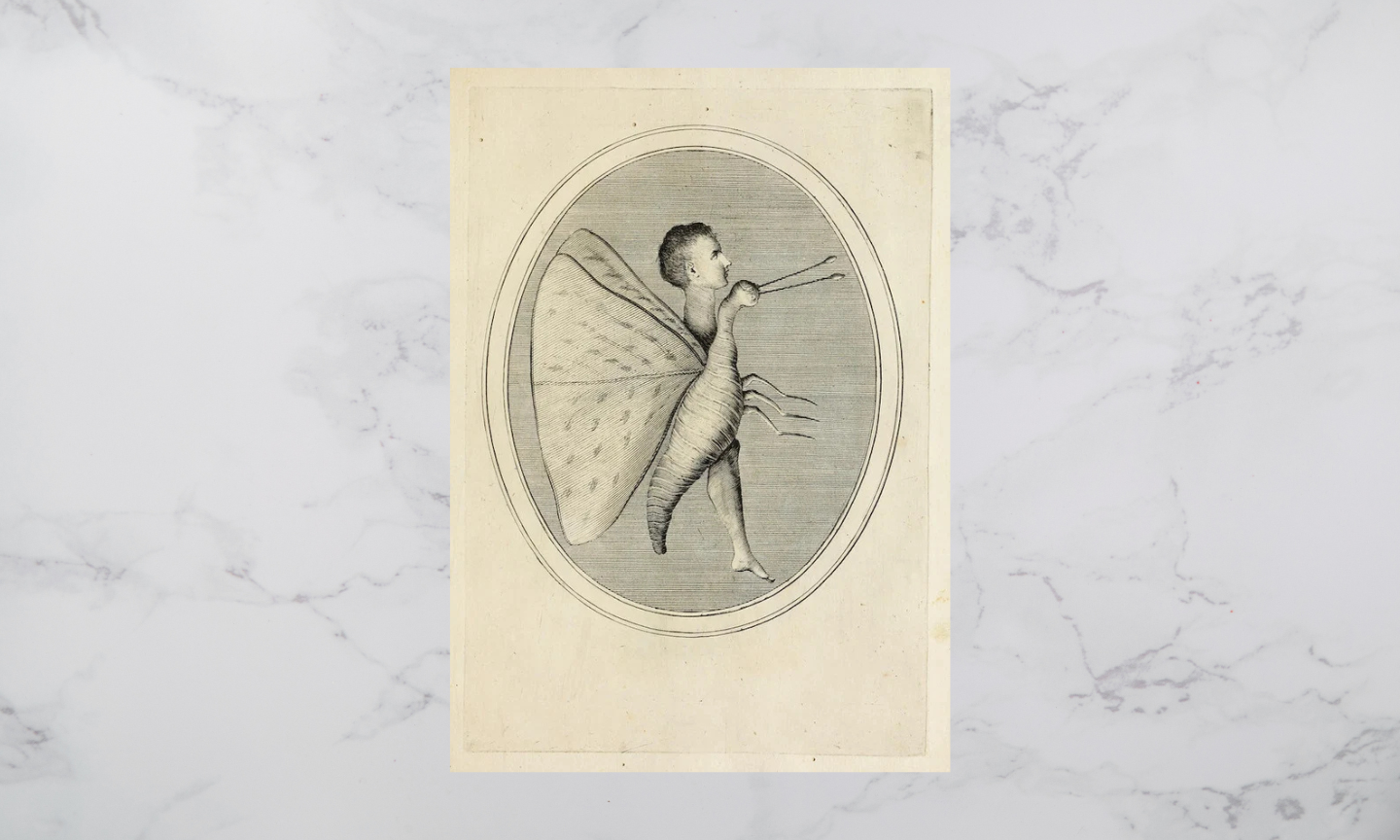
Moths, their wings white as flour, flit against the oil lamps with no regard for their flammability, only with a primal searching for light. Each flutter of their wings lets out a soft swish; each collision into the lamps a dull thud. This cadence repeats itself deep into the warm dusk of the evening, until the sun bleeds out across the sky and the moths, their little bodies, gather in heaps on the porch.
Next to their mass grave, another. This one of ivory soap splinters, smelling sweetly of artemisia and bergamot. At first glance, the two piles look the same, both delicate hills of soft snow. One is more devastating than the other, but which depends on who you ask. The moths are dead, but the soap splinters indicate something is dying. Which is worse—the act or the outcome?
The source of the soap splinters is a young woman—picture her as you will. Black, white; blonde, brunette; tall, short. The only consistency needed here is her face. It must be wrinkled, though by all accounts she should be too young for such a thing. And it must be deeply etched with sorrow. There can be no exception to this.
This is the fabric of her evenings: she carves seashells from soap until the basket runs out of unshaped bars and the mosquitoes grow ripe with her blood. She takes great care with each shell, meticulously chiseling every curve and line to perfection, already mourning the loss of detail that will come when the soaps assume their intended purpose. These were her past nights, and will be her future ones; this is the wanting, the waxing and the waning, the unrelenting emptiness. In this way, moths and humans are alike—always searching for something beautiful, drawing towards it despite evidence of destruction.
His footsteps don’t make a sound, his body appears out of nowhere, like a shadow slipping through the flicker of a flame.
“I know we said that we’re not talking, but how long were you thinking?” His voice tumbles from his mouth.
“They say you’re dead,” She blinks but does not look up.
“I am.”
“Am I dead too?” She tries not to sound hopeful.
“No, I just had to see you before I left.”
“And where are you going?”
“Onward, to whatever comes next.”
She looks up and sees him as he once was. A young man—picture him as you will. Black, white; blonde, brunet; tall, short. The only consistency needed here is his face. It must be smooth, ethereal. Handsome. And it must be deeply etched with relief. There can be no exception to this.
“Can I come with you?”
“No, you know that.”
“But I want to.”
“Let this be enough.”
“Can you at least come closer?”
“No,” his voice shakes. “It will break me.”
She gets angry. “How can you go and leave me? How can you leave me again?”
He doesn’t feed the fire in her voice. “Maybe someday we’ll see each other again, on the other side of things.”
“You said that before, when we were kids.”
“I remember.”
“And you never came back.”
“But I did, didn’t I?”
“Now that it is too late.”
He smiles softly. “If I had come any sooner, neither of us would have been ready.”
She doesn’t smile. She doesn’t say anything.
“I just had to see you, before I go.”
A storm gathers along the horizon, the wheat stalks wooly and stiff with static. The sky bruises, then splits open like an overripe peach. They stare at each other through the sheet of rain, faces bright and pale in the glow of the oil lamps. The wicks get wet. The lamps go out. Still, they stare through the dark in the direction of the other, faces bright and pale only in the glow of fitful lightning strikes; until between the flicker of one strike and another, he disappears.
All the moths, dead and alive, blow away in the gale. All the soap, carved and uncarved, sinks into the porch wood. She stands, walks down the steps and across the yard to the spot where he just was. She fits her heels to the outline of his boots in the mud and stares up to the sky. When the next bolt anchors to her bones, she doesn’t feel a thing but relief.