
It comes right at the start. For a brief moment. As intimately Manipuri as it gets. The face of Hijam Irabot, from the rubbles of history. In the darkness of a movie theatre in Imphal, and elsewhere in the world, Irabot is invoked by Lakshmipriya Devi at the start of her directorial debut, Boong.
The photograph, which fades away before one realises who it was, perhaps marks a subtle political moment in a Manipuri modern-day classic. Then, the film begins. A children’s film, that has cultural markers spread generously in every frame, all hidden till you spot them. And once you do, you come face to face with the beautiful and heartbreakingly violent history of Manipur, a state Nehru thought was the jewel of India.
Many nights before the BAFTA night in London, when Lakshmipriya Devi, or LP, greeted the world in Meiteilon after Boong won the best children’s film award, in 2006, Henry V Jardine, principal officer at the US Consulate General in Kolkata, visited Manipur, a state in India’s northeast, bordering Myanmar. On August 16 that year, two American citizens had been injured in a grenade attack at the International Society for Krishna Consciousness premises. It was reason enough for his visit and later for a detailed secret cable to Washington DC. The message would have remained hidden if Wikileaks hadn’t swung into action. “In ConGen’s many interactions, even with some government officials,” said the cable, “a recurring comment was Manipur was less a state and more a colony of India.” His observation wasn’t entirely off the mark.
The first family of cinema
March 1946. Irabot, about six months short of 50, has been allowed to return to the kingdom of Manipur. Irabot’s political work in Manipur, his anti-colonial, anti-imperialistic speeches, had led to his arrest in January 1940 and being pushed out of the kingdom.
Irabot’s family was almost forced into poverty when they were moved out of their ancestral home under new British administrative rules. He lost both parents at an early age. His maternal aunt, connected by marriage with the royal family, brought him up. The multitalented Irabot was initially recruited for the king’s hockey team. His debating skills came into the notice of the king, who ensured Irabot married into the royal family. Despite this almost cinematic start to his life, Irabot’s politics soon took him towards a secular, communist movement. To jute-mill workers, tea workers, labourers, organising and uniting for a better life for all, in Calcutta, Assam and Burma.
After Irabot returned home in 1946, he plunged into politics straightaway. By October 1949, the Dominion of India annexed Manipur. Manipur’s king, Bodhachandra, had signed an accord with India in September that year, which remained secret till October. The Manipur Socialist Party, the Communist Party of Manipur and leaders including Irabot opposed an annexation that had a strong whiff of coercion.
Historians John Parrat and Saroj Arabam Parrat write[1] that it was around this time that Irabot and his comrades started distributing communist literature across villages in Manipur. After 18 months, the Red Guards, the military wing of the movement, started training in guerilla warfare. After that, according to John and Saroj, the “Meitei insurgency movement” began. It fragmented into several armed factions over time, but the groups continued to be relevant, with demands that ranged from complete secession to more political autonomy.
Irabot passed away in 1951 in Burma. He was apparently there trying to arrange military training for his supporters and forge deeper ties with the Burmese communist movement. In Burma, as John and Saroj note, “A memorial stone there bears the name, ‘Comrade I Singh’.”
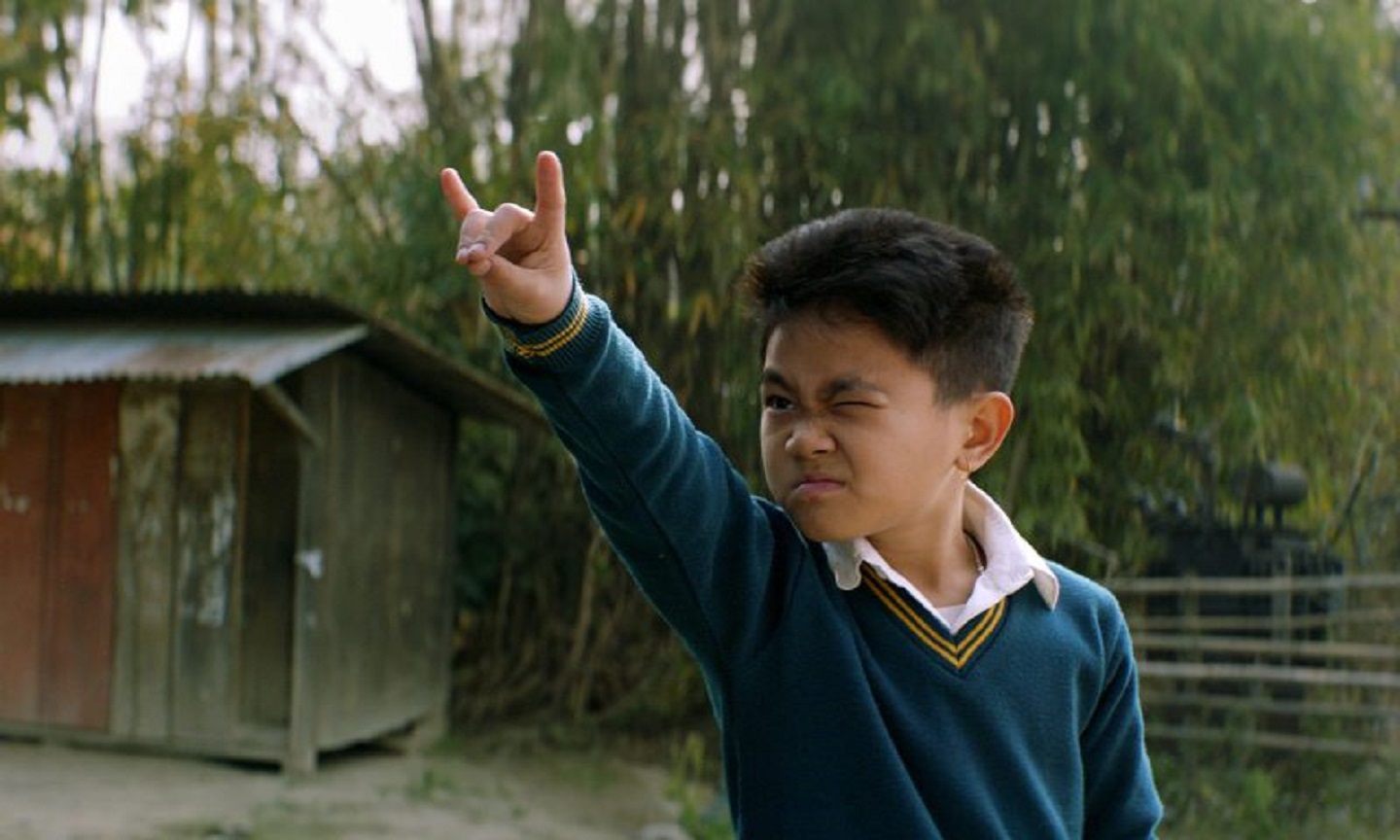
John and Saroj wrote about Irabot in 2000. Twenty-six years on, the violence remains constant, morphing into different actors and different contexts and different demands. Boong has been birthed in this space of brutal ethnic conflict. The latest episode of violence is between the majoritarian Meitei and the Kuki-Zo communities. It has caused at least 250 deaths, massive population displacement, and violence against women. Ironically, a Kuki actor plays a Meitei boy in the film that won India its first BAFTA.
Seventy-five years after Irabot’s death, he appears for a few seconds, and for the first time in cinema, in Boong. Many Manipuri hearts leapt in joy at his sight before they embraced a film that tells the story of a young boy and his search for his absentee father. A search that takes him across the border to Burma, now Myanmar, with his friend—a Marwari boy, an outsider, a mayang.
I reach out to LP, but she is bound by some omerta of the Mumbai film world. And everyone wants to speak to her anyway. The details aren’t hard to find, though.
LP’s aunt, MK (Maharaj Kumari) Binodini Devi, was a writer, social activist, filmmaker and, in her first life, a princess. Binodini was close to Irabot, a cousin by marriage. Binodini’s brother was Bodhachandra. The connection goes deeper. LP’s mother Sabita and her sister Chongtham Kamala, a reputed playback singer in Manipuri films, grew up in the same household as Irabot and his wife Khomdonsana. Irabot’s wife was the sister of LP’s maternal great grandmother.
Cinema in the time of violence
Fourteen years after Irabot’s death, in 1964, the United National Liberation Front (UNLF), a Meitei armed insurgent faction, was formed under Arambam Samarendra Singh. More than two decades later, in 1988, Raj Kumar Meghen became the chairperson of the UNLF, which had been running operations out of the jungles of Burma.
Just a year before Meghen’s appointment, in the hill districts of Manipur, the Indian army had carried out a brutal counter-insurgency operation called Operation Bluebird. One that would lead to illegal detentions, arbitrary arrests, torture and illegal executions by state forces. It was a time when Manipur was under the Armed Forces (Special Powers) Act, or AFSPA, a law introduced to curb dissent and separatist movements, which gave the army the license to shoot, detain and arrest anyone on suspicion and immunity from prosecution. An Act that had led to Binodini return her Padma Shri to the government of India in protest in 2001 (she had received it in 1976). The ghosts of British colonial control that had chased Irabot and many others was up and running in much the same way in an independent India. A lot had changed in Manipur by the 1980s, but a lot hadn’t either.
At some point amid all this, cinema had quietly arrived in Manipur. This was a year after the end of World War II, when Imphal had become a battlefront, in 1946, the same year Irabot was allowed to re-enter Manipur. A coincidence, which takes one back to the royal family.
***
I am meeting Dr Johnson Rajkumar, an old friend and Manipur’s only film conservator, and one of the very few trained film conservators in India. He takes me on a time travel.
The Sree Sree Govindaji Film Company was formed by Bodhachandra, a film buff, he says. Two years before the film company was set up, Bodhachandra’s coronation ceremony was filmed and documented at his own initiative. The importance of the moving image and its archival value was not lost on the king-to-be. Its details still rest in the Colonial Films database. The king’s brother Priyabrata was also bitten by the cinema bug. He went around capturing cultural traditions in Manipur on a Bell and Howell camera, in 8mm.
The making of the first attempted feature film in Manipur, Mainu Pemcha, began in 1946. There were several Bengalis involved in the project, both behind and in front of the camera. The film, based on a Manipuri play by Ayekpam Syamsundar Singh was, ironically, filmed in Hindi to reach a bigger market. Ironical, since Hindi films have been banned in Manipur since September 2000. The Revolutionary People’s Front had given the call. That ban still remains. A sequence in Boong brings it up in a moment of smart black comedy.
“I could salvage just a few reels,” Johnson says of Mainu Pemcha. “Fourteen reels were completed. And nine unedited reels were screened in 1948.”
In the restoration process, it was found that the film was shot on different reels: some nitrate films, some acetate films. That made the restoration take on a completely different challenge. Perhaps unknowingly mirroring the unique history of Manipur, the film was not in Manipuri, not filmed in uniform film plates, and not finished. A state, closer to Myanmar than to India, with tribes like a patchwork quilt, unique and stunning and yet constantly in the grip of violence. It’s full potential never realised.
It took three decades for another film to be shot in Manipur, in 1972. The first Manipuri film by a Manipuri director: Brojendragee Luhongba by Sapam Nodiachand.
“It was a film that was released a year after Matamgi Manipur, directed by a Bengali [Debkumar Bose], in 1972. Both films deal with a clash of modernity and tradition,” Johnson says. Sapam died in oblivion after directing one more film. His first film was preserved by another filmmaker and was digitised in 4K after much effort. Perhaps it will be restored one day too.
The journey from 1946 to 1972 and beyond was a strange one for filmmaking in Manipur in that there were exactly zero films. What thrived were theatre and radio plays. But when films were eventually made, the results were remarkable. The region had violence written all over it and yet, there were no signs of it in the cinema. At the Imphal Cine Club, run by K Ibohal Sharma, world cinema was screened, a world far removed from the days and nights of Manipur.
***
In 1961, three years before the UNLF came into being, there was the Tagore centenary. Binodini, who had studied in Santiniketan, and a group of artists, composers and poets formed a group called Roop Raag in Manipur. All artists of Manipur who loved Tagore gathered there. “Music, theatre, film grew out of this place,” Binodini’s son Somi Roy, a film curator and writer, says.
Binodini had turned to writing plays, for the stage and for the radio, apart from her own literary works. She gradually moved to screenplay writing and teamed up with Aribam Syam Sharma, who was transitioning to filmmaking. A young Aribam had been present on the sets of Mainu Pemcha and had been hypnotised by what he had seen. The films written by Binodini and directed by Aribam took Manipur and the world by storm. In 1980, the year AFSPA was imposed in Manipur, Aribam-Binodini’s Olangthagee Wangmadasoo (Beyond the Heat of Summer) was released in Friends Talkies, a cinema house in Imphal’s Paona Bazar. A photograph of the crowd outside the cinema house captures the craze.
The next year, Imagi Ningthem (My Son, My Precious) was released. It went on to win at the Grand Prix at Festival des 3 Continents in Nantes in 1982. The same year, it premiered at the Museum of Modern Art in New York. In 1991, their film Ishanou was included in the Un Certain Regard section at Cannes. Both films engaged with motherhood and were made entirely in Manipur. Films, again, that were made in the shadow of violence and yet, translated not a drop of that in celluloid.
It would only be in the late 1990s and then the 2000s that Manipuri filmmakers would attempt films on insurgency. What went missing were necessary feature films that were never made. Necessary documentation never carried out. At least on celluloid.
Insurgency as entertainment
In 1996, Laimayum Surjakanta made a film called Meiree (Flame). A love story with a murder, a criminal gang, a bomb blast, and criminal politicians, Meiree is about everyday violence in Manipur.
Surjakanta would make two more films around violence. Made in 2000, his film Hayenga Kanageeno (Whose Fate is it Tomorrow?) again dealt with violence and corruption and confronting corruption. As documented by Meghachandra Kongbam in Manipuri Cinema, “How long can we survive in this world, wielding weapons to bring peace among us,” says an anti-corruption crusader, a woman, in the film after killing a corrupt male police officer.
Then, Suryakanta’s 2001 film Operation Sangai concerned itself with encounter killings and clashes between underground outfits and the police.
For the first time, these were films that were mirroring Manipuri society. In 2008, Ningthouja Lancha burst onto the scene with his video film, Mami Sami. A loose translation of the title is “a film that is a little hazy”. In 1986, Lancha was a young filmmaker Binodini had worked with for filming her radio play Thengmallabara Radhamanbi on VHS. With the three-hour-long Mami Sami, in the haziness of conflict and different interest groups of the state, Manipuri cinema came face to face with the reality of their times. It took the audience to the cinematic locale of Loktak Lake and wove in life and helplessness in the shadow of insurgency.
Outside of the celluloid world, the violence continued unabated. Cinema and violence reflecting each other. Melodrama and death vying for supremacy.
Bachaspatimayum Sunzu and Paban Kumar’s documentary AFSPA 1958 was a dystopian reminder of truth being stranger than fiction. It documented the spontaneous protests after the rape and murder of Thangjam Manorama in 2004, including the “Indian Army Rape Us” protest by Meira Paibis that followed.
Daylight at night
In 1993, a group of 75 would-be filmmakers signed up for a filmmaking workshop organised by the Manipur Film Development Council. Binodini, forever a film activist, saw the potential of video for a small film industry in Manipur, Somi Roy writes. Binodini reached out to Tomiyo Sasaki and Ernest Gusella, an artist couple from New York, to teach the language of video editing to aspiring filmmakers in Manipur. The 1993 group, a talented lot of filmmakers who would later make their own films, then spread out across Manipur. “This workshop really flipped the game for young filmmakers in Manipur”, thinks Somi. Fimmakers Sunzu, Surjakanta and Lancha were all part of it.
Yet, it would take three decades for Boong to arrive, with its story set in the backdrop of muted insurgency and the days and nights of Manipur, of the road towards Moreh and across the border to Myanmar.
Akhu Chingangbam is the line producer and music director of Boong. A lyricist, musician and singer, he is the frontman of the band Imphal Talkies. His band is named after Imphal Talkies, a cinema hall formerly known as Rupmahal, that has stopped movie screenings and now remains alive through the music the band creates and sometimes theatre performances.
The violence in Manipur is not unknown to Akhu. Attacked and even abducted for his political views, and for protesting against violence, Akhu has always tried to build bridges between communities. He reminds me that his wish is for all actors in Boong, Kuki or Meitei, to watch the film together. It’s a wish that seems improbable at the moment. “The film shows how it used to be at one time, living under one umbrella,” Akhu says.
As violence, both visible and insidious, threatens to silence voices in Manipur, filmmakers respond with renewed creativity and courage. Recent releases, including Boong, are not just regional stories but universal meditations on survival, dignity and resistance.
Manipuri cinema has a long history. Emerging from a region rife with political tension and cultural flux, it has walked the tightrope between dissent and celebration. From early black-and-white classics to today’s digital innovations, Manipuri filmmakers have chronicled rebellions, rituals, and ruptures. They continue to do so. The filmmakers play both product and provocateur.
Boong made the most news, but two short films also arrived in that cinematic run in 2026. Tenzing Pukhrambam’s The Nightmare of Bembi and Thingam Parshuram’s Toy Gun, which capture the various facets of conflict in Manipur and the affective consequence of violence on the people in the state.
For LP, it seems, Boong was never merely a film, nor even an artistic experiment bounded by the limits of cinema. It was, rather, a love letter to Manipur, a place she described while up on stage as: “very troubled, very much ignored, and very unrepresented in India.” Seen in that light, the film’s success carries a weight that extends well beyond the BAFTA recognition. It marked a personal vindication, certainly, but it also stood as a rare and forceful assertion of presence, an insistence that a community long relegated to the margins of the national imagination could no longer be so easily overlooked.
A film can’t change society. But Boong turns the spotlight on the cinema community of Manipur, be it Bodhachandra or his brother, be it Binodini or Aribam Shyam Sharma, be it the video filmmakers or just the stories of violence that this state has endured or even the story of Hijam Irabot, still untold except for a brief moment. Somehow, cinema has always magically carved a space for itself in Manipur.
The skies lit up when Boong arrived in Imphal, Akhu says.
The shooting, he says, would start by 5.30a.m. I don’t think anyone has shot a film in this scale in Manipur. For Bollywood, it’s a small film. For Manipur it was big. It was a challenge, Akhu says, to put up crane, then have lights from a height of sixty feet. “It was a big deal. By night they would see the light bursting through.”
But does that light reach the hills of Manipur?
Filmmaking in the shadow of violence has so far been limited to the Meiteis and the Imphal Valley. For people from the hill districts of the state—forever in a tussle with the valley and witness to intense violence over the years—telling their stories in their own way, be it in a feature film or in a documentary, hadn’t quite happened. It’s happening now, in a small way.
Two filmmakers from the Senapati district and the Poumai Naga tribe of Manipur, brothers trained at Satyajit Ray Film and Television Institute in Kolkata, have attempted films on the social and cultural lives of their communities in the hills. Alexander Pou’s My Grandfather’s Home is an ethnographic documentary made in the video format in 2014, and Ashok Veilou’s Look At The Sky is a 2019 digital film that tries to fill this blank. Veilou’s film tells the story of a man ostracised by his village for not supporting the village candidate in an election.
With the changing nature of violence in Manipur that has split the state along ethnic lines, perhaps a few years down the line there will be more films from the hills and the valley that capture violence and change head on. As the light reflects off Boong and merges with all these other beautiful films, the hope is that other filmmakers would be inspired to tell their stories in their way too and reveal more about this corner of India and its cinema against all odds.
***
[1] lnternationales Asien forum, Vol. 31 (2000), No. 3-4, p. 275-288
Hijam Irabot and the Radical Socialist Democratic Movement in Manipur by John Parratt and Saroj Arabam Parratt