
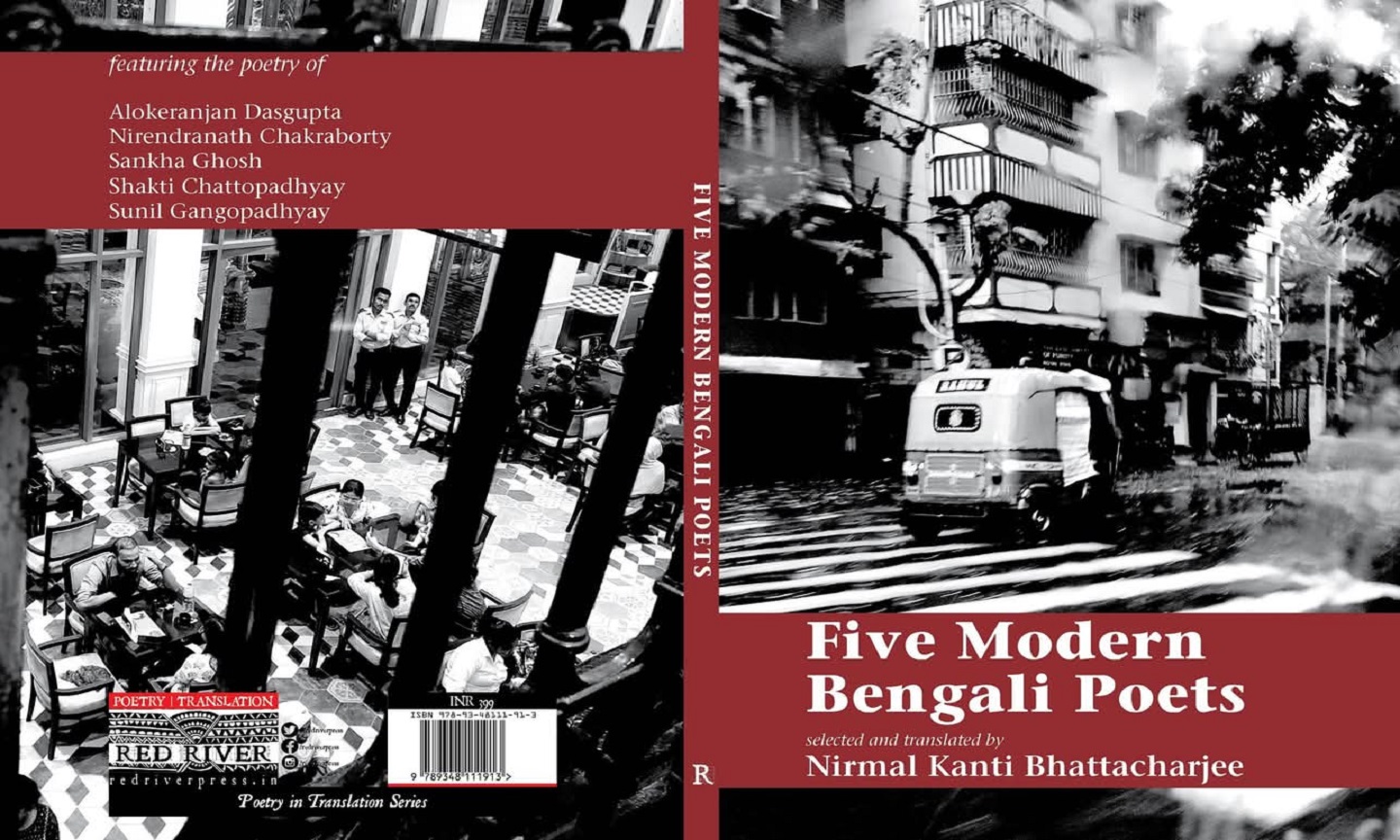
Title: Five Modern Bengali Poet: A Book Review
Translator: Nirmal Kanti Bhattacharjee
Publisher: Red River
Year of Publication: 2026
Five Modern Bengali Poets unfolds less like a formal anthology and more like a sequence of encounters, carefully shaped by Bhattacharjee. Each poet arrives with a distinct tonal world, yet connected by a subtle continuity, like walking through Bengal as well as Calcutta across decades: intellectual, restless, rain-soaked, political, intimate.
The voices are not unified by argument but by personal attention, tonal shifts, fragments of memory, and the way language holds both private experience and shared time and space. The collection offers a continuity of reflection, unmitigated, introspective, and deeply aware of modernity as lived experience.
The real gem of Bhattacharjee’s work lies in the introductions, bibliographies, and craft analyses he provides. Each poet is framed with clarity. Their trajectory, major works, and stylistic concerns are outlined in a way that allows the reader to enter their evolution and choices. These contextual layers make the anthology function not only as a collection of poems but also as a way of reading Bengali modernism. As Bhattacharjee notes, translation is both continuity and change, ‘A good translation balances fidelity and creativity, accepting some loss while enabling renewal, allowing the poem to gain a fresh life in another language, almost like forming a “third language” between the two.’
The translations themselves move with deliberate restraint. Bhattacharjee treats translation not as mechanical transfer but as a creative, interpretive act, what might be understood as ‘rupantar’ as much as ‘anuvad’. That often produces a slightly muted but faithful emotional register, a kind of soft echo rather than a loud performance, where the poems’ spirit is preserved even when form or sonic texture shifts. At the same time, one senses his presence shaping how these poems are encountered in English. The title of each section depicting a poet quietly carries this spirit.
Alokeranjan Dasgupta (A Poet and a Polyglot, 1933–2020) writes in layered contrasts, balancing faith and doubt, local and global, self and collective. He juxtaposed local Bangla idioms with global symbolic registers and repeatedly created a poetry space, a language diction of his own.
‘Sensing that I am climbing the pyre
with the trees and plants,
the ranpura plays out
the smog alarm.’
‘ There will be a scandal if the shramana gets any hint.
Realising this, the Japanese plants create
A sublime pattern in the middle of the courtyard’.
Nirendranath Chakraborty (Poetry is My Mother-tongue, 1924–2018) embodies clarity and accessibility. His language is transparent and deeply resonant, dissolving the boundary between poetry and daily life. For him, poetry is not an addition but an essential part of life; he looks at poetry not as a soliloquy of a poet but a conversation with others.
‘Some of us wanted to be teachers,
some doctors, some lawyers.
Amalkanti did not want to be any of these.
He strove to be sunlight.’
‘For, being defeated by the forces of life
he came to Nature to share his grief.
He was not aware
that Nature herself had so much sorrow.’
Shankha Ghosh (Poet Perfect and Scholar Extraordinaire, 1932–2021) deepens the tone into ethical reflection. His voice carries a quiet but unmistakable moral gravity. His poetry does not declare; it insists. It bears witness with restraint, allowing history and conscience to surface through carefully measured lines.
‘Make him a little more drunk.
Otherwise, he won’t be able to bear the burden of this world!’
‘ I stand alone for you
at the corner of the lane
Thought of showing you my face
But the face gets hidden in advertisement..;
Shakti Chattopadhyay (A Postman in the Autumn Forest, 1933–1995) disrupts this reflective space with a more visceral intensity. His bold, often nature-infused verse brings fresh energy to Bengali poetry, reshaping rhythm, imagery, and voice. There is in his work a restless, almost defiant movement, where the lyric risks breaking into something raw and unpredictable, carrying the reader into a landscape that is simultaneously intimate and elemental.
‘Never forget that near our courtyard,
the moon lies in the water of the bottomless well.
‘Everything tumbles from head to foot,
Wall against wall, cornice against cornice.
The pavement changes in the midnight’
Sunil Gangopadhyay (A Poet for All Seasons, 1934–2012) widens the frame of reference. A creative leader as much as a poet, he galvanized literary culture through the Krittibas magazine and his own varied output, mentoring generations and defining the contours of Bengali modernism.
‘For love, I’ve lived life dangerously.
I’ve plucked one hundred and eight blue lotuses
by ransacking the whole universe’.
‘I always feel I need to tender an apology
but can’t exactly pinpoint the crime.
I always think I have forgotten an important task
but can’t remember it.’
Together, these five poets trace a vital arc in post-Rabindranath Tagore Bengali poetry. Each contributes a distinct energy: the intellectual and cross-cultural in Dasgupta, the lucid and accessible in Chakraborty, the ethical and socially rooted in Ghosh, the experimental and visceral in Chattopadhyay, and the culturally generative in Gangopadhyay.
While the anthology focuses on these five voices, readers of Bangla poetry might also think of Subhas Mukhopadhyay (1919–2003), whose work carries lyric intimacy alongside social awareness. Among the post-Tagore poets, Jibanananda Das (1899–1954) remains a quiet, ever-present influence on modern Bengali poetry.
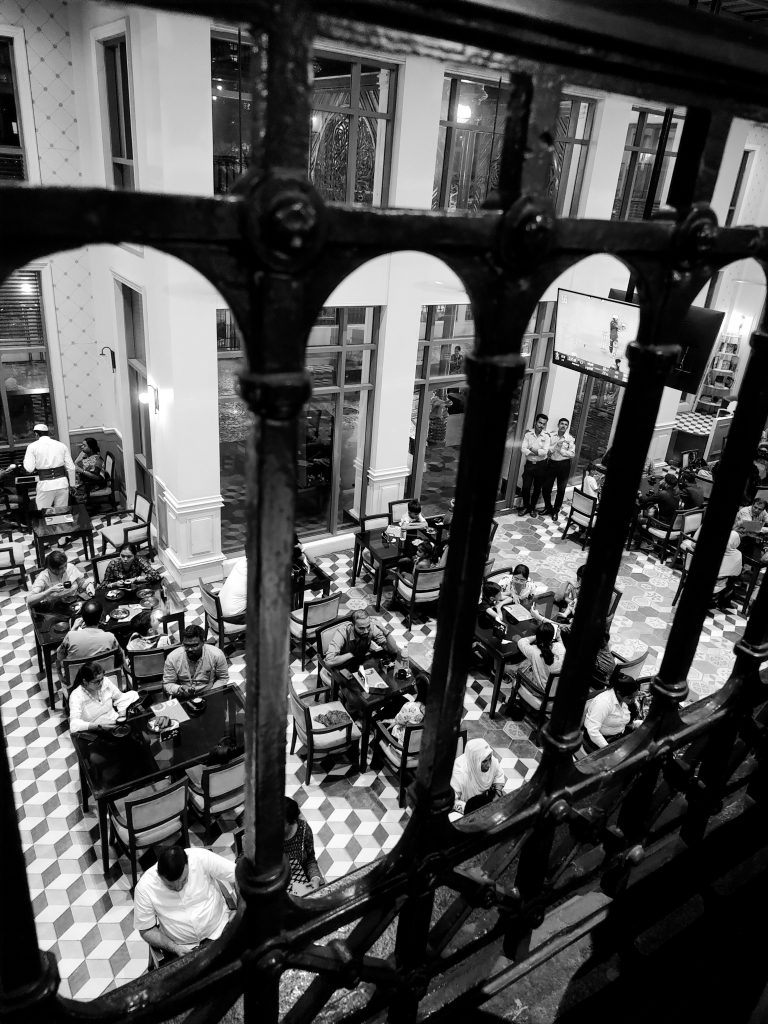
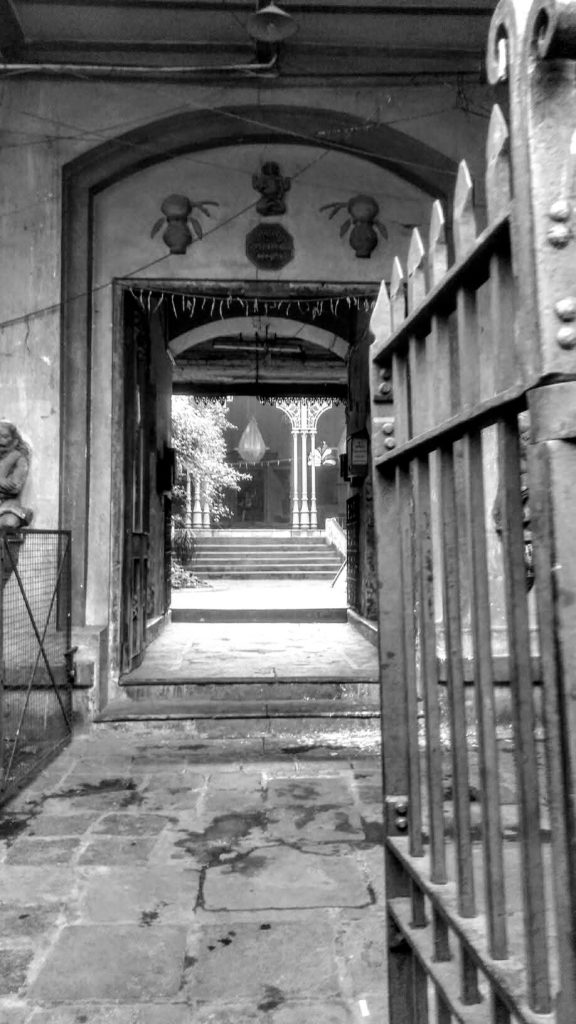
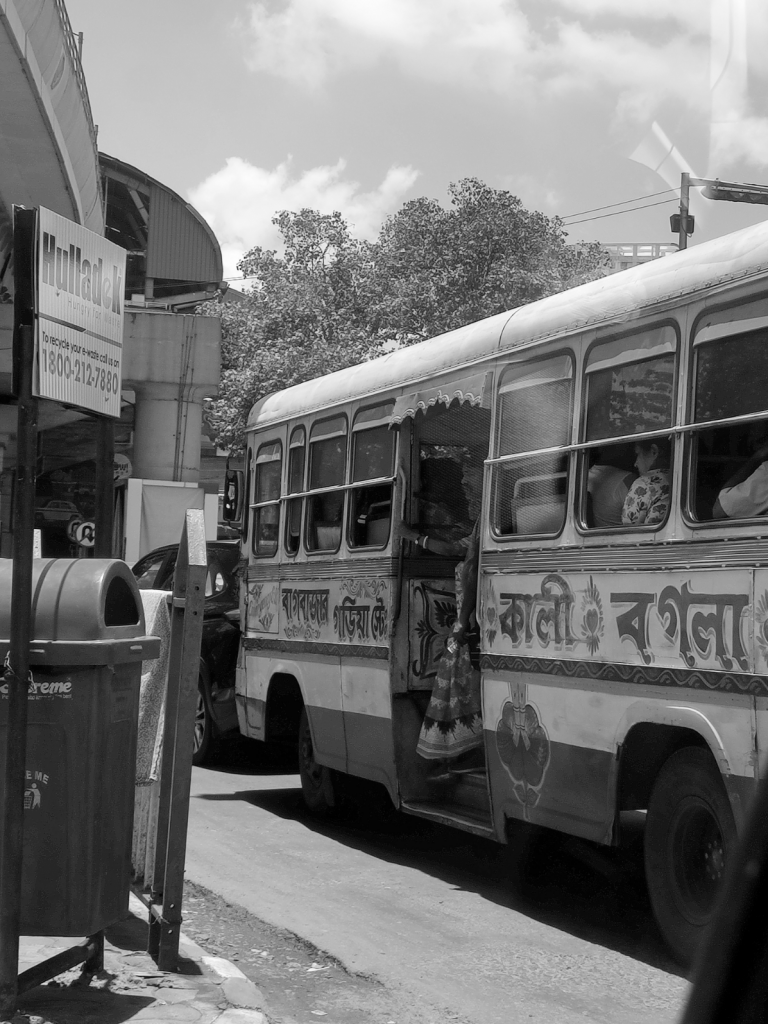
What holds the anthology together finally is not just the selection but Nirmal Kanti Bhattacharjee’s role as reader, critic, and translator, shaping the way we encounter these major five modern Bengali poets in English. This is what made K. Satchidanandan call it ‘profound insight’ into Bangla poetry. Without being a definitive anthology, it remains a carefully tuned entry point, offering a space to enter, linger, and come away with a deeper understanding of Bengali modernism. The production quality, along with the placement of black and white photographs of Calcutta, is well considered, making this a must-read for non-native and new readers of Bangla poetry.