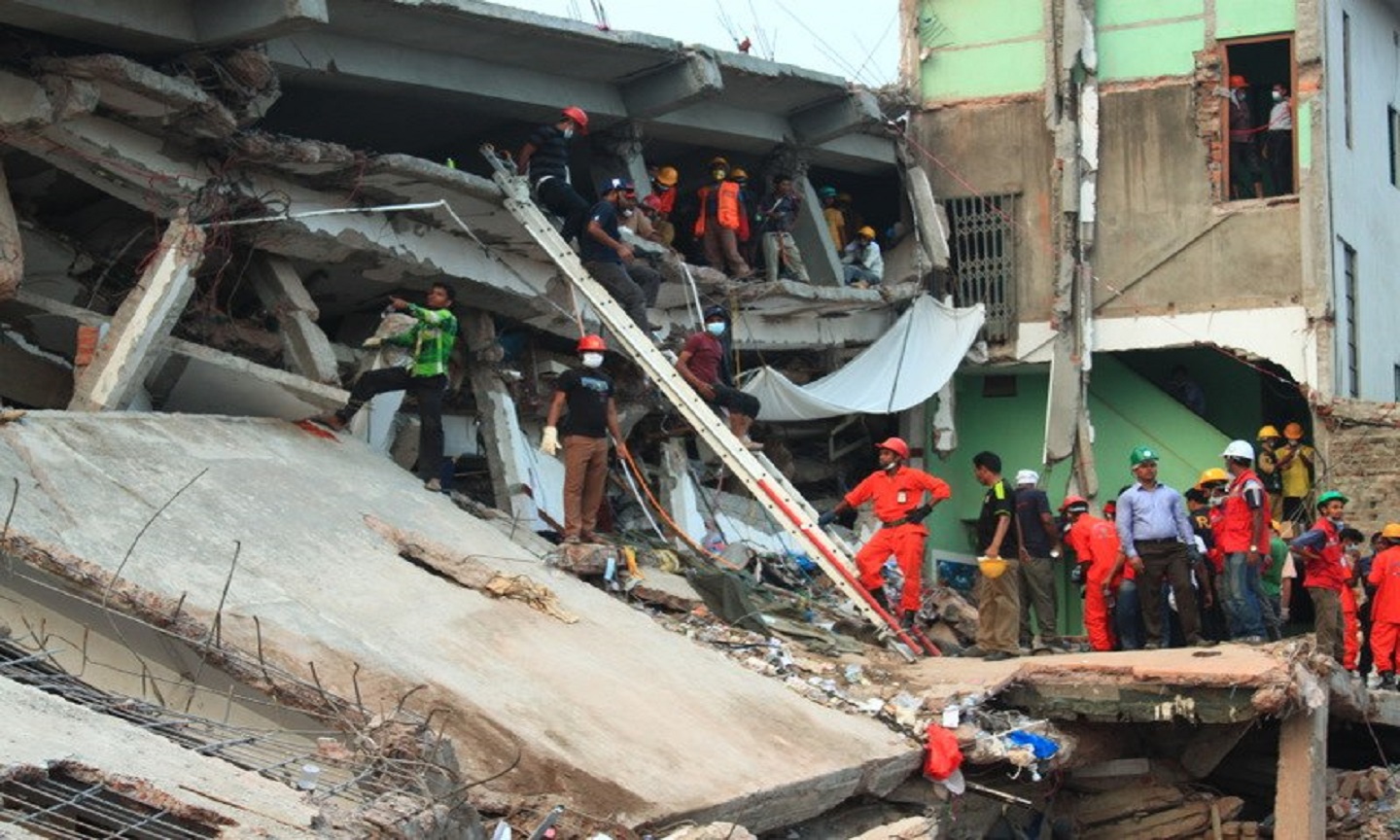
Author’s Note:
On my mother’s side, I come from a Jewish family that immigrated from what is now Belarus to the U.S. at the beginning of the 20th century. Poor, non-English speaking, and barely educated, my grandmother and her three sisters found work in New York City sweatshops and garment factories, some of the only jobs available to them. When I was a child, my mother told me stories about the terrible pay, verbal and physical abuse, and substandard working conditions in garment sweatshops and factories at that time, particularly the story of the Triangle Shirtwaist Factory fire of 1911, a tragedy that stemmed from the factory’s horrific working conditions, the owners’ lack of accountability and anti-union stance.
When I read about the Rana Plaza collapse in 2013, I took the news personally. I grew up with images of the blazing Triangle building and the deaths of 146 workers, most of whom were young immigrant women just like my grandma and great aunts — it was not a great leap to connect what happened in Bangladesh to the Triangle fire, my grandmother and her sisters. I asked the question: “How could an industry that served as a pathway for my family to not only survive but become part of the American middle class change so little — or even go backwards?”
That question led me to undertake a research trip to Bangladesh, during which I interviewed a number of survivors of Rana Plaza, labor rights activists and lawyers, and women who sewed in Bangladeshi factories. I’ve been telling their stories and researching the stories of other garment workers, as well as the industry itself, ever since. The more I learn, the more I believe that I need do my part, small as it is, as a consumer, educator and writer, to help push for changes in the garment industry, changes that support and sustain the people who make our clothes.
***
Union Maids
Today: The Triangle Fire is close to my heart, admits Kalpona Akter,self-titled Shadow for Bangladesh Workers’ Unions, she of arrests, a jail-term,
shareholders meetings at Walmart’s headquarters pleading the needfor safe factories.When I was a girl in the factory, teen in Bangladesh sewing elbow to elbow
inside the locked production floor, it could have been the same for me —if she had worked in New York City, 1909.
Today, Kalpona’s contralto rises above ring-ringing cycle rickshaws, tuk-tuk honksand screeches, men arguing, call to prayer, outside her Dhaka office,
transports me to the Triangle Shirtwaist Factory’s service entrance off Greene Street.Kalpona exits, a shivering girl in November, 1909, hurries east
to the shirtwaist workers’ meeting to hear young Clara Lemlich,mezzo soprano, call a citywide strike in Yiddish.
Today, my mom’s reedy soprano singsof a union girl never fooled by liars,
thugs or billy clubs, girl organizing the guysto strike for fair pay, freedom in a major key
melody as easy to learn as “A, B, C,the Alphabet Song,” or the chorus of “Dayenu:
It Would Have Been Enough,”a song we sang together
in the early 1970s, when I was a kid,especially during shopping trips
to the Lower East Side, in between stopsat Orchard Street’s cramped stalls
of bargain apparel, our duet accompaniedby the thump and whir of Singer machines
driven by ghosts stitching their shadowsinto my elastic brain.
***
To Target
The International Accord for Health and Safety in the Garment and Textile Industry is the 2021 version—and expansion— of the Bangladesh Accord on Fire and Building Safety, a legally-binding agreement between international garment brands and global trade unions, first signed in 2013 to make ready-made garment factories safe after the Rana Plaza collapse killed 1,134 Bangladeshi garment workers. The garment brands that have signed the International Accord commit to independent health and safety related programs in Bangladesh, programs based on the successful past Accord agreements, and new feasibility studies. Target U.S.A., headquartered in Minneapolis, Minnesota, has never signed the Accord.
The top floorsof Target CorporationWorld headquartersdisplay stripes of coloredlight every nightin the city whereI live.Lavender, violet,blue, silver,glow the evening skylike a jackpot sign.Dear Target,here’s the messageI send back to youin black letters,blood background:stop castinga blind eyeto the safety ofthe Bangladeshipeople who sewapparel for you,stop transformingyour supply chaininto a drainwhirling workers’ livesthrough the redbulls’ eyeinside your concentriccircle logo,stop turninggarment workers’bodies intofactory accidenttargets.
***
#Garment Workers, Too
If the Garment Workers, Too appexisted, I could enterH&M, Walmart, GAP,aim at shelves of black T shirts,press Garment Workers, Too. Hear:
“You’re not meeting target production,” the batch supervisor yelled. He pushed me to the floor, hit my breasts, kicked me.
From high-rise chinos in the corner:
I refused my manager’s repeated requests for dates, tried to file a harassment case. The next day, I was fired.
GAP, Walmart, H&Msigned Contracts to givetheir Bangladeshigarment factory workersa voice.
The Garment Workers, Too, appwould play those voices back.
A Chorus from the trench coat display:
We enter the factory, two separate lines: young girls, elder women. My supervisor says, “Go and die at home. Why come to work if you are so old?”
Not Angelina, Gwyneth,Ashley, voicesbroadcast globally,not the twenty-twowho publicly accusedthe U.S. president,
not me, unable to stoptoo intimate words assertedby mentors, but not dependenton their paychecks for survival.
From folds of Boys’Flannel Hoodies,Garment Workers, Toowould amplify the voicesof Bangladeshi womentoo afraid to givetheir names.
The manager throws heavy bundles of papers and clothes at us, especially during high stress production times, doesn’t leave marks that could be used as evidence.
I did not report rape. I would be blamed, shunned by my family, co-workers. What future would I have?
To every Americanwoman shopper,Garment Workers, Toowould uncoverminds and bodiesmade fair gameat work. Our ownmuscle memories,clogged by watchingour fatherspummel our mothers,hearing us branded“Cow,” “Pig,”or other barnyard beasts,enduring men’sprotrusions exposed,the flesh beneath our blouses,skirts, dresses,trousers, nicknamed,propositioned,jabbed, mashed,_____________.
Our limbic systems knowthat we, dressed in differentcultures, classes, wearsome of the scarscarried by the womenwho make our clothes.
At least H&M, Walmart and GAPsigned Contracts to allowthe women in Bangladeshi factoriesto testify.
Toddler overallswould disclose:
I became pregnant; they threatened dismissal. I terminated my pregnancy.
After I went on maternity leave, my contract was not renewed.
At least H&M, Walmart, GAP,allow us access, buthow can we collude in
“You have a pig brain.” “I will fuck you if you do not work on time.” “Bitch,”
by wearingsilence?
***
Craft Project
1. Step OneLooking through the convex-curved window by my desk, outside of which the street where I live appears bigger and further away, I follow the pattern of Covid-19 virus cells, varied as snowflakes, that flutter by to infect more and more people: neighbors’ sons, the carpenter working upstairs, friends, their partners and kids.
2. Step TwoI open Taslima’s email from Dhaka Bangladesh, 7,691 miles from my home office.
Though there’s a Covid reality, local garment factory owners have a huge number of ready-made-garment orders from the west. They’re pressuring workers with tremendous garment production targets. Workers can’t enjoy a single day off. Their wage, fixed three years ago, has become nearly impossible to survive on. Workers are still losing their jobs; they’re still struggling to be paid what they’re owed; they’re still fighting for health care. During one protest, a worker said, “We’re hungry. We don’t think about the corona virus. We want food and wages first.” Tomorrow we’ll hold another rally. Hope you will be with us.
3. Step ThreeI read that American brands like Walmart and Target, who source their separates in Bangladesh, have been anxiously watching Covid corrode their supply chain: customers want different clothes; new styles cost triple the price to transport, ship too slowly; factory lockdowns stall production. Walmart and Target have cancelled orders and payments to Bangladesh factories; watched their pandemic profits soar nonetheless. Now they’re calling for near, on, re shoring. Why outsource to Asia when Mexico borders us? Better still, go back to Made in LA., N.Y.C., towns in-country.
4. Step FourFamily members roll their eyes on Zoom. “How can you ask us to think about garment workers? We’re in the middle of a pandemic.” To calm themselves, they crochet clover leaves, repurpose jeans, quilt blankets. I don’t blame them. I comb and spin flyaway snarls of fear to keep myself tethered to daylight.
5. Step FiveI craft my yarn of nerves into a planet-sized globe of thread the color of blood, attach my shaky thoughts, the nimble minds of my loved ones and any other American clothing brand customer, the brains of American fashion conglomerate C.E.O.s, and owners of Bangladesh garment factories to the red circuit connecting us inextricably to the needs of Bangladeshi garment makers to eat, work and care for their children and parents and spouses without begging. Whenever a garment worker goes hungry, we’ll all go hungry or feed each other, not as far shore, on or near shore neighbors; we will cohabitate a living, breathing shore of shared safety.
Note: Taslima Akhter is the president of Bangladesh Garment Workers Solidarity.
Image by Sharat Chowdhury