
At the Border
–Lopamudra Basu
A short pudgy man with ice grey eyes once looked
at my papers, at the Ontario New York border and said
‘You are missing one signature from the International Office.
I am not sure if you are a PhD candidate
or an illegal alien flipping burgers at McDonald’s.’
The words sting, even after a decade, undeserved guilt,
raw fear of a life of many years,
rudely unravelling. A life spun in libraries,
rides on the uptown train to the Bronx,
our little apartment of ragged chairs, bookshelves bent
with secondhand books from the Strand, floors strewn
with essays of students who were single moms
juggling babies and exams, between flipping burgers.
A lifetime later, now with a new passport
my palms dampen and throat dries at the border.
I did not flee a war to come to this land,
with a toddler at my hip and my life in a backpack.
Yet I know that if this blue booklet with
the watermark of bald eagle is lost,
this face or accent will not shield me.
And if born in another country,
ruled by cartels instead of unions
I could be that woman at the border
hearing the last wail of a vanishing son
grief turning me to weeping stone like Niobe
or like Draupadi with matted hair mourning
the death of all her children in battle
or like Sethe, haunted by the ghost of Beloved,
death more bearable than children sundered by slavery.
The Divorce Dislocation
–Feroza Jussawalla
Kilauea is erupting again,
Hawaiian eruptions, I have personified,
taken into my body,
like the eruptions
of rancid acid,
from my own gut,
through my hiatal hernia,
opening like the mouth of Kilauea
drowning me,
in my own fluids,
undigested food,
undigestable announcements
filling my lungs—
drowning me
interstitial lung disease
from the day you erupted
with your divorce announcement
turning me to limpid lava,
drowning me—
But Madame Pele
awakens me,
from my chemo fog
to dance in my own fire.
Hawaii, where my mother had moved,
when cast out our motherland
nineteen seventy-six, Emergency
turned, bicentennial year of hospitality.
Hawaii, what I thought was my aina
and you, you, husband of thirty years,
cast me out again,
locations, dislocations,
continuous and constant,
movements and migrations,
every one of them, cancerous
from Las Cruces, to Albuquerque,
to Hawaii and back to Albuquerque.
And you, you as you parade in your
academic regalia, well lei’d,
and I watch from behind
a chain link fence,
unacknowledged,
in my own mother’s land
that she brought you to,
where you parade with
another woman,
well lei’d.
That gut punch
you dealt me husband,
has turned into hernias
hiatal, inguinal,
strangulated
bowels of pain,
Thirty years of service
to you,
husband,
where did they go?
I Let Go Her Hand, Deliberately
–Mary Ann Mohanraj
The rules were different when I was a child.
My parents feared the cost, a daughter’s pain;
and if she strayed from old Sri Lankan rules,
she might be branded loose, or even wild.
I slept with boys and girls, or both, or more;
Monogamy was never meant for me.
The final fight—my little sister’s plea
barely enough to counter Amma’s “whore!
Years passed, the thread grew thin, but then
I had a child. Drawn back into familial embrace.
We hadn’t married first, so bastard named—
—a word that had no weight for us. But when
our girl would reckless run at her own pace—
Amma, I understand your fear. We are the same.
My Body, My Enemy
–Shafinur Shafin
As a child, my mother warned me,
“Don’t go outside, a ghost might eat you”
but mom, god will save me.
You always say god never let
any harm come to children because they are
his favorite angel!
Mom had no answer!
When I grew up as a girl,
mom said, “Don’t go outside alone!
There is always a vulture to snatch
and fly you away! You will never find mom again!”
but mom God will save me, right?
He doesn’t like to separate me from you
When I became a teenager,
mom said, “it’s always bad guys
if find you alone
they will prey on your body”
Now grown,
Still, I can’t go alone in the dark.
Mom doesn’t say anything.
It’s me who is afraid.
I cannot help but feel,
That my body is a burden, a seal,
Keeping me chained, afraid to roam,
For fear of the eyes of society
now I understand,
there is No-God to save me
he is helpless too, like mom
Note on the Anthology:
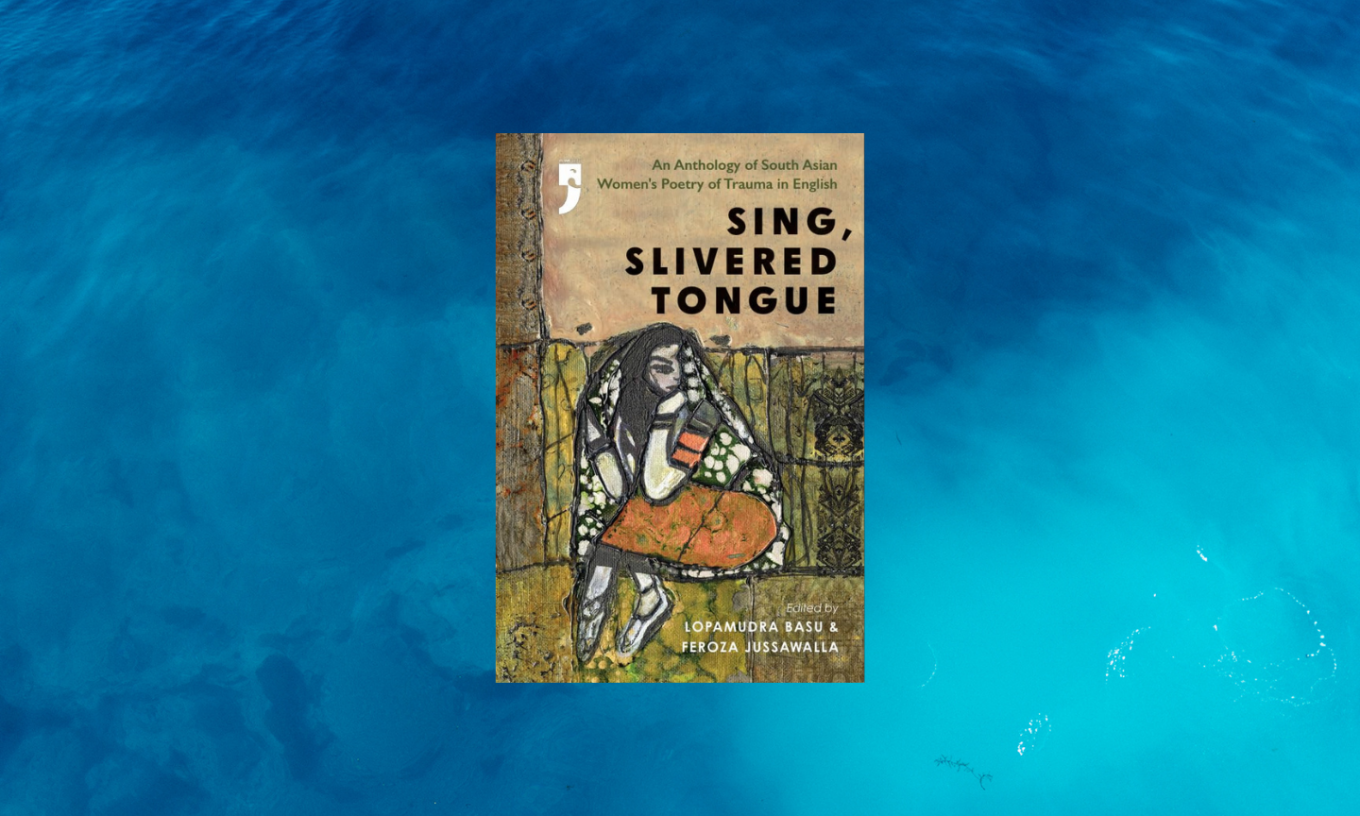
Sing, Slivered Tongue: An Anthology of South Asian Women’s Poetry of Trauma Edited by Lopamudra Basu and Feroza Jussawalla, New Delhi, Yoda Press, 2025. Price Rs. 499
Sing, Slivered Tongue: An Anthology of South Asian Women’s Poetry of Trauma in English is a collection that brings together sixty-eight contemporary women poets from South Asian nations and diasporic communities beyond their national borders. Trauma in this volume encompasses both women’s experiences of political violence as they have emerged from varied nationalist, religious, and linguistic struggles such as the Bangladesh Liberation War of 1971, the Sri Lankan Civil War, and the ongoing conflict in Kashmir. Trauma in this collection also includes experiences which are private, occurring within the domestic sphere, but nevertheless deeply damaging because of their unacknowledged and unredressed nature. Poetry serves the function of testimony, creating a record of these realities when public institutions seem to enforce a code of silence and oblivion.
It was our aim to present as many varied aspects of South Asian women’s traumas as we could accommodate in the anthology. We wanted to include a range of life experiences from women who are still young and at the beginning of their poetic journeys, to those who are acknowledged experts in the field with numerous accolades and publications. We were very eager to celebrate the variety and richness of South Asian nations and not just limit ourselves to India. This led us to acquire poetry from Nepal, Sri Lanka, Pakistan, and Bangladesh. However, due to the larger volume of submissions form India, there are more Indian poets in our anthology. Within India, we were striving for a broad range of poetic submissions from as many regions as possible. We were particularly keen to represent regions like Northeast India that have often felt isolated from the mainstream discourse. Of course, since we were primarily seeking South Asian poetry in English, our poets are broadly from the urban and English educated communities within South Asia. However, we tried to include experiences of marginalization from the perspectives of economic precarity, caste, sexual orientation, and other non-dominant aspects of identity.
This project was conceived when we noticed a lack of South Asian women’s anthologies in the realm of poetry. The editors Lopamudra Basu and Feroza Jussawalla, are academics of Indian origin now based in the U.S. We teach courses in Postcolonial and Multicultural Literature. We noticed a gap in available resources to teach Postcolonial Poetry. While anthologies on Postcolonial Literature are available, there is a lack of volumes featuring poetry. Most anthologies focus on prose genres. As poets who have published our own poetry in various platforms, we wanted to conceptualize a new anthology that would address the lacuna in women’s poetry. In early 2023, we finished drafting a project description and sent it out to various websites and listservs. Soon, we began to receive poetry submissions. We also reached out to personal friends and colleagues and asked them to recommend contemporary South Asian poets that we could contact. We soon received many enthusiastic submissions of poetry. We worked long distance, meeting for several hours on Zoom or WhatsApp where we read the poems together and came to decisions about acceptances and rejections.
Once we had enough poems that we felt comfortable with, we started grouping them into thematic sections. This exercise also helped us write a book proposal showcasing our strengths and getting ready to send the proposal out to several publishers. The process of finding a publisher was not without challenges. We approached several scholarly publishers in the U.S. For them, a collection focused solely on poetry by South Asian women did not seem like a viable project. Some mainstream publishers whom we approached in India were of the opinion that they published only limited books related to poetry. Finally, we received an enthusiastic response from Arpita Das, founder and publisher of Yoda Press. She immediately liked our concept note and asked us to submit the completed manuscript. We worked closely with several poets, editing individual poems. Our goal was to always encourage and preserve the unique poetic voices of our contributors. We did not want to privilege any dominant style or aesthetic. Our editorial suggestions were aimed at producing greater clarity or context, without sacrificing the uniqueness of each poet’s submission.
In the end, our anthology turned out to be one showcasing a tremendous variety of topics. Some touched on contemporary instances of violation of women’s bodies including the horrendous rapes of Nirbhaya in Delhi in 2012, the Kathua episode in 2018, Hathras in 2020, and finally the brutal rape and murder of a doctor at a medical college in Kolkata in 2024. There are several poets who responded to these events as witnesses and warriors for social justice. However, many poems in the volume are not about the ongoing sexual violence faced by women. Many are about less visible aspects of trauma, initiated by subtle and invisible aspects of grief like personal losses of parents or spouses. Some deal with the quotidian aspects of life and caregiving of elderly parents or the dissolution of marriages. Several poems memorialize the devastating losses of Covid, which left so many dead not just from the disease but the inhumane lockdowns in cities that precipitated a migrant crisis reminiscent of the 1947 Partition. However, the poems in our anthology are not just an expression of a litany of women’s suffering. What unites them is the common quest for healing and the quest for justice. Ultimately, many poems speak to each other creating dialogue, interplay, and solidarity.
Our volume Sing, Slivered Tongue is unique because contemporary anthologies have not been devoted to women’s writing. Several recent anthologies published mainstream publishers have attempted to capture a broad overview of poets writing in our times rather than curate poems by women focused on a specific theme. Sahitya Akademi has published a volume of women’s poetry titled Silver Years. It collects poetry of women who are above the age of 60. Thus, it is limited to a specific generation of poets. Our anthology as mentioned before, seeks to bring different generations together in its pages. We also attempt to bring together diasporic poets and those based in their nations of origin. The impetus of the volume was to speak across borders and countries and seek points of intersection in our experiences and poetic expressions. Finally, the title is an invocation to women to sing their sorrows and reject silence. It was inspired by several poems in the collection that reference women’s tongues being cut because of their courage to speak truth to power. Through this volume, we hope to continue the work of giving poetic form to buried traumas.