
I spent my waking hours on the thirteenth floor of the university library, sitting on a dark brown and beige checkered couch, looking out of large, steel framed windows, brooding about my future. Occasionally, I would walk over to the thick-paned windows and let my eyes drop to the ground below. The sight made me queasy; I would shuffle back to the safety of the couch and brood some more.
I was writing my final history paper, Life in a Fascist State in the Twentieth Century, and wanted to include a personal perspective. My family left Portugal when it was under Salazar’s Estado Novo regime, which had been overthrown a year earlier with the carnation revolution. I dug into childhood memories but none bore historical weight: watching my father catch jellyfish at the beach in Setúbal; eating oranges in my avó’s quinta; playing with dolls with my friend Joana. None of that validated me as a witness to fascism. I asked my parents about life in the old country, hoping to draw out political memories, but my father shook his head. ‘Better to forget the past. We’re Canadians now. Your future is here.’ It wasn’t that simple. My name, for one thing, was a reminder that my roots were Portuguese. As for my future, I had no idea what that was going to be. I knew my parents expected success. How many times had they told me they had emigrated so that I could have a better life!
“Just write the damn paper,” Henry, my boyfriend, told me, nodding at the pages of scribbled notes littering the dark brown and beige checkered couch.
“I want to say something about my own history.”
“It’s an essay, not a memoir,” Henry shot back before turning to his own work.
I wished I had Henry’s confidence. He knew what he was going to do. He was going to law school. Become a successful lawyer. Make lots of money. Henry, my friends, everybody around me it seemed, was galloping ahead to success. I was going to be left behind. Sometimes I wondered if I was with Henry just to be a part of his success.
In the end I did what Henry told me to do. I combed through my scribbled notes, picked the best points, and wove them together into an essay, abandoning the thought of including a personal narrative. My courses finished, and with no job prospects, I went back home to my parents. My bedroom with the bright pink chiffon curtains ruffled around the edges, the floral bedspread, and the Bob Dylan poster on the wall, expressions of my eighteen-year-old self, embarrassed me. My tastes had changed in the four years I had been at university but what I had gained in sophistication I had lost in confidence. Four years ago, I had been eager to go out into the world and now I was back home watching late night TV and sleeping until early afternoon.
“Why don’t you visit my sister Leonor in Lisbon?” my mother suggested, a worried look on her face. “Your father and I have talked about it. We’ll pay for the trip. It’s your graduation present.”
Lisboa in June was pastel blue sky, green-covered hills, and warm breeze on our faces as Leonor drove from the airport to her apartment in Algés, on the outskirts of the city.
“Lie down and rest,” said Leonor, showing me a bedroom furnished with dark mahogany furniture. I remembered it had been my grandparents’ furniture.
I recognized the black and white photographs of my grandparents on the wall. The same ones my mother had at home. I smelled the peppery scent of geraniums from the flower box on the window ledge as I lay in bed waiting to fall asleep.
I woke to the sound of my aunt’s voice and followed it to the kitchen where I found a man sitting at the table watching her taking a casserole out of the oven.
“Margarida!” Leonor greeted me. “Did you get some sleep? This is Nuno, an old friend. He dropped by while you were resting. He’s joining us for almoço. We’re having bacalhau à bras.” She placed the casserole steaming hot with shredded cod fish, matchstick-size potato strips, scrambled eggs, dotted with black olives, parsley and lemon wedges, on the table. She filled our glasses with red wine and gestured to us to start eating.
Between mouthfuls I inspected Nuno. Short, solid built, thick arms and legs. He looked to be in his late thirties but was dressed young, in bell bottom jeans and a pink and purple paisley long-sleeved shirt. He wore his dark brown hair down to his shoulders. I noticed his eyes darting around, circling the room like a flashlight.
“I’m teaching this afternoon but Nuno can drive you to Lisbon. He has a new sports car,” said Leonor, before cautioning Nuno. “Drive carefully, don’t crash this car.”
“You crashed your car?”
Nuno opened his mouth as if he was about to speak but raised his glass of wine instead and took a long sip.
“The car was a wreck but graças a Deus Nuno walked away without a scratch.”
I wondered why Nuno hadn’t answered for himself. So far he hadn’t spoken.
The afternoon sun was in full burst, pouring down like shimmering gold. The trees and shrubs stood still in the heat. Nuno drove slowly. Cars honked for him to speed up but he didn’t seem to notice and continued at a snail’s pace.
Downtown Lisboa emerged in faded buildings, walls covered in graffiti with names and symbols of political parties and slogans. Everything looked old and small. When I was a child, the buildings towered over me. Rossio, the center square, buzzed with noise and activity. People everywhere. Strolling, talking, reading newspapers, drinking espresso, smoking. Everybody was arguing politics: the 25 de Abril revolution had given birth to dozens of political parties, nuanced in ideology and strategy, full of promises. Everybody had an opinion. The flower stalls around the water fountain were splashed in color: red carnations, pink azaleas, yellow mimosa, purple and white anemones. I wandered around the shining, broken cobbled sidewalks, swept up by the bustle. Nuno tagged behind. We wove our way around the narrow, winding alleys of Alfama, twisting and turning under the shade of the overhanging roofs, climbing up to Castelo de S. Jorge.
Once a fortress protecting the city from up high, the castle was now ruins, more garden, with swans, peacocks and tourists strolling around the grassy grounds. Below, Lisboa spread out wide as the quiet, blue Tejo river made its way to sea. I sat on the remains of a wall and remembered when I used to come up to the castle grounds on Sunday afternoon with my parents. I loved running around the ruins with other kids, playing hide-and-seek in the dug-outs and chasing the peacocks, trying to get them to fan their feathers and show their colorful eyes. I looked up and caught Nuno looking at me.
“Do you want to go back?”
He nodded.
Traffic was slow, bumper to bumper, as Nuno tried to make his way out of the city. I noticed he was driving around the same streets, going in circles.
“Are you lost?”
In response he abruptly turned into a lane with a Não Entre sign. The bottom of the car scraped in a harsh ripping sound as he drove across the raised track. From the opposite direction an electric tram advanced towards us, the driver waving to Nuno to go back. Instead, he stopped the car and sat motionless.
“You need to reverse and get back into the road,” I said, wondering how he’d missed the Não Entre sign.
He didn’t seem to hear me or see the tram moving towards us. He sat still as a statue. I knelt on the car seat, my knees moist with sweat, sticking to the leather, and waved my arms for the cars on the road to let us merge back into traffic.
“Back up,” I commanded in a loud voice, slapping him hard on the shoulder.
It stirred him into motion. He started reversing the car, scraping out of the raised platform back into traffic. He continued circling around the same streets.
“Why don’t we turn right here?” I suggested, recognizing one route he hadn’t tried. A lucky guess. It was the road back to Algés.
“Oh dear,” gasped Leonor when I told her what had happened. “I thought he was better. The accident must have shaken him up.”
We were sitting in the living room, drinking maracujá, passion fruit liqueur.
“He doesn’t talk. What’s wrong with him?”
“It’s a long story,” Leonor started, as she refilled our glasses, “I’ve known him since we were kids. He was always quiet. A little odd. He was conscripted and sent to fight in the Angola war of independence. I didn’t know what had happened to him. Then five years ago a friend told me he had been admitted to the hospital where she worked. He was catatonic. Staring into space like a statue.”
“Oh!” I had seen a version of that in the car.
“He had been captured and imprisoned in a Congo jail for three years.”
I jerked my head back in shock, spilling maracujá on my hand.
“How does he manage?”
“His family is well-off and supports him. I don’t ask questions because, as you know, he doesn’t say much. Just nods or shakes his head. I found out about the car accident from another friend.”
Another sip. Leonor refilled our glasses. I felt warm and tingly. The soft-colored flowers on the wallpaper appeared to be turning brighter.
“Your mother wanted me to go to Canada.”
I thought her eyes glistened with tears but I couldn’t be sure. I was feeling blurry eyed myself from jet lag and too much maracujá.
“I didn’t want to leave Portugal. My friends, my home, my job. Learn a new language that I would never master. Your parents emigrated because they wanted to give you a better future. I thought it was too late for me to start a new life. I’m happy about the revolution but it’s a mess right now. There’s no stable government. Every week there’s someone new in charge. Universities are closed. Food is rationed. The water is turned off.” Leonor laughed. “Don’t worry, I store water in jugs.”
“It’s funny but even after all the years away Lisbon still feels like home. I know who I am here. In Canada I feel like an outsider.”
“Portugal is going to catch up but it will take a long time. I’ll be old when it happens.” Leonor sighed.
We drank some more maracujá.
Nuno showed up the next morning after Leonor had left for school.
“Can we go to the beach at Setúbal?” I asked, picturing him in a soldier’s uniform.
He nodded.
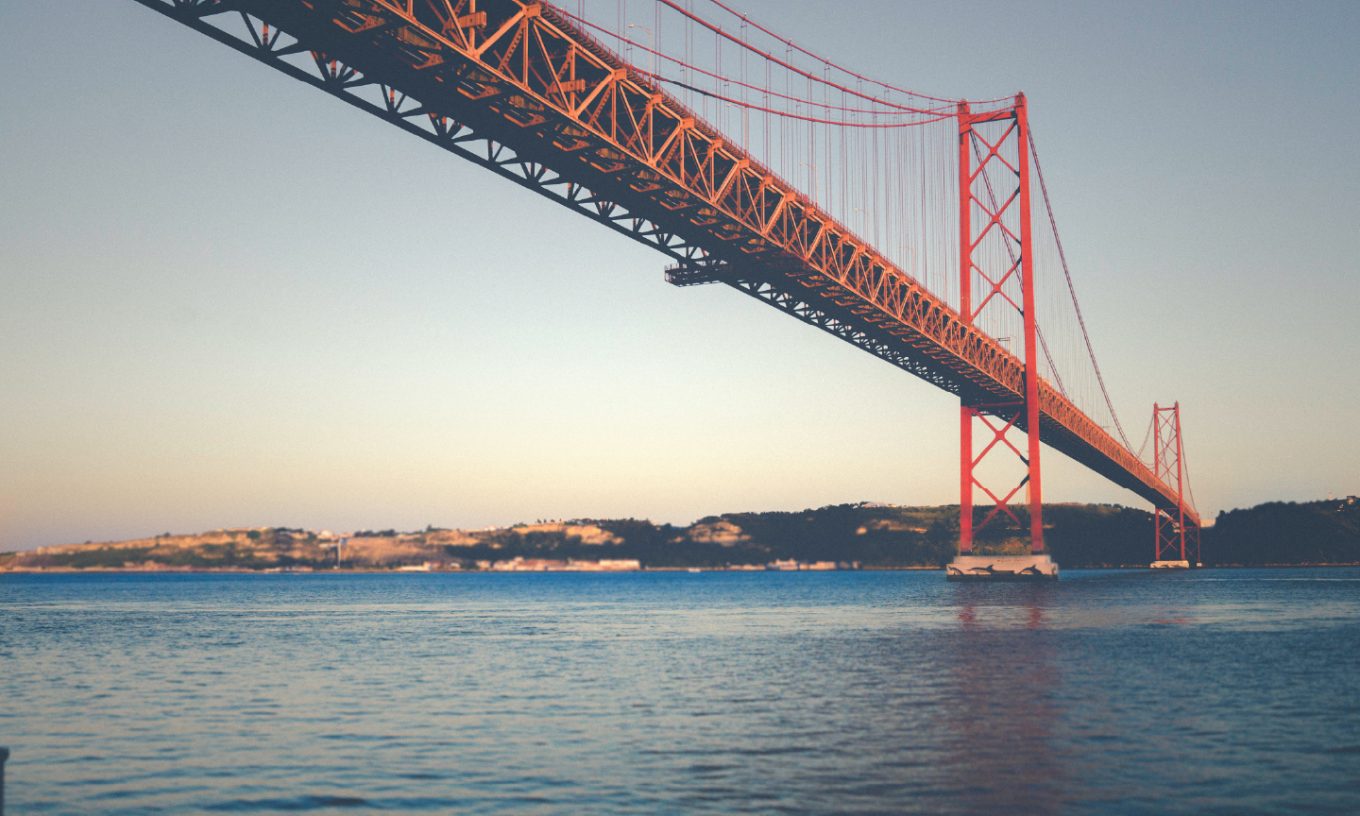
We crossed the Tejo river on the new bridge, Ponte 25 de Abril, all bright orange vermillion and suspension. It was the first new-looking structure I had seen since arriving. Inaugurated in 1966 it had been renamed in honor of the revolution. I was afraid to look down the vast drop to the water below and kept my eyes fixed on the open arms of the Cristo Rei statue, beckoning us to the other side of the river.
The beach in Setúbal was littered with bodies stretched out on the glinting sand.
“Aren’t you swimming?” I asked Nuno, heading out into the sea.
He glanced down at his bell bottom jeans and long-sleeved shirt in response, and retreated into a straw roof café.
I stayed in the water for a long time, floating on my back, gazing up at the sky, hoping to catch a glimpse of the future. I only had to be patient and scan every inch of blue to find it. Finally, when everything started looking fuzzy and glittery, I gave up and swam back to shore. My head felt like an inflated balloon about to burst.
I found Nuno smoking in the straw roof café.
“Can we go back?”
The moment the car rolled onto the metallic platform of Ponte 25 de Abril, away from the Cristo Rei monument towards Lisboa’s seven hills, I could feel it weaving in the lane. Nuno’s protruding brow glistened with sweat and he gripped the steering wheel like a child driving a bumper car. I felt the bottom of my stomach dropping. Was he going to drive off the bridge into the river just as he had turned into the electric tram track the day before? Suddenly, I longed for the safety of the dark brown and beige checkered couch in the library, where I sat feeling anguished about the future. A future I had taken for granted.
The car zigzagged along the bridge. Getting so close to the vermillion railing I was sure I could touch it with my fingers if I stretched out my arm. I forced myself to sneak a peek down at the river, the water shimmering dark through my sunglasses. I imagined smashing through the cold steel railing, my body spinning in the air, then plunging into the deep, dark water. I had wasted so much time, worrying about a life that wasn’t going to happen.
Nuno veered the car away from the railing, back towards the median. My heart leaped with hope. Maybe I could keep him from driving off the bridge? Maybe I could save us? I could hear Henry barking at me. ‘Just make him stay on the bridge.’
“Thank you for taking me to Setúbal. I enjoyed it.” I spoke in a soothing voice, as if I were humming a lullaby to a baby.
His lips curled in a smile.
“Have dinner with Leonor and me tonight,” I invited him.
He raised his left arm and draped it over the car door on the outside, hugging it. With his right hand he steered the car straight. The vermilion railing moved away from me. Ahead I could see the cars driving off the bridge onto the safety of the road. We were almost there. I held my breath, as if that would make us get off the bridge faster.
“Tomorrow I want to go to Cascais.”
He nodded.
“Sintra too.” I was running out of things to say.
Then I felt the car bounce as he drove it off the metallic platform onto the road. I was so happy I wanted to get out of the car and run all the way home. Glancing sideways I saw Nuno’s long dark hair flapping in the breeze, playing peek-a-boo with his face. He blinked as the sweat ran down his eyelids.
“He drove so close to the railing I could have touched it,” I exclaimed to Leonor later that evening, after Nuno had left.
“You are never getting in the car with him again,” Leonor declared. “I’m sorry I suggested it in the first place. I had no idea.”
“I thought we were going to dive into the river.” I shivered at the memory.
“I’ll call my friend who works in the hospital where he was treated. Maybe she can reach out to him. He needs help.”
Nuno didn’t show up again at Leonor’s. Nor could her friend track him down. He seemed to have disappeared.
For years I woke up from the same dream. Sitting in Nuno’s car on Ponte 25 de Abril,just as he was about to drive off the bridge to the bottom of the Tejo river. A moment of terror as I waited to die. Then the fog of waking up from the dream. Lying in bed uncertain of what was dream and what was real. Slowly, becoming conscious of my breath, warm from sleep, feeling the weight of the covers on top of me, the mattress under me. Sighing with relief to be alive.
I have never forgotten those moments on Ponte 25 de Abril in Nuno’s car. I have never forgotten Nuno. If he could manage with his trauma, so could I.
I went back to Toronto. I hadn’t missed Henry. When I told him I wanted to break up, he didn’t seem surprised and agreed. ‘We should meet other people.’
I work for a Portuguese newspaper writing freelance articles. I interview immigrants who came to Canada in search of a better life. Like my parents, they say they emigrated so that their children could have a better future. I know it’s more complicated than that.
On Sundays I talk to Leonor.
Occasionally, I ask her if she has seen Nuno.
Once she spotted him in Rossio.
“I noticed this guy sitting at a café by himself, wearing a wool turtleneck sweater in the middle of a heat wave.”
“Nuno?”
“I went up to him and asked how he was. He nodded and smiled. I told him to drop by.”
“He was still sitting in the same spot when I passed by later. Gazing into space. I didn’t disturb him that time.”
Photo by Glauco Zuccaccia on Unsplash