

I
What would you do on a lazy summer afternoon when the temperature soared to 34 degrees Celsius and humidity to 60 per cent? Well, you sit under the shade or smoke by the river, or work if you are one of the unfortunate ones in the village without good education due to your own doing. Your parents are government servants; you are a spoiled brat. You dropped out of school after matriculation because why bother about eight hours of studying when you can laze around at home or work under MGNREGA and earn a decent 350 rupees a day for a hundred days? Of course, you never think what would happen after one hundred days and you have no reason to do so. You have amassed a fortune worth over 35,000 INR during the period and have had enough to buy all the good things that the village and Shillong could offer you.
But you are seventeen. And eighteen. And sixteen. And fourteen. The future is far away. And many a time the future does not exist; even if it does, it ends at the junction where the weighbridge stands and that’s where you foresee yourself. Working as dalal where you help the malik in navigating the hurdles of weighbridge through your connections. You smuggle cows. Gold. Drugs. Dal. And guns, if there are enough insurgent groups in Bangladesh. You have nothing to worry about. You have 350 rupees every day in your wallet, a good smartphone for music, videos and selfies. And a girlfriend for fun. You have palm trees for shade, a river for bathing, Dona’s shop for coffee, and Jied’s pub for alcohol. You have an empty road in the northern part for an evening run. And you have National Highway 44 E as your future.
This is the road that has shed more money than a sick body sheds virus. You have nothing to worry about, let alone about school and education. You said, “Look at so and so… they have a BA, BSc degree and work for a pittance. 15,000 a month as contractual employees.” You said, “Why make life hard while being a teenager when life is just going to be tough when you are an adult?” For someone without a good education, you are quite philosophical, which I’m not surprised of because you sleep at 3 in the morning (when you don’t go to work) like Socrates. So maybe you are a Socrates in this small corner of the world. Sure, Socrates never had any BA, BSc, or PhD in his life and you will certainly use that as an argument for your nonchalance only if you know enough about Socrates. But you don’t, and it doesn’t bother you a bit. You have good internet to keep the world at your fingertips and you speak English better than the schoolers. You would never want to leave this paradise, these rivers, waterfalls and these endless shades that protect you from the heat and remind you that the world is a harsh place. So, you sit there or sleep happily in the comfort of your bed and count days and nights, doing the same boring routine that you always do.
Everything changed with the arrival of Bo. He walked in high-waisted skinny jeans, his curly hair draping over his shoulder and his back. A thin line of mascara on his eyelashes, a tinge of pink-red on his lips. He was twelve years old, five feet eight inches tall and strutting around the village like a whore of Police Bazaar. You knew immediately that was something you couldn’t stomach. You knew how revolting it is for a boy to walk around like that, staring at men like that, talking to other men like that. Deep down you knew you didn’t hate him for hate was such an easy word that carried only the most superficial of feelings. Deep down in your heart of hearts, you knew you wanted to swallow that sick son of a bitch and defecate him into a hellhole that not even God can conceive of reserving for the greatest of sinners. And you knew very well how a little malice can unravel the vilest of reactions, how that inglorious sight of transgression can damage the splendid reputation that you carved for yourself. So, what did you do on that hot summer night when you were confronted by that apparition of transgression that you understood so little about yet cared for and feared so deeply?
This was the night in question:
Five policemen led by the officer-in-charge of the area Police Station arrived in the village the next morning to conduct the investigation two hours after the riverside discovered the body of Bo. His face was bludgeoned beyond recognition, his penis was cut off, and his testicles were crushed. His rectum was penetrated with a two-feet stick and his clothes were torn off his body. People crowded around the brutalized body carelessly covered with a plastic sheet. They could only look at the body blankly, conveying neither emotions nor sensitivity.
I looked around trying to find one solitary face that showed a little bit of sadness, a little bit of emotion, but I found none. Of course, why would I expect that? I knew that they found the crime quite horrible. I knew they despised that such action occurred in the village which has the reputation of being a peaceful place, and I also knew that in order to be sad, in order to be emotional or show even the slightest indication of grief, there is a need for something to grieve about. But here lay a body that was not something to grieve about. It carried with it the permission to kill. It is too much to care about a life that doesn’t matter; it is too much to weep over a body that’s not weepable. So, there he lay sheeted by plastic and covered from the world – unwept, unmourned.
II
Hypatia came to me, her face and her pace betrayed the enthusiasm that she tried to hide.
“What brings you here, Hy?” I asked. She didn’t answer me instantaneously. She took her time pulling the chair, and checking her reflection in the full-length mirror, pouting as she parted her hair. We were in Liza’s beauty parlor. Since it is owned by my niece, I frequented it for leisure during the evenings. The village was filled with murmurs and inaudible noises about the incident, speculating the causes and the identity of the murderer. Everyone assumed it might be Mia, a big man known in the area as Ordang[i] or a snake master – a practitioner of black art whereby the soul of the victim is offered to the serpent-like monster in order to be wealthy. But Hypatia, that bright and gossiping girl of sixteen, thought otherwise.
“Do you know that Bo was seen last night going to the river?” she asked me.
“I assumed that already otherwise how could his body be found there?”
I also had a good deal of knowledge about Grindr date gone wrong whereby gay men are being lured into a rendezvous only to be killed by the posers. I read one such story that happened in New Delhi during the lockdown and presented a paper on the vulnerability of queer people. But all these times, my life had been so insular to such experiences that when it hit me that this in fact could be one of the likely scenarios, I was shocked and at the same time excited that it happened here in the village. “But what you don’t know and what I do know is that Jay was also seen going to the river,” she said.
“Wait a minute. Are you trying to imply that Jay and Bo met up by the river? On a date?” Liza asked, her eyes wide open. Before I could say anything, Hypatia replied, “I’m not saying or assuming anything. For all I know, maybe Jay stalked Bo and found the perfect opportunity to kill him. If he killed him.”
“And why would he want to kill him?” I asked.
“How do I know?” she said, her sharp eyes mocking me, “I didn’t know there was a killer in the village, with the exception of Mia, but here we are. Someone is dead. And nobody has any fucking clue as to what’s going on?”
“Do you genuinely think Jay did it?” I asked.
“I don’t know what to think. I only know that I am innocent. Besides that, you all are suspects.
I chuckled. Of course, I know she didn’t suspect me.
“Do you think they will catch the killer?” asked my niece.
“Yes. They always do. They are going to track his phones, his call records, his social media…”
“He doesn’t have any of those. I mean he used to but we all know what happened between him and his uncle. I mean that’s fucked up, right?” interjected my niece.
“Well, that’s bad enough for them,” said Hypatia.
“Well, they will manage to find the culprit if they really want to. But I have seen cases that go cold and off trail, especially when it comes to the less fortunate people,” I said.
“What do you mean less fortunate? His father is a doctor,” she said.
“He was adopted. He was not even from our tribe, and why the hell would his parents send him here while they lived in the city if not for the fact that they were ashamed of having him as a son?” I retorted.
“I would be ashamed if I had him as a son,” she said and laughed.
“Yes, checking out on boys while they take bath; dressing up like a girl; I’ll kill my son if he’s like that,” my niece agreed. She was even more vehement in her final assertion. Like she meant it. As if she had also seen the apparition that would negate her belief in her goodness. But something that she said gave me a new insight. What if after all, it was his own relatives that killed him as a way of excising the malignancy that they perceived as destroying the reputation of their family?
“Do you think his relative would do it then like you said you would if you have a son like that?” I asked my niece.
“Probably, I wouldn’t blame them even if they do.”
Of course, she wouldn’t. I began to understand that in this place, Bo never had a chance. He was surrounded and beset by the very forces that saw his existence as undesirable – his friends, his family and even a stranger like me who was completely detached from the intricacies of the village affair. It was only then I realized that the night in question was only a caldera accumulating the pressure that had been building up inside its belly. Because with every superficial story of how love and marriage were made, there was always a silent contempt for that story and that contempt can only build up the frustration which, when it exploded, consumed first and foremost, someone like Bo, someone without a need to live, without a story to tell, and whose memory was betrayed by the sordid affair that indicted us of the pretentiousness that characterized our convenient life.
Hypatia ate her aloo muri. and left soon afterwards, disappearing just as she appeared. Suddenly. Swiftly. Without a warning. Like a sordid wind.
III
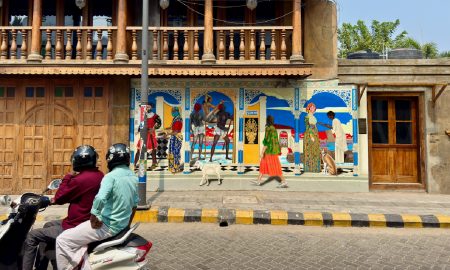
A few weeks before the night in question, I saw Mike, Ben and Usama busy painting a wall. Here they poured their emotions through the kitschy doodles they called murals. I watched their hands and fingers moving carefully over the broad wall as they devoted their attention both to the walls and the paints they carefully applied and to their new subject of hatred, the recent subject of attention because he came as something strange, something exotic in a bad and fearful way. It was a symmetry of dread that haunted them and the rest of this quiet village of endless laughter dissipated into the hot humid air. The plain of Bangladesh looked like a corpse from over these hills, one without the stench of putrid dead bodies. The stench was here though as these three boys lamented the current new addition to the village. It only took a small hint from Usama, nicknamed after the infamous Usama Bin Laden of Al Qaeda, to bring down the tower of nonchalance and peaceful contemplation and turn it into dust.
“He was beaten yesterday by Lui. He said ‘fuck you’ and Lui beat the shit out of him,” Usama said, smiling with satisfaction as to what had happened. This new information about the situation of Bo suddenly riled up Ben who said, “That happened? Oh My God! I’m so happy. He really deserved it. That bad-mouthed whore. He is a hijra whore.” His words were muffled by the clenched teeth of anger and satisfaction.
Mike was calm and measured. “I heard if he comes to your house, he will straightaway enter your bedroom,” He said. “That’s the part I hate most. Why would anyone enter a bedroom?”
“Because he is expecting to see you asleep so that he can molest you, run his hand over your body and grope your thing,” said Ben.
“One day he’s going to get it,” said Usama, “I’m pretty sure of that.” I kept note of this remark by Usama because there was a part of me that wanted to cling to the belief that Usama would be incorrect about this prophetic vision of his. It was a part of me that wanted to indulge in that game of cat and mouse – Usama, the mouse and I, cautious, prudent and always precise, a cat. In longing for that, I wanted this peace to go on, this disruption and subtle noise to continue; I longed for Usama to keep making predictions, for Mike to be as calm and measured as always and for Ben to keep reveling in that hatred that had consumed him. In short, I just wanted them to be fixated on the murals, trace the histories of the village through those countless words, patterns and figures that they painted and went about with their lives as usual. Before the arrival of Bo. I didn’t want them to smell the stench of the village. This was my vision and mine alone, my secret that only I and Bo and Meban, and Pynkmen and Saccatus could understand. But most importantly, it was mine and mine alone. Little did I know how wrong I was. Though I felt the stench that clung to my body like a scared child, I denied and convinced myself into denial and went on with the thought that Usama would not get it right. But Usama was a prophet and I was just a pretender.
IV
April was quarantined by the health authorities because her brother stayed with her for a few days and later on, he tested positive for COVID-19. April, a 58-year-old woman, happened to be the only friend that Bo had in the village or that’s the impression I got. I used to see him frequenting her house and helping her with chores. When he was done, he, along with April’s maid who only played games on her phone, would shoot short dance videos and post them on Tik-Tok. To my knowledge, he was the only boy in the village to use TikTok (before it was banned). However, April’s quarantine allowed for a perfect opportunity for Bo’s family to restrict his movement, lest he infect others, they said.
I approached April few weeks after his murder to enquire about the incident and her friendship with him. April didn’t hesitate. She didn’t mince words. She felt as if it was her duty to show Bo in a different light, different than the one everyone saw him in the village.
“He was a good boy, you know. Very precious. Such a good talker as well.”
“Did he mention anything strange or peculiar to you?” I asked. She looked at me, her head tilted slightly to her left shoulder.
“What can I say? “she sighed, “He mentioned about his uncle abusing him when Bo protested his curfew. His uncle shouted at him and said, ‘So now you have learnt how to talk back to me, you whore.’ He even slapped Bo hard across the face.” “Bo told me that his uncle always shouted at him for belly dancing in reels. He once said to Bo, ‘Do you think anyone wants to see your face around here, you slut? This will be good for you. You will not go out and if I find you breaking this rule, I will thrash your dick-hungry ass.’
“Bo had no choice but to walk away from his uncle,” April continued. I could feel a sense of sadness in her voice as she narrated the ordeal of a young boy whom she called her friend. Fortunately for him, they did not confiscate his phone which served as his best friend during his isolation. But his uncle restricted his screen time to one hour a day and asked him to delete his TikTok account.”
Little did Bo know that while it smelled like a perfect opportunity, his phone also trapped him into the grand conspiracy that resulted in his dead mutilated body by the river. No one wept for him. Only Usama’s words can be heard in this sullen atmosphere haunted by curious stares of satisfaction and horror.
“I knew it. I told you this will happen,” he exclaimed, as if triumphant and elated that his prediction had come true. Perched atop the river bridge, he grinned at me, exposing his stained teeth, satisfied with how accurate and how sinister a prophet he was.
V
He received a black eye from Diang’s father. He was beaten by Lui. My own brother said he would kick him hard and threatened him not to ever gaze in his direction. Lal said such creatures shouldn’t be among normal people. Usama, who was privy to every word and thought of the people of the village, told us that Bo would get it. How then, did I become so numb to these predictive indications that I completely missed all the marks that pointed towards the larger trouble? I was not the one who believed in the general goodness of people. But in this instance, I failed to acknowledge their evil sides. Because I believed that this place had bred so many nonchalant people that doing anything drastic would be too much trouble for them. I believed that my people may be evil, but more than that, they are lazier. You can always forgive me for this naivety because, at the end of the day, I was made from the same dust that the rest of my kind were made up of. I was insular, ignorant and uninformed about everything.
The night in question, then, came to me as a second coming — swift, sudden, shocking, unexpected, and with a bang. More importantly, it was the lack of salvation that gave it shock value. My aunt, whose house is situated by the narrow path to the river, said she saw a tall slender boy going to the river at around 8 p.m., but she didn’t recognize him. She only saw the apparition of a slender figure, like a vine, like a Kynthiang-ke-deliang- a shape shifting monster in War legend and assumed it was him.
“Probably it was a date that went wrong,” she said, chewing her kwai.
“Probably it was a business deal gone wrong,” said her husband, grinning with an obvious insinuation.
There was something about the incident that made everyone shocked, amused, and delighted. They can only revel in the delightful uncertainty of “probably”. Probably it’s because of this…probably it’s that…the word uttered and escaped like sand through fingers because it is cheap. It came with a little imagination, little creativity, little expectation and an enormous amount of insinuation. So, you see, the night in question rested entirely upon this “probably” and how little certainty is there, how little our knowledge, our ignorance, our indomitable quest of curiosity can help us in unravelling this mystery, but probably a little enlightenment might help prevent this tragedy altogether.
VI
I do not pretend to know what had transpired during those dark, secret hours, sinisterly hidden from us by the night, by the roar of the river and figures so slender, so slim, and so opaque that nothing about this will ever come to light. The investigation as I know went cold after a few weeks due to the lack of leads and interest. After all, Bo’s death was a convenience that finally came, an absolution that finally beckoned us from a proximity that was so close that we held its ever-stretching hands, pulled it and hugged it tightly, never to let it go. We will not betray our salvation; we will protect our kind; we will not let the convenient death of a figure we so reviled destroy the lives we so loved. So, we hid the truth; no, there was no truth to hide, there was no falsehood. Bo’s death was only a simulation, only a dream that never happened, whose existence was only marked by the mnemonic we called a cross that bore his name on the cemetery. And that’s about it. Bo died. He will not be remembered; his name will not be spoken; life goes on after the night in question. The road still bleeds crores of rupees every day; the summer continues to be hot and humid as always.
You continue to earn your MGNREGS wages. This is a place where nothing ever happened.