
Along the high pastures of Auvergne, France, 1575…
The gentle clanks of glass on glass sounded from the kitchen where Mama was rinsing the cutlery. The water in the rinsing bowl swished around as she dunked each fork and each knife into its crisp wetness, some spills making their way down the bowl’s sides in thin streams.
“Mathilde!” my Papa’s distant voice sang out from the meadows where he was tending to the cows.
I turned my head to the open window that, with its burnt umber planks, perfectly framed my Papa’s far away figure among endless green fields that blanketed the earth, leave a few cows scattered about. “Yes, Papa!” I called back to him. In this manner, we often sang to each other, back and forth, through the open window.
He paused his duties to look at me. “Bring me your working hands!”
On my cue, I sprang out of my seat and ran past the window, into the fresh fields themselves, and soon thereafter we set off to make our daily rounds, our family being one of milkmen and milkmaids. Papa and I each carried two pails of creamy milk on either end of a long stick that balanced on our necks and on our shoulders. With our commodity upon our sleeves, we grazed the hills up and down, just as the cows do.
When we reached a large cottage at the top of an ample hill, my Papa rapped at its door. It was opened by Monsieur Christoff, whose skin was beginning to fold into itself in slivers, and whose stocky stature was beginning to slouch with age.
“Monsieur Christoff, how do you do?” my Papa greeted. “Would you and the madame be in want of any milk? We’ve just tended to our cows.”
“Uhh … Monsieur Dupont, we remain faithful patrons to the milkmen of this town, but I’ve dealt with tricky merchants trying to best a man of the bourgeoisie prior. A little greed is not only innate to the lower-class man, what so brimmed with envy, but it seems almost essential to hold a competitive ground to the fellow men in your trade.” He dawned a cunning smile as if he were meant to impress us with his offensive words, ‘Ha! Look how I have caught you in your little act!’ his eyes seemed to say. And yet, there was no act: simply me and Papa and our milk. “I tell you what,” he began again, “Bring the cows, and milk them in front of my eyes. Only the Lord knows whether the milk upon your shoulders has been watered down.”
“Monsieur Christoff, we haven’t touched the milk. Papa only milked the cows this morning.”
Christoff looked me in the eye, then at Papa. “Tradesmen can be incorrigible, you understand. The arsworms would try to convince me this Earth is round if they could.”
“But this Earth is round,” I began, but Papa placed a hand on my shoulder.
“We don’t mean for any troubles, Monsieur Christoff,” Papa spoke. “Come Mathilde, we can bring Luna.”
“Luna better be a cow, for god sakes!” spat Monsieur Christoff.
“Oui, she is.” Papa turned me around and we grazed back, to retrieve Luna.
We grazed in silence. I looked at my Papa’s face: the face he often wore when he was too distracted to predict how long it would take a cloud in the sky to roll in front of the sun and offer us some shade. It was the face he wore when he was too distracted to even look me in my eyes. But he wore it only briefly before turning to face me. “Mathilde, you know the Earth is round.”
I nodded my head.
“Good. That’s right, ma fille.” He paused. “It’s been proven as well. Some fifty years ago, a man named Ferdinand Magellan – a Portuguese man – he had a disagreement with the king of his country, so he turned to the king of Spain and promised him a new route to the Spice Islands of the East, lands where spices grew on trees and the sun never ceased to share its warmth with its people, even long after it would set, even into the deepest of winter.”
“What about spices make them so valuable? Why do not men travel so for gold? Or knowledge?”
Papa chuckled. “Mathilde, if you had a taste of such spices, you would never be able to chew through your mama’s boiled goose again.” I snorted. “Anyways, Magellan guaranteed the king this unorthodox passage would grant Spain far faster means to acquire spices, faster than the Portuguese. The king was quite desperate, so he sent Magellan off with 270 men and five ships.”
“All for the Spice Islands of the East?” I asked.
“Oui. Only they went west,” he explained. “They traveled a very long time. You have heard of the hardships of the sea, of travel?”
I nodded my head. I had heard of men leaving, and never returning.
“Many men could not hold on to their lives. Eventually, even Magellan could not outlast his own voyage. He perished in a battle that was not meant for him, and that forced his men, what few were left, to make a most difficult decision: whether or not to pursue an end they were unable to see at the time.” He set down the pails along his back for a moment to pluck a long piece of straw from the ground and stick it between his teeth. Then he picked his pails back up and resumed his tale. “One of the men, Juan Sebastian Elcano, who found honor in promising to finish what his captain started, led the journey from that point onward. He, along with but a few surviving men, finally reached the precise spot they had embarked from, some three years after they had first departed its soil.”
I looked up at my Papa, right into his eyes, and smiled. When we made it back to the house, he told me to wait while he stepped inside for a moment. When he returned, he was carrying a small ball of mil, perfectly rounded, and painted with earthy tones of green and blue and white.
He placed it in my open palms. “Never forget,” he said. “Protect it.” Then we picked Luna from the herd and made our way back to Monsieur Christoff’s cottage, empty pails on our shoulders.
Elias, my friend, lived very close to us. He would often come to visit, and we would sit amongst the grass under the shade of the south-facing wall of our home, and we’d make fun of the clergymen that would occasionally pass through with their funny wigs and pants.
“Oui, I saw one with a painted spot on his face! Right here!” he pointed to his cheek. “And I know it was painted because as he was reaching for his horse, his sleeve brushed against his face and smudged the spot!” We laughed together. Later on, I would show him the painted Earth Papa gave to me, and he would bask in its subtle beauty. “Oooh la la! How did he get this? Commoners can’t even touch paint!”
I simply shrugged my shoulders and told him what Papa told me. “He told me to protect it. To never forget the Earth is round.”
Elias chuckled, “Mathilde! Of course, the Earth is round!”
I still remember the first time I saw General Jacque Nicolas Bazaine. He was a Marshal of France under the King, and had come now to our village for a reason I had not known, let alone understood. It was at the market steps. The market was a vast space on a hill that was comprised of just steps: each one higher than the one before, each one crowded with vendors and merchants parading their commodities. I had come that day to look for some clay to repair a cracked pail; Papa said we could not afford a new one. Something as trivial as clay could be found at the bottommost step, but the more pompous goods were at the top. I, myself, had never found the need to make it past the third step, but that day, I noticed a strikingly lustrous pair of boots traversing through the crowd of the 10th step, striding to the sides here and there to avoid the occasional passing villager. I knew just by the way they moved that they were dawned by someone important. A grim part of me was almost lured in by the robustness of his stride. I needed to see this man’s expression. I needed to understand his power. I started to make my way up the second and third, then the fourth, fifth, and sixth steps, a rush enveloping me as heads began turning, my feet unrelenting. I soon found myself on the ninth step where my eyes caught his face: a strikingly harsh jaw line, dawning a luxurious wig of sandy curls that shined nearly white in its outline, and a uniform with varied embellishments that blinded the village when he’d turn at certain angles. He was admiring a most exquisite object, something like I had never seen before. I didn’t get quite enough of a chance to look at it before I was stricken to the ground, likely by some brute clergyman. I awoke to the dirt beneath my body, in the shadow of the first step.
Now that man was at our door.
“Oh, won’t you come in, Monsieur.” With a tremble in her voice only I may have heard, Mama stepped aside, and let him into our home, sending me to my feet. “Would you care for some water?”
“Oh no, thank you, madame.” He flashed a smile that seemed merely a mask he had conveniently slipped before his face. Never before had I seen a smile that I had not felt, but his bleak eyes spoke nothing of authenticity. His black leather boots exerted a force I had never felt imposed on our creaking floorboards. I thought they would surely give in to his mass, that they would crack at every corner he drifted to. He made his way toward me slowly before speaking. “Salut, how do you do?” he chirped.
I struggled to find my voice before responding. “Fine. Thank you.”
Just then, Papa stepped inside, and my heart was able to catch up to itself. He would tell him to leave us be, and we could return to our lives. But instead, my Papa greeted the General, and welcomed him to explain the reason for his visit. My mama and I stayed dormant at either side of the room, standing, watching.
“Of course, you are deserving of that, monsieur. I,” he put a hand to his chest, “am General Jacque Nicolas Bazaine, Marshal of France under the King himself. I often frequent this village, acting officially as the King’s eyes, ensuring everything is running as intended and so forth. But I have come here today to inform. Are you familiar with one Rafael Augustin?”
“I have heard the name. He does not reside in this village?” My father responded.
“No, no,” he smiled, “But he is to, shortly. It appears him and the entirety of the Augustin family are to report to this very village and take up post as dairy farmers. It is said to be nothing short of a divine calling, reinstated by the Holy King himself!” His arms moved in grand, dramatic gestures, as if they were meant to impress us. Then he stepped closer toward my father, slowly and deliberately. “Consider this a friendly warning from his highness, truly a favor to you… the Augustins are prepared to own many more cows than you, and charge much less for milk than you do. Seeing as though you and your family are currently dairy farmers of the very village the Augustins are to occupy, it may be rather tempting to resist their settlement; however, it would behoove you to keep your own country’s interests at heart.”
Papa tried a smile, then even a chuckle as he turned to face Mama, but her visage remained filled with worry. He stopped. “Marshal, thank you for informing us, but we must continue our work. The King will understand?”
“The King has only given me orders to inform.”
“Well,” Papa turned and caught my eyes with his, only briefly before darting his gaze back to the general. “I think then he will find our continued efforts in milking our cows, should he ever visit.”
“To his quandary,” General Bazaine accepted. He seemed satisfied with his visit, almost ready to head towards the door when he froze in his boots. He had caught sight of the painted Earth, and now his gaze remained trapped upon it. I sunk on the inside, but my heart ceased, and further ceased when I saw Papa swallow.
The General turned to face me, a cunning smile looming on his face. “La fille, is this yours?”
Though it felt as though my entire body were trembling, I did my best to nod my head. Better it be mine than Papa’s.
The General broke out into a fit of laughter, picking up the earthen ball of clay. “Oh, la fille,” he laughed, as my family and I remained still. “You are but a commoner, so you do not know better, but this is a holistically inaccurate depiction!” He would not stop laughing. “Come here, child. You see, the Earth is flat, like this table.” He banged his hand on our table with the sweeping force of his palm, causing not only the table to shudder, but myself. “The idea that the Earth is round is improper, its banbury tale.”
I needed to make Papa proud. “General, the Earth is round, and there is proof! In 1519, two Spanish men-”
“Please!” The General’s voice hung on the walls of our home for a moment. “Please child, next you will try to convince me the Earth is slowly rising in temperature by the day!” Then he pocketed the ball of clay into his satchel. “Best you not spread the lunatics’ word.”
“Marshal, please. That is quite valuable to my family.” I watched my Papa plead, and to no avail. The General did not relent, but instead, sifted through his satchel and pulled out a strange contraption, setting it where the ball of clay previously sat.
“A newest technology, this is a pendulum clock. One for keeping time. Consider it a gift from your King.” And with that, he took off, the Earth in his possession.
Continuing our business as usual, we set out one morning to make our daily rounds. Trekking upon the vibrant hills with Luna alongside us slowed us down significantly, but my Papa refused to leave her behind anymore. We arrived at Monsieur Christoff’s cottage, and Papa rapped at the door as he does, and Monsieur Christoff answered.
“Bonjour Monsieur Christoff, how do you do?” my Papa greeted. “One pail or two today?”
But Monsieur Christoff’s eyes did not meet Papa’s. “It is the Augustins, monsieur. It is to no offense; their milk simply costs far less than yours. Madame and I could use the extra livres, you see.”
Papa’s eyes lowered for a brief moment, I could feel his heart sink, before he gave Monsieur Christoff a polite smile. “Oui. We understand.” Then he turned me around, and we slowly headed to our next house, but not before we remained within earshot of Monsieur Christoff’s callings: “Adieu, round-Earthers!”
Papa and I were turned away house after house, denying us the pleasure of sharing our sweet cows’ milk with the village. But what hurt even more were the lingering judgements that began to weigh us down, the words “round-Earthers” practically sewn into our garments the way people snickered.
Our home quickly became filled with crates of milk no one would take. Sometimes, Papa would not even take me with him. I spent the extra time helping Mama around the house and teaching myself how to tell time on the pendulum clock General Bazaine left us. Mama had mounted it on the wall shortly after Bazaine’s visit, and since then, it is as though the General never left this house. It loomed over this family, day and night, as reliably as time. Though I tried, I could not avoid it. I stared at it so much, I decided to learn how to understand it. Eventually, I could. It was difficult at first, but then I could. I pondered over General Bazaine, and whether or not he was capable of reading a pendulum clock. I decided the odds were not in his favor, for if he was, he would have taken the opportunity to showcase any sliver of intelligence he had by teaching us how to read it before leaving us with the unbeknownst object. Just as the clock was becoming less daunting, though, the crates of milk, filled to the brim, became more daunting. They mocked me and my family.
One morning, I waited for Papa to leave without me, then soon after, I, too, left to make my own rounds, grabbing a crate of milk on my way out the door. I started at the end of our usual route in an attempt to beat the Augustins and avoid Papa. When I arrived at the first house, I found my fist rapping at the door; I didn’t even think about it. And when I was met with no immediate response, I continued my rapping until the door opened, and behind it stood Mademoiselle Clements.
“What is it, child?” She asked frantically.
“The Earth is flat!” I spat.
“Pardon?”
“The Earth is flat, and I am selling our family’s milk! Would you care for some, mademoiselle?”
And she bought three crates.
Slowly, the crates full of milk that cluttered our floors began to lessen, and though Mama and Papa were leery, they readily accepted their usual, third-rate fortune, and did not question my morning absences.
One evening Elias came by, and as we laid on the grass that tickled our skin, he asked to see the ball of painted clay again.
“It does not exist anymore,” I explained.
“Pardon?”
“It was not accurate. It was made on the basis of simple, Banbury tale.”
“Pardon? Mathilde, the Earth is round, by your own word!”
“The Earth is flat,” I spoke, and though my heart panged with pain, I just laid there, and continued to let the grass beneath me brush softly against my skin.
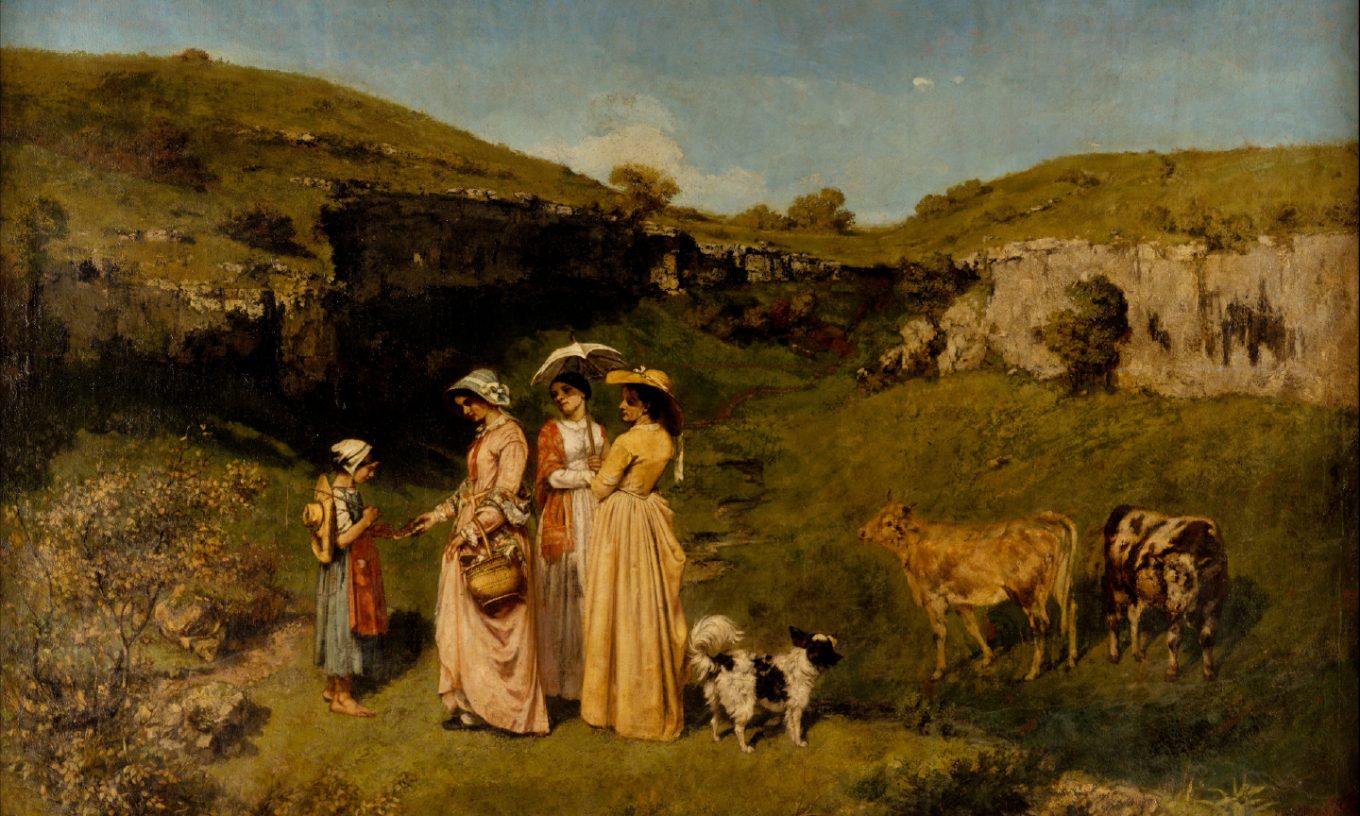
Image: Young Ladies of the Village, 1851–52, Gustave Courbet (French, Ornans 1819–1877 La Tour-de-Peilz), Oil on canvas