
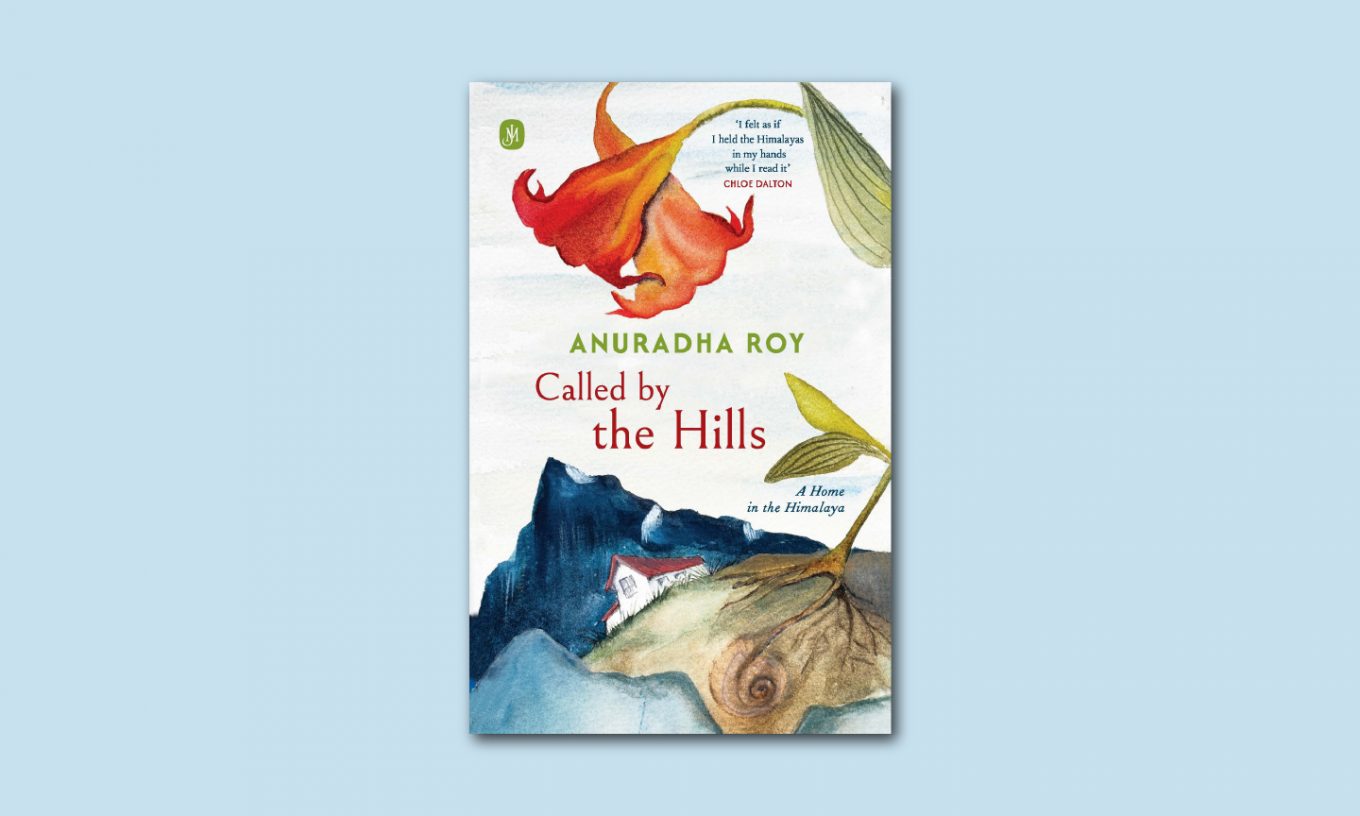
Called by the Hills: A Home in the Himalaya by Anuradha Roy, John Murray India/Hachette, 2025
Those who are familiar with academic publishing in India know about Permanent Black – an independent publishing house, which has been bringing out seminal books for the past 25 years. It is run by a publisher-duo – Rukun Advani and Anuradha Roy – who previously had made their mark as editors. Ramachandra Guha, in The Cooking of Books, recounts in detail his writer-editor relationship with Advani over decades (begun while the latter was at OUP), emphasizing the defining role that he played in making Guha the writer he became. Advani would eventually leave OUP and his life and career in Delhi to set up home and shop in distant Ranikhet, a small village nestled in the higher Himalaya. What living in that home would entail and how it transformed them as individuals is at the heart of Called by the Hills. While it is Anuradha Roy’s memoir, Advani’s presence is embedded in her narrative – as part of the ‘we’ who shares her life in the hills.
The book was a suggestion during the pandemic by Roy’s publisher, Christopher MacLehose, who wanted her to write on the flowers of the Himalaya “so that imprisoned readers could wander in imagined gardens far away” – surely, the most altruistic motivation for publishing there can be! Initially reluctant, because of her “botanical inadequacies”, Roy eventually gave in, reasoning with herself:
… it is a fact that, over twenty-five years, I have – with a lot of help from friends – turned a barren and rubbish-laden patch into a garden of sorts, certainly a corner of earth where butterflies, bees and birds come, where our dogs like to gambol about in all weathers, where the perfume from Datura and Nicotiana makes us want to sit outside in the evenings, and the colours bring us out for a look first thing in the morning.
She started writing, but soon realised that she couldn’t “separate the garden from all that went around it.” Indeed, the book recounts Roy’s relationship with every sentient being that make up her home and environment: from her dogs – Biscoot, Barauni Jn. (named after a train station), Piku, Soda and Jerry – to the plants in her garden and the flowers and fruit that grow (or refuse to) in it. (Not to forget a scorpion who had to be dealt with when the home was new). What is most striking about the memoir is that, while friends and neighbours and acquaintances fill up the pages of Called by the Hills, the book leaves us in no doubt that it is Roy’s relationship with the natural and non-human world that is at the core of her existence. The human relationships often emanate out of them. Thus, it is, that while providing voluntary daycare to Jerry that Roy became friendly with her neighbours from whom the pup was eventually adopted. Or, while trying to learn more about the flowers, plants and birds round her home and locality that Roy enters into the orbit of scholars devoted to the study of various aspects of life in the higher Himalaya. They understand the nature of her quest – not the kind of adventurer who conquered peaks, but someone driven by a profound curiosity to know the hills intimately – and indulged her accordingly. There’s Ravi Dayal, her landlord, who could identify bird from song; there’s Durga Kala, who would recommend books to her (by E.H. Aitken, among others), while he worked on a never-ending biography of Jim Corbett, and attracted other scholars and travellers like Bill Aitken and Shekhar Pathak to his home.
An interesting aspect of the book is that, when Roy writes of lives that impinges upon hers, they branch out into other lives and narratives and histories. A case in point is her chapter on her housekeeper – whom everyone calls ‘Ama’ but she secretly nicknames ‘the Ancient’. It is one of the most delightful chapters in the book – describing with comic relish, their fraught relationship, where she perpetually falls short of the housekeeper’s idea of what a ‘memsahib’ should look and act like, and with whom she is at loggerheads about what to plant in her garden and how; and yet, whose indispensability renders any plans of doing away with her irrelevant.
While giving her back-story, Roy effortlessly gives a sociological account of ordinary lives in the hills: from home and family, to working conditions and living quarters, down to the violent quarrels she has with a neighbour. The grand-aunt who brought up the Ancient in an idyllic village near Katmandu, the man from Garhwalshe eloped with and married, his diplomat employer who brought the couple to Ranikhet when he retired, and his ‘memsahib’ wife are additional character-sketches that provide pathways to her past and the service economy that props up life in the hills, whether in colonial or contemporary times.
A very moving chapter of Called by the Hills is of Roy’s friend and neighbour, Amit, who is etched on the reader’s mind: his face “ravaged by rum and grief”, his house open to visitors outside his class, his books and flowers (and a recipe from his late wife) bequeathed to the author, and his death, thin and pale and alone in a Calcutta hospital.
The central irony of Roy’s life with her husband in Ranikhet is that they run a publishing house in a place where most inhabitants are unlettered, who don’t read books and simply don’t understand the nature of their work. Yet, it is to them that she runs back after the whirl of Lit-Fests. Not for her the glare of media spotlight or basking in being a talking head. Not for her, other affectations of the writerly life, either. One realizes that not every writer has a room of one’s own – or even a desk – with a view, when she tries to send a magazine-worthy photo of a writer’s desk, upon request by one. And fails to measure up to their expectations. Called by the Hills is thus, in a sense, a book about Roy decidedly not measuring up: to her housekeepers’ ideas of a memsahib, to the world’s ideas of the writerly life, to her neighbour’s ideas of what a woman should do (have children and not “wander the hillsides doing nothing”).
Wandering the hillsides is precisely what had to be restricted during the Covid years – not just owing to lockdown, but because forested towns like Ranikhet began to undergo a slow process of wilding, once animals sensed the retreat of humans. Leopards and jackals roamed in broad daylight in parks and roads, and even close to homes, having lost – like humans – their “sense of day and night and time and place”. Jerry fell prey to one such predator. Of the ensuant grief, Roy poignantly writes:
Something broke with Jerry’s killing, not just within us, but also in our relationship with the forest. The trees I loved seemed to me now massed together like a dark, hostile force and I could no longer take pleasure in the brilliant blue sky, the first touch of sun on the snows, the birdsong. To be in the Himalaya is to become pantheistic: to worship the light, the radiant effulgence of the peaks, to think of them as gods. But these gods on our doorstep now seemed remote, implacable, ruthless.
Jerry lives on in the memoir, which becomes an act of mourning as much as remembering. Roy’s artworks – 45 watercolours and sketches, spread evenly over the book – allow the reader to see her world with greater vividness. Done in the nature of journal entries, these works are intimate studies of flowers and fruits, trees and birds, balanced out with misty mountain views, winding forest paths, and houses distant or up close. With the occasional sketch/portrait of dear ones.
The reader remembers them long after closing the book.