But I don’t have to say a word to the trees.They already know everything.Like when you knelt before me— that’s not exactly what happened.
Instead: You cracked my pulsing ribcage(two hands clasped, pressed),reached into my slackeningthorax, held aloft my electric greenheart so the sun shone through.My ventricles and valves lit up:angular, cast iron slabs of deepshade stood upright like bookswith clustered oak bezelsin the dank, late-noon gloom. Didn’t you notice?
And also, that one time (before you)—when in search of forgotten songs, I rolled my heart out,presented with pride even though flattened,to a cartographer specializing in my condition—
the incomparable melancholia brought on whenalready dangerous concentrations of high lonesomeslide down wooded ramparts and in rivuletspool atop secret pastures dappled beneath lacycanopies of Quercus lobata in early spring— I’m telling you—all that light in the trees out there is me.
Or did I get my words wrong?Am I the moth (transposed: lepidoptera)summoned to the oak by invisiblescented syllables, a nose-to-tailprocessional of parasites digging in doing damage, disguised as bark?
You held up a mirror so I could see all my deficits—the lacquered scrolls of -ectomies, bite marksin tear-dropped clusters the whole world over(flood, famine, fire, genocide). I’ve chartedtheir courses and confluences—pointed uselessly to the bereavedrefugees in my smoldering spine as if their faces weren’t obvious.
All this as I was trying to disappearinto the oaks (as you wished I would),bidding my mouth learn to swallow sunlight,my fingers to suck up water, when I walkedthrough my self alone refracted.I returned breathless from the glittering glen to tell you (inconvenienced by my revelations).
Needless to say, said the mapmaker to menot long after you left,you mustn’t ever try to put this backwhere you found it. Now you must take great care.
In stillness, remove heart as directed.Line up the hardest parts of your everywhere-selfwith the bark and graft to the treesfilled with light to diminish risk of futureperforation. Hold heart firmlywith both hands—especially whenapplying jutting, glowing canyonsand chaotic quantities of euphoric green.And, finally, it may be bestto leave a heart riddledwith illuminated oaklore to rest in shade,to reach in silence beneath the earth,to link up with those singing cellsforever beckoning liberation.
Archimony* at Dusk
*Noun: anger about an injustice you only discovered long after the fact, after years have passed and everyone else has moved on […].–The Dictionary of Obscure Sorrows
Bats dip their wingtipsinto the inkwellof the slow, sighing gloaming,twirl ribbons of dark acrossthe disappearing day.Their invisible threadsstitch the parts of meI couldn’t reach in time.
Tonight my shatteredheart stands witnessto the skyward calligraphydrawn by those with the namemeaning hand-wing,and I know—beside the windowabove the drowsy prairie mallowand poppies—every flourish,every kerning tourniquets a differentkind of devastation—truth found too late,legible only by the long lost lightof forgotten stars.
Synesthesia: A Fairytale Remix
Once I walked througha forest made of colorsthe sound of a cathedral’s choir—storybook pastels as night felland the voices began—a muted,emergent euphoria composed of dusty tealsoverlaid with inky, nightshade bluesand still the sighing violet hues (somewhere).Then came the far away whispering greens—azure variations carved from resonant sky.
All beginnings and endingssmudged and disperseddecant a weighted curtainon the sylvan stage of this perplexing glitch:the gods can’t tell if I’m a princesson the page or a pauper peddling tales.
In truth I’m little more thana careworn insomniacdreaming myths into motion,inhaling colors through my earsknotting cantankerous thoughtsinto trinkets I barter for a scrapof tin-torn shut-eye.
The Parable of the Choirsuggests it’s my turn to take a breath now,reassures me others will sing while I cannot.At last my palms slide from the gilded book,pull the characters from theirparchment holds—I smear their serif soulsacross the night, slip into the wakeof lilting sleep—and so topple the kingdomdangle the beautiful young loversthe wicked old witchand the bright ethereal fruit,toss the long-awaited kiss—dash them allinto the star-blushed universeoff the edge of my bed.
They land in a crumpled stack—bent pages,dented corners, every instanceof their joy and sorrow slammedshut within the heavy hardboundtesseract of words where theirworld blurs with mine. I step intothe relief between happily ever afterand the end—indecipherable harmonies humthrough the forest’s incandescent twilight.
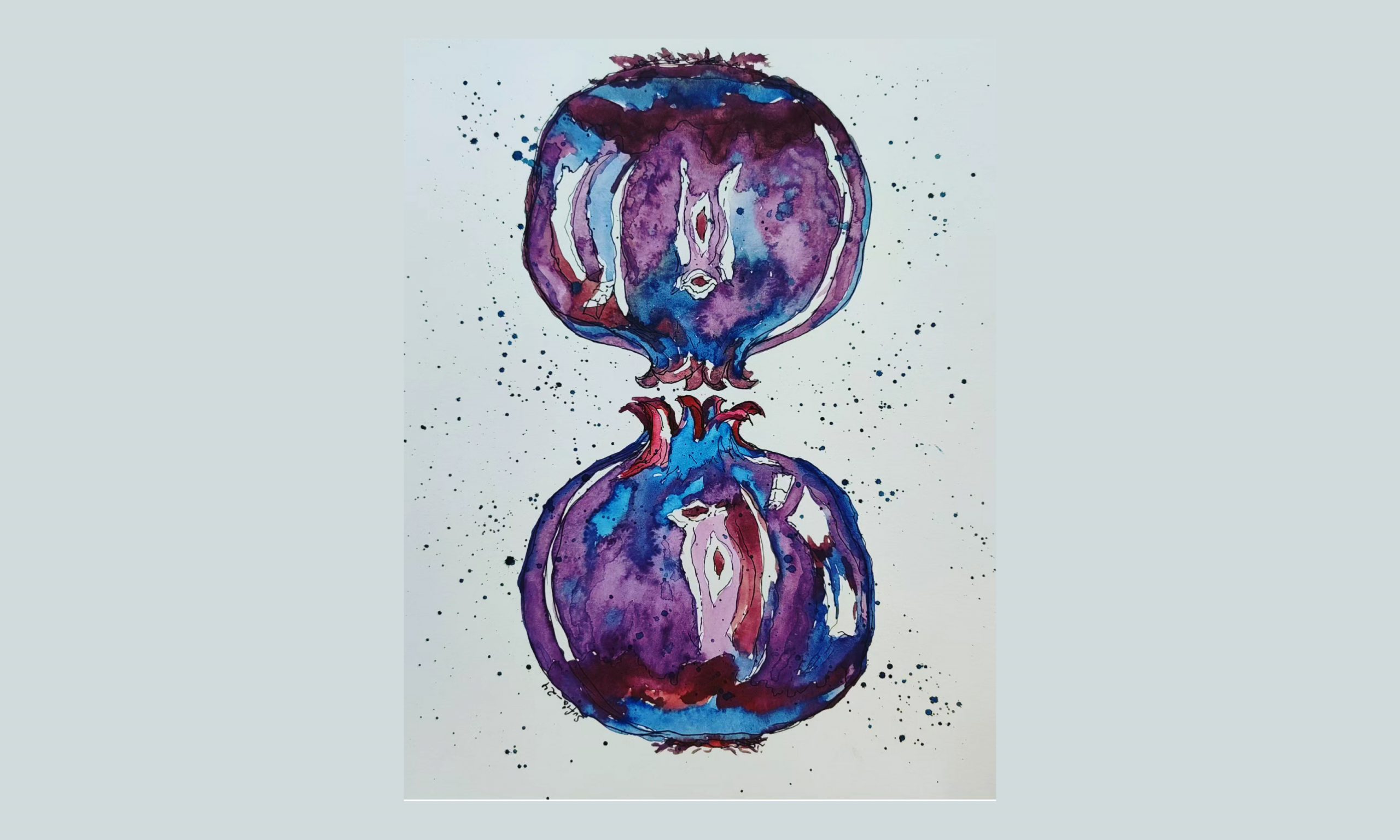
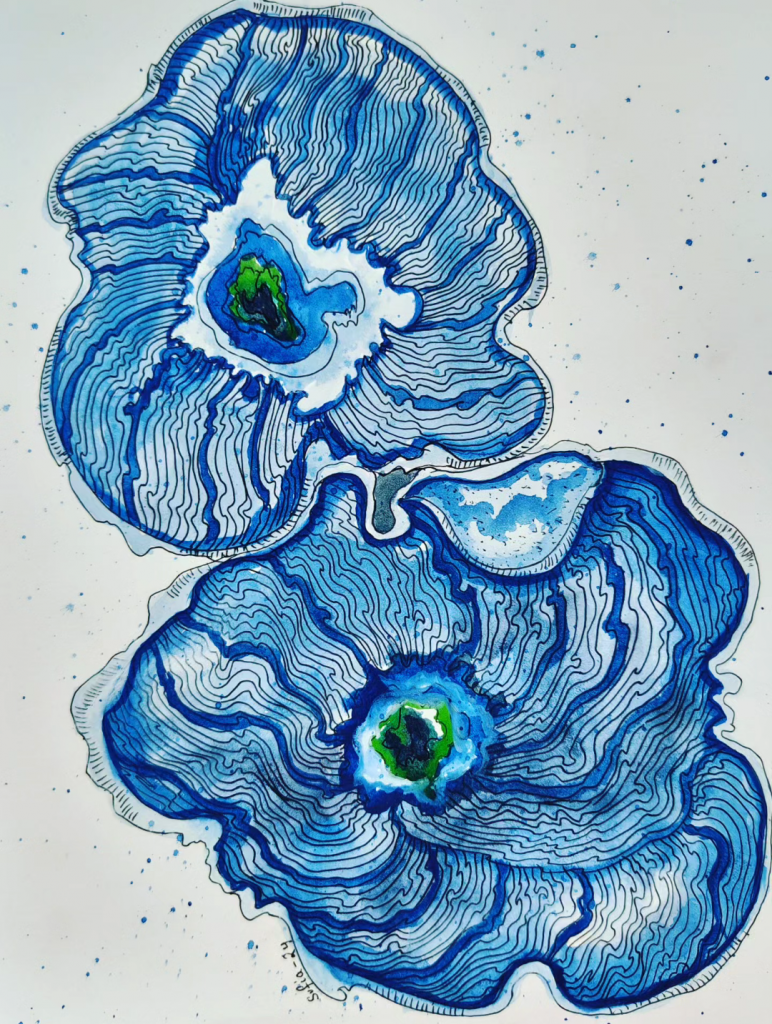
Illustration by Sufiya Khatoon
Illustrator Bio: Shortlisted for Yuva Puraskar 20&22, Sufia Khatoon is a multi-lingual performance poet, artist, facilitator and mentor. Awarded with Suprabha and Santiranjan Sengupta IPPL Poetry Book Award 2023. She is the Joint Editor of Antonym Collections, Editor EKL Review and Co-Founder of Rhythm Divine Poets community Kolkata. She was nominated as one of the 100 Inspiring Indian Muslim Women from West Bengal by RBTC. She has authored “Death in the Holy Month ” shortlisted for Yuva Puraskar Sahitya Akademi 2020-22 and Ger-mi-na-tion ( Longlisted Atta Galatta Bangalore Literature Prize 22)
❧
About the writer
A.E. Copenhaver. A.E. Copenhaver is a novelist and writer. She’s worked in the environmental and nonprofit sectors for over a decade and has had the privilege of writing for many different organizations and outlets. Her debut novel, MY DAYS OF DARK GREEN EUPHORIA, won the Siskiyou Prize for New Environmental Literature and was published by Ashland Creek Press in 2022. Her flash fiction has been featured in the Kirstofia anthology and published by Fiction Attic Press. Her poetry appears in Dusk Magazine and Beyond Words. Born in Bellevue, Washington, A.E. Copenhaver moved to Oregon recently and before that lived most of her life in California.