
After the last sputter of rain, we quickly decided to walk to the barrio to buy provisions at Quintilla Store. We had no more rice and had consumed all our sardines and tuna cans because it had been raining for 5 days and we couldn’t get out of the house. We received new alerts on our cellphones that a new storm was coming, which meant more rainy days and nothing to cook or eat, least of all the simple spaghetti, on which I usually melt some butter, sprinkle salt, mild paprika and olive oil, or brush Parmesan cheese when it was available, to give our isolation in the Pacific jungle a Mediterranean taste, if only to keep a culinary consistency in a fickle world.
We had no opportunity to go to the market in Taytay to buy vegetables like what we did every Saturday. We feared there might be a landslide or some trees might have fallen on the path, and driving the motor was dangerous in the mud, and when there is a strong wind.
The world in these moments seems to be in a transformative phase, a “becoming” instead of just “being,” getting close to the idea of Nietzsche as the opposed to Schopenhauer, the “nay” sayer, if I look at it in this light.
A Dionesean vitality of the wind that knows no measure verging on the chaotic, drawing a sustenance from the change that it is creating in its extreme form of desire, when the wind blows day after day.
Fallen trees could block the access to the main cement road until someone finds out about it and brings a chainsaw, because it takes half a day to cut the tree trunk with the machete, and if that tree is heavy, it will need many people to push it to the side and free the passage, a process that will easily take at least half a day.
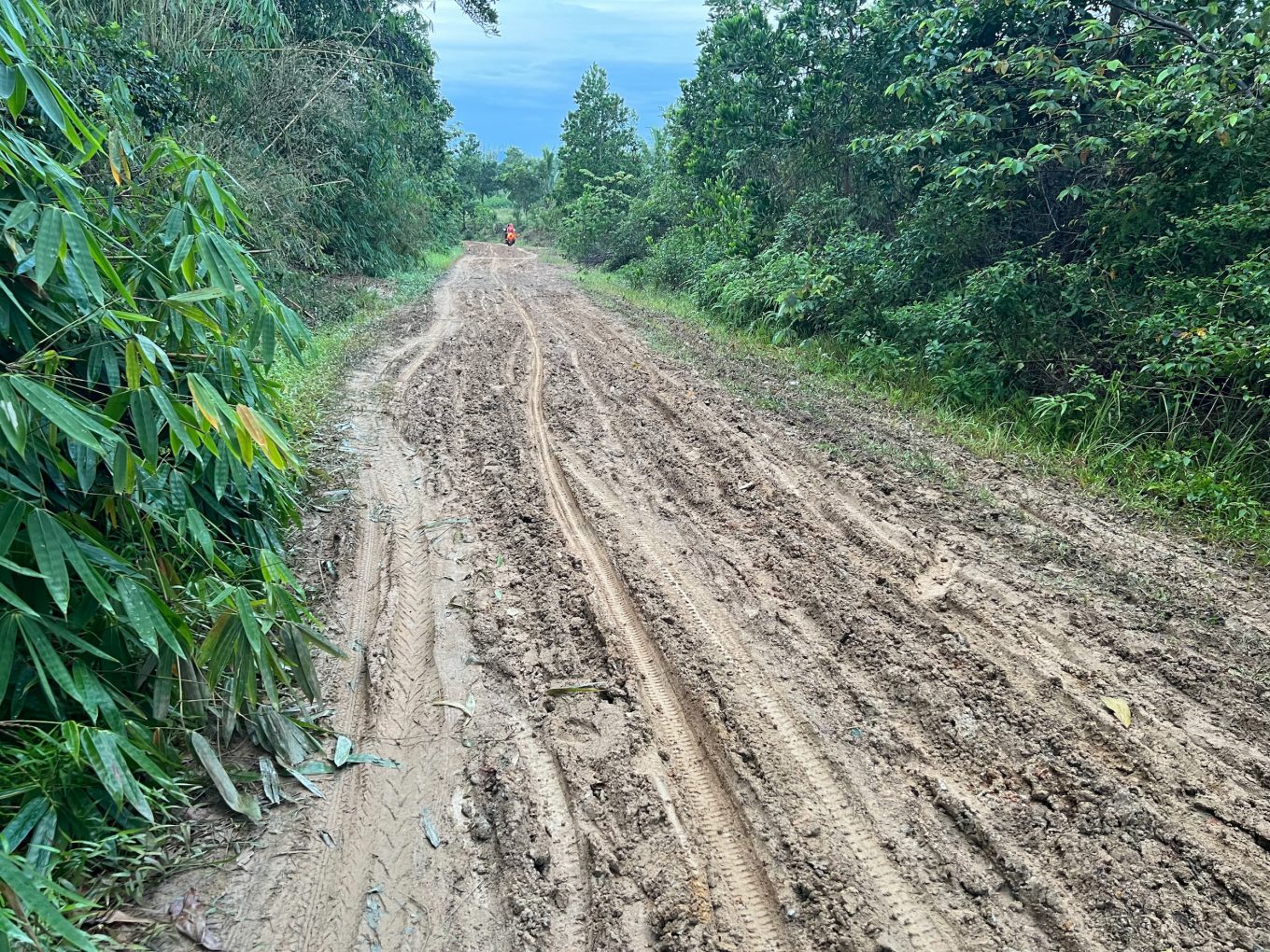
There’s a twenty minute walk, a distance of two kilometers on the “carabao path,” before reaching the main cement road. The path is originally meant to be used by the farmers taking their buffaloes to the rice fields in the valley skirting the contour of the hill, and, with the passing of time, it was slowly widened to accommodate tricycles and motorbikes, as more people came to work and live in the area.
When the farmers began to sell the harvest to wholesale buyers as their production exceeded their needs, the barangay decided to bring a heavy machine to enlarge the path for the trucks, removing large chunks of soil and rocks, bunches of bamboo and Mangium trees, leaving a ditch to channel rain water to the valley to drain the soil and prevent landslides.
The meteorological authorities issued alerts for cyclones, monsoon storms, earthquakes or tsunamis as a preventive measure. The inhabitants of the islands are warned because many live in shanty huts on the coastline, river banks and harbors, because it was rent-free government property, and no politician had the incentive to keep removing people from place to place if they wanted to be re-elected.
The Red signal is when the storm picks up in intensity as it approaches the archipelago to make a landfall, a signal correlated with the force of the wind and the rain. The adjacent area on the map is sometimes colored in orange, which means less intense conditions and a weakening storm, and further inland, the yellow color when there areg only sporadic gusts, the storm exiting the landmass, the Philippines being an archipelago surrounded by sea on all sides.
Sometimes, during the rainy season, a monsoon rain and a cyclone meet over the island, the one coming upwards from the South China Sea, the other from the Sulu Sea on the opposite side of Palawan, both approaching from different directions, East and West, known locally as the Habagat and the Amihan winds, accompanied with low rainy clouds for days and nights without interruption, interspersed by lulls now and then, following the changes in the atmospheric pressure and the progress of the storm, either picking up speed or dissipating after a few days.
The storm from the western side of the island, the “habagat,” corresponds to the “sala” side of the house, where the view of the valley opens on the declivity of the land and the vista of the canopy to the mountain chain far away, from whence the wind blows without hindrance. We have the wardrobe cabinet and the wash line on the entire length of the wall along the windows that are usually kept open for ventilation and light, and there’s only the avocado tree outside to protect, absorb and fend off the force of the elements. We have to close the shutters when the wind starts to blow from that direction, and because the hatches are rusty and broken, unable to withstand the wind, we nail them to the windowsill timber, to keep our clothes dry and safe, because in the rainy season, it takes three days for the laundry to dry, the air being humid and damp. The Amihan and the Habagat sometimes meet with a monsoon wind coming from a different direction, in a vortex turning on itself continuously until the storm weakens and a lapse begins to form between two bouts of rain. On the fifth morning the respite lasted two hours, and we decided to walk to the barrio, which was enough time to go and come back with provisions.
There were no landslides on the path because the area was covered with the thick lush, rainforest vegetation, with big trees standing above all the rest, smaller trees, creeping vines, ferns and moss in an uncontrollable jumble of fauna and flora that seemed to grow without interruption. I have to hire CobraMan and Tbong to clear the area around the house every two months.
The road where the excavator widened the path was a mixture of clay and ore, and on the sides, fern and a thick carpet of grass had already grown, with layers of decomposing humus in the strata emitting an agreeable odor in the fresh air. A fallen tree blocking the way had already been cut with a chainsaw and removed to the side.
Stagnant water formed muddy pools the flat land could not absorb anymore. With a piece of bamboo, I had to poke a hole in the mud to let the water flow, fearing it will soften the earth and make this portion of the curve fall into the valley, as more water trickled down from the land above.
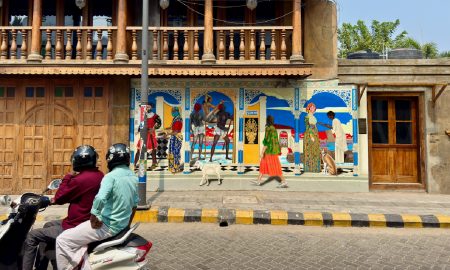
There were traces of tricycle in the mud on all the length of the path, footprints, and carabao hooves stamps, leaves, broken twigs and disheveled branches torn from the tousled canopy strewn everywhere. In the sari-sari grocery store facing the rice mill, neighbors waited under the nipa awning for the Charity jeepney to Taytay.
They exchanged some words with Sheryll, most probably about the weather, because nothing else happens here, except when there was a petty theft or a sex scandal the women of the barrio gossiped about and kept between themselves, as they usually do. Some dogs came mooching at our feet. A tricycle sputtered past. Some boy walked to the store to buy one cigarette, seven pesos, and stood there puffing smoke and chatting. Electric poles at regular intervals spanned the road to the other side of the hill with sagging lines under the low grey clouds. The municipality widened the intersection with a bulldozer to give more space to the trucks when they turn on the carabao path from the cement road, but the separation created holes in the clay where the soil had been washed away already. More water flowed from the cement road into the clearing and trapped the motorbikes in the mud in front of the Sari-sari store and the rice mill.
It was a Sunday morning and not a single person was on the road with us. A firsthand experience of nature in its evolving conditions, witnessing the awakening of the day after the storm, with some natives in front of their nipa huts, walking to the grocery store or the barrio because there was no other means to commute. Children walked to the school on this road on ordinary days, sometimes riding on the carrossa coming or going to the fields, in a blissful condition such as Rousseau thought of it, not yet influenced by the modern world.
As we walked on the main street of the barrio to buy bread, Sheryll pointed to the kubo hut and said,: “Do you remember him? It’s Onsoy.”
When we came near, Onsoy asked her if I was still drinking.
She replied, “sometimes,” answering on my behalf, which of course was not true.
I am a teetotal now. At peace with the world, if it had a meaning or not.
“Tell him I didn’t give up the fight, it’s from Pink Floyd, ” I said looking at her, but I sensed that she didn’t understand, judging from the way she looked at me with eyebrows raised.
“It’s a mental fight now, but it used to be physical,” I added, to clarify, but still she didn’t get it.
“See what I mean, Neg?”
A diminutive of “Negra,” a nickname I gave her when we met at Pristine Beach many years ago in Daisy’s beer shack, and she called me “kalbo”, which means bald in Tagalog.
“Whatever,” she replied as we walked to Quintilla store. This word was her favorite, she used it when she could not find better ones to cover her ambiguities,
I was surprised that people remembered me. I seldom hang around in the barrio, except when I pass through on the motorbike or a tricycle to the house in the hills of Tulatulahan.
But I discovered that I had a reputation, vouchsafed over the years, by the people I drink with. I was invited once to Titing’s baptism ceremony of his son many years ago, but I can’t say precisely who I was with.
Titing, the younger brother of Big Chef Jinjin, the son of uncle Rufo, owns eleven hectares of rice fields in Tamalarong. His house was in a clearing, on stilts two meters high, in the midst of the trees. I remember when the pastor left after the blessing, and when the women took the children aside, we sat on the floor mat made of laths of bamboo and the full moon in the canopy was so close that it was like we were on a magic carpet after so many drinks, seven or eight of us, and someone gave Rodney a hundred peso to get another bottle. Onsoy raised his hand in a salute and said “pare.” So I waved back, a second time, remembering that night.
Sheryll said “pare” is a sign of respect. But to me, it means that I was in the collective memory of that night, when we shared a common interest.
I ran into Brad across the street, who greeted me with “One shot,” almost shy, near the bridge of Abongan, smiling, seemingly happy, perhaps tipsy.
Titing was more diplomatic and conscious of himself, he just waved while driving his tricycle.
He was inspecting his rice fields perhaps, or his goats and piglets.
Five minutes on the main road, and I already saw my drinking buddies.
Once at Father Ben’s house, Sheryll told me that the ex-barangay Capitan wanted to talk to me. Kalbo Senior, the ex-Capitan, was the governor’s right-hand man. A feared person, in a rural area.
He heard that I was building a house with the Ipil wood, which was prohibited.
The contractors were Uncle Ontoy and Uncle Digol, Sheryll’s uncles, who hired many people from the barangay, Mero, Paranto, Mike, Dong and Jhun. No doubt he knew that Mike and Dong went to the jungle to log the precious tree.
We lived in a tent right there in the jungle when the foundations were laid, after clearing the trees, the creeping plants, and the bamboo to burn them and get rid of insects and ants.
A primitive area, with big trees, strange noises at night and a dense fog at dawn until the sun came up like a soft flashlight through a curtain, the tallest trees in the valley protruding like masts around fallen sails.
At the Abongan bridge, I saw Gerold. He recognized me and we shook hands. I don’t remember sharing alcohol with him, but from the way he was receptive, I concluded that he must have heard of my “exploits,” if I dare say so.
He seemed, crossing the bridge one way, then coming back the other side, a bit confused. Sheryll told me that his wife left him and went back to Quezon, south of the island, to her family.
“Do you remember one time we heard her screaming in the middle of the night? He was chasing her with a machete?
Poor boy! I murmured.
Joel waved at me while driving his motorcycle, shouting “pare.”
I knew what was on his mind.
“Mamaya, mamaya,” “later, later,” I said, gesturing in the air.
My acquaintances in the barrio were different from those in Puerto Princesa or Manila. I was with Jason and Api in Puerto Princesa. Jason, of Italian origin from Perth, and Api, from the Netherlands, living with Rica on Liberty Street.
We would meet in the afternoon at Pristine Beach behind the mangrove to chat and watch the mountains of Manguinguisda at sunset, thinking we were lucky to be in this isolated cove, hiding from the world, confident with the thought that no one will find us here.
In Manila, I would meet with Bitoy and Alan on Del Pilar or Mabini Street near the Ambassador Hotel, next to the Manila Girls Nightclub, both demolished now.
We didn’t talk much, but we agreed on the general aspect of things, starting from the point of view that it is what it is, and we had to deal with it as such. That was in short how the drinking session proceeded, a ceremony of some sort, like the Last Supper, munching bits of chips and salty peanuts in the dark alley, or on Titing’s bamboo floor mat.
At the store, Senior Quintilla was no longer behind his narrow desk where he computed prices on bits of paper his wife repeated from behind the counter.
He died some years ago. Fail, emaciated, he would walk from his grocery shop to sit under the mango tree and chat with the tricycle drivers on Sunday morning, a mere ten meters away. The distance, from his desk to the bench, meant a day off in his mind.
He asked me one time if I liked the coconut alcohol, the “tuba,” or the “lambanoug,” and of course I told him that I didn’t mind.
His son-in-law runs the grocery store now, but said nothing when he saw me choosing a bottle of Mojito from the shelf I intended to drink with CobraMan and Tbong.
He looked worried, eyes red, as if he had no sleep.
He talked with Sheryll for a moment and I stood at the door looking at the school’s playground, the church painted blue in the foreground, with coconut trees around it, the carabao in the tall grass, the indigo clouds threatening more rain, a gusts of wind in the pending fronds.
“His rice fields are flooded,” Sheryll said as we walked out, carrying nylon bags.
“The storm is wasting his harvest. Maybe two hundred thousand pesos,” she said casually, as if everything was fine and dandy with the rest of the world.
We could hear the preparations for the Sunday service, choir and organ notes rehearsed in the church. It was a quiet morning with sparrows gliding low over the playground, and the electric church bell amplified on the microphone sounding silver tones.
Image provided by the author