
Jean-Emmanuel drove his family’s white Peugeot through the Verdière farmlands. Donkeys whipped their straw tails at flies that gathered on their backs. Horses grazed on their paddocked land. Massive bulls stuck their horns over their wooden fences and watched our car drive over their dirt roads. In the seats surrounding me were Jean-Emmanuel’s wife, Delphine, and their three children, Raphael, Anastasia, and Laetitia, ages five, three, and two. My eyes were focused out the window, straining to take everything in.
My entire visit to France was absorbed with such earnest haste. Everything felt urgent, like the last time I would ever see it. I was taking in their world with big, gulping breaths, and praying I’d remember every detail. At twenty-two in a beautiful pastoral country, I loved everything to the point of pain.
When I began taking French classes in the fifth grade, my mom pulled out a framed picture of her in Paris when she was twenty-two. Her arm slung over an iron railing; the Eiffel Tower stood in the background to her right. She looked beautiful with her curly brown hair billowing into the European wind and her long tan legs poised gallantly like the tower behind her. Everyone thinks their mother is the prettiest, in pictures that capture her youthful lust for life. But my mom, drenched in Parisian air, framed in sterling silver and backed by a midnight blue velveteen kick stand, was the most beautiful of all.
I ran my fingers over the glass. “I will make it there one day.”
I became enthralled with the wonder and romance of not only the French language, but everything to do with the country. Decadent pastries, flavorful cheese, the awe of the Mediterranean coast, the fields of lavender, the ancient vineyards, the history of artists, the mesmerizing accents – I loved it all.
Then, just one month shy of my college graduation, my now-ex boyfriend took a trip through Europe with his six friends, so I decided I’d go to France alone. I didn’t need a man – I didn’t need anyone. I punched “AuPairWorld.com” into my keyboard and searched for a family who fit my requirements: No cooking. No cleaning. No tiny outfits.
“We are Catholic and hope that our au pair shares the same beliefs,” Jean-Emmanuel and Delphine said over our one phone interview.
They agreed to host me, and in return I would speak English to their three children. They provided me with a private loft apartment attached to their garage and seventy-five euros per week.
As their au pair, I went wherever they did, and I was happy to. I accompanied the family to buy local miel de lavande at the farmer’s market, to their friends’ ivy-covered homes, and to Mass every single Sunday morning.
I told them I was raised as a Presbyterian. We didn’t rub rosary beads or cross ourselves, but we did sing songs and break bread. I thought the gist of all Christianity was the same, after which they assured me that Presbyterianism was not the same as Catholicism, but as long as I was a Christian, they were happy. So happy, that I couldn’t break it to them that I wasn’t a practicing Christian anymore. All those bread-breaking and song-singing Sundays were years before I sat in their car, on our way to the church of the Château de la Verdière, Provence’s largest castle which stood at the top of the town’s central hill.
Jean-Emmanuel parked the car at the base of the hill, and I helped the children out of their car seats. We walked through rues en calade, cobblestone streets that twisted between ochre-colored stone buildings. Terracotta tiled roofs cascaded up the slope of the steep hill, each home’s windows adorned with colorful shutters. Purple, red, and blue decorated the earth-toned chateaus. Flat pebbles that puzzled the road beneath our feet led us up to the castle. The scene was like that of a storybook. I couldn’t believe such beauty and peace existed, and that I was getting the privilege to witness it.
Inside the castle’s chapel, a kaleidoscope of colors reflected from its stained-glass windows. Light danced over neat rows of pews, drawing my gaze up toward the altar. A stone-carved statue of Mary stood solemnly before the congregation; her hands fell at her sides with palms facing forward. Jesus was there too, above us all, hanging from a wooden cross. Two young sisters harmonized over their brother’s violin behind the altar. Their vocals echoed through the hallowed room as the congregation filed into their seats. Then, when their song reached its close, Mass began, and my loneliness set in.
I appreciated my new family and all they had done for me in the few weeks I had been in France, but as the only American in their small village, and often the only fluent English speaker aside from my host-father, I easily slipped into feelings of estrangement.
One night, a family of friends came over – a small blonde couple with a daughter Anastasia’s age and a new baby boy. Delphine prepared dinner which began with an apéritif – olives, a sliced baguette and wine. Then we ate salad with fresh tomatoes and a homemade lemon vinaigrette, followed by quenelles, sausage-shaped dough in a cream sauce native to Delphine’s hometown near Lyon. As with every dinner, a course of cheese followed our meal. Racellete, comté, roquefort – Jean-Emmanuel introduced each one before eating. I wrote them all down in my journal under a page titled “Cheeses to Remember,” alongside the labels I peeled off the half bottles of wine I bought at the local supermarché. 375 mL was the perfect amount to drink in the bathtub before bed.
At first, everyone spoke slowly to me, ensuring I understood before moving on with the conversation.
“I’m from the United States,” I said. “Près de New York City.”
“C’est à côté de New York, pas près de New York,” the father of the friend-family said. He was happy to teach me something, as I’ve found most men are.
The man worked at the emergency room with my host mother, so when the French wasn’t going over my head, their medical jokes and hospital gossip were. The wine poured and words sloshed in their mouths, and my brain struggled to keep up.
“What did he say?” I asked Jean-Emmanuel. Delphine knew next to no English, so I had to rely solely on her husband for any communication, which I hated. Jean-Emmanuel was nice enough, but I craved a sort of female companionship. I felt stripped of more than just a social life. I lost any semblance of a personality. There weren’t any other Americans, nor any other foreign nannies to commiserate with. No one caught my goofy jokes, no one shared my same taste in music, no one wanted to chat about the latest book I read. There was no one to bike into town with. In France, I was just the inarticulate au pair.
“He was making a joke about someone they work with at the hospital,” Jean-Emmanuel said, still smiling from the comment, not even taking his eyes off the conversation to answer me.
After my third glass of wine, my brain couldn’t bother keeping up. I zoned out of the conversation, poked at the blueberry tarte and crumble of comté left on my plate, and finally excused myself for the night.
I ran a tub and cried because I was an emotional twenty-two-year-old girl with an easy tear trigger, but also because I just wanted to belong, and I wasn’t sure where I would find that comfort again.
In the Verdière chapel, Anastasia sat to my right. Her pudgy toddler fingers circled the blue stone inside my ring. At three years old, she probably understood just as much of the sermon as I did. I was relieved to have the children to dote on. Play the part I knew I’d fit into. With the kids, there was purpose to my presence.
For most of the Mass, I blended in well. Songs were sung and I stared at the hymnal’s pages, as thin as fairy wings and tinted maroon on their edges. I stood up and down and up again, feigning every prayer. But once it came time to receive the Eucharist, I was a sore thumb.
The wafers and wine were only for the confirmed Catholics, so I usually sat alone while my French family went up for the blessing. This ceremonious consumption, I noticed, was much more formal than what I received growing up in my hometown Presbyterian church. It was a small church – just ten rows of benches on the ground level and five more on the balcony – but the altar was always gloriously decorated in greenery and adornments by our local florist, David. On the first Sunday of every month, we took communion. Pastor George set up a table before the altar, draped with a white tablecloth, supporting a small loaf of bread and a chalice of grape juice.
“This is not the table of the church, but the table of God,” he always said. “It is made for not only those who love God, but also those who want to love God more.” He invited everyone: the old and young, the skeptical, the firm believers. The table was for those who came to church every Sunday like Maggie and her mom who always sat in the front row by the piano. And those who hadn’t been to church in weeks – like my family, who sometimes took so long to get ready in the morning that we would eventually decide it wasn’t worth the trip into town. There was room for the elderly ladies who only stared at their shoes because their backs were so crooked, and room for the children who were dragged to church kicking and screaming. God’s table was for everyone.
My eyes would grow to the size of golf balls as Pastor George passed the plate of bread and shot-glass saucer of grape juice through the isles. We all took little sips from our miniature cups and nibbled on our dainty pieces of bread like we were at God’s tea party.
It was impossible for me to translate the French priest in the Verdière castle’s chapel, but I knew he wasn’t inviting me to any tea parties. Catholics went to great lengths to prove devotion to their faith. The small stale crackers, the shape and consistency of sand dollars, felt more like an exclusive honor – a prize given straight from Jesus himself.
Anastasia, who had my ring gripped between her fingers and my string bracelet looped around her wrist, grabbed both my hands as she scooted her tiny three-year-old body down the wooden pew after her family.
“Allez!” she said, with her squeaky voice. “Come Holly!” As far as Anastasia knew, I was part of her family. How could I let go of her hand after she had just started to love me? I slid out of the pew and stood with her behind Raphael in line for the Catholic version of bread and grape juice.
Children, like the one gripping my fingers, who were unconfirmed, walked up to the priest with their hands crossed over their chest. Showing they were not yet confirmed but preparing to one day be worthy of the Eucharist. Maybe I could cross my arms too, I thought, but my French family knew I wasn’t studying to be a Catholic. Or, like my friend Emma, who once attended mass with her Italian-American family and didn’t want her grandmother to know she was unconfirmed, I could take the cracker from the priest and tuck it down my sleeve. Or I could just eat it. It was only a cracker, and this was church. Didn’t God pull out a seat for everyone at his table? But before I decided how to properly approach the altar with my lack of faith, a firm hand grasped my shoulder and pulled me out of line. It was Jean-Emannuel.
“What are you doing?” he asked. His eyes burned with urgency. “You can’t take the Eucharist. You don’t believe!”
The blood drained from my face under the seriousness of Jean-Emmanuel’s voice. I felt like my seat at the table had just been pulled out from under me. Hot with embarrassment, I turned back to sit in the pew alone. I wrung my wrists and blinked back tears as my family continued up the aisle.
Delphine received the blessing and returned to her seat next to me. Through broken English, she explained that as a Catholic, she believed that a priest’s blessing literally turned the wafers into the bones of Jesus Christ. As a Presbyterian, I believed that the bread is merely a symbol of Jesus and his offering; she told me. To people like me, it was not actually his bone, just a metaphor.
I definitely did not believe that the cracker transformed into bone; I was a realist over anything. But Delphine’s justification didn’t make me feel any better. At that moment, I didn’t care enough to understand. I was stung by rejection.
After the service, everyone met outside on the terrace that overlooked the castle’s kingdom. Delphine and Jean-Emmanuel mingled with their friends, but I just wanted to sit and look out on the terracotta roofs alone. As a non-Catholic American, I didn’t belong, no matter how hard I loved the culture and the country and its people. I felt an overwhelming sadness, something I shouldn’t feel at the top of a castle in the South of France.
We were still in our church clothes – sandals and all – when we arrived at Gorges du Verndon, a massive canyon carved by the Verndon river. This hike was our next Sunday adventure. Pure turquoise waters flowed between limestone cliffs until the river steadied itself into the Lac de Sainte-Croix. The sights were even more breathtaking than the castle we came from.
I trailed a couple of paces behind my French family as the six of us – three adults and three toddlers – hiked up the mountain. We traveled through dirt paths and up stone staircases. We hugged the canyon walls and looked down upon the earth’s vibrance.
At that time in my life, loneliness was the most terrifying feeling in the world. I was still in the process of understanding that it moves, like the waves lapping in the Mediterranean Sea or the current of the Verdon Gorge. Everything passes – the bad feelings, the good ones, the days I had left living in the French countryside.
In ignorance, I had protested what wasn’t mine – beliefs that felt too grandiose or old-fashioned or uncool. I carried that opposition to a foreign land. I sat when they stood, I filled my mind with useless, selfish thoughts to distract myself while they prayed. I stayed silent in their rejoice. In my obsession with defiance, I closed myself off to the greatest joys of experiencing a different culture. But there, on a mountain in the French countryside where my heart always longed to be, I caught the light. My boiled embarrassment had subdued. As I turned my face toward the vast horizon and breathed in the beauty of the country, I felt peace.
I heard cheers from below and looked down at a crowd of young people in the water. They were taking turns jumping off the rocky cliff waterfall into the crystal pools. Every few minutes, another body in the distance would soar through the air and land into the pit of turquoise with a splash. A great waterfall gushed behind them. Maybe, I thought, there were other ways to find my place. Maybe if I too jumped off the cliff into the gorge, I could be baptized by the world.
My change in heart was not as drastic as day and night, or Saul to Paul. I was human after all, and only twenty-two– still crawling away from the ignorant invincibility of youth. But compassion grows, as does the table. Whether it takes us a short time or long, I pray we all pull out a seat.
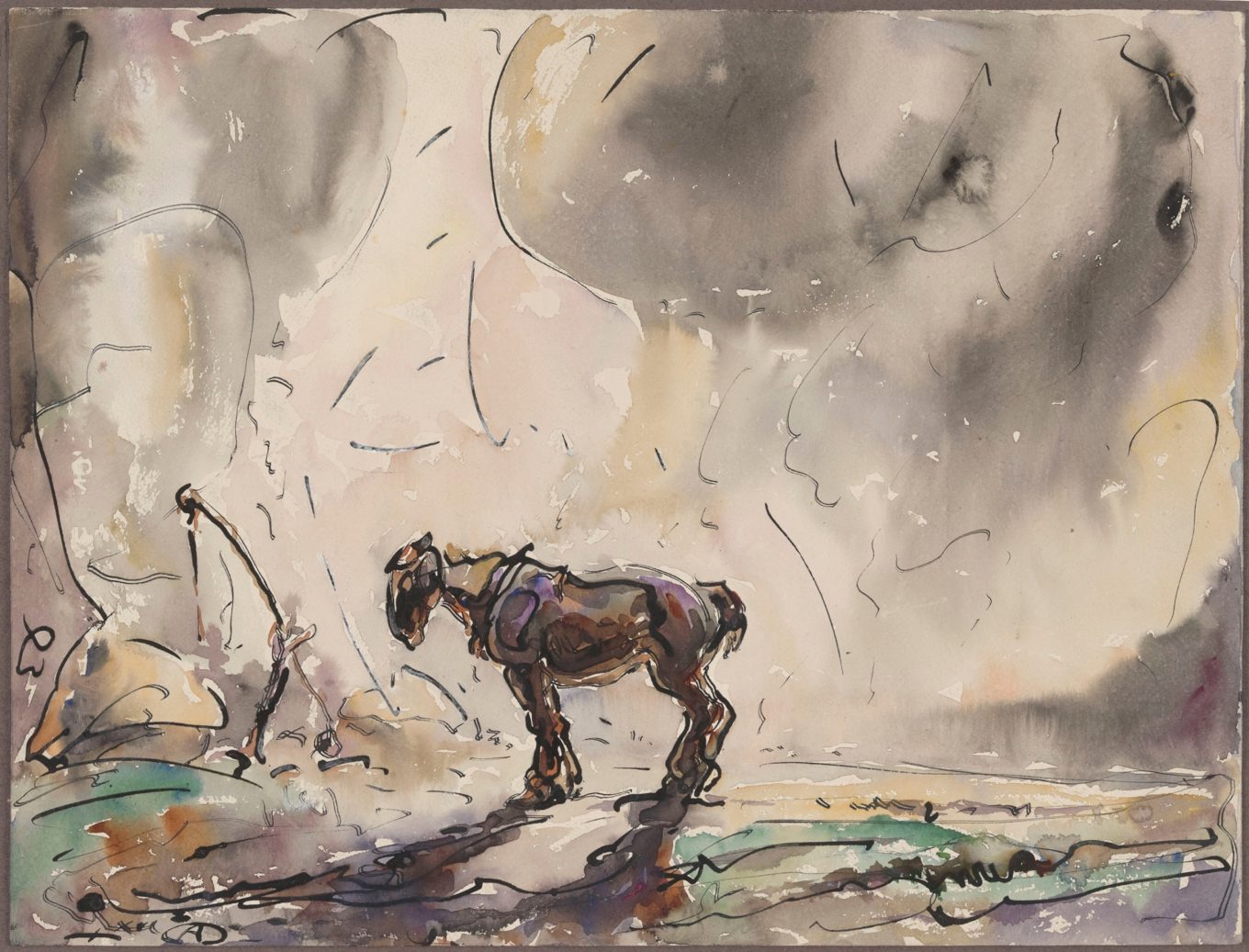
Image: Lonely Horse by Alfred Ost, 1926