
We cycle back to find ourselves parents and children
Mythic and fallen, caught and rebellious
And beneath it all,
Comically, tragically hopeful
Ever hopeful
And still lost
Lost, like Odysseus, still and ever
Dreaming of glory and seeking home.
I colored neatly inside the lines. Didn’t mess up once. I colored the girl’s face peach, her dress and anklets robin’s egg blue. Her shoes I colored black just like my patent leather dress shoes. I was eight.
Aunt Evelyn studied my picture quickly and drew my box of sixty-four Crayolas close to her chest. She licked her lips as I waited expectantly for her praise. Instead, she pulled out a color I’d never used before and drew an olive vee on the girl’s forehead, the face I’d labored so hard to perfect. She drew violet shadings on her cheeks and knees. I bleated my outrage: “What are you doing? Skin isn’t supposed to be green and purple. It was pretty, and now you’re ruining it.”
She took my hand and led me into the living room, pulled out a picture book and thumbed through the pages until she found a portrait of a woman. It was crazy: Half her face was yellowish green, the other half pink with brown squares, and there was a thick green stripe running straight down the middle of her nose. Her hair was black and purplish, not solid but made up of lines and triangles. Her right eyebrow was a black arch; the left one, not even at the same height, was peacock blue. “What do you think,” she asked.
“It’s not real,” I sniffled.
She lifted my chin gently and commanded, “Look at me. Is my skin the same color under my eyes as on my nose? What happens to the shape of my eyes when I smile? Close your eyes and remember.” I heard her stand up and, even with my eyes shuttered, I could sense the room darken as she pulled down the window shade. “Now open your eyes and tell me the colors you see in my face,” she said.
“I see grey and purplish,” I whispered slowly.
“What kind of purple?” I hadn’t a clue. She prodded me forward. “Is it blue purple or red purple?” Blue purple, I was sure. “And what color is the shadow?” Purplish grey, I guessed. Yes, she said and awarded me the praising smile I coveted.
I also secretly coveted her long white coat with the shaggy sheep’s wool collar and cuffs. She let me try it on with white kid gloves she inherited from Grandma Rose. I’d sit atop her bedroom armchair piled high with brocade pillows where I became the queen of France. Aunt Evelyn knew where to find wild peony bushes and the sweetest August corn. She knew how to make jewelry boxes out of beach shells. There were a zillion colors of paint by the easel in her studio.
2
Cropped fashionably short and mannish, Aunt Evelyn’s bright white hair was striking, but it was her charcoal grey, almost black, eyebrows you noticed first. Those thick, confident arches echoed her familiar stance: left arm crooked at the elbow and bangle-braceleted hand splayed at her hip. That day she wore snug grey wool trousers tapered close at the ankle and a Banlon turtleneck covered in gold, olive, and fuchsia comets.
My mother’s look was softer, and her stance was softer, too. Handsome in a tailored navy pantsuit, she stood relaxed and attentive, waiting patiently for her sister to be ready. She sported the same comfortable black oxfords she wore to work at the food bank. Her silver hair, longer and fluffier than her sister’s, formed a cloud, a cloche gently framing her face. A delicate silver chain with a single pearl dropped from her throat, and she wore tiny silver earrings to match.
All those rainy Saturday afternoons they dragged me to the National Portrait Gallery. After five minutes walking through the rooms and glancing at the paintings, I was done. But my mother and Aunt Evelyn were just entering their own world, strolling arm in arm, heads bent together like nesting doves. They whispered and pointed, advanced, and paused in the rhythmic steps of a slow, intimate waltz. I found a bench and waited, knowing the whole day was likely wasted and wondering if it was worth the strawberry sundae they’d promised. I watched people. I watched the guards watching people, circling their slow circuit of the galleries. I watched my aunt and my mother. I watched my feet. I watched the sun filter through the skylight and cast a shadow on the wall. I considered a precise name for that wall color. It would have been useless to ask if we could leave. We would leave when they were done, when they were sated. And yet I wonder if they knew or hoped it might stick. They made no explicit effort to engage me. They just let me steep there like hot water infused with fragrant green tea.
Twenty years later I would spend hours at light boxes pouring over images of paintings to be hung on gallery walls. I would worry about their juxtaposition, the lighting, wall tones, and complementary text to accompany them. I would find joy as I made the gallery circuit, chatting with guards and watching people whispering and pointing, finding patterns, making stories. “Come look at this with me,” I’d say to foundlings abandoned to gallery benches. “Tell me the shapes you see. Why do you think the painter made that girl’s face half orange and half pink?” I listened to the outlines of their boredom, the sketches of family stories, and vivid reveries. I envisioned who they saw, whom they sought, how they colored themselves. I encouraged them to close their eyes and try to imagine the images in a different light.
3
As they cooked together on most holidays, the sisters reminisced and argued–most often, most vehemently, about their mother. Brandishing a large wooden spoon in her right hand, Aunt Evelyn stood astride her stove, poised to underscore her case, stir the simmering stew, and point accusingly at my mother. “Mama was awful to the nurses. Always,” she railed, eyes flashing, big gold earrings jangling.
Patiently beating egg whites in the opposing kitchen corner, my mother turned to face her sister, shoulders square, alert, yet not aroused. “Mama couldn’t speak English,” she said slowly as if repeating an old refrain. “Think about how hard it was for her to communicate, how vulnerable and frightened she must have felt.”
“There was absolutely nothing vulnerable about her. She was a brick wall,” Evelyn muttered, half under her breath, but loud enough to be heard. From my perch at the far end of the kitchen table, I watched these titans clash as if their dead mother was an emergency requiring urgent action. I never met my grandmother, but I could feel her power in the tone and timbre of their arguments. I could limn her form from her daughters’ expressive eyes, their long legs and heavy breasts. It was harder to discern the colors of her personality though; Evelyn and Selma presented a study of contrasts.
“You don’t know how hard it was to go to that nursing home every day to try and please her.” Aunt Evelyn’s voice was shrill. “Mama was angry at everyone. She was mean.” Umbrage rising, my mother’s cheeks reddened, but instead of a rebuttal, she closed her eyes, exhaled a long breath, and tried to find new words to settle her sister. It was too late. Aunt Evelyn’s slow burn ignited in flames and she struck: “You don’t know how it was. You weren’t there. You weren’t the one who had to be there every day.”
The assault hit its mark. My mother’s eyes filled with tears and her face turned ashen. But just as her head sagged, my neck stiffened, and all the color that drained from her cheeks enflamed mine. “Stop picking on her,” I hissed from my chair at the table in the third corner of the kitchen. As soon as the words left my mouth, I regretted taking the bait.
“This is not your business,” Aunt Evelyn hissed back. “She was my big sister long before she was your mother. Stay out of it.” Tending to her sister’s wound, to Evelyn’s need to be claimed and acknowledged, my mother stayed silent. It was the role she’d played for most of their lifetimes.
The stew they were cooking simmered on the front burner, and I fled the kitchen in my own stew of resentment and shame. I didn’t know that my mother didn’t need protecting. I didn’t know that Aunt Evelyn did. I didn’t realize that just as the unsettled business of Grandma Rose’s legacy churned in and between her daughters, it filtered through them to simmer in me, too.
4
It’s thrilling to watch the opening of these shipping crates alongside my colleagues, all of us white-gloved, holding our breath and checklists, expectant as children on Christmas Eve. In the bowels of TOMA’s storage vaults, the preparators gently pry open the wooden boxes from Florence to reveal twenty-five Renaissance paintings and icons sheathed in shrouds and entombed in pillowy foam to protect them during travel. I lift the cloths swaddling a small altar piece depicting John the Baptist flanked by putti and portraits of the Italian patrons who commissioned it, or perhaps their honored parents or grandparents. Their identity is long lost to us as is the motivation for their benefaction. The altar might have been a gift of piety or a show of ostentation, an act of reverence or a bid for forgiveness. But regardless of its genesis, these ancient portraits infuse this humble vault with fresh wonder. I imagine generations of pilgrims and penitents kneeling before them in intimate conversation with their ancestors.
For the past two weeks, Grandma Rose has hovered at my easel, appraising me as I appraise her. This is the woman who raised two stubborn and fearless girls to take their place in a world far beyond her reckoning. The echoes of her voice, the shadows of her form formed me, yet I don’t know what she knew or what she felt. Can I paint my way to her from the imprints of her legacy? I’ve outlined a silhouette from a photograph found in a faded yellow cardboard box in a bureau drawer stuffed with old family pictures, travel visas, and birth and death certificates. The photo depicts her peering down at a book, perhaps a family bible, seemingly oblivious to being watched, to being documented. I can’t see her expression to discern if she seems happy or sad, approving or disapproving, but framed by a long dark coat with a fur collar and cuffs, she fills the picture plane like a sentinel, somber and omniscient.
I’ve painted Aunt Evelyn with a long flowing scarf at her neck in hues of ocean blue and sea green. My aunt loved the times of day near dawn and dusk when the light is low and looking at the horizon, you can’t tell where blue ends and green begins. I color her eyes hazel, a tempest of light and shadow. She peers forward defiantly and taunts me to look deeper.
I’ve painted my mother’s face olive and rose, with swipes of lilac and peach shadowing her cheeks. Just last week, a clerk selling foundation at Pomeroy’s make-up counter applied three different tones of beige to the inside of my wrist searching for an optimal match. “I have a cousin with olive skin like yours,” she noted casually. In the adjacent magnifying mirror, I watched myself smile my mother’s smile. In my family portrait, her eyes–one green, one brown–shine with kindness. She wears a long navy-blue dress and a single pearl necklace. Aunt Evelyn’s head rests on her shoulder.
I’ve posed Grandma Rose behind her daughters, a sturdy hand on each of their shoulders as she peers out beyond them to me. I’ve been struggling to capture her eyes in the portrait in just the right light. She’s eluded me. The more shading, the more contrast I added, the muddier the canvas became. Until yesterday. When we unwrapped the altar piece in the basement of the museum, my questions about its patronage and provenance faded away. What captivated me was its luminosity, an aura that travelled undiminished across an ocean and a millennium. I pick up Aunt Evelyn’s easel inscribed with my own palette of paints. I can’t resolve Grandma Rose’s true colors, but I can, I will, highlight her eyes in luminous tones of reconciliation.
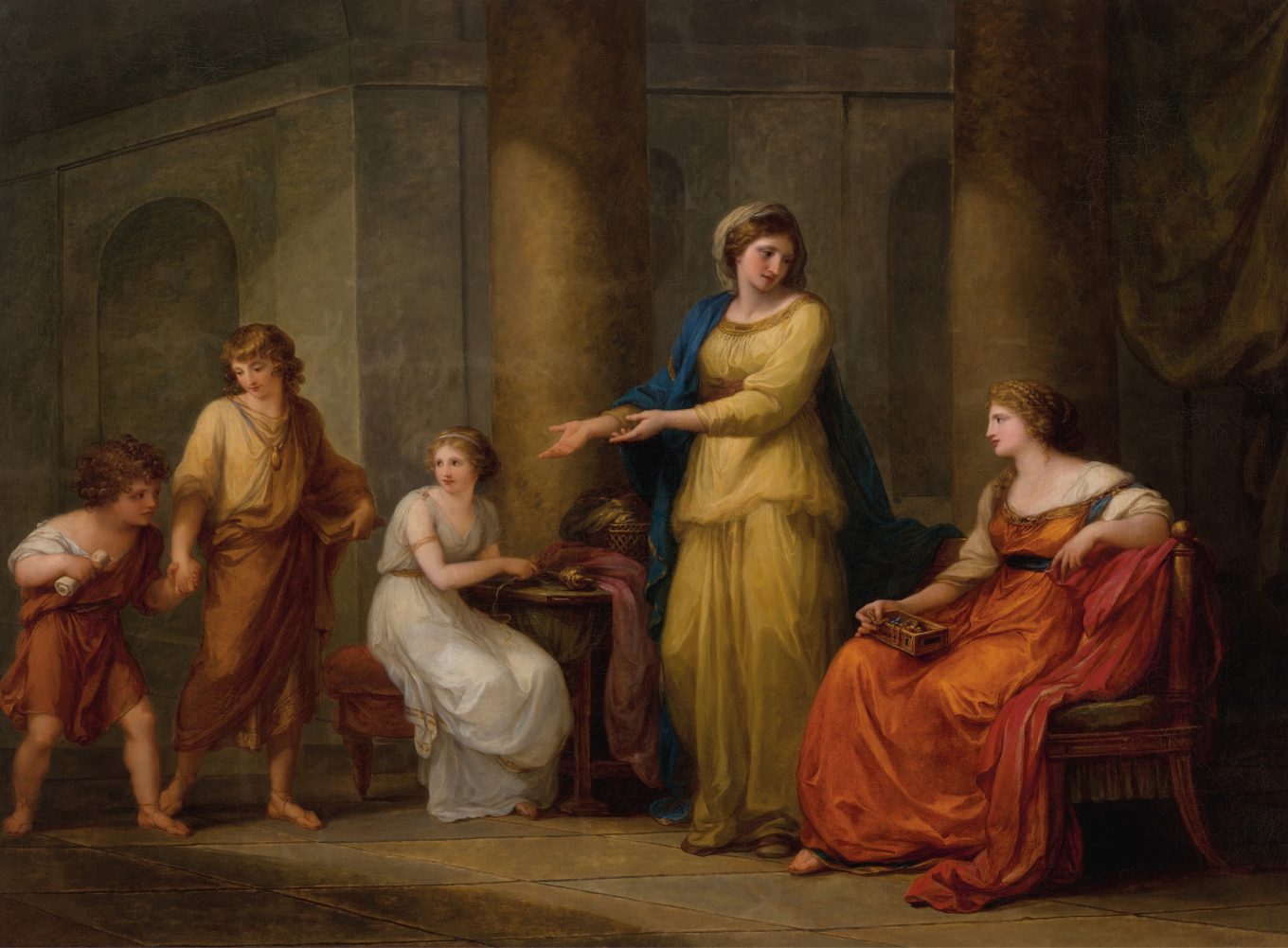
Image: Cornelia, Mother of the Gracchi by Angelica Kauffmann, 1788, oil on canvas