
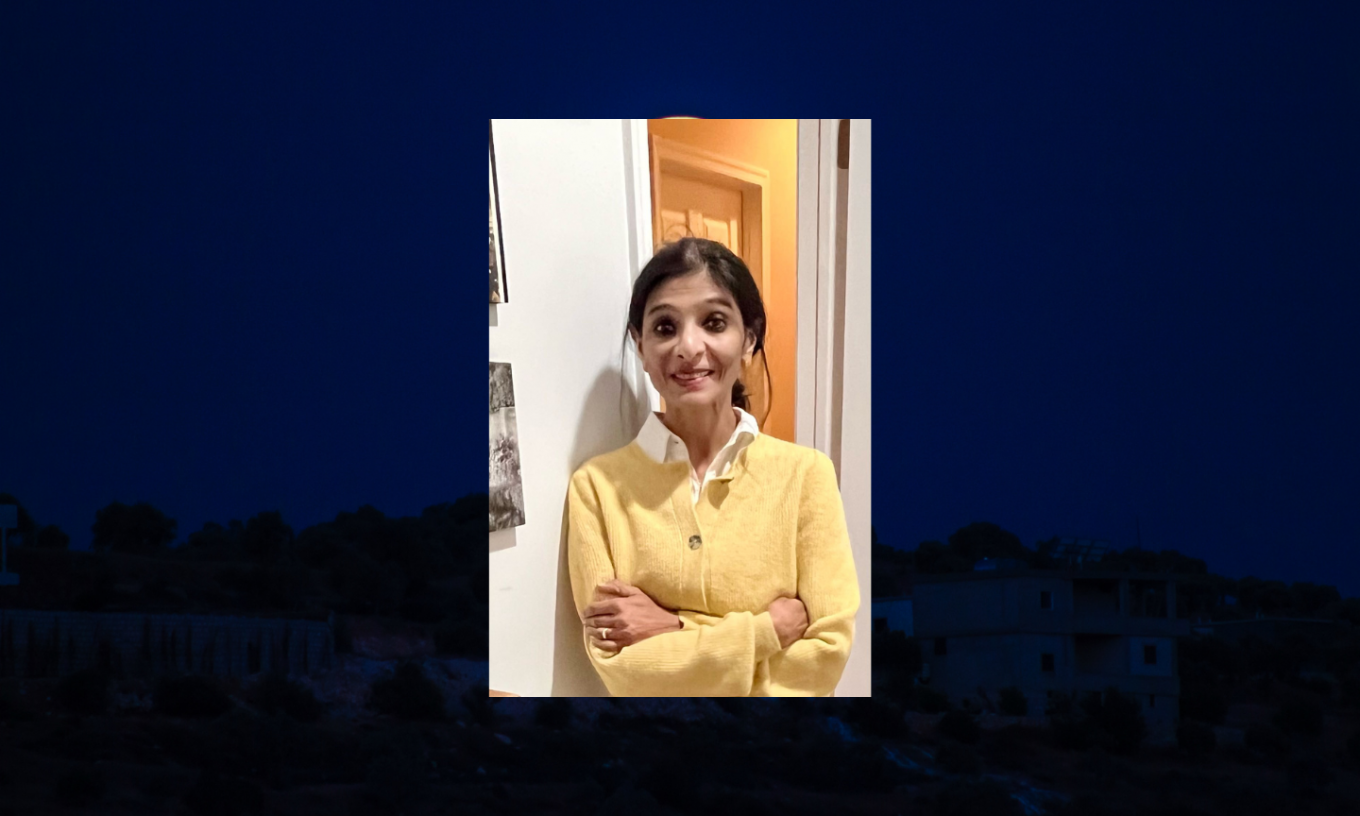
Anuradha Kumar was born in Odisha. She lived in Mumbai for over a decade, where she worked for the Economic and Political Weekly; presently she lives in New Jersey. She has degrees in history and management, and an MFA in Writing from the Vermont College of Fine Arts (VCFA). She writes often for Scroll.in. Her stories and essays have appeared in places like Fiftytwo.in, The India Forum, The Missouri Review, Catamaran Literary Reader, The Common, Maine Literary Review, and other places. Two of her essays received notable mention in Best American Essays editions of 2023 and 2024. Her essay collection, The Sound of Lost Memories, was recently a finalist for the Gournay Prize (University of Iowa) and will be published (2027) by Cornerstone Press (University of Wisconsin, Stevens-Point). Her recent work includes two novels in the ‘Bombay Mystery’ series: The Kidnapping of Mark Twain (2023) and Love and Crime in the Time of Plague (October 2025), both from Speaking Tiger Books. Wanderers, Adventurers, Missionaries: Early Americans in India 1700-1950, a work of nonfiction appeared in 2024 from Speaking Tiger Books. Her books for younger readers include Her Name Was Freedom: 35 Fearless Women Who Fought for India’s Independence, (2022) and Flying Horses, Secret Rivers, Magical Cities: Incredible Adventures from India and Beyond, 2004, both from Hachette India.
***
TBR: You have straddled different genres and target audiences. In which genre do you find yourself more prolific or inspired?
You know, I never intended to be prolific or to be called this. A lot of this prolificacy came from a sense of desperation—and I was younger then—and a wish to be heard and belong. Long ago, I wrote a novel, The Dollmakers’ Island, and then later, It Takes a Murder. I mean I was younger, and trying to do the ambitious things: writing fiction with history and a lot of other stuff blended in. I had read a lot of Calvino during the time I wrote Dollmakers’ and there were Calvino elements like numerous storytellers, playing with the ‘truth,’ placing the reader too as an active participant, etc. A murder is only the binding motif in It Takes a Murder.
I always wanted, and still do so, to bring history into everything I write. But to do it differently, to work on interesting literary forms. Which is very hard, and most times I fail. Sometimes, as someone once told me, I put too many things into a story (short or long) but it does give so many moments of pleasure—fitting every diverse element in, seeing how connections can get made—it’s like being in a parallel universe or our own, if only we could believe this.
But, and I’m sorry to make this long, I struggled to find publishers for both these books, and when I did, finally, my editors and publishers (Divya Dubey who had set up Gyaana, and the late Nandita Aggarwal at Hachette India) stood by me, pointing out connections in the manuscript that already existed, that I could play up. And there were encouraging reviews. Dollmakers’ was even made into a play and staged in Delhi. So, I just went on, trying to write that way, hoping to get better. I had to also figure out that ambition needs to be tempered with competence, and developing an expertise, and this takes so much more time, patience with oneself and the world, and there’s no end to this, really. Nor should there be.
TBR: Your stories span a gamut of human experience and areas of work. It is a diverse and varied canvas that you offer your readers. What drives your decision or desire to write your next book, article, story? Would you like to walk our readers through your choices or urges – the creative gathering and the process thereafter, the creative choice.
When I read about something or someone who is only a passing mention, a stray reference, or merits just a footnote, I find that intriguing. Sometimes it’s just curiosity about invisible lives, forgotten moments in history, things like that. For instance, my editor at Scroll suggested I write on forgotten South Asians in America (when we were all part of one colonized subcontinent), and that was such an eyeopener really. All those lost, forgotten, brave lives. When I began reading up about one, other figures appeared, all clambering out of the woodwork, then the struggles they endured, the isolation, and desperation they faced, and it really felt essential to tell their stories. And it’s been done so wonderfully by historians, filmmakers, and others: Vivek Bald, Ali Kazimi, for instance, and I guess, being an outsider emigrant myself, I wanted to be a part of this storytelling as well.
The difficulty or rather the challenge was to find sources about them. So, one went digging through archives, and old newspapers, records on ancestry.com, etc. After a while, one gets creative in looking for resources. A name somewhere, a reference elsewhere, makes you look deeper, and through myriad, convoluted ways, you find a story of sorts.
TBR: History is found in the gaps of its telling. Your writing often dips into these gaps. What kind of questions, from history or from the gaps in its telling, send you on a quest?
It must have begun when I read history in college, and university (Delhi). We were reading volumes of the Subaltern Studies, and our teachers were telling us about the history that happens on the margins, of those who had fallen off the pages, and were ‘unarchived’. What they were essentially telling us was to ask questions, be skeptical about ‘official versions,’ or the easily accepted story, and look for clues in things unsaid, or made invisible: like voices of women through the centuries, so many other marginal groups and figures over the centuries.
TBR: Your narratives are often woven around lesser known or obscure details, lending them a journalistic tone and observer’s approach, which is also engaging and empathetic. A lot of it is about South Asian experiences in the West, but also the reverse, of travelers to these countries from the West. Does this arise from your experience of living outside the homeland or from a basic interest in the immigrant experience?
OR
You write about those who sailed from India to other places and those who sailed to India from other places, primarily America. How does living outside India help you ‘see’ this journey that others have undertaken? Does it in any way underline and deepen your sensitivity to those travelers, those experiences that you think somebody who hasn’t travelled away from comfort zones may not be able to bring to the table? I’m not talking of researched work. I’m talking here of the instinctive response to another’s experience that deepens one’s writing. The kind of ‘thairaav’ that lends strength to one’s expression of another’s experience.
‘Thairaav’ is such a lovely word, Sucharita. Makes me wish someone had shared this with me before, in the context in which you’ve done.
It’s sometimes hard to figure out when and how one is an outsider. It could also be an interesting exercise, to imagine oneself as such.
My father had a transferrable job, we moved every two years or so, and growing up in small towns in Odisha and big cities like Delhi always made me feel I had this shifting, alternate selves. That I was, could be, a different person, every new place I went. One didn’t do this consciously. I just told myself once not to make the same mistakes again.
All this above is to say that I felt myself to be an outsider always. It comes with a desperation to fit in, to be accepted, to want invisibility when you get unwanted attention. And then it gives you a different, somewhat unique perspective into things, of this new world you find yourself in.
If I were to give my younger self advice now, or someone else, I’d tell them not to be so keen to be accepted, to become like ‘them,’ but to take time in just seeing things, figuring out where best one can fit in. But that desperation, then the curiosity, and empathy, all this makes complex selves of us and everyone else, and there must be a way to tell each other this.
TBR: There was a time when writers were pursuing the immigrant identity in their stories. Now the world is more global, and also narrower, more walls being raised. You have lived long years away from home terrain. How do you think the new world and the identities it engenders or challenges, the new immigrant issues, have affected the stories you explore?
It’s made me more conscious of myself as an outsider and comfortable too, over time, in my own skin. Though I am unsure entirely of the latter thing. Sometimes I do feel the need to ‘over-explain’ when I am writing about India. And I try hard not to write about the usual things: the angst, anxiety, quest to belong, which are important of course, but there is always so much else to write about.
TBR: Anuradha Kumar. Anu Kumar. Adity Kay. What has this journey been like?
I think of myself as just Anu, even Anuradha. The entire long thing (me and my last name) when I hear it aloud, or see it somewhere somehow makes me self-conscious. Which is weird. I’ve not figured this out myself. At one time, I used to prefer Anu Kumar – it was quick, short, slipped off someone’s lips and mind. I liked that invisibility, maybe years of being an outsider, of not wanting to be seen, was the reason. And when I wrote initially, or the books for younger readers, I was this short name.
Then the chance came to write the series on the three ‘great kings’ of ancient India, and both my editor and publisher (Hachette India) suggested I have a different name, so as to avoid confusion. Adity Kay is actually not all that different. I used to be Aditi before my parents changed my name, when I was about eight or so—maybe there’s a discomfort with that, a name is so intimate, and a child has no will or opinion, right? And ‘Kay’ takes off from my last name’s initial. But writing with a different name or no name, almost someone else, freed me up to write differently.
It’s only a few years back that I used my formal, legal name. I feel strange seeing it on a book cover and other public stuff. Like, when people tag me, or say my name aloud, I just feel like saying, call me anu (see, lower case), or anuradha. Must be because I still feel the outsider looking in, through a window, at a gathering I am almost or not really a part of.
TBR: You once mentioned that you want to write the stories never written. Have you written some of these in the intervening years? How have those stories changed for you, the way stories do, after they have lived in your memory and your mind over the years?
Goodness, that sounds just like what an immature, inexpertly ambitious person would say! But because I came to the writing world late, I was initially desperate, and in a hurry. I wanted to write these other stories, but I guess, I had to learn the ways to tell a story. Every story has a life of its own, you can’t rush it, really. And memory makes it even more interesting. A story can look so different with time, with just a shift of perspective, a change of character. Even now, I feel I could have written something differently. It Takes a Murder, or The Hottest Summer in Years, loosely based on stories I’d heard and altered, I wish I could have done them differently, or maybe even do so now. That’s what the French writer, Patrick Modiano once said. That he writes the same novel over and over again. This isn’t literally true, it’s just that the events and preoccupations stay the same, and he’s always looking at these differently, playing with them like a Rubik’s Cube.
TBR: A question I’ve wanted to ask for a long time. What led to The Kidnapping of Mark Twain? What were your thoughts when you conjured this delightful story in your mind?
It’s actually something that happened over time.
I’d read his Following the Equator some time ago. But in the last decade, since I’ve been in the US, I’ve read about different kinds of outsider experience. Then at the same time, in the same breath, I was at that stage of life where I began asking myself things like, had I made the right choices, the right moves, what things had I got wrong, stuff like that. And I thought of Bombay, about its, so very recent, modern, and cosmopolitan past, how it was a city made by outsiders (largely) and I hoped for a book that encapsulated that world, how outsiders experienced it, and a mystery has always been at the heart of what I try to write. But now that you ask, I can’t figure out how it fell into place.
The other thing also is that besides Mark Twain’s account of his world travels, I also came across Henry Baker—the American trade consul in Bombay who is one of the protagonists in The Kidnapping of Mark Twain—and his book about his business travels to the northwest of the Indian subcontinent. Baker came here a decade (1915-1917) or so after my novel is set (1896) but I thought he’d make an interesting character too. So, once I had these two in place: Mark Twain, Henry Baker, I worked on getting the puzzle into place.
TBR: You have published extensively and would have worked with different editors. What has your writer-editor experience been like? Also, who is your first reader? Do you share the usual ‘shitty first drafts’ or prefer to send in the final polished version?
When I first began writing, I’d read of the unique writer-editor relationships. Raymond Carver-Gordon Lish, William Maxwell at the New Yorker and all the writers he mentored: Mavis Gallant, JD Salinger, John Cheever, etc. How the writers at the Bloomsbury group worked with each other, and more recently, the story of Pankaj Mishra reading Arundhati Roy’s first manuscript. I mean she’s mentioned this in her recent memoir, but one had read about this soon after she won the Booker.
And I had all kinds of idealized notions, and these foolish, somewhat entitled expectations. And now I am so embarrassed and feel so guilty. I feel there were so many who were so kind, and I didn’t thank them adequately or in time. There should be at first, for a writer, a basic level of competent writing.
I guess I didn’t have that, nor did I come from, for lack of a better word, a ‘suitable world’ – a world where dreams of writing and being a writer are welcomed, and accepted seamlessly. But at least I knew how to take criticism and learn from it—I am being honest—and with my first editors, I was happy to be a student: whether it was the late Krishna Raj at the Economic and Political Weekly, editors like Luis Fernandes (who worked with Amar Chitra Katha for a long time), Vatsala Kaul-Banerjee, who first told me I could write about history (for younger readers), Nandita Aggarwal who sadly passed on two years ago—she didn’t mind my persistence and saw something in It Takes a Murder,–then Renuka Chatterjee at Speaking Tiger, who has so much experience and an eye for spotting ‘fluff.’ I’ve learnt not to take editors and their time for granted, and I appreciate so much their skill and gift – of understanding what the writer is trying to say, and working behind the scenes to make a story come alive. I am grateful that so many of them were willing to help and work with me.
It was the husband, Ajay, who read early drafts of my early novels (till It Takes a Murder). Also, I have to confess: As a newbie writer, I made the mistake of sending early drafts of my writing to some editors. But one learns, especially from mistakes. And so, I really go on at it now: revising, rewriting, even leaving stuff aside when it isn’t working right then.
TBR: How do you balance between the instinctive writing that much of fiction is about and research that underlines so much of your work? With fiction, do you write in a planned, structured manner or let the writing lead you? How much time do you usually put aside for research, or is a simultaneous process, one feeding the other?
When I am writing historical fiction or stuff related to history, I always have to keep looking up and referring to things simultaneously.
Earlier, I did write with a kind of definite outline in mind. But now I somehow find it doesn’t work too well. Like, if one sinks deep into a story, everything takes on a different dimension. The place, or setting, will soon take on more meanings, the characters speak up as well, and so there’s a constant jostling inside your head.
There’s a Muriel Spark novel, you know, The Comforters, where the narrator thinks she is a character in a novel and tries her best, all the time, to assert her own will against what is being written about her.
TBR: When, in your writing career, did you decide to straddle the real and the fictional world? Was there a leap of any kind? Of subject, faith, interest? A sudden trigger? How do you balance both worlds, something that doesn’t come easily to many writers?
I am not sure if I have decided that yet, Sucharita, or if I am balancing it suitably enough. But I think writing for Scroll came to matter a lot to me. Naresh Fernandes, the editor, was so encouraging, and welcoming of my ideas. I remember it was Naresh who first had the idea I could write about the diaspora, the border-crossers, because I was like them myself. And then of course, Aman Khanna, also at Scroll, asked me to write about the early South Asians in America, and with that a whole world of research, finding new stories, diverse experiences, and people to write about, opened up for me. All that research, about people and things, not easily available in the archives, really helped me, you know. Sometimes, a name will leap out at me, and I’ll be so curious that I can’t let go, till I have the name revealed in all its multi-dimensional complexities. At least I want to try.
TBR: With the increasing tendency of more and more non-fiction titles from the experts, where do you find the art of storytelling and imagination placed in the future of both writing and reading.
I kind of feel, and from what I’ve learnt so far, that one needs imagination to tell a story well. And even to ask the right questions. When one does that, asking questions, one perhaps knows where to look and research. And the best nonfiction books are those that seem like stories-set in real life but capable of transporting us to a different place, to become someone different.
TBR: I find that Jamshedpur, where I was born and brought up, has seeped into my mind such that it often finds its way into my storytelling, in my sense of place, of people. Has your upbringing in Orissa influenced your stories in any definite way or underlined them subconsciously, perhaps?
Connected strand: Your sense of place – is it primarily research, or a combination of research, familiarity, imagination, connectedness…?
I have two different answers to this.
I left Odisha about 40 years ago, and it was only recently—in 2019 or so—that I found I could write about the many places there, the people I knew once, with some detachment. And the more I thought, the more things that hadn’t seemed important then came to me. Since I spent my childhood there, those memories, visual images, perceptions—as you say yourself—are still so vivid. They have a visceral feel, a directness and immediacy that surprises me still. I want to write more about Odisha, and not obliquely like in It Takes a Murder, or even Letters for Paul, but I’ve had to contend with doubts that it’s a place not so important or relevant. And that’s upsetting. I’ve still to work around this, though I write about Odisha, every now and then.
Then the other thing, about how I tried to imagine and evoke a place: Los Angeles of the early 20th century (1910s-1950s). One of the first South Asians I worked on and researched: Bhagwan Singh Gyanee—a Ghadar revolutionary, itinerant preacher, and writer of self-help books—lived in this city for decades. There was also Bhogwan Singh, turban wrapper in Hollywood films, also a lecturer (everyone then was keen to know about the ‘Hindus,’ and their exotic and strange customs) at local venues. To write about these two men, who I felt, sometimes stood in for each other, I had to picture LA of that time. And I used old photos, old newspaper records, telephone directories, and almanacs, even google maps to get a sense of distance and place. Strangely, it helped.
TBR: As writers we respond to the world around us in subtle ways, we observe it in ways that are different from those of others. Does this help you to write or does it stymy the writing in any way, inserting the need for distance before you actually write? Could you perhaps share some instances from your writing life that may reflect this need?
I find it more satisfying and gratifying to write about the past. Like, I understand parts of my life in Odisha, at least I think I do, better now, with the long passage of years.
There was something, for instance, that confused me for a long time. I couldn’t quite understand why I’d behaved in a certain way at a certain point in my life. But years later, like more recently, when I really talked myself into writing about that time, I was even able, much to my own surprise, to articulate that confusion, the frightening chaos, and desperation that had so gripped me all those years ago.
TBR: Tell us about your reading life – what do you like to read? How have your reading choices changed or evolved over the years? Is there a definite weaning away from one kind of reading or a shift toward a more defined choice?
In recent years, I’ve loved reading writers who are wonderful from the sentence level up, if you know what I mean. And from then on, pull you into this world they are making. There are a few occasions when the writer flubs it and then it can get frustrating. But among the writers I’ve consistently loved and admired are: Andrea Barrett, Andrew Miller, Shanta Gokhale, Kamila Shamsie, Jhumpa Lahiri, Sebastian Faulks, Neelam Saran Gaur, Yoko Tawada, Kazuo Ishiguro, Elizabeth Strout, Penelope Fitzgerald.
Then there are all those wonderful writers of detective fiction: I love the worlds they depict, their expert construction of plot and setting and how they work on flow. Dashiell Hammett, Raymond Chandler, Maurice Leblanc (Hachette India’s Thomas Abraham has done a great job of reissuing these classics as ‘yellowbacks’), Jaqueline Winspear, and the Japanese greats—Yukito Ayatsuji, Tetsuya Ayukawa—, Premendra Mitra, Satyajit Ray, and of course, the ones we began with, Conan Doyle, Christie, Chesterton. Actually, one could go on, right?