
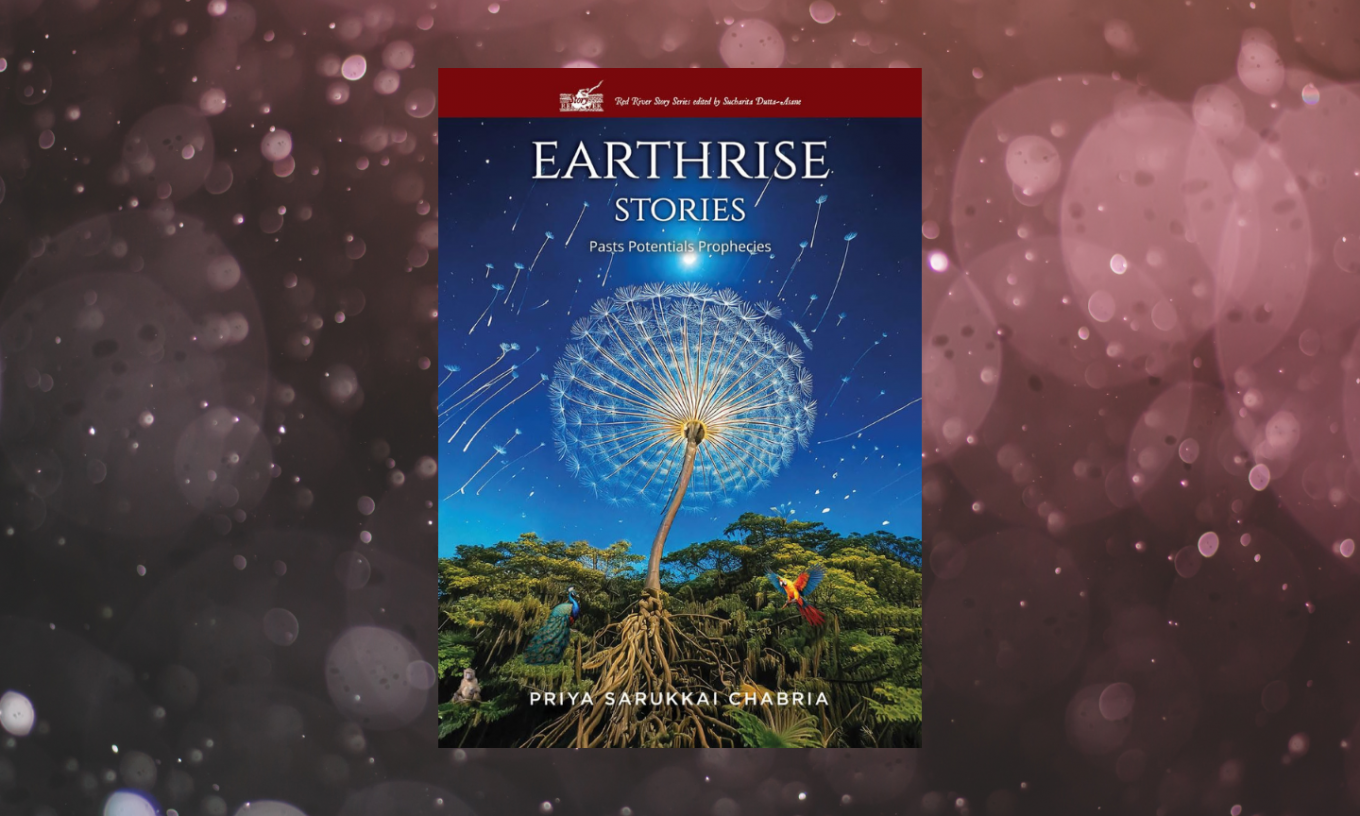
Title: Earthrise Stories: Pasts Potentials Prophecies
Author: Priya Sarukkai Chabria
Publisher: Red River Story (an imprint of Red River)
Year of Publication: 2025
THE MANY FACES OF THE EARTH FOLLOW A WEAVER OF DREAMS
Mythology and the various tales associated with it have cultivated many civilizations. Some were written to induce morality in society. Some drew the rules and regulations for people who live in a community. Others drive people to exhibit what the tales and their characters speak about. Most of them have a strong bond with religion and hence, society has never questioned their objective. Rather they accepted those tales blindly and made them holy. In the present time, what we do know is that most of these stories have been written by men (saints, gods or kings) wearing the lens of patriarchy. Hence, with the help of these stories, male-dominated societies have been either subjugating or controlling women to frame communities using their own rules. The entire process is prominent when it comes to India. It would not be wrong to say that, for India, religion and its stories have been the proponents of patriarchy. Priya Sarukkai Chabria’s collection Earthrise Stories: Pasts Potential Prophecies, dwells in time and tells a few stories by taking off the specs of patriarchy. They hover from the past to the present time and the freedom it gets takes them to the future making them stories about time. And like always, time has the power to relax any contracted vision.
The author divides the book based on the different dimensions of time. It becomes necessary to give readers an idea of the possibility if those characters lived in the dimension different from what the stories deliver. Priya has given us a fair idea of what she does in the book by dividing the chapters in the following time circle: Pasts Re-presented, Now, Ten Years from Now, In the Near Future, In the Far Future and Prophecies that Come True. Most readers would connote the genre of the book as speculative fiction which is legitimate or valid. But when speculation becomes untrue and draws before us a reality that we cannot deny, the genre goes beyond theorizing a hypothesis. At the same time, the author speaks about climate change by moving out of her actual time circle. She forms a warp to lend her voice to those who might not have any in the future. Her voice might appear to us as an echo. But those cascades of echoes become necessary to figure out whatever is required to understand the past, present and future. In recent times, cultural alienation has led to differences more than diversity – collisions more than cultivation – and a suffocation more than sustainability.
In the first story Menaka Tells Her Story, Priya becomes critical about the Gods who enjoy ridiculing a woman’s identity. Earthly men (storytellers) wrote the apsaras to justify the power of male demigods, and patriarchy cherishes putting a woman’s character in question. Lust inside a woman has always been seen as a negative quality. It becomes evident when we figure out the reason why in several communities’ onion and garlic are referred to as non-vegetarian items. Scientifically, these two items trigger two important hormones in a woman: dopamine and oestrogen. To hinder the widows from getting into another relationship, this particular idea of abstinence was enforced. In a similar way, Menaka is considered a nymph, which is not immoral, but the demigods use their sexual vigour to distract their enemies, thus making us detest or judgmental towards the apsaras. In this story, the author gives her own voice to Menaka and she takes pride in who she is. At the same time, she questions the authority unlike how she has been written in holy texts. Is it speculation? It is not. It is an expression of what we always look for in a human being irrespective of anything.
A similar kind of dissent grows inside another apsara named Urvasi, in the play Urvasi & Pururavas After 2.5 RGVeda X.95. Scriptures give us the information that Pururavas is the ancestor of the Pandavas, Kauravas and Yadavas. Little does anyone discuss about how he attained power and the exploitation under his name which still is responsible for a woman’s violation. Priya’s Urvasi challenges the man who has never been questioned because of the vastness of religion. She takes audacity in her hand, stuffs it in her mouth and uses it to spill everything that she could not say in all these yugas.
In the third story, the writer provides a voice to Mandodari, the one who has never been written separately in a scripture. Her intelligence and political understanding went unnoticed and most of us only know her as the wife of Ravana. Here, Mandodari is a queen who stands up for her principles and knows why she should befriend and talk to Sita. Her sacrifice by going beyond the rules of her husband is what we seek. The story offers us a different perspective towards both Sita and Mandodari. It also magnifies the lives of women in the clan of those who have their head thrusted in power and ego. The writer’s Mandodari has a balanced mind and seeks freedom.
In the story Kairos, Priya gives us a glimpse of the world we are living in. A world that is incapable of doing anything without a device. Her observation of the microcosm makes us realize what we miss in everyday life. The information we expect to receive arrives to us in a manipulated form. The times of our past have little room in our busy lives which speaks volumes about our empty hearts and how the necessary elements are considered trash. Similarly, the story Cockaigne A Reappraisal (Draft) by Dr Indumati Jones, exposes the hypocrisy of the human race. She makes the ideal sound unfamiliar and sarcastically shifts the pragmatism towards us. But this story gives a gigantic push to the developed minds and urges us to come out of blindness, fake beliefs and the culture of fear. At the very end, readers also get to understand the problems and crisis that come with modernity.
A ’What If’ Manifesto: Imagine is an important story of this collection since it brings a world many would consider unimaginable. But this is the entire point of the story: to imagine what is not even a dream. When we call Dusty Rhodes as The American Dream, it is because the lower middle-class people of the USA saw a man who performed for twenty people only to keep his passion alive. The millions who mourned his death counts only because he dreamt something that everyone tried to crush. Priya Sarukkai asks us to dream. To nod for the right things. To approve what we want to have so that we are not too late. To live the origin and feel what took birth from it. Why? Because humankind deserves kindness, and constant realization of why we are humans.
Earthrise Stories: Pasts Potentials Prophecies is a very important collection under the umbrella of Red River Story Series as it encourages us to go beyond what we read and experience usually. The writer has not just crafted an alternate portrayal of legendary myths; rather she has gone beyond the legends in an attempt to open our eyes and imagination to see what we need to do – and how we should project our learning to the next generation.