

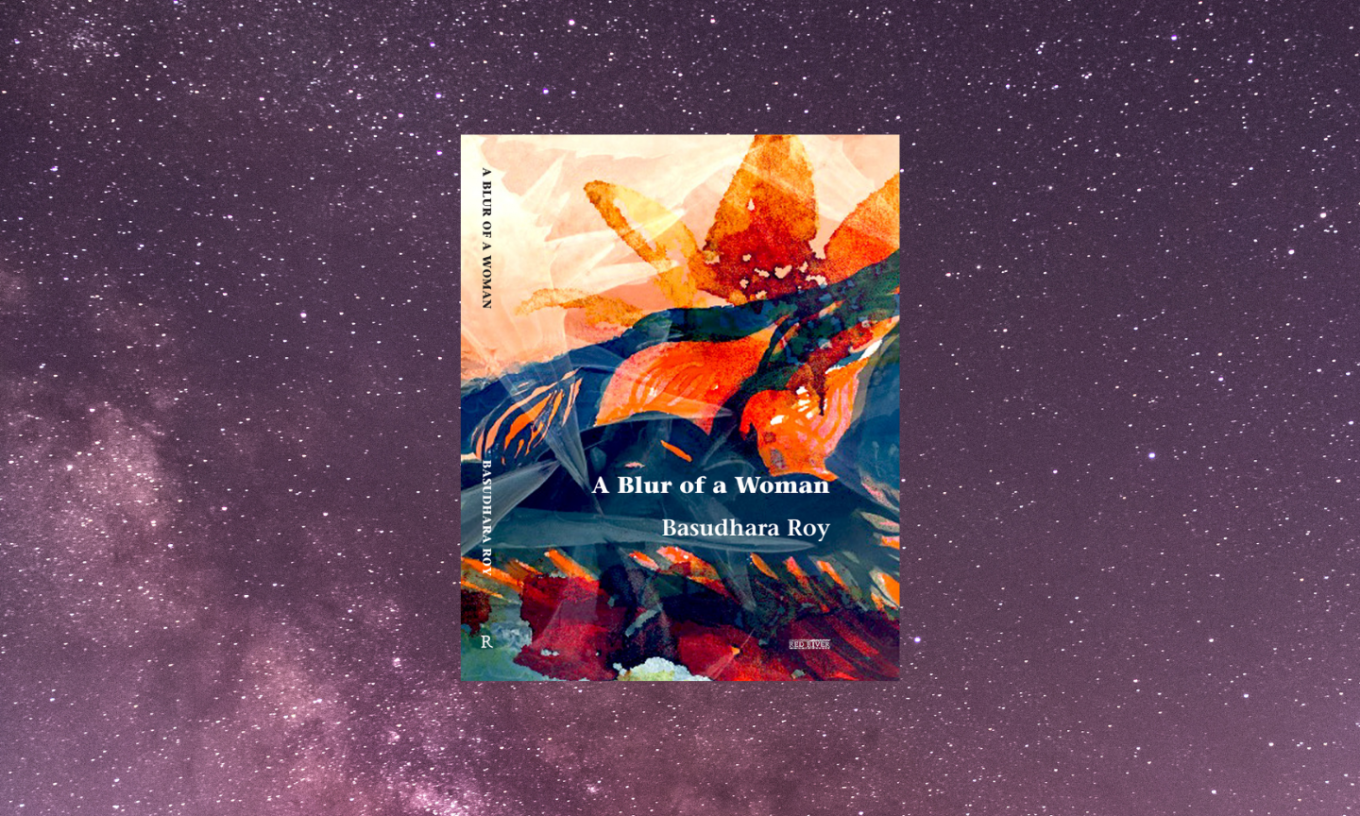
Title: A Blur of a Woman
Author Basudhara Roy
Publisher: Red River
Year of Publication: 2024
Basudhara Roy’s A Blur of a Woman: A collection of poems that brilliantly occupies the space between the self and the world.
While responding to the question of whether women write “women’s poetry,” the English poet Jo Shapcott remarked that women’s poetry shows “a unique openness to the world and the body.” While some poets derive a unique perspective by anchoring the body and the self as concrete poetic objects, other poets make an effort to highlight the elusive nature of the two.
Basudhara Roy’s fourth collection of poetry, A Blur of a Woman, does both – it re-creates the self and the body and wills their erasure. At the first glance, Roy’s poems are deeply steeped in the experiences of womanhood. After some careful reflection, one observes a desire to subvert and transcend subjecthood. A desire, perhaps, to morph into other identities, or be without identities that hoist onto the self.
“Duḥkha,” the first poem in the collection navigates the afflictions lashed by the world outside; the poetic resolution comes when the persona goes beyond the self and communions with trees,
I have long spoken to trees to know
that every trunk yields in compassion.
Rugged, grooved, tawn they invite me
to bring to them my dowry of splinters
and break with them the bread of silence.
Waiting, they teach me is a faith, being
on one’s toes a religion and forgiving a ritual
like breath. I home against their bark, stilled
by the world’s misery sobbing in their veins.
The collection hinges on the aqueous nature of the self – one of the ways the poet does this is by employing water imagery. For instance, in “World’s End”, the poet writes, “They disbelieve that I am soluble in the dark as salt in water.” In “The Woman and the Sea” the poet anthropomorphizes the sea as a woman. In “Things I am learning from the sea”, the poet recommends going against the societal tide,
In a regime where the law is to store
be lawless and hoard nothing
but the mystery in your salt-scraped soul.
Throughout the collection, water imagery reveals that the poet’s wishes of dissolving her identity increasingly overpowers her desire to hold on it. In many poems, the compassion the persona feels for the world around is discernible. A distinct ecofeminist sensibility, like in this line from “Love Style Columbus”, “…you need not be a native/to love another land.”
In A Blur of a Woman, Roy has included a few list poems. Roy’s poems pile numerous disparate objects together with subtle wit and humour. “What I Live With”, a mundane list of things punctuate the page without commas for a pause or thought,
“children husband parents poetry plants
cell-phone laptop camera music Zumba
obesity thyroid diabetes hypertension.
She lists these out to share things in her to-do list when a person of interest fails to show up for an appointment with her. She concludes, “that in your to-do list/there are infinitely better things to do/than me.” “Six ways to kill a poem” is another list poem that presents a manual of sorts to obliterate poetry.
While some poems tether towards the business of living, others delineate stages of grief. “Soka: A Triptych” has three poems that grapple with the loss of a child. Another three-part poem, “Breaking the Triptych” is about heartbreak and loss. The persona in these poems is an all-seeing-feeling- empath whose acuity may sting the reader. The poet is not keen to dispense the healing balm of words and looks right into the eye of that social non-grata the trifecta of grief, mourning, and loss. Squirm with discomfort all you will, the poet will not let you look the other way, she writes:
…Having given up
all you loved she is trying to grow
concave so she will have space
to hold your emptiness. It’s only
another gestation, she softly says.
She makes familiar with other’s grief that requires some letting go of the self. A point that she somewhat directly makes in, “Notes on Arrival.” “To enter this poem,” she demands
“take off your slippers.” The titular poem, “A Blur of a Woman” reiterates the wish to “unbuild herself/disappear dissolve/become a blur.”
Like her earlier collections, Roy’s training as a literature scholar and professor illuminates her poems. Literary allusions and refrains in her poems create distinct nuanced layers. In the poem, “In Which Bimala Agrees to an Interview for a Special Issue of Post-Text Feminism”, Bimala, a character from Tagore’s novel Ghare Baire, is re-animated for a candid interview. Furthermore, her poem “Doors” invokes Nora from Ibsen’s A Doll’s House. Even if one were to miss some of those intertextual references, the rich wordplay and witticism more than make up for it.
A collection of ghazals in the volume is a testimony to Roy’s dexterity with the form. Ghazals like “A Ghazal for Beginning”, “Monsoon Ghazal”, “Ghazal for Tonight” and so on, are joy to read. A jaunty lyricism runs through all her ghazals. “Water Ghazal”, is a confluence of Greek, Islamic and Hindu mythological references. The following lines from “Ghazal of Rain” illustrate, amongst other things, how sprightly the poet lands her radif, line endings of the second line of the couplets:
The desert writes rebellion in a tongue of rain.
The manifesto of its syntax an overhung of rain.
In one in whose pores like lichen loss grows
you will scarcely find a grief unsprung of rain.
The Shadja is exiled from my gharana of notes.
Your sitar drapes in mourning unstrung of rain.
One cannot help being obvious and reminisce of Agha Shahid Ali, the most remarkable ghazal practitioner in English. Like Ali, Roy seems to be at home with the ghazal form, residing in it with ease. She also alludes to Ali in the poem, “On Reading Shahid”, where she says, “In your unlit home, the air has holes. / I darn them as you sleep…” Roy acknowledges that she participates in the continuation of Ali’s poetic tradition through her writing.
Another notable poet commemorated in the collection is Keki Daruwala. Roy has dedicated the volume to Daruwala and the poem “Night, Stalking” is written in his memory. In the penultimate poem in the collection, she writes of the senior poet as a brilliant stripped tiger whose passing sinks the island of poems. The richly visual poem is a befitting tribute to the poet as it is a testimony to Roy’s sensibilities.
Poems in this collection elicits wonderment. This is a collection by a thinking-feeling-woman who goes about inhabiting spaces between the self and the world. Moreover, this shimmering consciousness allows her to “become a blur”, her ultimate wish, as she throbs in and around bodies, texts and contexts.