
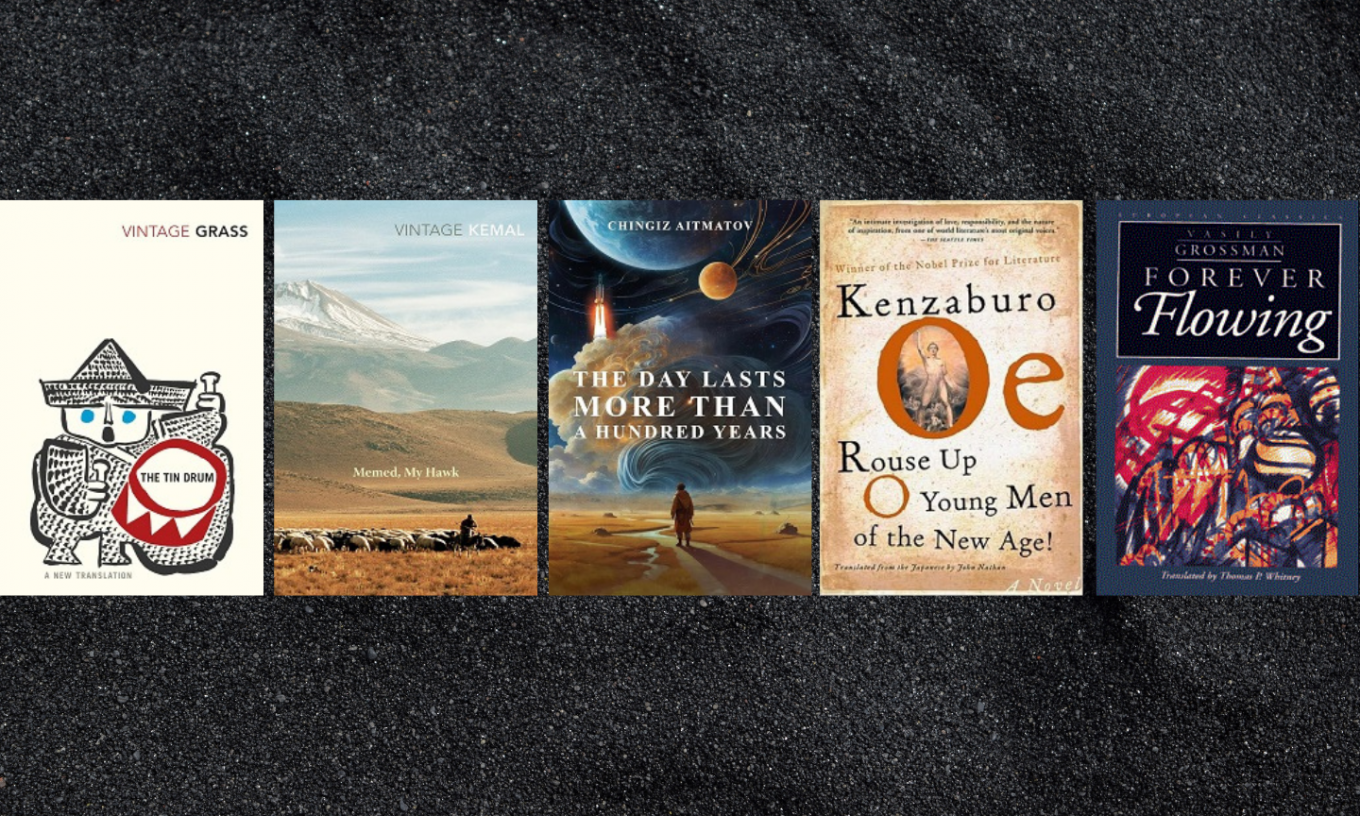
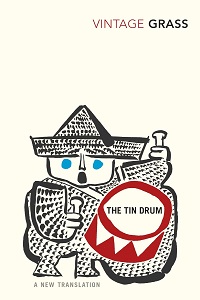
The Tin Drum, by Gunter Grass
My sister Sita was in the UK briefly in 1980, and she brought back this novel, which had an attractive red cover and an image from the 1979 film of the same name by Volker Schlöndorff. I knew the name Gunter Grass from a book of his poems that Sita had brought home when she was in college. I was a first year M.A. (Economics) student in Calcutta University when I read The Tin Drum, first published in German in 1959 and translated into English by Ralph Mannheim in 1961. A good part of the reading took place during the long L-9 bus rides across Calcutta to the Economics Department. Although I had been a precocious reader as a child, and quite a voracious one during my college and university years – this book shook me. There was a moment when I paused, did a double take, and thought, so this is what is called literature! The novel is about the lunacies and horrors of the Second World War as seen through the eyes of Oskar Matzerath, a highly eccentric little boy with a tin drum, who never grows up. The employment of this literary device, and the canvas of the War – was what had made me pause in the middle of the novel and become aware of what I was reading. I read Midnight’s Children some two years later, and I recall that I at once remembered The Tin Drum. Could Salman Rushdie have written his novel if he hadn’t read The Tin Drum! Reading the novel also created a feeling of intimacy towards the author, and when Gunter Grass lived in Calcutta for a period in 1986, he visited the office of Unnayan, a social action group where I worked, for information about rickshaws. I had carried Sita’s copy of The Tin Drum with me and got his autograph on that. Five years after he received the Nobel Prize for literature in 1999, Max Mueller Bhavan, Kolkata, invited him over, and I was fortunate to be invited to a dinner in his honour in early 2005, as well as to a day-long river cruise, on which my wife, Rajashi, and son, Rishiraj, then 9, also accompanied me. A day with a Nobel laureate, wow! I had memorable conversations with Gunter Grass, and he said that he vividly remembered his visit to Unnayan in 1986 and that he used the information he collected in one of his novels. He warmly embraced me and Rishiraj when we bid goodbye.
***
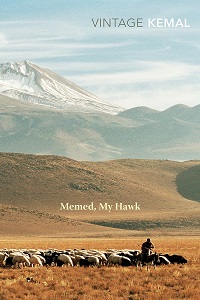
Memed, My Hawk, by Yaşar Kemal
I found this novel in the living room of Jai Sen, founder of Unnayan, in Calcutta; I met him in late-1984, and that encounter then shaped my life and career. It must be in late 1985 or early 1986 that I borrowed the book and then read it. This was the debut novel of Yaşar Kemal, of Turkey, first published in 1955 and translated into English by Edouard Roditi in 1961. In this novel too I paused, had a double take, and reflected. A literary device, and a canvas. Memed is a young boy from an Anatolian village, who is a victim of the abuse and cruel violence of landowner Abdi Ağa. Memed leaves home, and becomes a bandit. Through the novel we witness the transition of Turkey from a feudal society into a modern one, even as Memed grows up and matures. In the end of the novel, Memed views Abdi Ağa from a distance, now no longer the towering figure oppressing his life but a shrunken pathetic creature, because Memed’s world and knowledge have grown far beyond his village and its powers. Forty years on, I still remember this novel, and consider it one of the great literary works of the 20th century.
***
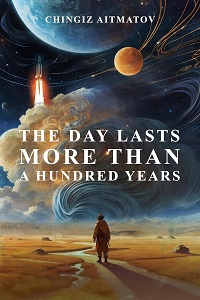
The Day Lasts More than a Hundred Years, by Chinghiz Aitmatov
In 1990, following several years of mostly academic reading, I decided to start reading literary fiction once again. And thus I realised that some of the greatest truths are articulated by writers far more eloquently and profoundly than scholars and academics. And one of the first novels I read in this season was The Day Lasts More than a Hundred Years by Chinghiz Aitmatov. I found this book in the library of Calcutta International School, where I taught during 1988-93. This novel in Russian by the Kyrgyz writer was first published in 1980, and translated into English by John French in 1983. I can’t remember the details of the story, but what I do remember is that to me it seemed like a profound cultural critique of Stalinism through a celebration of cultural diversity, a subject quite relevant at the time I read it in the context of the quest for a new consciousness in the wake of the collapse of the Iron Curtain and the demise of the Soviet Union. I lent the book to my anthropologist friend, Aditinath Sarkar, and when we met after he had read it, he told me that he wasn’t going to return it! The book was also in the collection of my old friend Ruchir Joshi, film-maker, writer and columnist, and he gave it to me when he was getting rid of some books. I then gifted that copy to writer Siddharth Deb when we met for lunch in Tangra, Kolkata a few years back, with a brief introduction on why I considered it a profound book. He said he looked forward to reading it. It is for me one of the great novels of the 20th century.
***
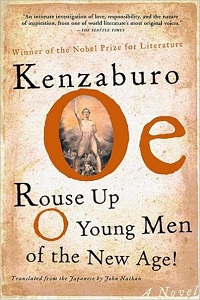
Rouse Up, O Young Men of the New Age, by Kenzaburō Ōe
I received this novel as a gift from my sister Shyama, and read it in early 2005, during a train and bus journey via Bangalore to Rishi Valley School, to visit my older son, Rituraj, who was a Class 7 student there. Kenzaburō Ōe was a celebrated author and lifelong anti-nuclear peace activist, who was awarded the Nobel Prize for literature in 1994. His son had a serious brain condition from infancy and some of his writing has the duo of a writer father and his challenged son as principal characters. Rouse Up … written in Japanese in 1983, and translated into English by John Nathan in 2003 – is literature for littérateurs. It is about the relationship of the father and son, and the relationship of this relationship to the poetry of Blake (which the writer-father is translating). The semi-autobiographical work consists of a number of standalone pieces in scintillating prose, each of which begins with some incident in daily life, then narrates its development into a crisis before concluding epiphanically. After admitting Rituraj in boarding school in 2003, I had kind of tied a stone to my heart to deal with the sadness of his being away, and now I was on my way to visiting him – so the father-son aspect struck a very personal chord. I finished the novel, and then spent a couple of days in the school, meeting his teachers and hearing their feedback about my son’s academic conduct and performance. There were critical comments, which made me sad, and in one case, Rituraj was also present when the teacher told me about his failings. I will never forget the look in Rituraj’s eyes – of sadness about his father being troubled. I did not castigate him at all, and as it happened, just before I left, I was walking around near the school guest house, and came upon a middle-aged woman, who worked in the school kitchen, and her mentally challenged daughter. The lady asked me who I had come to meet, and when I told her my son’s name, she smiled in delight and told me that he was a very nice boy, and a friend of her daughter. That was all the feedback I needed to receive about how my son was doing, and my heart was once again filled with joy. Rituraj passed away in 2013, so this memory becomes all the more poignant for me. I was in London at the end of 2005 and visited the Waterstones bookshop on Gower Street and bought the novel, A Quiet Life, by Kenzaburō Ōe and read it soon after. Originally published in Japanese in 1990 and translated into English by Kunioki Yanagishita and Willian Wetherall in 1997, it was a kind of sequel to Rouse Up … While the latter was for me a full-blown affair, the former too was an accomplished work, but a ‘quiet’ one in comparison. Reading the two, one after the other was also an experience. I realized that there is something beyond a powerful work, which can overwhelm a reader. A ‘quiet’ work too reveals the writer’s literary imagination and craft, and the two together tell us something about the writer’s range of capability. I was happy to give my copies of Rouse Up … and A Quiet Life to my friend Sarker Hasan Al Zayed, a scholar and teacher of literature in Dhaka.
***
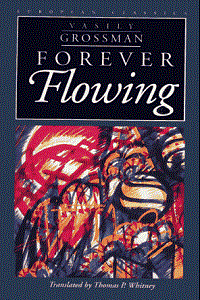
Forever Flowing, by Wasily Grossman
I bought this novel, first published in Russian in 1955 and translated into English by Thomas P. Whitney in 1972, from the Classic Bookstore in Calcutta (now Earthcare Books) in 1992, but it was only in 2012 that I finally read it. The protagonist of the novel has been in the Gulag for thirty years and is released after the death of Stalin. And now he must struggle to find a place for himself in an unfamiliar world. I thought the novel was a profound psychological critique of Stalinism and the whole Soviet project, far superior to anything penned by Aleksandr Solzhenitsyn. Not long after I read the novel, I learnt that the 1972 translation – which I had read – was deemed deficient and that there was a new 2011 translation by Robert Chandler, titled Everything Flows.
***
On Translation
I listed five great novels of the Post-War twentieth century, all of them deeply political and historical works, and I read all these books in translation. That would not have been possible if it were not for translators. As a reader, when you read a translated work, you implicitly assume that it is the author’s work that you are reading. But no, there is a translator in between, who is mostly invisible to the reader but has to perform a task with great sense of responsibility and skill. Great works of literature – are read more in translation than in their original languages. I have been a translator for two decades now, endeavouring to share, curate and showcase something of the wealth and treasures of voices from the margins in Bangla, and in this period translation and publication of literature from the various bhashas of India has grown considerably. Translators’ names appear on the book covers, there are prizes, fellowships and residencies for translation, the International Booker Prize has been awarded twice to Indian writers, one of them was translated by an Indian translator, and the JCB Prize for Literature awards the translators as well. All this is very good and positive, but if we want to see more and more quality translations of important works from and into Indian languages we still have a very long way to go as far as the publishing ecosystem is concerned. Translators are silent warriors, without whom literature and world literature would not exist. So with this list of five great novels, I also raise a salute to the tribe of translators.