
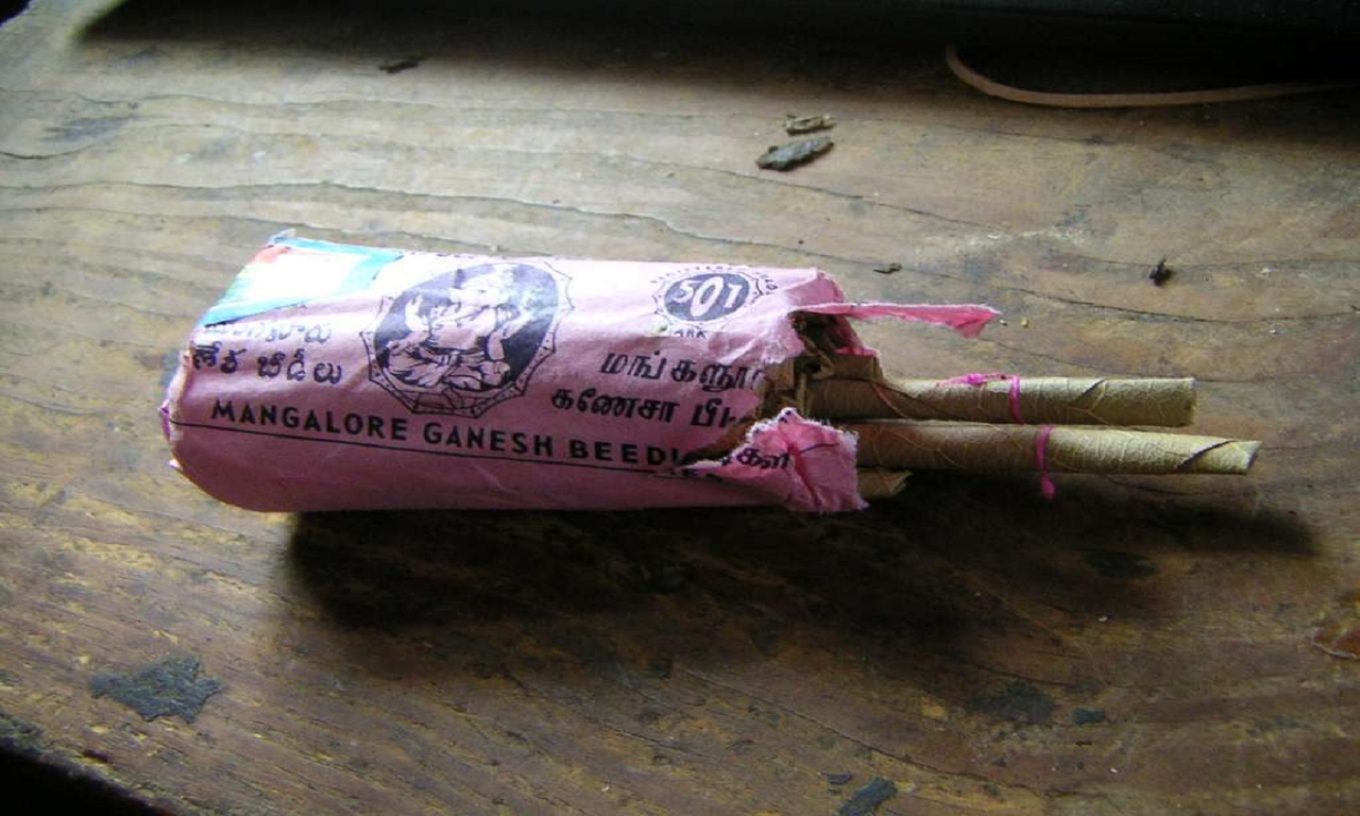
I live next to a big tree on one end of the Payyambalam beach. The tree with sweet scented white flowers that look like promises and with foliage as deep as the ocean. Every day after sunrise, I walk from that end to the other end of the beach. Sometimes a beedi for company and at other times, imperfect shells that people leave behind. I sit on the sand and pretend to watch the ocean, but I watch loners. I watch lovers. If they see me, they leave. If they don’t see me, they stay. And I blow a mouthful of beedi smoke into their kisses. Eyes closed, they think their beloved smokes in secret. Do they see my long hair and long teeth and white sari, you ask? No, that’s not how I look or what I wear, unlike what the old wives’ tales say. The old wives never saw my straight black braid, my kohl smeared brown eyes, the magenta saree, the gold hoops my older sister gave me when I finished high school.
I watch schoolkids. I watch families. I see a woman and two kids. The girl, about four or five, tries to dangle from the woman’s hand like a monkey. The woman trips and a bottle of water falls out of her bag followed by a few packets of Parle G biscuits. She sighs a tired sigh, not unlike the one my mother sighed the last time she and I had an argument. The little girl says sorry amma and picks the packets and puts one back in the bag, hands one to her smaller brother and the last one she tucks tight in her palm where tiny black plastic bangles collude at the juncture of her chubby wrist. Her amma places the bag on the ground, and sinks down onto the sand, like I’ve seen many do before the ocean.
The girl walks towards the waves by herself, still clutching the packet of biscuits, the water a little above her anklets. Does she want to go out further? Can I maybe help her a little? I am supposed to lead people to their watery graves. That’s what the locals say. I have, according to them, a reputation to keep up as the malevolent spirit of the beach. A scorned woman with a little too much passion and a tragic one-sided love story. That’s who I am. The little girl runs back right in time, careful to not let the waves get her calves. She is a smart one.
I unwrap a fresh beedi from the fold in my sari, where I also keep matchsticks and a few currency notes, and an old photo which I don’t know any more how old. The blue shirt which I had chosen for him, and white flared pants, standing amongst a bunch of trees in his backyard, looking up and smiling at whoever clicked the picture. He with the eyes that looked like promises. He had left me at this beach by myself. I’d tried to grab his hand, but he walked away without even a glance, back to his parents who had told him to stay away from me. I stayed behind, and promptly threw myself into the ocean. So melodramatic I was.
A biscuit drops on my lap.
“Eat,” the girl says, and stands there looking at me, as if she has made up her mind about what I need.
“Are you by yourself?” she asks.
Yes, I tell her.
“Why?”
“My family is far far away,” I say.
“My father is also far far away is what amma says.”
She turns to look at her mother who is now reclining on her side with her head resting on one arm, her other arm around the little brother, and her eyes caught in a limbo between weariness and awareness.
“Where is your amma?” she asks.
“She is…”
“Do you play with her every day?”
I laugh, a moment later feeling chastised by an old regret.
“Chippi, come here,” her amma calls her, the signs of fleeting terror on her face that disappear as soon as she realizes that Chippi is but a glance away. The fear that mercilessly teases parents and guardians in the vicinity of water, as I have seen here very many times.
Chippi runs back to her mother. I bite into the biscuit.
“She is all alone, amma. So, I gave her a Parle G. She plays with her amma every day,” Chippi relays to her mother, the last statement presented more as a reason than a fact to explain why her Parle G packet was already empty. Her mother looks in my direction with eyes that cannot see me, which I am more used to than tiny hands offering me biscuits.
Chippi sits next to her mother, hidden partly by her mother’s hand and her sari drapes, looking at me. I can feel the stories she is making up in her mind about me. I can feel the gaze and the questions she wants to ask. A child used to observing and to discerning the right moments to ask or not to ask questions. I wonder if she knows my story yet. Someone, maybe her mother or a well-meaning aunt or cousin, would tell her when she is old enough to have a lover of her own who might disappear. Or maybe, kids these days are smarter and don’t need me anymore. Like Chippi who sees me.
I fold the corners of the old photo and make it into a boat. I keep creasing the folds till they become taut beyond redemption. I walk with it back towards my end of the beach, and let the waves take it away, like all the ashes of the lost ones.
Where exactly is the end of a beach, you ask? It’s where I stop.