


1: the apartment
Ellen was a Harvard graduate from Connecticut and lived her Harvard haughtiness as only graduates from Harvard can do. I shared my apartment with her. She was a year older than me, a friend of a friend. I found her loud and clumsy, not necessarily physically clumsy, but energetically, if that makes sense. To me, she was the sound of her black pumps in our shared hallway, the heavy clump clump, like a statement, I’m here, I’m here. I’m important. Also, I must admit I’m not partial to blonds and all they symbolize, so there was a bit of my cultural prejudice, too. But living with her was merely an arrangement. She paid half the rent for my one-bedroom apartment on West 48th Street, a rent I could never have managed to pay alone, and she was trustworthy, fully employed at New York University where she raised money for the Business school. She loved to brag about her successes, how she flirted, played footsie, and squeezed money from rich donors. Her stories echoed like her heels in the hallway.
The apartment was small; one bedroom in the back, which was hers; a room in the front which I turned into my living room/bedroom. I built a tiny loft space, only feet from the ceiling, where I put a futon. That was my bedroom. Between us was a narrow hallway, click click click go the heels, a modest bathroom, and a tiny kitchen with a sink jammed in the corner, and a refrigerator and stove so close to each other they had to be opened separately. Our building was an old, three-story brownstone painted white and light blue. I loved it. In each of our rooms, we had marble fireplaces with black-painted, old iron guards. Of course, the fireplaces didn’t work but they were beautiful. And the ceilings were high with wood details around the edges. Our apartment was on the top floor. There was a restaurant on the ground floor, which served no food, only liquor and drugs. I never went inside but I did watch people coming and going and heard the fights. Eva and Noni, my Greek landladies, sometimes lived on the first floor. Eva was a big-boned woman with a tough, square face framed by her black hair cut short with bangs. Noni was tiny and moved like a bird, doing whatever Eva wanted. Eva was the boss in every way, the Greek mafia boss, in fact, who ran the porn theatres on 8th Avenue and was somehow in on the drugs sold downstairs. But they were nice to me and loved my cat. I spent many hours smoking with them in their apartment. More time with them than with Ellen.
Lucian was Ellen’s boyfriend. They met on the public tennis courts on 9th Avenue near 52nd Street. I saw them playing a couple times. Lucian had the most bizarre style I’d ever seen. He wrapped his grip with so many layers of tape it was twice normal size, and he would turn his hand and the racket at an angle to face the ground then flip it toward the ball only seconds before impact. He spent most of his free time on the courts, and when not there, he carried his tennis bag with him, and talked about tennis constantly.
They had their first date on the court. When Ellen told me about it, she was so excited. The second time they met, he took her for champagne and brunch after a game or two. Whenever she mentioned Lucian, she said how cute he was. He did have a nice smile, grin really, and a coy way of approaching women, chin slightly tucked, looking up with a twinkle in his eyes. There is no doubt there was a sweetness about him. But I’m convinced that what attracted Ellen to him, in her cultivated liberalness, was the deep, dark brown of his skin and what that meant to her. Of course, after commenting on his cuteness, she was quick to add that he was a lawyer who worked in Wall Street, also went to Harvard, and his family were royalty in Martinique.
He moved in with Ellen after they’d been dating for a month, into the tiny room in the back. He brought only one small bag, and his tennis stuff. Evidently, he had another apartment somewhere in the city, but he stayed with her. At first, all they did was fuck, like crazy, and they were loud. My friends and I joked about it. Ellen would appear, hair tousled on weekend mornings (and through the day), to get orange juice for both of them. She would shake the Tropicana container as loudly as she clicked her heels, pour two glasses, and return for another fuck. The intense fucking lasted about six months, then the fighting began. And it was louder than the fucking. Ellen would screech in a high-pitched voice; it was brutal. He never raised his voice, and always looked sheepish when he emerged from the bedroom. He smoked nonstop.
When Ellen worked late, Lucian invited himself into my room, and told stories about Martinique, or talked about politics. He almost always asked me to go to dinner with him some night, or visit ‘his island.’ I didn’t like that he flirted with me, and would sometimes hide in my room, quiet as the dust bunnies, hoping he would think I was out. One thing I found odd when we talked was his repetition of the phrase, “arbitrary and capricious.’ I’d been around other lawyers, and never heard them use it, and he used it a lot, with Ellen, too.
He showered Ellen with gifts, a fur scarf, bedazzled sweaters, Chanel perfume, a trip to Paris. And there were lots of expensive dinners when Ellen wore the gauche clothes he’d given her that she loved and thought very fashionable. They had the same taste. He always wore his shiny, blue suit. Arm in arm, they’d leave the apartment, click click click went the heels, like they were the Kennedys or something.
They lived in the back room together for two years, and then finally, finally decided to move to their own apartment. They found a place on 43rd street. Ellen had me over for dinner soon after they’d settled. Not known for her cooking abilities, she served chicken cooked in the microwave. Lucian showed me his books, or rather his book. He had a biography of Mozart, a thick book with small font, in which he’d marked all over the margins in tiny script. He loved Mozart as much as tennis.
2: the call
Ellen called a few days after it happened. She was hysterical, and I don’t use that word lightly (or naively). I know how it’s been used against women. She was panting and gulping for air. I could tell her nose was running, her eyes pouring tears, her face probably red. ‘He’s dead. Lucian is dead,’ she said. We were young, in our mid-20s. This didn’t happen. The air popped from my lungs. I started to cough from lack of breath and shock. “An aneurism burst in his heart. It was probably genetic,” she said, “happened in the middle of the night. He seemed to be sleeping then gasped.” It woke her, she reached out for him; he was already dead. I couldn’t imagine what this felt like for her. I was devastated, and he wasn’t my boyfriend. It was inexplicably unfair. She told me she called 911. His body had started to turn cold by the time they arrived. The paramedics took him away. Somehow the family was contacted and quickly arrived in New York. He’d just returned to New York a few nights earlier from a short trip to Martinique to take care of something having to do with his sister, who was also a lawyer. To add insult to injury, the family immediately left with his body, not allowing her to meet them, or see his body again, or have a ceremony of any sort. “They wouldn’t talk to me,” she said, “They didn’t approve of their prince being with a white woman.” There was no closure for her, for any of us. He was gone, just like that, just like he’d never been here.
I told Ellen she could move in with me again, if it would help, and stay as long as she needed. She had Dave, her best friend, but she couldn’t move in with him. And honestly, even though she bothered me, I thought it might help me, too. I wondered about the others who would be shocked by his death. From what I knew, Lucian only had one other friend, someone he played tennis with. I wondered about the law firm though, if Ellen had been in touch, if they were doing anything. She never directly answered my question about that. Whenever I mentioned any sort of remembrance service, she started crying. She moved in. I’d moved my futon to the back room after she and Lucian left, so I gave her the front room…for about a month. I even took her on vacation with my new boyfriend and me, our first vacation together, to Puerto Rico. She was a nightmare, never fully present, often just sullen and silent. She cried a lot, too. But it made sense. We had to be kind.
After she left my place, she didn’t stay in the city very long. She found a job somewhere in the Midwest running a company and moved. We stayed in touch for a couple months but all we had in common was Lucian, so our correspondences quickly dwindled.
3: later
Two years passed, maybe three. I was going to visit Dave, Ellen’s best friend, at the AIDS Foundation where he worked. We’d bumped into each other on the subway. He didn’t look well; he was very thin and weak. He’d been fighting AIDS for more than eight years, one of the early victims, and longer-term survivors, but it looked like he might be losing the battle. Like all those diagnosed with AIDS in the early years of the epidemic, his drug regime was intense and always changing, and he was in and out of hospitals. He’d worked for the AIDS foundation since its inception, but I’d never visited him there, and he wanted to show me around, introduce me to some of his brave co-workers. We were in a crowded elevator going to the 4th floor when I asked how Ellen was doing and said something about how horrible it was that the family didn’t allow a service for Lucian, just swept his body away. “What are you talking about? We had a service,” he said. “Ellen told me there was no service.” I remembered that she hadn’t told me about Lucian’s death for a few days, explaining it was because she was so upset. I hadn’t questioned her. Blood rushed to my face. We exited the elevator. “Yeah, we had a little service, just a few of us but by then Ellen knew and was really pissed.”
“About what?”
“You don’t know?”
We went for coffee so he could explain.
After Lucian died, Ellen had to figure out what to do with his body, and how to contact his family. She started by looking through his briefcase, which of course she hadn’t done before. She’d never been let into his life, and didn’t question it, which baffled me. She never visited his office, met his coworkers, or talked on the phone with any of them, never met friends except the one he sometimes played tennis with. What she found in the briefcase was shocking: discharge papers from a Manhattan jail where he’d spent the two nights that he said he’d been in Martinique with his sister, and perhaps most importantly, a subpoena to return to the court so that he could be taken to Rikers Island to serve his sentence. He died the night before that could happen. She found other papers, including a lease for a room on 8th Avenue, and a key. He rented a tiny room above a porn theater only blocks from my apartment. She and Dave visited and found a dingy room with a simple desk, a metal chair, and a small TV. A metal hanger hung from a nail; his blue suit was still under plastic from the dry cleaner. A metal ashtray overflowed with cigarette butts. By the side of the desk were his paint supplies. And on his desk, a couple of blank checks that didn’t belong to him. Lucian hadn’t been going to a law firm every morning but instead he crossed the street and went upstairs to his lightless little room, where some days he changed clothes, and took the subway uptown to paint rich people’s apartments. e
Painters don’t make enough money to impress women like Ellen. Women like Ellen, or so Lucian must have thought, need gifts and vacations and fancy dinners. And so, he stole checks from the people whose apartments he painted. At first, he took only a little money from a number of people, and it went unnoticed for almost two years, but he found he needed more, maybe it was the cost of the shared rent, and he began increasing the amount but decreasing the number of people he was stealing from and it was noticed, and he got caught. Of course, his heart burst, his blood spilled over. His truth was too much to contain, his shame or self-condemnation too great to hold. The price of this ticket was too high. In the end, I think all of this came down to one thing, one physical attribute that determined his trajectory, his skin color, which affected how people, especially white people, saw him, how he saw white people seeing him, and how he wanted to be seen by those people who didn’t, wouldn’t, and could never see him without the filtered prism, the prison, of his skin color.
“What about Harvard?” I asked. “He did go to Harvard,” said Dave. Ellen, fueled by rage, was dogged about learning everything, including looking through Harvard’s attendance and graduation records, and yearbooks. Lucian went to undergrad, but not Harvard Law, and he didn’t graduate. He was on scholarship and only attended for one semester. He didn’t get the grades to keep the scholarship. I can’t imagine what it was like for him to move through the sea of whiteness and privilege at Harvard in the early 1980s.
“And his family?” I asked. “Ellen and I flew to the island, stayed just a couple days. Lucian was no prince, far from it. His father was a poor fisherman. His mother deserted them when Lucian was very young. And he had no siblings.” Who was this person who managed to get a scholarship to Harvard?
Dave said Ellen hated Lucian after he died. She was so angry at him for not being who he said he was. “But it’s funny,” said Dave, “I remember Ellen once early in their relationship telling me she thought he might be a painter. She said she’d seen paint spattered on his tennis shoes. She never brought it up again, even after he died. When we found paint cans in his rented room, she mentioned nothing, acted surprised.”
Was it funny, this? I don’t think so. I see her as a participant in his death. She and all she represents. She rendered him invisible, unacceptable as he was. She never would have dated a painter. He had to have the credentials: Harvard, lawyer, prince. Those paint spatters, next to the click click click, remind me of white worsted.
For all the twists and turns, maybe there is a straight line. Odd as it seems, I think it was his love, but not love as usually characterized. Born into a world of racism, born into poverty on an island and in a family that offered him little hope, he made his way to Harvard. He dreamed. He believed. Don’t those dreams, that believing, come from love. Twice he did it, once again after the first dream failed. He hollowed himself out, filled up with lies, for love.
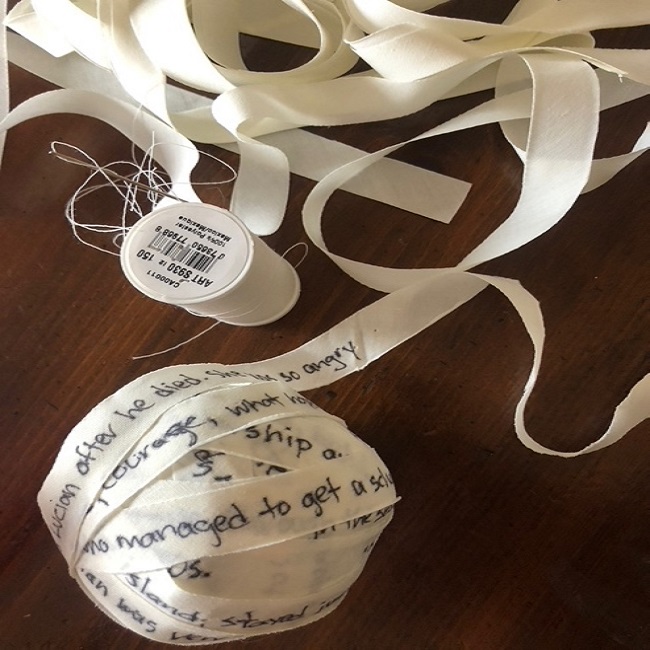
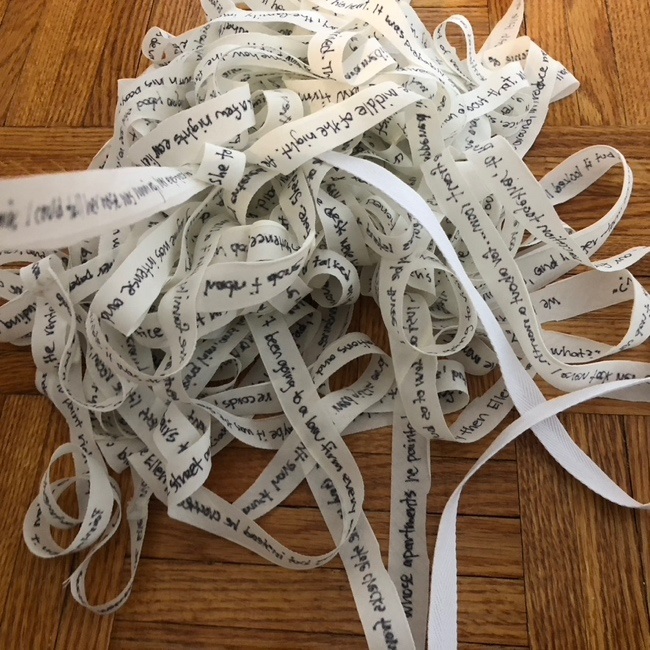
How do I end this story, make sense of it? Honestly, I can’t. I’ve been trying for 30 years. There are just too many pieces that will not be easily tied together, too many layers under each action, too many strands even when I lay out the story in a line. Under lies are truths, under truths, lies. Ends lead to beginnings, hope to despair, dreams to destruction, love to death. What sense is there in a world that hollows the soul? It’s far from straightforward, far from a linear tale, a straight line of reason; as the ball unravels, it falls onto the ground in a jumble of folds and layers, crossing over itself in places like memories of…
NOTE:
The decision to tell this story in a linear form corresponded with the idea of making it into a physical object. I hand cut, hand-wrote and stitched a narrow piece of cloth that became half the length of a football field: this process took ten hours. Then I rolled the tape into a ball so the reader could unravel it while reading and lose linearity as the tape fell randomly atop itself, replicating the act of remembering. As with any true story, this is full of lies.
In the third section, I thought of MLK’s Letter from a Birmingham Jail, April 16, 1963: “Oppressed people cannot remain oppressed forever. The yearning for freedom eventually manifests itself, and that is what has happened.” As well, the paint spatters reminded me of white worsted, a symbolized memory and reality of enslavement, born of the click click of practical pumps echoing down a hallway, an enslavement to an economy, and an economy of ideas that imprisons, and, in so doing, takes everyone/everything into the heart of darkness. It is true that when a person unravels a ball of twine or tape, that person will by her or his nature uniquely distribute the falling tape; it may land in clumps or bunches thus overlapping in spots or pulled straight in patterns (zigzagging across the floor or pacing right to left and left to right again and again), or both or more. Just so, does a reader interpret a story uniquely distributed.
Photo by PAUL SMITH on Unsplash